
What Is a Back Rank Mate? How It Works and How to Avoid It
TL;DR
In one sentence A back rank mate is checkmate by a rook or queen on the last rank, when the king is trapped behind its own pawns. In our data 160 of our 24,996 Lichess puzzles are back rank mates Typical puzzle rating Median 1072, ranging from 680 to 2441 Who delivers it A rook or a queen, sliding onto the 1st or 8th rank The fix Make luft: one pawn move (h3 or h6) gives the king an escape square
What a back rank mate is
After you castle, your king usually sits behind a row of three pawns. That's safe in the opening, but it has a hidden cost: the king can't step forward. If an enemy rook or queen reaches your back rank (the row the king stands on) and nothing can block or capture it, it's checkmate.
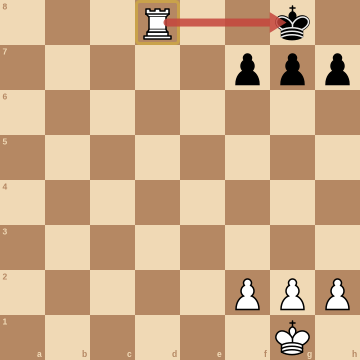
Notice that White needed only one piece. The black pawns did the rest of the work, and that's why this pattern catches so many players: it doesn't look dangerous until it happens.
How often it really happens
We sorted our puzzle library, built from 24,996 positions taken from real Lichess games, by the pattern behind each win. 160 of them are back rank mates. The median puzzle rating is 1072, which makes it one of the first mating patterns players learn to see. But the range goes from 680 all the way to 2441, because strong players hide the same idea behind a sacrifice or a deflection.
A real example
Here's one of the easiest puzzles in the set, rated 680. White has just captured a black queen on e3 with the rook, and it's Black to move.
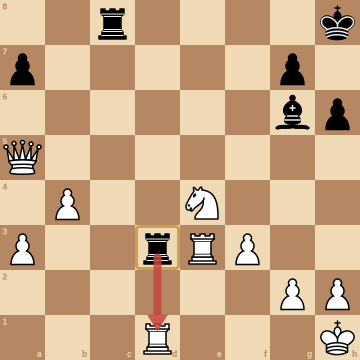
33... Rxd1+ 34. Re1 Rxe1#
In plain English: Black's rook takes the rook on d1 with check. White can only block with the other rook on e1, and Black takes that one too. White's king has nowhere to go: the rook on e1 covers g1, and its own pawns on g2 and h2 block the rest. Checkmate.
How to avoid it: make luft
The fix is one move. Push one of the pawns in front of your king, usually the h-pawn. Chess players call the empty square this creates luft, German for "air".
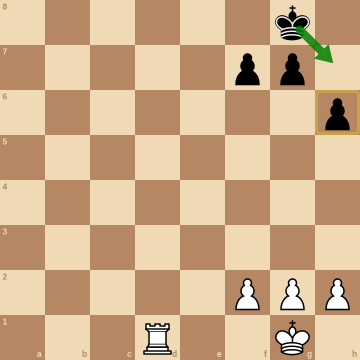
- When to do it: once your pieces are developed and the rooks have left the back rank, a quiet h3 (White) or h6 (Black) is usually a good use of a move.
- Keep a guard: if you can't spare a move, keep one rook or your queen able to cover your back rank.
- Count the attackers: before you trade or move your last back-rank defender, ask whether an enemy rook or queen could land there next move.
How to use it against your opponent
- Look at their king. Are all three pawns in front of it still on their starting squares? Then the back rank is a target.
- Count the defenders. If only one rook guards the back rank, try to deflect it, trade it off or attack it twice.
- Look for checks. Every rook or queen check on the back rank is worth calculating, even if it costs a piece first.
Related patterns
The back rank mate is one of several checkmate patterns where the defending king is trapped by its own pieces. The smothered mate is the knight version. For the full set of tactics, start at our chess tactics guide.
FAQ
What is a back rank mate?
A back rank mate is a checkmate delivered by a rook or queen on the opponent's first rank (the row the king starts on), when the king can't escape because its own pawns block the squares in front of it.
How do you prevent a back rank mate?
Give your king an escape square, called luft, by moving one of the pawns in front of it, usually h3 for White or h6 for Black. Keeping a rook or queen guarding your back rank also works.
Is a back rank mate the same as a corridor mate?
Yes, mostly. A corridor mate is the general name for a king trapped in a line by its own pieces. The back rank mate is the most common version, on the first or eighth rank.
What rating do back rank mates matter at?
Every rating. In our puzzle set taken from Lichess games, back rank mates range from beginner puzzles rated 680 to puzzles rated over 2400, where the mate is hidden behind a sacrifice.
Solve real back rank mate puzzles from Lichess games, sorted easiest first. Sign up free and track your progress free with an account.
Try 160 back rank mate puzzles →