The Bishop's Opening: One Calm Setup Against Everything 500 to 2000 Players Try
TL;DR: the data
Built from 143 million Lichess games played by 500 to 2000 rated players You play White, 21 practice lines, every move of yours checked by Stockfish Most common line 1. e4 e5 2. Bc4 Nf6 3. d3 Bc5 4. Nf3 d6 5. c3 After 2...Nf6 3.d3 3...Bc5 34% · 3...Nc6 21% · 3...d5 13% Worth knowing After 2...Nf6 3.d3 Bc5 4.Nf3 Ng4?, only about 3% of players find 5.Bxf7+!, and they win 64% of those games.
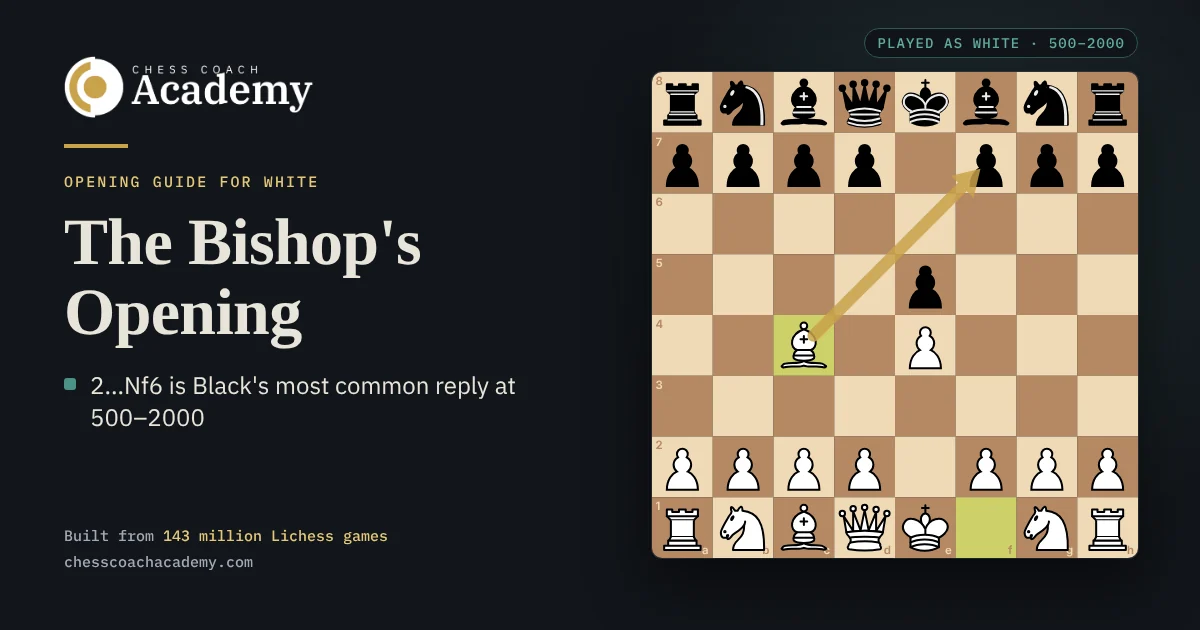
The Bishop's Opening is 1.e4 e5 2.Bc4. You bring the bishop out before the knight and point it at f7, the one square in Black's camp that only the king defends. Then you follow the same simple setup almost every time: d3, Nf3, c3 and castle. The name just describes that second move.
This guide is built from 143 million Lichess games played by 500 to 2000 rated players. At this level 2.Bc4 is played in about 11% of games after 1.e4 e5, second only to 2.Nf3. Black's replies are spread out, with 2...Nf6 and 2...Nc6 the favorites, but you'll see the same few middlegame positions again and again, because many move orders lead to the same place.
1. e4 e5 2. Bc4 Nf6 3. d3
Practice the Bishop's Opening free →Who it's for
Players rated roughly 500 to 2000 who want one calm, reliable setup against 1...e5 and would rather understand a plan than memorize lines. The same moves (d3, Nf3, c3, O-O) work against nearly everything, so it's a good choice if you don't have much time to study.
It also suits Italian Game players who are tired of meeting the Petrov (2.Nf3 Nf6). If you want sharp gambits and quick knockouts, the Vienna Gambit or the Scotch will give you more of those.
Why it works at 500 to 2000
- Little to memorize. Many move orders transpose into the same quiet Italian positions, so one plan covers most of your games.
- You avoid the Petrov completely, because your knight isn't on f3 yet when Black plays ...Nf6.
- There are still chances to win quickly. After 4...Ng4?, played in 14% of games in one line, 5.Bxf7+! wins a clean pawn.
- The quiet d3 setup rarely gives a big advantage. Most main lines end level, and you win in the middlegame, not the opening.
- Your own f2 pawn is a target too. Black's bishop on c5, often joined by ...Ng4 or the queen, aims straight at it.
- When Black strikes early with ...d5, your bishop is attacked and you need to know the answer: take on d5, then Nf3 and castle.
What 500 to 2000 players actually play
After 2...Nf6 3.d3, Black's most common move is to copy your bishop with 3...Bc5 (34%), followed by the solid 3...Nc6 at 21%. The active 3...d5 shows up in 13% of games, and 3...h6 and 3...c6 each come in at 9%. Every one of these is met by the same move, Nf3, except 3...d5, where you take the pawn first.
Three numbers from the data are worth remembering:
- In this rating range, 2.Bc4 is played in about 11% of games after 1.e4 e5, second only to 2.Nf3.
- Black's most common replies to 2.Bc4 are 2...Nf6 (34%), 2...Nc6 (30%), 2...Bc5 (12%) and 2...d6 (10%).
- After 2...Nf6 3.d3 Bc5 4.Nf3 Ng4?, only about 3% of players find 5.Bxf7+!, and they win 64% of those games.
How to play the Bishop's Opening: move by move
Each board below is a decision point from the practice lines. The arrows show Black's most common replies at 500 to 2000, labeled with how often each one is played in that exact position. Under each board you'll find why players choose the move and the answer you play.
After 1. e4 e5 2. Bc4
Four replies cover most games. Against all four, your next move is the same: 3.d3, protecting e4 before Black can attack it twice.
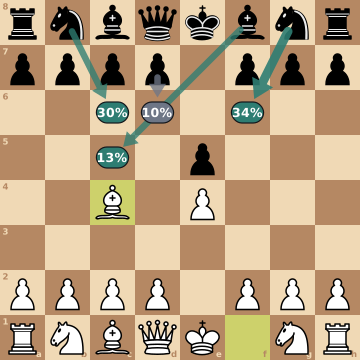
- 2...Nf6 (34%). Your e4 pawn has no defender yet, so you need to deal with it.
Your answer: 3. d3. Protects e4 and opens a path for your dark-squared bishop. - 2...Nc6 (30%). It develops and protects e5 at the same time.
Your answer: 3. d3. Protect e4 in advance and open your c1 bishop. - 2...Bc5 (13%). Both bishops now point at the enemy f-pawn.
Your answer: 3. d3. Protect e4 and open your c1 bishop. - 2...d6 (10%). It blocks the f8 bishop's best diagonal, toward c5.
Your answer: 3. d3. Keep e4 safe and open your c1 bishop.
After 1. e4 e5 2. Bc4 Nf6 3. d3
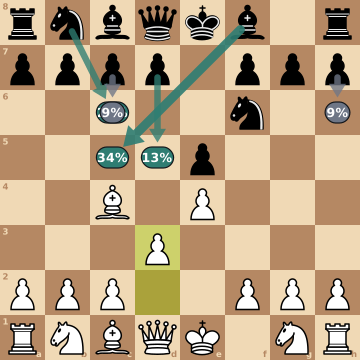
- 3...Bc5 (34%). Now Black's bishop points at your f2 pawn, which only your king defends.
Your answer: 4. Nf3. Develops, attacks e5 and gets you ready to castle. - 3...Nc6 (21%). Black keeps options open for the f8 bishop.
Your answer: 4. Nf3. Develops and attacks e5. - 3...d5 (13%). Your bishop on c4 is attacked, so you must react.
Your answer: 4. exd5. Take the pawn. - 3...h6 (9%). It's safe, but it doesn't develop a piece.
Your answer: 4. Nf3. Keep developing while Black spends time on pawn moves. - 3...c6 (9%). d5, supported by the c6 pawn, which would attack your bishop and e4.
Your answer: 4. Nf3. Develop and attack e5.
After 1. e4 e5 2. Bc4 Nf6 3. d3 Bc5 4. Nf3
The most important position in the guide. Three of the replies are calm, but 4...Ng4 is a mistake with a tactical punishment.
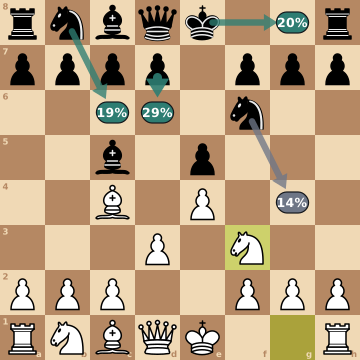
- 4...d6 (29%). It makes e5 solid and opens the c8 bishop.
Your answer: 5. c3. Prepares d4 and gives your bishop a retreat square on c2. - 4...O-O (20%). O-O gets Black's king to safety.
Your answer: 5. O-O. Castle too, and don't grab the e5 pawn. - 4...Nc6 (19%). The position is now the same as a quiet line of the Italian Game.
Your answer: 5. c3. Prepares d4 and takes the d4 square away from Black's knight. - 4...Ng4 (14%). Ng4?Bxf2+.
Your answer: 5. Bxf7+. Give the bishop to drag Black's king out.
After 1. e4 e5 2. Bc4 Nc6 3. d3
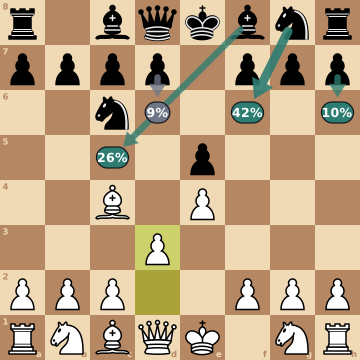
- 3...Nf6 (42%). Your e4 pawn is attacked, but d3 already protects it.
Your answer: 4. Nf3. Develops and attacks e5. - 3...Bc5 (26%). Your f2 pawn is defended only by the king, so keep an eye on it.
Your answer: 4. Nf3. Develops, attacks e5 and guards the kingside. - 3...h6 (10%). Black plays h6 early.
Your answer: 4. Nf3. Develop and attack e5. - 3...d6 (9%). It blocks the f8 bishop's best diagonal, toward c5.
Your answer: 4. Nf3. Develop and get ready to castle.
After 1. e4 e5 2. Bc4 Nc6 3. d3 Nf6 4. Nf3
This is now a quiet Italian Game, reached by a different move order. The plan with c3, O-O and Re1 is the same.
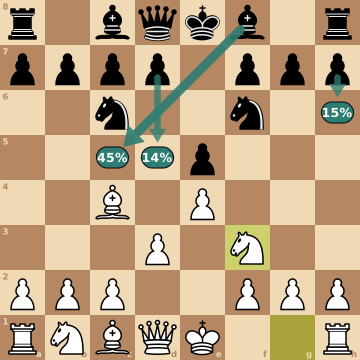
- 4...Bc5 (45%). Nf6.
Your answer: 5. c3. Prepares d4 and keeps Black's knight off d4. - 4...h6 (15%). Black plays h6.
Your answer: 5. c3. Prepares d4 and gives you the b4-a4 idea. - 4...d5 (14%). Your bishop is attacked, so you need to act now.
Your answer: 5. exd5. Take the pawn.
After 1. e4 e5 2. Bc4 Nc6 3. d3 Nf6 4. Nf3 Bc5 5. c3
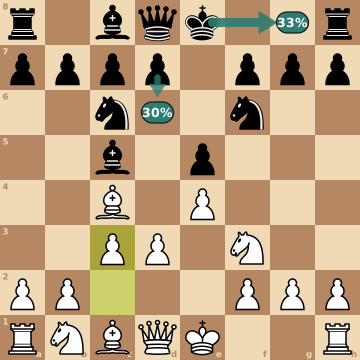
- 5...O-O (33%). Black castles.
Your answer: 6. O-O. Castle too. - 5...d6 (30%). Black supports e5 with d6.
Your answer: 6. O-O. Get your king safe.
After 1. e4 e5 2. Bc4 Nc6 3. d3 Bc5 4. Nf3
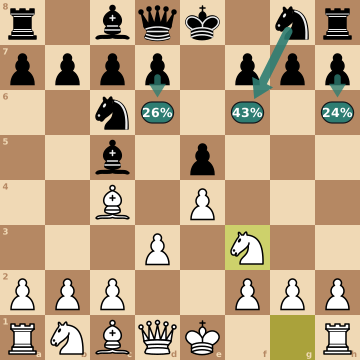
- 4...Nf6 (43%). It's the same Italian position again.
Your answer: 5. c3. The Giuoco Pianissimo setup. - 4...d6 (26%). Black supports e5 with d6.
Your answer: 5. c3. Prepare d4 and keep Black's knight off d4. - 4...h6 (24%). Black plays h6.
Your answer: 5. c3. Prepares d4 and gets b4 ready.
After 1. e4 e5 2. Bc4 Bc5 3. d3
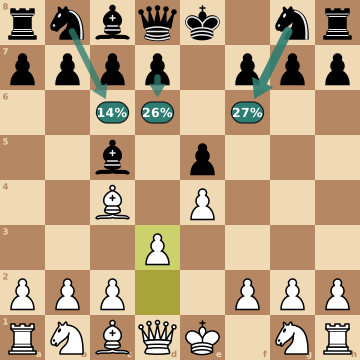
- 3...Nf6 (27%). Black develops Nf6.
Your answer: 4. Nf3. Develops, attacks e5 and guards your kingside. - 3...d6 (26%). Black supports e5 with d6.
Your answer: 4. Nf3. Develop, attack e5 and help guard f2. - 3...Nc6 (14%). Black develops Nc6.
Your answer: 4. Nf3. Develop and attack e5.
Your plan after the opening
The core setup: d3, Nf3, c3, Nbd2 and castle
Against 2...Nf6 3.d3 Bc5 4.Nf3 d6, play c3. It keeps a black knight off d4, prepares d4 later, and gives your bishop a retreat to c2 or b3 if it's chased. Then Nbd2, castle, Bb3 and Re1. Stockfish rates the position about level, but it's easy to play and your pieces all have good squares.
If Black ever jumps ...Ng4 to hit f2 twice after you've played c3, answer with d4!. The pawn attacks the c5 bishop and blocks its line to f2, and Stockfish rates you more than a pawn better.
1. e4 e5 2. Bc4 Nf6 3. d3 Bc5 4. Nf3 d6 5. c3 O-O 6. Nbd2 c6 7. O-O Nbd7 8. Bb3 Re8 9. Re1
Against 2...Nc6: welcome to the quiet Italian
After 3.d3 Nf6 4.Nf3 Bc5 5.c3 you're in the Giuoco Pianissimo, the quiet line of the Italian Game. Castle, play h3 to keep Black's pieces off g4, then Re1. Later you can gain queenside space with b4 and a4, or open the center with d4. There's no rush: improve your pieces first.
1. e4 e5 2. Bc4 Nc6 3. d3 Nf6 4. Nf3 Bc5 5. c3 O-O 6. O-O d6 7. h3
When Black strikes first with ...d5
Take the pawn with exd5. Almost every player recaptures with the knight, and now nothing defends e5. Nf3 attacks it, Black has to spend a move on it, and you castle. Then Re1 adds a second attacker on e5 while Black's king is still in the center. Stockfish rates you slightly better.
1. e4 e5 2. Bc4 Nf6 3. d3 d5 4. exd5 Nxd5 5. Nf3 Nc6 6. O-O
Against ...h6 setups: gain space with b4 and a4
When Black spends a move on ...h6 and later puts a bishop on c5, chase it with b4. After ...Bb6, a4 threatens a5, trapping the bishop. Black has to find ...a6 or ...a5 to give it room. Then you castle and play Nbd2.
Traps and common mistakes
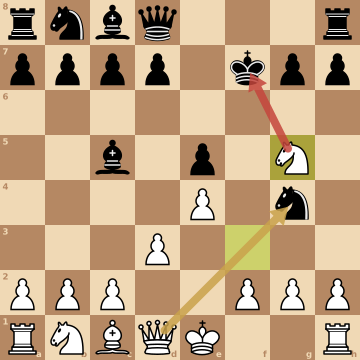
Missing 5.Bxf7+! against 4...Ng4?
1. e4 e5 2. Bc4 Nf6 3. d3 Bc5 4. Nf3 Ng4 5. Bxf7+! Kxf7 6. Ng5+ Kg8 7. Qxg4
4...Ng4 threatens ...Nxf2 and ...Bxf2+, and 14% of players try it. Most White players miss the tactic. Give up the bishop: after 5...Kxf7 6.Ng5+ the king has to step away (6...Qxg5 just drops the queen to 7.Bxg5), and 7.Qxg4 takes the loose knight. You're a clean pawn up and Black's king is stuck on g8, blocking its own rook.
Only about 3% of players find 5.Bxf7+!, and they win 64% of those games. Stockfish rates you about one and a half pawns ahead.
Grabbing e5 too early
1. e4 e5 2. Bc4 Nf6 3. d3 Bc5 4. Nf3 O-O 5. Nxe5? d5!
When Black castles with 4...O-O, the e5 pawn looks free. About a quarter of players take it, but 5...d5! hits your bishop and e4 at once, and Black wins the pawn back with the easier game. Just castle.
The same idea costs even more after 3...c6 4.Nf3 d5. There 5.Nxe5? loses your bishop to 5...dxc4. Move the bishop first with 5.Bb3.
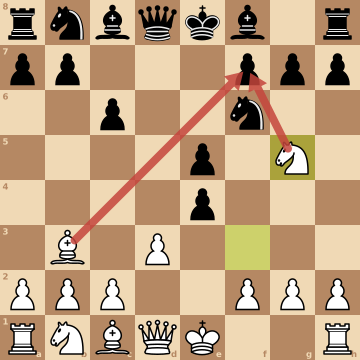
Missing 6.Ng5! after ...c6 and ...dxe4
1. e4 e5 2. Bc4 Nf6 3. d3 c6 4. Nf3 d5 5. Bb3 dxe4 6. Ng5!
After 5.Bb3, Black often opens the d-file with 5...dxe4. Don't recapture right away. 6.Ng5! hits f7 twice, with the knight and the b3 bishop, and only the king defends it. Nxf7 would also fork the queen and the rook. Stockfish rates you about a pawn better.
Forgetting about your own f2
Black's bishop on c5 aims at f2, just like yours aims at f7. Against 2...Bc5, watch for ...Qf6 or ...Qh4: together with the bishop, the queen threatens Qxf2 checkmate. Nf3 blocks the f-file and covers h4, and castling finishes the job. Get your knight to f3 before you do anything fancy.
Black's bishop gets trapped on b6
1. e4 e5 2. Bc4 Nf6 3. d3 h6 4. Nf3 Nc6 5. c3 Bc5 6. b4 Bb6 7. a4 O-O 8. a5
This one is a mistake your opponents make. After b4 and a4, the bishop on b6 needs ...a6 or ...a5 to have somewhere to go. If Black castles instead, a5 traps it: c5 is covered by your b4 pawn and a7 is blocked by Black's own pawn, so you win the bishop for a pawn or two.
Frequently asked questions
Is the Bishop's Opening good for beginners?
Yes. The setup (d3, Nf3, c3, O-O) is the same against almost everything, so there is very little to memorize. It also teaches good habits: protect your center, develop, and castle before you attack.
Why play 2.Bc4 instead of 2.Nf3?
The main reason is the Petrov. That defense only exists after 2.Nf3 Nf6. After 2.Bc4 Nf6 you calmly protect e4 with 3.d3 and bring the knight to f3 a move later. Against 2...Nc6 you often reach the quiet Italian Game anyway, so you give up very little.
What is the most common reply to the Bishop's Opening?
At 500 to 2000 on Lichess, Black's most common replies to 2.Bc4 are 2...Nf6 (34%), 2...Nc6 (30%), 2...Bc5 (12%) and 2...d6 (10%). This guide answers all four with 3.d3.
Is the Bishop's Opening the same as the Italian Game?
Not at first, but it often turns into one. After 2...Nc6 3.d3 Nf6 4.Nf3 Bc5 5.c3, you have the same position as a quiet line of the Italian. The difference is that you skip the Petrov and a few sharp Italian lines along the way.
How popular is the Bishop's Opening?
In this rating range, 2.Bc4 is played in about 11% of games after 1.e4 e5, second only to 2.Nf3. So it's not a rare sideline, but many players still meet it less often than the main openings.
Keep learning
- All 36 opening guides: every opening on the site, grouped by what you play as White and Black.
- Is the Bishop's Opening Good?: How 2.Bc4 sidesteps the Petrov, when it transposes to the Italian, and what Black plays.
The Coach plays the Bishop's Opening against you with the moves 500 to 2000 players actually choose, including 4...Ng4 and the early ...d5, and explains every move in plain English. Progress tracking is free during the open beta.
Practice the Bishop's Opening free →