The Bogo-Indian Defense: A Low-Theory Plan Built on 1200 to 2000 Lichess Games
TL;DR: the data
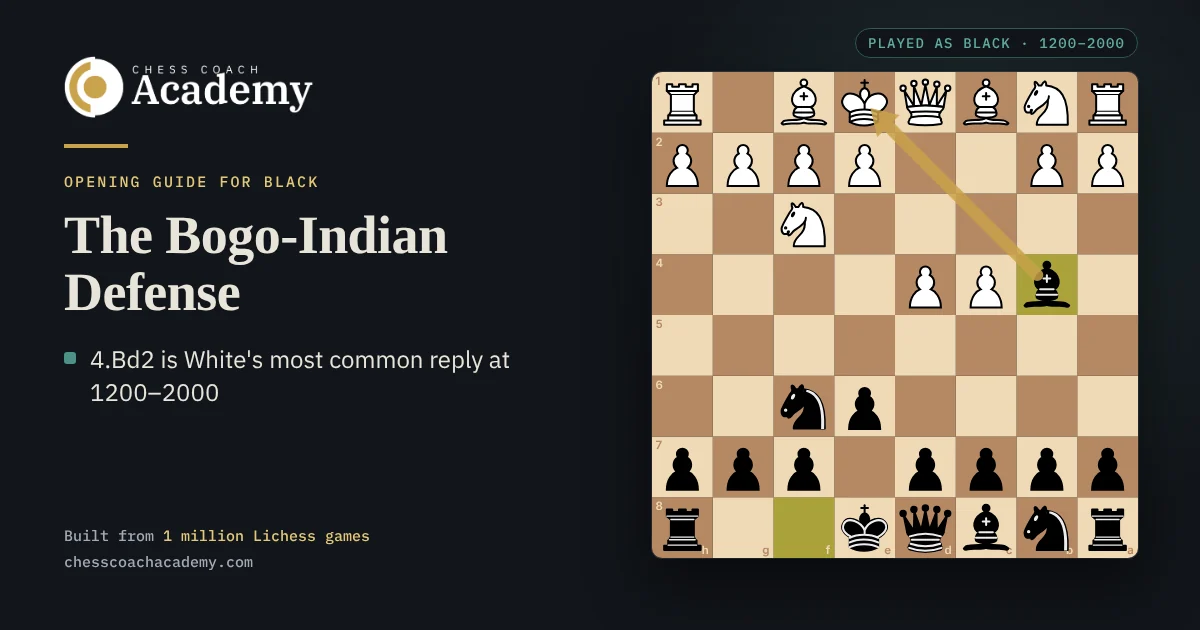
Built from 1 million Lichess games played by 1200 to 2000 rated players You play Black, 20 practice lines, every move of yours checked by Stockfish Most common line 1. d4 Nf6 2. c4 e6 3. Nf3 Bb4+ 4. Bd2 Qe7 5. a3 Bxd2+ 6. Nbxd2 d6 7. e4 e5 8. d5 O-O 9. Bd3 a5 Replies to 4...Qe7 5. a3 40% · 5. g3 21% · 5. Nc3 19% Worth knowing After 4.Bd2, Black wins 47% of games with 4...Qe7 but only 43% with 4...Bxd2+, the most common move at this level.
The Bogo-Indian is what you play when White sidesteps the Nimzo-Indian with 3.Nf3. You still bring the bishop to b4, but this time with check. White has to block it, and in most games that means offering a bishop trade with 4.Bd2.
Most guides teach this opening from games between masters. This one is built from 1 million Lichess games played by 1200 to 2000 rated players, and the data gives a clear message. After 4.Bd2, the most popular move at this level is to trade bishops straight away, but the quiet 4...Qe7 scores better. This guide is built around that move and one simple plan: trade the dark-squared bishops, then put your pawns on d6 and e5.
1. d4 Nf6 2. c4 e6 3. Nf3 Bb4+
Practice the Bogo-Indian Defense free →Who it's for
Players rated roughly 1200 to 2000 who answer 1.d4 with 1...Nf6 and 2...e6, and want a low-theory reply to 3.Nf3. You won't need to learn long forcing lines. You'll need to know one pawn structure and why it works.
It suits you if you like solid, strategic games where the plan barely changes from move to move. If you already play the Nimzo-Indian, the Bogo is a natural partner, because the 4.Nc3 line takes you straight into Nimzo territory.
Why it works at 1200 to 2000
- One plan covers most of the tree. Against 4.Bd2 you play ...Qe7, trade bishops at the right moment, then ...d6 and ...e5. The same setup works against a3, g3, Nc3 and e3.
- Your pawns end up on dark squares after White's dark-squared bishop is gone, so White has no minor piece left that can attack them. Your light-squared bishop stays free.
- It's low on theory. There are few sharp lines to memorize, and most endings in the Coach's tree are level by Stockfish.
- White often keeps a little more space. In the 5.g3 and 4.Nbd2 lines Stockfish gives White a third to almost half a pawn, so you need patience.
- The 4.Nc3 lines are really Nimzo-Indian positions, with slightly different ideas (...h6 and ...c5, or ...d5) that you need to learn separately.
- It only covers 3.Nf3. If White plays 3.Nc3 you're in the Nimzo-Indian, and rarer fourth moves like 4.Nfd2 aren't in the tree.
What 1200 to 2000 players actually play
Here is what White plays after 4.Bd2 Qe7. The most common move is 5.a3 at 40%, asking your bishop to decide. After that come 5.g3 (21%), 5.Nc3 (19%) and 5.e3 (11%). The good news is that your plan is the same in all four: the bishop trade on d2 comes sooner or later, and then ...d6 and ...e5 follow.
Three numbers from the data are worth remembering:
- At this rating range, 19% of players answer 3.Nf3 with 3...Bb4+, second only to 3...d5 (43%).
- White's replies to 3...Bb4+ are 4.Bd2 (55%), 4.Nc3 (36%) and 4.Nbd2 (9%).
- After 4.Bd2, Black wins 47% of games with 4...Qe7 but only 43% with 4...Bxd2+, the most common move at this level.
How to play the Bogo-Indian Defense: move by move
Every position below comes straight from the practice lines. The boards are shown from your side, and the arrows mark White's most common replies at 1200 to 2000, labeled with how often each one is played in that exact position. Under each board you'll find the reply, why White plays it, and the move you answer with.
After 1. d4 Nf6 2. c4 e6 3. Nf3 Bb4+
White has three ways to block the check. More than half of players choose 4.Bd2, which is where most of your games will go.
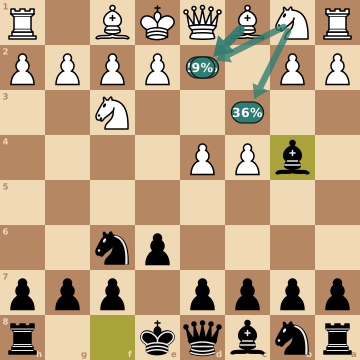
- 4. Bd2 (55%). White's bishop now attacks yours on b4.
Your answer: 4...Qe7. e5. - 4. Nc3 (36%). This position is also a Nimzo-Indian, reached by a different move order.
Your answer: 4...O-O. Castle and keep the pin. - 4. Nbd2 (9%). White blocks with the other knight, Nbd2.
Your answer: 4...O-O. Castle and wait.
After 1. d4 Nf6 2. c4 e6 3. Nf3 Bb4+ 4. Bd2 Qe7
Your queen protects the bishop, so you choose when to trade. Against 5.a3 take on d2 at once; against 5.g3 develop with ...Nc6 first; against 5.Nc3 and 5.e3 castle.
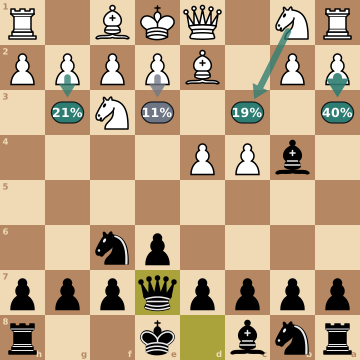
- 5. a3 (40%). a3 attacks the bishop with a pawn.
Your answer: 5...Bxd2+. Trade bishops, with check. - 5. g3 (21%). White wants Bg2 first.
Your answer: 5...Nc6. Develop and put pressure on d4. - 5. Nc3 (19%). White develops the knight to c3.
Your answer: 5...O-O. Castle and keep the bishop on b4 for now. - 5. e3 (11%). White wants Bd3 and castling.
Your answer: 5...O-O. Castle first.
After 1. d4 Nf6 2. c4 e6 3. Nf3 Bb4+ 4. Bd2 Qe7 5. a3 Bxd2+
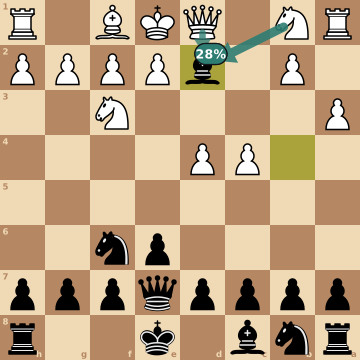
- 6. Nbxd2 (71%). The knight is developed and helps support a later e2-e4.
Your answer: 6...d6. e5 and opens your c8 bishop. - 6. Qxd2 (28%). White recaptures with the queen.
Your answer: 6...d6. e5 next.
After 1. d4 Nf6 2. c4 e6 3. Nf3 Bb4+ 4. Bd2 Qe7 5. a3 Bxd2+ 6. Nbxd2 d6
The main position of the Bogo at this level. Half of White players now build a big center with 7.e4, and you meet it with 7...e5 straight away.
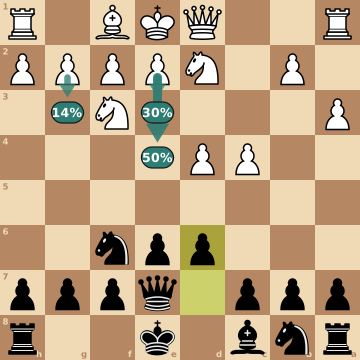
- 7. e4 (50%). The knight on d2 protects e4.
Your answer: 7...e5. Challenge the d4 pawn right away. - 7. e3 (30%). White plays the quieter e3.
Your answer: 7...O-O. King to safety. - 7. g3 (14%). White prepares to put the bishop on g2.
Your answer: 7...O-O. Castle while White spends time on g3 and Bg2.
After 1. d4 Nf6 2. c4 e6 3. Nf3 Bb4+ 4. Bd2 Qe7 5. a3 Bxd2+ 6. Nbxd2 d6 7. e4 e5 8. d5 O-O
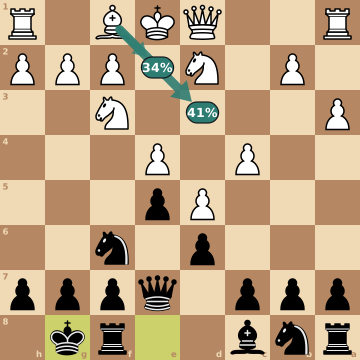
- 9. Bd3 (41%). The bishop protects e4, but it's blocked by White's own pawns on light squares.
Your answer: 9...a5. Slows down White's queenside pawns. - 9. Be2 (34%). It clears the way for castling but still sits behind White's light-square pawns.
Your answer: 9...a5. The same idea: make b4 costly for White.
After 1. d4 Nf6 2. c4 e6 3. Nf3 Bb4+ 4. Bd2 Qe7 5. g3 Nc6 6. Bg2 Bxd2+
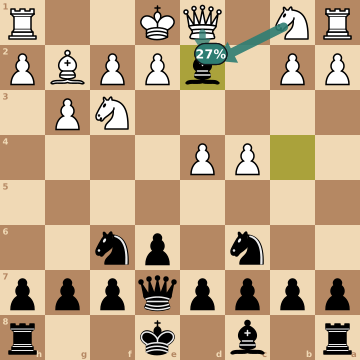
- 7. Nbxd2 (73%). White recaptures with the knight.
Your answer: 7...d6. e5. - 7. Qxd2 (27%). But the queen on d2 can be attacked.
Your answer: 7...Ne4. Attack the queen and gain time.
After 1. d4 Nf6 2. c4 e6 3. Nf3 Bb4+ 4. Bd2 Qe7 5. Nc3 O-O
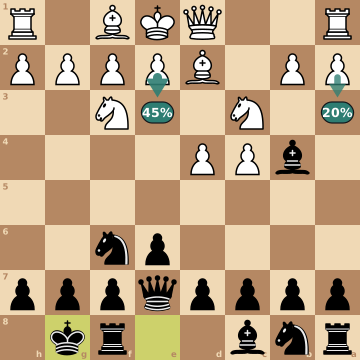
- 6. e3 (45%). White gets ready for Bd3 and castling.
Your answer: 6...d6. e5. - 6. a3 (20%). Taking on c3 is the natural answer.
Your answer: 6...Bxc3. Trade the bishop for the knight.
After 1. d4 Nf6 2. c4 e6 3. Nf3 Bb4+ 4. Nc3 O-O
This is a Nimzo-Indian position reached by a different move order. Against the pin 5.Bg5 ask the bishop with ...h6; against quieter moves claim the center with ...d5.
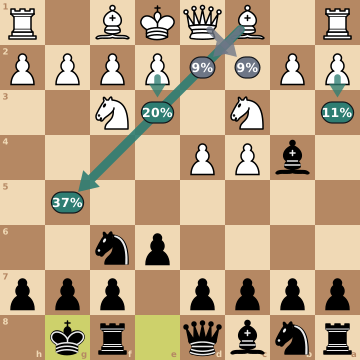
- 5. Bg5 (37%). The bishop pins your f6 knight to your queen on d8.
Your answer: 5...h6. Ask the bishop to take or retreat. - 5. e3 (20%). The e3 pawn supports d4 and prepares Bd3.
Your answer: 5...d5. Claim the center with a pawn. - 5. a3 (11%). White plays a3, attacking your bishop.
Your answer: 5...Bxc3+. Trade with check and double White's pawns. - 5. Qc2 (9%). White plays Qc2 to protect the knight.
Your answer: 5...d5. Take the center. - 5. Bd2 (9%). Now taking on c3 would let White recapture with the bishop.
Your answer: 5...Qe7. Back to a familiar position. - 5. g3 (6%). White prepares a fianchetto with g3.
Your answer: 5...d5. Claim the center.
After 1. d4 Nf6 2. c4 e6 3. Nf3 Bb4+ 4. Nc3 O-O 5. Bg5 h6
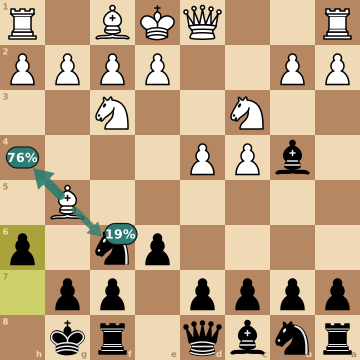
- 6. Bh4 (76%). The f6 knight is still pinned to your queen.
Your answer: 6...c5. Hit White's center instead. - 6. Bxf6 (19%). White gives up the bishop with Bxf6.
Your answer: 6...Qxf6. Recapture with the queen.
After 1. d4 Nf6 2. c4 e6 3. Nf3 Bb4+ 4. Nbd2 O-O
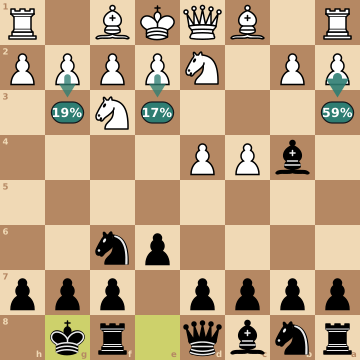
- 5. a3 (59%). White wants you to decide now.
Your answer: 5...Be7. Retreat and keep your bishop. - 5. g3 (19%). White prepares Bg2 with g3.
Your answer: 5...b6. Get ready to put your bishop on b7. - 5. e3 (17%). White supports d4 with e3.
Your answer: 5...d5. Claim the center.
Your plan after the opening
Against 4.Bd2: trade bishops, then ...d6 and ...e5
Once the dark-squared bishops are gone, put your center pawns on dark squares with ...d6 and ...e5. White has no bishop left that can attack them, and your own c8 bishop has plenty of room.
If White locks the center with d5, castle and play ...a5 to slow down b4 and c5 on the queenside. Then turn to the kingside: ...Bg4 pins the f3 knight, ...Nh5 heads for f4, and ...f5 attacks White's e4 pawn.
1. d4 Nf6 2. c4 e6 3. Nf3 Bb4+ 4. Bd2 Qe7 5. a3 Bxd2+ 6. Nbxd2 d6 7. e4 e5 8. d5 O-O 9. Bd3 a5
When White trades on e5
Against quieter setups with e3, castle first and then play ...e5. White often takes with dxe5, and you take back with the pawn. Your queen on e7 still guards e5, and because it isn't on the open d-file, the queens stay on. Develop your b8 knight to d7 or c6 and put a rook on d8.
1. d4 Nf6 2. c4 e6 3. Nf3 Bb4+ 4. Bd2 Qe7 5. a3 Bxd2+ 6. Nbxd2 d6 7. e3 O-O 8. Bd3 e5 9. dxe5 dxe5
Against 4.Nc3: play it like a Nimzo-Indian
Castle and keep the pin. If White pins your knight with 5.Bg5, ask with ...h6, and after 6.Bh4 hit the center with ...c5 rather than chasing the bishop. Against 5.a3, take on c3 with check and fix the doubled pawns with ...c5. Against 5.e3, 5.Qc2 and 5.g3, claim the center with ...d5.
1. d4 Nf6 2. c4 e6 3. Nf3 Bb4+ 4. Nc3 O-O 5. Bg5 h6 6. Bh4 c5
Against 4.Nbd2: keep your bishop
Here trading on d2 would let White recapture with the c1 bishop and develop it for free. Castle, and when White plays a3, drop the bishop back to e7. Then ...d6 and ...e5 give you the same kind of center as in the main line.
1. d4 Nf6 2. c4 e6 3. Nf3 Bb4+ 4. Nbd2 O-O 5. a3 Be7 6. e4 d6 7. Bd3 e5
Traps and common mistakes
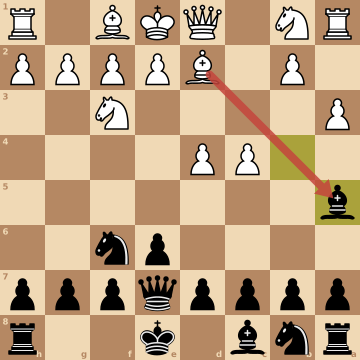
Retreating the bishop to a5
1. d4 Nf6 2. c4 e6 3. Nf3 Bb4+ 4. Bd2 Qe7 5. a3 Ba5?? 6. Bxa5
After 5.a3 the bishop is attacked, and a5 looks like a natural retreat. It isn't safe: White's bishop on d2 looks down the same diagonal and simply takes it.
Trade with 5...Bxd2+ instead. It comes with check, so White has to recapture, and you never have to worry about your bishop again.
Thinking e5 is loose after dxe5
1. d4 Nf6 2. c4 e6 3. Nf3 Bb4+ 4. Bd2 Qe7 5. a3 Bxd2+ 6. Nbxd2 d6 7. e3 O-O 8. Bd3 e5 9. dxe5 dxe5 10. Nxe5?? Qxe5
When White trades on e5 and you recapture with the pawn, it can look as if your e5 pawn has no pawn support. But the queen on e7 guards it. If White grabs it with 10.Nxe5??, then 10...Qxe5 wins a knight for a pawn.
So don't rush to defend e5 with another piece. Use the time to develop your knight and put a rook on the open d-file.
Missing the ...Qb4+ trick in the 5.g3 line
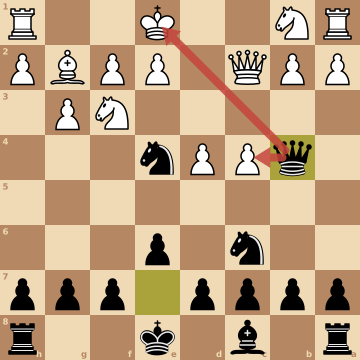
1. d4 Nf6 2. c4 e6 3. Nf3 Bb4+ 4. Bd2 Qe7 5. g3 Nc6 6. Bg2 Bxd2+ 7. Qxd2 Ne4 8. Qc2 Qb4+
When White recaptures on d2 with the queen, 7...Ne4 hits it at once. After 8.Qc2, 8...Qb4+ makes every block awkward. 9.Nbd2? Nxd2 10.Qxd2 Qxc4 wins you a pawn, 9.Nfd2? drops d4 to ...Nxd4, and 9.Qd2?? Nxd2 wins the queen.
Stockfish rates 9.Kf1 and 9.Nc3 as White's best, and the game is level. Against 9.Kf1, play ...d5 and castle.
Chasing the bishop with ...g5
1. d4 Nf6 2. c4 e6 3. Nf3 Bb4+ 4. Nc3 O-O 5. Bg5 h6 6. Bh4 c5
In the 4.Nc3 line, White pins your knight with 5.Bg5, and after 5...h6 6.Bh4 the pin is still there. Kicking the bishop again with ...g5 is tempting, but it weakens the pawns in front of your castled king.
Play 6...c5 instead. It attacks d4 and opens a path for your queen to a5. The usual follow-up is ...cxd4 and ...d5, and Stockfish rates the position level.
Frequently asked questions
Is the Bogo-Indian good for club players?
Yes. It's one of the lowest-theory answers to 3.Nf3, and one plan (...Qe7, trade bishops, ...d6 and ...e5) covers most of what you'll face at 1200 to 2000. At this level 19% of players answer 3.Nf3 with 3...Bb4+, second only to 3...d5.
What is the most common reply to the Bogo-Indian at club level?
At 1200 to 2000 on Lichess, White blocks the check with 4.Bd2 in 55% of games. 4.Nc3 comes next at 36%, and 4.Nbd2 is played in 9% of games.
Should I play 4...Qe7 or 4...Bxd2+ in the Bogo-Indian?
The data favors 4...Qe7. After 4.Bd2, Black wins 47% of games with 4...Qe7 but only 43% with 4...Bxd2+, even though the trade is the most common move at this level. With the queen on e7 you choose the moment to trade, and your queen already supports ...e5.
What's the difference between the Bogo-Indian and the Nimzo-Indian?
Both put a bishop on b4. In the Nimzo-Indian White has played 3.Nc3, so the bishop pins a knight. In the Bogo-Indian White has played 3.Nf3, so the bishop gives check instead. If White answers the check with 4.Nc3, the two openings meet and you're in a Nimzo-Indian position.
Why put pawns on d6 and e5 in the Bogo-Indian?
Because the dark-squared bishops usually get traded early. Once White's dark-squared bishop is gone, pawns on dark squares can't be attacked by a White bishop, and your light-squared bishop has open diagonals. It's a simple structure that you can reach against almost every White setup.
Keep learning
- All 36 opening guides: every opening on the site, grouped by what you play as White and Black.
- Nimzo-Indian vs Queen's Indian vs Bogo-Indian: Whether the Bogo-Indian or the Queen's Indian is the better partner for your Nimzo.
- The most reliable 1.d4 defenses for Black: Nine 1.d4 defenses compared with Lichess data at club level.
The Coach plays White against your Bogo-Indian with the moves 1200 to 2000 players actually choose, including 4.Bd2, 4.Nc3 and 4.Nbd2, and explains every move in plain English. Progress tracking is free during the open beta.
Practice the Bogo-Indian Defense free →