Caro-Kann Advance Variation for 800 to 2200: The Black Plan That Works in Real Games
TL;DR: the data
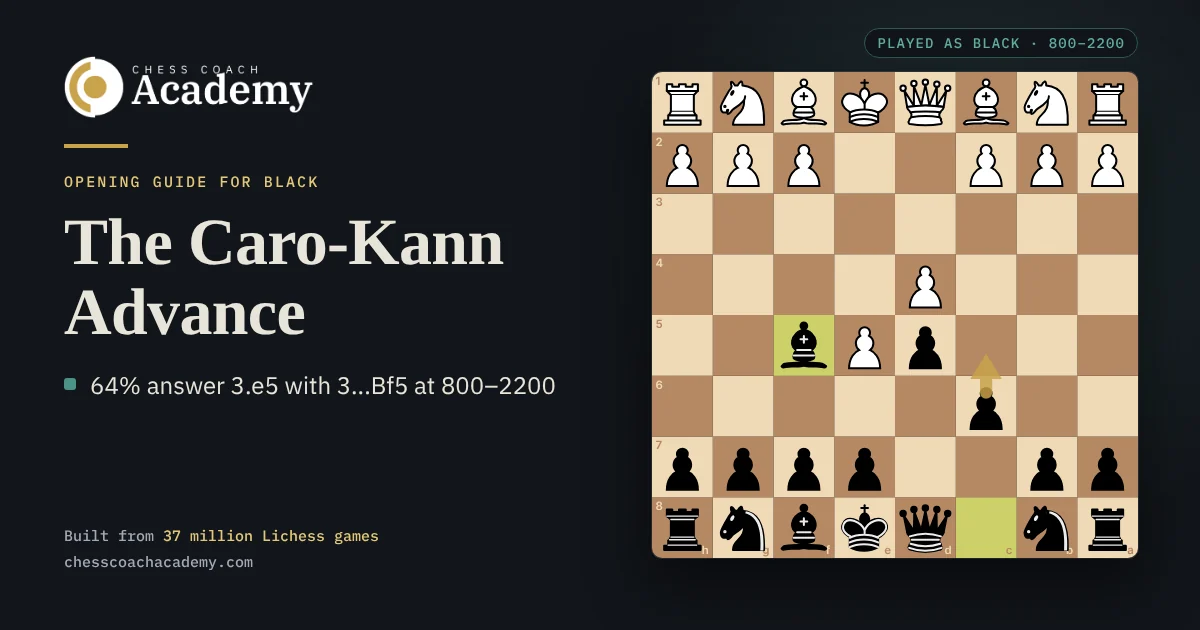
Built from 37 million Lichess games played by 800 to 2200 rated players You play Black, 14 practice lines, every move of yours checked by Stockfish Most common line 1. e4 c6 2. d4 d5 3. e5 Bf5 4. Nf3 e6 5. Bd3 Bxd3 6. Qxd3 c5 7. c3 Nc6 8. O-O Nge7 Replies to 3...Bf5 4. Nf3 28% · 4. Bd3 22% · 4. h4 8% Worth knowing After 4.h4, 16% of players reply 4...e6?, which lets 5.g4 hunt down the bishop. White wins 69% of those games.
The Advance Variation is the line you'll meet most often as a Caro-Kann player. After 1.e4 c6 2.d4 d5, White pushes 3.e5, grabs space and keeps your knight off f6. Your answer is 3...Bf5: the light-squared bishop comes out before you play ...e6, so it never gets locked behind your own pawns. Then you build a solid chain with ...e6 and attack the base of White's chain with ...c5.
This guide is built from 37 million Lichess games at 800 to 2200. At that level 3.e5 is White's most common third move, and after 3...Bf5 you face six different fourth moves in real games. Four of them are calm and all take the same plan. The other two, 4.h4 and 4.g4, go after your bishop with pawns, and those are where games are won and lost.
1. e4 c6 2. d4 d5 3. e5 Bf5
Practice the Caro-Kann: Advance Variation free →Who it's for
Players rated roughly 800 to 2200 who play the Caro-Kann, or are thinking about it, and want one clear plan against the Advance. It's a good fit if you're comfortable with a slightly cramped but very solid position and like knowing exactly which pawn you're attacking.
If you want quick tactical games as Black, this isn't that. Most games are decided in the middlegame by who uses the pawn structure better. That's exactly why it works well across such a wide rating band: the plan stays the same while your opponents get stronger.
Why it works at 800 to 2200
- One plan covers almost everything: ...e6, ...c5, ...Nc6 and ...Nge7, all aimed at White's d4 pawn. ...Qb6 often joins in to hit b2.
- Your light-squared bishop is never a problem. It comes out to f5 and usually gets traded for White's best bishop.
- Several of White's tries help you. Against 4.f4 Stockfish rates you slightly better, because f4 guards e5 but does nothing for d4.
- White has more space, and in lines like 4.h4 h5 White keeps a small edge. You need patience.
- You must know two sharp answers: 4...h5 against 4.h4, and 4...Be4 against 4.g4. Normal moves lose the bishop or give White a big attack.
- The pawn on e5 takes f6 away from your king's knight, so it has to go the long way round via e7.
What 800 to 2200 players actually play
Here is what White plays once your bishop is on f5, at 800 to 2200. The quiet 4.Nf3 leads at 28%, and 4.Bd3 (22%) offers a bishop trade right away. After that it spreads out: 4.h4, 4.f4 and 4.Nc3 each show up in 8% of games, and 4.g4 in 6%. Add h4, f4 and g4 together and more than a fifth of your opponents start pushing kingside pawns on move four, so the sharp answers are worth learning properly.
Three numbers from the data worth remembering:
- At this rating range, 3.e5 is White's most common third move (42%), and 64% of players answer it with 3...Bf5.
- After 3...Bf5, White's most common moves are 4.Nf3 (28%), 4.Bd3 (22%), 4.h4, 4.f4 and 4.Nc3 (8% each), and 4.g4 (6%).
- After 4.h4, 16% of players reply 4...e6?, which lets 5.g4 hunt down the bishop. White wins 69% of those games.
How to play the Caro-Kann: Advance Variation: move by move
Every board below is from the practice lines and is shown from your side. The arrows show White's most common replies at 800 to 2200, labeled with how often each is played in that exact position. Under each board you'll find why White plays it and the answer the Coach teaches you.
After 1. e4 c6 2. d4 d5 3. e5 Bf5
The key position. Six replies are common, and four of them get the same answer: ...e6, then ...c5. The exceptions are 4.Bd3, where you trade at once, and the pawn pushes 4.h4 and 4.g4.
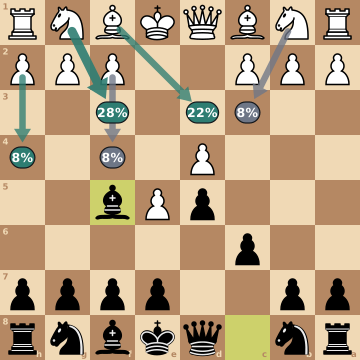
- 4. Nf3 (28%). The knight guards d4 and White gets ready to castle.
Your answer: 4...e6. Now that the bishop is out, lock in your d5 pawn. - 4. Bd3 (22%). It challenges your bishop before White has even developed a knight.
Your answer: 4...Bxd3. Take the trade. - 4. h4 (8%). You need to know the right answer.
Your answer: 4...h5. Stop White's h-pawn in its tracks. - 4. f4 (8%). White supports e5 with f4.
Your answer: 4...e6. Your bishop is already out, so build the chain. - 4. Nc3 (8%). White develops Nc3.
Your answer: 4...e6. Solid and safe with the bishop already out. - 4. g4 (6%). It chases the bishop right away and grabs space on the kingside.
Your answer: 4...Be4. Hit the rook on h1.
After 1. e4 c6 2. d4 d5 3. e5 Bf5 4. Nf3 e6
Your setup is almost done. Against every reply except 5.c4 your next move is ...c5 (after the bishop trade if White plays 5.Bd3).
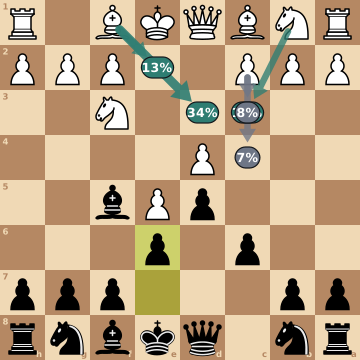
- 5. Bd3 (34%). White's light-squared bishop is its best bishop here, because White's pawns sit on dark squares, so White is happy to swap it for yours.
Your answer: 5...Bxd3. Take the trade. - 5. Nc3 (16%). It develops quickly but doesn't support d4 the way c3 would.
Your answer: 5...c5. Strike at d4 straight away. - 5. Be2 (13%). It's a modest but solid setup.
Your answer: 5...c5. The same plan: hit the base of the chain. - 5. c3 (8%). c5 in advance, so White can always take back on d4 with a pawn.
Your answer: 5...c5. Hit d4 anyway. - 5. c4 (7%). White hits d5 with a second pawn instead of building a chain.
Your answer: 5...Ne7. Develop and add a defender to d5.
After 1. e4 c6 2. d4 d5 3. e5 Bf5 4. Bd3 Bxd3 5. Qxd3 e6
The bishops are gone, and White's light squares are a bit weaker for the rest of the game. Your plan is ...c5 against every reply.
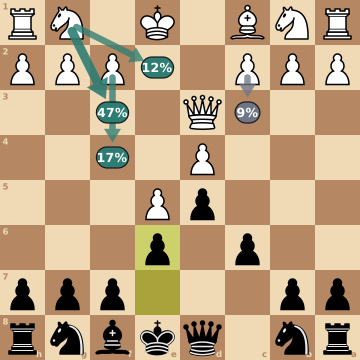
- 6. Nf3 (47%). Qxd3.
Your answer: 6...c5. Hit the base of White's pawn chain. - 6. f4 (17%). White supports e5 with f4.
Your answer: 6...c5. Attack d4, the pawn that f4 doesn't help. - 6. Ne2 (12%). White develops the knight to e2.
Your answer: 6...c5. Same plan: attack d4. - 6. c3 (9%). White supports d4 with c3 first.
Your answer: 6...c5. Hit d4 before White finishes developing.
After 1. e4 c6 2. d4 d5 3. e5 Bf5 4. f4 e6
White's f-pawn protects e5 but blocks the c1 bishop. d4 gets no help at all, so ...c5 is especially strong.
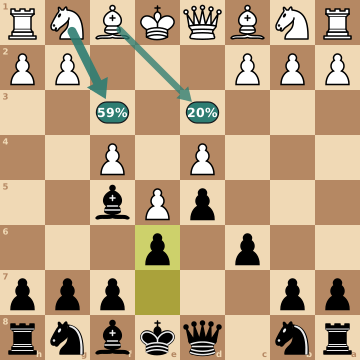
- 5. Nf3 (59%). White develops Nf3.
Your answer: 5...c5. Attack d4, the pawn f4 doesn't protect. - 5. Bd3 (20%). White offers a bishop trade with Bd3.
Your answer: 5...Bxd3. Take the trade.
Your plan after the opening
The main plan: pile up on d4
White's pawns on d4 and e5 form a chain, and d4 holds the whole thing up. Attack it with ...c5, add ...Nc6, and send your other knight via e7 to f5, where it hits d4 again. ...Qb6 adds a fourth attacker and looks at b2. Finish with ...Be7 and castle short.
If White grabs a pawn with 9.dxc5, answer 9...Ng6. The knight hits e5 at once and Stockfish still rates the game close to level.
1. e4 c6 2. d4 d5 3. e5 Bf5 4. Nf3 e6 5. Bd3 Bxd3 6. Qxd3 c5 7. c3 Nc6 8. O-O Nge7
Against 4.h4: stop the pawn with 4...h5
White wants h5 and g4 to trap your bishop. 4...h5 stops the h-pawn for good, and if White ever plays g4 you can take it. After the usual 5.Bd3 you trade bishops, then play ...e6 and ...c5 just like in the main line. White keeps a small edge (about a third of a pawn by Stockfish), but your pieces come out easily.
1. e4 c6 2. d4 d5 3. e5 Bf5 4. h4 h5 5. Bd3 Bxd3 6. Qxd3 e6 7. Nf3 c5
Against 4.f4: hit the pawn f4 can't protect
Play ...e6 and ...c5 as usual. The f4 pawn guards e5, but d4 has no extra defender and White's c1 bishop is hemmed in. After ...Nc6, bring the queen to b6 and the knight to e7. Stockfish rates you slightly better here.
1. e4 c6 2. d4 d5 3. e5 Bf5 4. f4 e6 5. Nf3 c5 6. c3 Nc6
Against 5.c4: defend d5 first
When White hits d5 with a second pawn, don't play the usual ...c5. After 6.cxd5 exd5 the center opens while White is ready, and Stockfish rates it almost a pawn better for White. Play 5...Ne7 instead, which protects d5 and keeps your options open. Develop, castle, and use ...dxc4 when your pieces are ready.
Traps and common mistakes
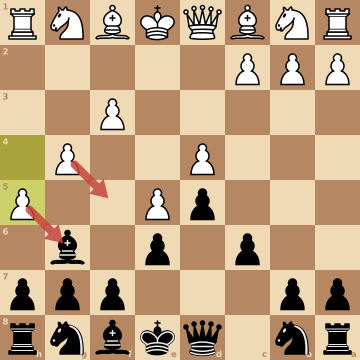
Answering 4.h4 with 4...e6?
1. e4 c6 2. d4 d5 3. e5 Bf5 4. h4 e6? 5. g4 Be4 6. f3 Bg6 7. h5
This is the most expensive mistake in the whole line. The natural 4...e6 is played by 16% of players at 800 to 2200 after 4.h4, and White wins 69% of those games. White's pawns chase the bishop from f5 to e4 to g6, and 7.h5 leaves it with nowhere safe to go.
The answer is 4...h5. It costs you nothing and your bishop is safe for the rest of the game.
Letting White double your pawns after 4.Bd3
1. e4 c6 2. d4 d5 3. e5 Bf5 4. Bd3 e6? 5. Bxf5 exf5
4.Bd3 is White's second most common move (22%). If you carry on with 4...e6, White takes on f5 and you're left with doubled f-pawns. Stockfish gives White more than a pawn's advantage. Take first with 4...Bxd3, and after 5.Qxd3 e6 you're back in your normal setup.
Playing 6...h6? in the 4.g4 line
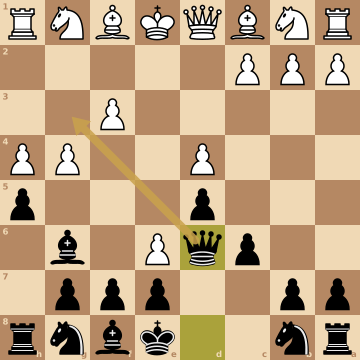
1. e4 c6 2. d4 d5 3. e5 Bf5 4. g4 Be4 5. f3 Bg6 6. h4 h6? 7. h5 Bh7 8. e6!
Against 4.g4, the bishop jumps to e4 to hit the rook on h1, then drops back to g6 after 5.f3 (never 5...e6??, when 6.fxe4 wins the bishop). Then comes 6.h4, played in 74% of games, threatening h5. The tempting 6...h6? loses time: after 7.h5 Bh7 8.e6! Stockfish gives White almost a pawn's advantage.
Play 6...h5 instead, which blocks the h-pawn and attacks g4. If White throws in 7.e6, answer 7...Qd6 and threaten ...Qg3+. After 8.exf7+ Bxf7 Stockfish rates you slightly better, and White's kingside is full of holes.
Playing ...e6 before the bishop comes out
If you play ...e6 on move three, your light-squared bishop is shut in behind pawns on c6, d5 and e6, and it can stay bad all game. Bring it to f5 first, then play ...e6. It's the move order that makes the Caro-Kann Advance easier to play than it looks.
Frequently asked questions
What is the best response to the Caro-Kann Advance?
3...Bf5 is the move this guide and the Coach teach, and it's also the most popular choice: at 800 to 2200, 64% of players answer 3.e5 with 3...Bf5. It gets your light-squared bishop out before ...e6 closes its path.
How do you play against 4.h4 in the Caro-Kann Advance?
Answer 4.h4 with 4...h5. It stops White's h-pawn from reaching h5 and trapping your bishop. The natural 4...e6? is a real mistake: after 5.g4 the bishop gets hunted down, and White wins 69% of those games on Lichess.
What is Black's main plan in the Caro-Kann Advance?
Attack d4, the base of White's pawn chain. Play ...e6 and ...c5, then ...Nc6, ...Nge7 heading for f5, and often ...Qb6 to hit b2 as well. The same plan works against almost every White setup.
What's the difference between the Caro-Kann Advance and the French Advance?
The pawn structure looks similar, but in the Caro-Kann your light-squared bishop gets out to f5 before you play ...e6. In the French Defense that bishop often stays stuck behind the e6 pawn. The price is time: in the Caro-Kann your c-pawn moves twice (...c6, then ...c5).
Is the Caro-Kann Advance good for beginners?
Yes, as long as you learn the two sharp answers (4...h5 against 4.h4, and 4...Be4 against 4.g4). The rest is one plan you can repeat in every game. That's why it works from 800 all the way up to 2200.
Keep learning
- All 36 opening guides: every opening on the site, grouped by what you play as White and Black.
- Why Is the Caro-Kann So Solid?: The pawn-structure reasons behind its reputation.
- How to Beat the Caro-Kann as White: The plans you'll face from the other side of the board.
- Five Openings, One Bishop: Why getting the bishop to f5 before ...e6 matters so much.
The Coach plays the Advance against you with the moves 800 to 2200 players actually choose, including 4.h4 and 4.g4, and explains every move in plain English. Progress tracking is free during the open beta.
Practice the Caro-Kann: Advance Variation free →