
Chess Notation Explained: How to Read and Write Chess Moves
TL;DR
Squares A letter for the column (a to h) plus a number for the row (1 to 8), so e4, f3, h8 Pieces K king, Q queen, R rook, B bishop, N knight, and no letter for a pawn A move Piece letter + square: Nf3 means Knight to f3 Symbols x capture, + check, # checkmate, O-O castle short, O-O-O castle long Comments ! good, !! brilliant, ? mistake, ?? blunder
Why notation is worth learning
Chess notation is how every book, website, coach and engine writes moves. Once you can read it, you can follow any opening line, replay famous games and review your own. It looks like code at first, but there are only a handful of rules, and you can learn them in about five minutes.
Step 1: name the squares
Look at the board from White's side. The columns, called files, are lettered a to h from left to right. The rows, called ranks, are numbered 1 to 8 from White's side to Black's. Every square has one name: the letter first, then the number. White's king starts on e1, Black's king on e8.
Step 2: learn the piece letters
- K = King
- Q = Queen
- R = Rook
- B = Bishop
- N = Knight (K is taken by the king)
- No letter = a pawn
Step 3: put them together
A move is the piece letter plus the square it moves to. A pawn move is just the square. Here is the start of the Italian Game:
1. e4 e5 2. Nf3
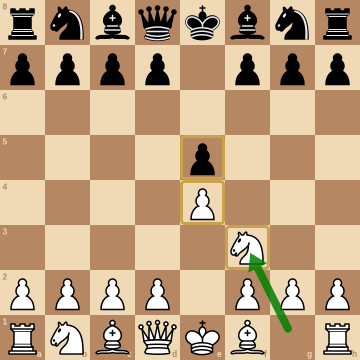
In plain English: White moves a pawn to e4 (pawn to e4), Black answers with a pawn to e5 (pawn to e5), and White brings a knight out to f3 (Knight to f3). The number counts full moves, so 2. is White's second move.
When a move belongs to Black and you write it on its own, use three dots: 2...Nc6 means Black's second move, Knight to c6.
Step 4: the symbols
| x | Capture. Bxf7 means the bishop takes on f7. For a pawn, write the file it came from: exd5 means the e-pawn takes on d5. |
| + | Check. Bb4+ means the bishop moves to b4 with check. |
| # | Checkmate. Qxf7# is Scholar's Mate. |
| O-O | Castling on the king side (short castling). |
| O-O-O | Castling on the queen side (long castling). |
| =Q | Promotion. e8=Q means the pawn reaches e8 and becomes a queen. |
If two of the same piece could reach the square, add the file (or rank) they start from. Nbd2 means the knight on the b-file goes to d2, not the other one.
Step 5: the ! and ? symbols
Books and engines add punctuation to comment on a move. You'll see these all over our guides:
- ! a good move, !! a brilliant one
- ? a mistake, ?? a blunder that loses
- !? interesting, worth trying; ?! dubious
For example, in the Blackburne Shilling trap, 4. Nxe5?? is marked as a blunder, because it walks into a smothered mate.
A quick test
Try reading this line from the Petroff Defense before you look at the answer:
1. e4 e5 2. Nf3 Nf6 3. Nxe5 d6 4. Nf3 Nxe4
Answer: pawn to e4, pawn to e5; Knight to f3, Knight to f6; the knight takes on e5, pawn to d6; the knight goes back to f3, and Black's knight takes on e4. If you got that, you can read any chess book.
How our site shows notation
Every move in our opening courses is written both ways: the notation, for example Nf3, and the plain English, Knight to f3. That way you learn to read notation while you learn the opening. Unsure about a word like file, rank or fianchetto? Our chess terms glossary explains 101 of them.
FAQ
What is algebraic chess notation?
Algebraic notation is the standard way to write chess moves. Each square has a name made of a letter (a to h, for the files) and a number (1 to 8, for the ranks), and each move is written as the piece letter plus the square it moves to, such as Nf3 for a knight moving to f3.
Why is a knight N and not K?
K is already used for the king, so the knight gets N. The other pieces use their first letter: Q for queen, R for rook and B for bishop. Pawns have no letter at all.
What do + and # mean in chess notation?
A plus sign (+) means the move gives check. A hash sign (#) means checkmate.
How do you write castling?
O-O is castling on the king side (short castling) and O-O-O is castling on the queen side (long castling).
What does 1...e5 mean?
The three dots show that the move is Black's. 1. e4 is White's first move, and 1...e5 is Black's reply.
Every move in our 38 opening courses shows the notation and the plain-English version side by side, on a board you can play through. Track your progress free with an account.
Browse all 38 openings free →