
Surviving the Danish Gambit: A Move-by-Move Defense
TL;DR
Games behind this article About 17 million Lichess games at 900 to 2000 What most Black players do Take twice: 2...exd4 in 62% of games, then 3...dxc3 in 73%. White wins 56% of games after 3...dxc3 The real danger Not the lost pawns, but falling behind in development while White's bishops aim at f7 Cleanest answer 3...d5. After 4.exd5 Qxd5 the position is level. Only 4.5% of players choose it If White gives a second pawn 4.Bc4 (79% of White players; White wins 57%). After 4...cxb2 5.Bxb2, develop with 5...Nf6 or 5...Bb4+ and Stockfish rates Black about two thirds of a pawn better Trap to avoid After 2...Nc6 3.d5, never play 3...Nd4?. 28% of players do, 4.c3 traps the knight, and White wins 69% of those games
What Black Is Actually Facing
The Danish Gambit isn't a trick or a bluff. White gives up material on purpose to get pieces out fast and open lines toward f7. Understanding what each White move is threatening is the difference between surviving this opening and getting run over by it.
Move by Move
White immediately challenges the center. At 900 to 2000 on Lichess, Black takes with 2...exd4 in 62% of games. The main ways to decline are 2...Nc6 (13%) and 2...d6 (8%). If you choose 2...Nc6, know the trap: after 3. d5, the knight must not jump to d4, because 3...Nd4? 4. c3 leaves it with no safe square.
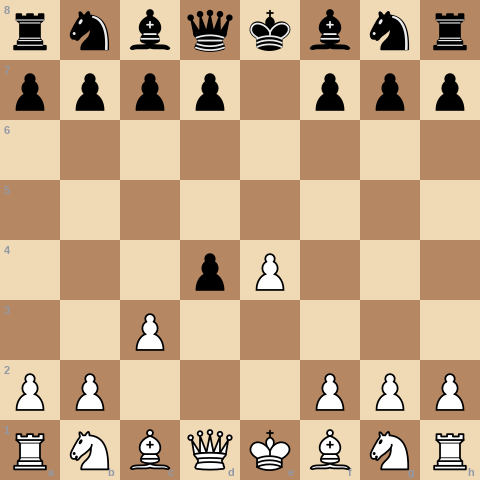
Black's pawn on e5 captured White's pawn on d4, and now White pushes the c-pawn to offer another one. This is the gambit's entire idea. Rather than simply recapture and settle for a normal central structure, White offers a pawn to rip open lines for rapid piece development. Here Black has a genuine choice, and this is the single most important decision in the whole opening.
3...dxc3 (the pawn on d4 captures the offered pawn on c3) is what 73% of players choose. Black is a pawn up but hasn't developed a single piece, and White wins 56% of games after it at this level.
3...Nc6 (11%) develops and protects the d4 pawn instead. White usually recaptures with 4.cxd4 and gets the ideal center with pawns on e4 and d4.
3...d5 (pushing the d-pawn two squares instead of capturing) is Black's cleanest answer. After 4.exd5 Qxd5 the position is level. It's rare, only 4.5% of games, so most White players won't have studied it.
Following the most common path:
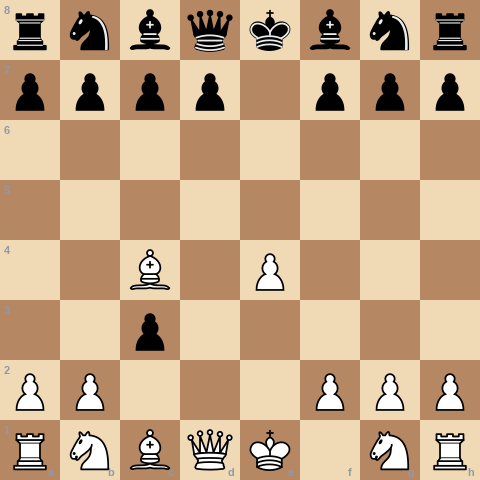
White develops the bishop to c4, aiming straight at f7, the classic weak point while Black's king is still in the center. 79% of White players at this level choose it, and White wins 57% of games after it. The other main move is 4.Nxc3 (16%, White wins 53%), a one-pawn version that Stockfish rates close to level.
4...cxb2 (the pawn on c3 captures White's pawn on b2) is the classic reply, and after 5. Bxb2, with the c1 bishop taking back, Black is two pawns up. White's bishops rake across the board toward f7 and g7, and Black still has no pieces out.
This is where Black has to stop grabbing. With calm development, 5...Nf6 or 5...Bb4+, Stockfish rates Black about two thirds of a pawn better. The famous 5...d5 gives the pawns back and leads to a level game. What Black can't afford is more pawn moves while White's pieces pour in.
The Honest Takeaway for Black
Surviving the Danish Gambit isn't about memorizing a single forced escape. It's about development. The simplest path is 3...d5, which leads to a level game. If you take the pawns, stop at two, get your pieces out and castle. One more warning from the data: after 3...dxc3 4.Nxc3, don't develop with 4...Nf6?, because 5.e5! kicks the knight and its only safe square is back on g8.
Frequently asked questions
Should you accept the Danish Gambit?
You can, but take at most two pawns and then develop. Most players at 900 to 2000 on Lichess take twice, and White still wins 56% of games after 3...dxc3, because Black falls behind in development. The pawns are fine. The lost time is the problem.
What is the best defense to the Danish Gambit?
3...d5. Black gives the pawn back at once, and after 4.exd5 Qxd5 the position is level. Only 4.5% of players at this level choose it, so most White players won't have studied it.
Is the Danish Gambit sound?
Not quite. After 4.Bc4 cxb2 5.Bxb2, Stockfish rates Black about two thirds of a pawn better with calm development. But it is a dangerous practical weapon: White wins 57% of games after 4.Bc4 at this level.
What is the trap after 2...Nc6 in the Danish?
After 3.d5, the knight must not jump to d4. 3...Nd4? 4.c3 leaves it with no safe square. 28% of players fall for it, and White wins 69% of those games.
How do I avoid getting mated on f7?
Develop your kingside pieces and castle before grabbing anything else. White's bishop on c4 and queen are aiming at f7, and every extra pawn move gives them another tempo.
More traps and gambits
Back to the full series:
- Chess Opening Traps & Gambits: Every trap and gambit guide in this series, checked against our data.
Practice Both Sides for Free
This site's Danish Gambit repertoire is built from White's perspective: 7 lines from Lichess games at 900 to 2000, with move-by-move coaching, covering the one-pawn 4.Nxc3, 3...Nc6, 2...d6 and the 3...Nd4? trap. That's exactly what makes it useful for understanding what Black is actually facing on the other side of the board. Every one of our 38 openings is free to try, and you can track your progress free with an account.
Play White's moves against what 900 to 2000 rated players really answer on Lichess, and you'll know every plan coming at you as Black. Track your progress free with an account.
Practice the Danish Gambit →