Surviving the Danish Gambit: A Move-by-Move Defense
TL;DR
- The Danish Gambit is White's sharpest try against 1...e5, offering pawns for rapid development. This guide is built from about 17 million Lichess games at 900 to 2000.
- Most Black players take: 2...exd4 in 62% of games, then 3...dxc3 in 73%. White wins 56% of games after 3...dxc3 at this level, so taking isn't the problem. Falling behind in development is.
- The cleanest answer is 3...d5: after 4.exd5 Qxd5 the position is level. Only 4.5% of players at this level choose it.
- If White gives a second pawn with 4.Bc4 (79% do, and White wins 57%), 4...cxb2 5.Bxb2 is fine for Black with calm play: after 5...Nf6 or 5...Bb4+, Stockfish rates Black about two thirds of a pawn better.
- If you decline with 2...Nc6, never answer 3.d5 with 3...Nd4?. 28% of players do, 4.c3 traps the knight, and White wins 69% of those games.
What Black Is Actually Facing
The Danish Gambit isn't a trick or a bluff. White gives up material on purpose to get pieces out fast and open lines toward f7. Understanding what each White move is threatening is the difference between surviving this opening and getting run over by it.
Move by Move
1. e4 e5 2. d4
White immediately challenges the center. At 900 to 2000 on Lichess, Black takes with 2...exd4 in 62% of games. The main ways to decline are 2...Nc6 (13%) and 2...d6 (8%). If you choose 2...Nc6, know the trap: after 3. d5, the knight must not jump to d4, because 3...Nd4? 4. c3 leaves it with no safe square.
2...exd4 3. c3
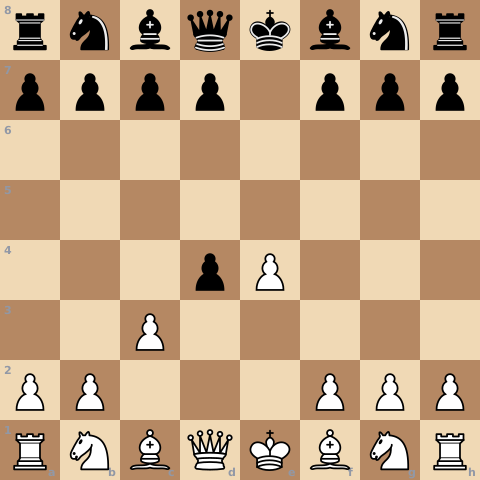
Black's pawn on e5 captured White's pawn on d4, and now White pushes the c-pawn to offer another one. This is the gambit's entire idea. Rather than simply recapture and settle for a normal central structure, White offers a pawn to rip open lines for rapid piece development. Here Black has a genuine choice, and this is the single most important decision in the whole opening.
3...dxc3 (the pawn on d4 captures the offered pawn on c3) is what 73% of players choose. Black is a pawn up but hasn't developed a single piece, and White wins 56% of games after it at this level.
3...Nc6 (11%) develops and protects the d4 pawn instead. White usually recaptures with 4.cxd4 and gets the ideal center with pawns on e4 and d4.
3...d5 (pushing the d-pawn two squares instead of capturing) is Black's cleanest answer. After 4.exd5 Qxd5 the position is level. It's rare, only 4.5% of games, so most White players won't have studied it.
Following the most common path:
4. Bc4
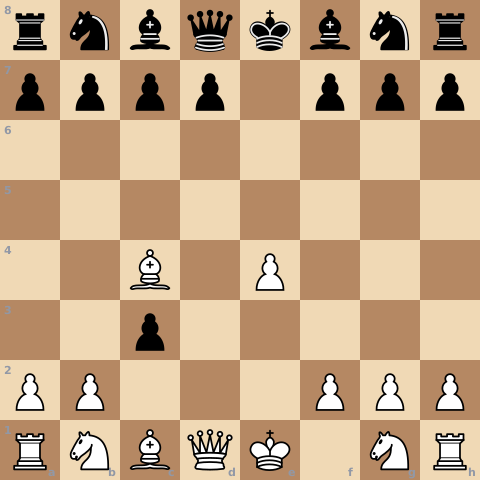
White develops the bishop to c4, aiming straight at f7, the classic weak point while Black's king is still in the center. 79% of White players at this level choose it, and White wins 57% of games after it. The other main move is 4.Nxc3 (16%, White wins 53%), a one-pawn version that Stockfish rates close to level.
4...cxb2 (the pawn on c3 captures White's pawn on b2) is the classic reply, and after 5. Bxb2, with the c1 bishop taking back, Black is two pawns up. White's bishops rake across the board toward f7 and g7, and Black still has no pieces out.
This is where Black has to stop grabbing. With calm development, 5...Nf6 or 5...Bb4+, Stockfish rates Black about two thirds of a pawn better. The famous 5...d5 gives the pawns back and leads to a level game. What Black can't afford is more pawn moves while White's pieces pour in.
The Honest Takeaway for Black
Surviving the Danish Gambit isn't about memorizing a single forced escape. It's about development. The simplest path is 3...d5, which leads to a level game. If you take the pawns, stop at two, get your pieces out and castle. One more warning from the data: after 3...dxc3 4.Nxc3, don't develop with 4...Nf6?, because 5.e5! kicks the knight and its only safe square is back on g8.
Read the full Danish Gambit repertoire →
More traps and gambits
Back to the full series:
- Chess Opening Traps & Gambits: Every trap and gambit guide in this series, checked against our data.
Practice Both Sides for Free
This site's Danish Gambit repertoire is built from White's perspective: 6 lines from Lichess games at 900 to 2000, with move-by-move coaching, covering the one-pawn 4.Nxc3, 3...Nc6, 2...d6 and the 3...Nd4? trap. That's exactly what makes it useful for understanding what Black is actually facing on the other side of the board. All 36 openings are completely unlocked during this site's open beta, no card, no limit, no account required to start, with your progress tracked for free if you create one.
Every line checked the same way, against real game data, not against what sounds right.
Browse all 36 openings free →