What Is the Standard PGN Line and Strategy for the Fried Liver Attack?
TL;DR
Short answer The Fried Liver is 1. e4 e5 2. Nf3 Nc6 3. Bc4 Nf6 4. Ng5 d5 5. exd5 Nxd5 6. Nxf7. White gives up a knight to drag Black's king into the center, then piles onto the pinned knight on d5. Black's best way to avoid it 5...Na5. Black gives a pawn but gets fast development and chases White's pieces. Black's sharp alternative 4...Bc5, the Traxler. A counter-sacrifice on f2 instead of defending. Our data The Two Knights (3...Nf6) is Black's most common reply to 3.Bc4 at 1000 to 1600 on Lichess: 31.7% of games, ahead of 3...Bc5 (27.8%). Our Italian trainer meets it with the calm 4.d3, not 4.Ng5, so there are no frequencies for the Fried Liver itself. Every line was checked for legality move by move. Recommended range for the Italian 1000 to 1600 Elo, 20 lines, built from about 131 million Lichess games
How the Fried Liver starts
With 3...Nf6, Black plays the Two Knights Defense and counterattacks e4. At 1000 to 1600 on Lichess it's the most popular answer to 3.Bc4, so you'll see this position a lot. White answers by breaking a basic opening rule and moving the same knight twice. The point of 4.Ng5 is f7: the knight and the bishop on c4 both attack it, and only Black's king defends it.
Black's standard reply is 4...d5, blocking the bishop's diagonal. After 5.exd5, Black has to decide how to deal with the pawn on d5. The natural recapture is the one that allows the Fried Liver.
The main line, move by move
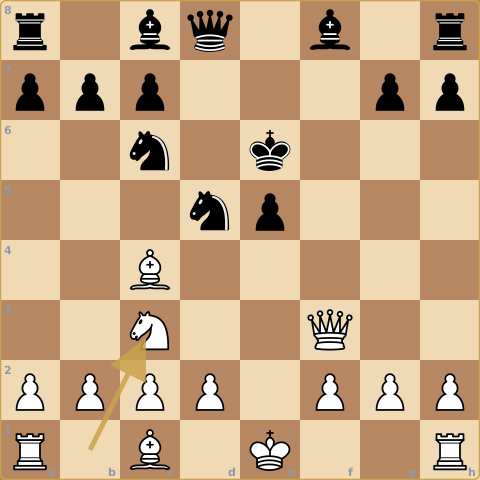
Here's what each move does:
- 6.Nxf7 forks the queen on d8 and the rook on h8. Black's best is to take the knight, so White is now a piece down for a pawn.
- 7.Qf3+ checks the king and attacks the knight on d5. Black's king has to stay close to defend it, and 7...Ke6 is the main move.
- 8.Nc3 adds a third attacker on d5. The bishop on c4 pins that knight to the king on e6, so it can't simply move away.
The usual reply is 8...Ncb4, which adds a third defender to d5 alongside the king and queen and eyes c2, where a knight check would fork White's king and rook.
White's strategy: open lines to the king
You're a piece down, so slow play doesn't work. The plan is simple to say and hard for Black to meet over the board:
- Keep the pin. As long as the d5 knight is pinned, Black can't untangle.
- Open the center. Pawn moves like d4 open lines toward a king stuck on e6.
- Bring the rooks. Castle and put a rook on the e-file as soon as you can.
- Watch c2. Black's knight on b4 is looking at a fork. Don't leave c2 hanging while you attack.
There's also 6.d4, the Lolli Attack, which strikes in the center right away instead of giving up the knight. Many coaches consider it the more testing try, but 6.Nxf7 is the version most people mean by the Fried Liver.
Black's strategy: survive, then return material
If you do end up with your king on e6, the goals are to keep d5 defended, get the king to safety, and give material back when it relieves the pressure. An extra piece is worth a lot once the attack runs out. The practical trouble is that the defense is hard to find at speed, and one slip usually ends the game.
That's why most prepared Black players never allow the position at all.
The safer choice for Black: 5...Na5
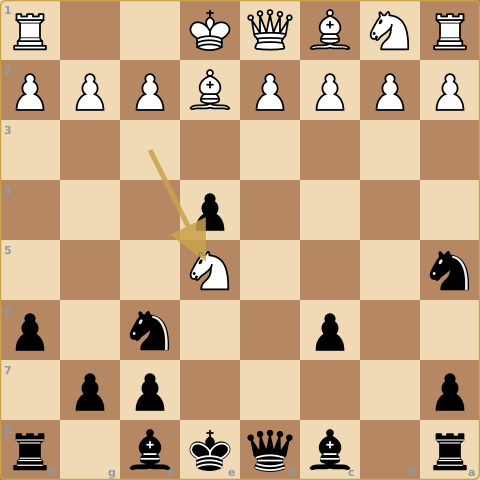
Instead of recapturing on d5, Black attacks the bishop on c4. After 6.Bb5+ c6 7.dxc6 bxc6, White's bishop has to retreat again, and ...h6 and ...e4 push the knight back twice more. Black is a pawn down, but White has spent a lot of moves shuffling pieces while Black develops with tempo. For most club players this is the most practical way to meet 4.Ng5.
The Traxler: counterattack with 4...Bc5
Black ignores the threat to f7 and hits f2 instead. If White goes for the fork on the queen and rook with 5.Nxf7, Black sacrifices on f2 and brings the knight to e4 with check, and White's king is dragged into the open too. This is very sharp and hard to handle without preparation, for both sides.
A practical way for White to sidestep the chaos is 5.Bxf7+, taking the pawn with check first. Black's king has to move (5...Ke7 is the usual choice), and it can no longer castle.
Where our Italian trainer fits in
Our Italian Game trainer does cover the Two Knights, but it answers 3...Nf6 with 4.d3, which keeps e4 safe and lets you castle in peace. After 4.d3, Black's replies at 1000 to 1600 on Lichess are 4...Bc5 (43%), 4...d5 (16.1%), 4...h6 (14.7%) and 4...d6 (8.5%). So the trainer won't drill the Fried Liver itself. It does drill the idea behind it, and knows when Ng5 is right:
After 4...d6 Black needs two more moves to castle, so the knight and bishop both hitting f7 is a real problem. Against a normal setup, the same jump just loses time.
For the full picture of which trap openings hold up at fast time controls, see the best trap-heavy openings for blitz and bullet and the traps and gambits hub.
Frequently asked questions
What is the Fried Liver Attack PGN?
1.e4 e5 2.Nf3 Nc6 3.Bc4 Nf6 4.Ng5 d5 5.exd5 Nxd5 6.Nxf7 Kxf7 7.Qf3+ Ke6 8.Nc3. White sacrifices a knight on f7 to pull Black's king to e6, then attacks the pinned knight on d5.
How do you avoid the Fried Liver as Black?
After 4.Ng5 d5 5.exd5, play 5...Na5 instead of 5...Nxd5. The knight attacks the bishop on c4, and Black gets active development in return for a pawn. The sharper alternative is 4...Bc5, the Traxler.
Is the Fried Liver Attack sound?
Against 5...Nxd5 it gives White a strong attack, and many coaches consider 6.d4 (the Lolli Attack) even more testing than 6.Nxf7. The catch is that Black doesn't have to allow it: 5...Na5 avoids the whole line.
Does the Italian Game lead to the Fried Liver?
Only if Black answers 3.Bc4 with 3...Nf6, the Two Knights Defense, and White then plays 4.Ng5. If Black plays 3...Bc5, the Giuoco Piano, the Fried Liver isn't possible. Our Italian trainer covers both 3...Nf6 and 3...Bc5, and meets the Two Knights with the calmer 4.d3.
Copy the lines (PGN)
Every line in this article in standard PGN, ready to paste into Lichess, Chess.com or any chess database.
[Event "What Is the Standard PGN Line and Strategy for the Fried Liver Attack?: Fried Liver main line"]
[Site "chesscoachacademy.com"]
[Result "*"]

1. e4 e5 2. Nf3 Nc6 3. Bc4 Nf6 4. Ng5 d5 5. exd5 Nxd5 6. Nxf7 Kxf7 7. Qf3+ Ke6 8. Nc3 Nb4 *

[Event "What Is the Standard PGN Line and Strategy for the Fried Liver Attack?: Lolli Attack"]
[Site "chesscoachacademy.com"]
[Result "*"]

1. e4 e5 2. Nf3 Nc6 3. Bc4 Nf6 4. Ng5 d5 5. exd5 Nxd5 6. d4 *

[Event "What Is the Standard PGN Line and Strategy for the Fried Liver Attack?: Two Knights, 5...Na5"]
[Site "chesscoachacademy.com"]
[Result "*"]

1. e4 e5 2. Nf3 Nc6 3. Bc4 Nf6 4. Ng5 d5 5. exd5 Na5 6. Bb5+ c6 7. dxc6 bxc6 8. Be2 h6 9. Nf3 e4 10. Ne5 *

[Event "What Is the Standard PGN Line and Strategy for the Fried Liver Attack?: Traxler, 5.Nxf7"]
[Site "chesscoachacademy.com"]
[Result "*"]

1. e4 e5 2. Nf3 Nc6 3. Bc4 Nf6 4. Ng5 Bc5 5. Nxf7 Bxf2+ 6. Kxf2 Nxe4+ *

[Event "What Is the Standard PGN Line and Strategy for the Fried Liver Attack?: Traxler, 5.Bxf7+"]
[Site "chesscoachacademy.com"]
[Result "*"]

1. e4 e5 2. Nf3 Nc6 3. Bc4 Nf6 4. Ng5 Bc5 5. Bxf7+ Ke7 *

[Event "What Is the Standard PGN Line and Strategy for the Fried Liver Attack?: Two Knights, 4.d3 d6 5.Ng5"]
[Site "chesscoachacademy.com"]
[Result "*"]

1. e4 e5 2. Nf3 Nc6 3. Bc4 Nf6 4. d3 d6 5. Ng5 *
Keep reading
- What Are the Best Trap-Heavy Openings for Blitz and Bullet?: Which trap openings are practical when the clock is short.
- Chess Opening Traps & Gambits: The full hub for traps, gambits and refutations.
Drill the Italian that the Fried Liver grows from
We don't have a Fried Liver trainer. The closest match is our Italian Game trainer: 20 lines built from about 131 million Lichess games at 1000 to 1600, covering the Two Knights with 4.d3, the Giuoco Piano, 3...h6 and the Blackburne Shilling trap. It teaches the same f7 pressure in positions you'll reach far more often.
It's free during the open beta, and you can track your progress on every line for free once you create an account.
20 Italian Game lines from about 131 million Lichess games. Free during the open beta, with free progress tracking.
Practice the Italian Game free →