How Many Chess Openings Should a Player Learn for White and Black?
TL;DR
Short answer Three. One opening as White, one defense against 1.e4 and one against 1.d4. Add more only when a specific reply keeps giving you trouble. A low-theory starter set London System (20 lines) + Scandinavian (15) + Slav (18) = 53 lines The 1.e4 catch A 1.e4 player needs answers to 1...e5, 1...c5, 1...e6 and 1...c6. From our library that's the Italian (20), Alapin (16), French Advance (15) and Caro-Kann Advance (13): 64 lines for White alone. Why one defense can cover several White systems At 700 to 1700 on Lichess, only 34% of players follow 1.d4 d5 with 2.c4. 2.Bf4 (21%), 2.Nf3 (15%), 2.e3 (12%) and 2.Nc3 (9%) are all common, and our Slav trainer meets every one with the same ...c6, ...Nf6 and ...Bf5 setup Our full library 36 openings and 613 lines. Nobody needs all of them.
The minimum: three slots
Every game you play starts in one of three ways. You're White, and you choose the first move. You're Black against 1.e4. Or you're Black against 1.d4 (or something that transposes to it). Fill those three slots and you have a complete repertoire.
That's the right number for most players below about 1400. Adding a fourth or fifth opening before the first three are solid usually means you know five openings to move six instead of three openings to move twelve, and the second is worth far more.
Slot 1: your White opening
This is where your first choice matters most, because it decides how much you'll need to learn.
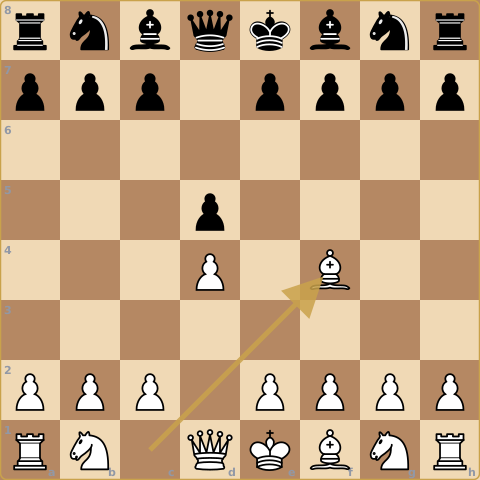
If you open 1.d4 with a system like the London, one repertoire covers most of what Black plays. At 400 to 1400 on Lichess, 55% of Black players answer 1.d4 with 1...d5, and White meets it, and most other replies, with the same early bishop move:
If you open 1.e4, you've signed up for more. Black has four main defenses and each needs its own plan. Using the openings in our library, a complete 1.e4 repertoire looks like this:
| Black plays | Opening | Lines | Range |
| 1...e5 | Italian Game | 20 | 1000 to 1600 |
| 1...c5 | Alapin Variation | 16 | 900 to 2200 |
| 1...e6 | French Advance | 15 | 900 to 1800 |
| 1...c6 | Caro-Kann Advance | 13 | 900 to 1800 |
That's 64 lines against 20 for the London. It isn't a reason to avoid 1.e4, which gives you open, active positions and teaches you a lot. It just means a 1.e4 player really has four White openings, not one.
The practical fix: learn your answer to 1...e5 first, then add the others in the order you meet them. The French and Caro-Kann Advance share the same idea (push e5 and take space), so learning one makes the other much easier.
Slots 2 and 3: your Black defenses
As Black you need two openings, because White's first move splits the game into two worlds. The good news is that a well-chosen pair can share ideas.
The Slav against 1.d4 is built on the same idea as the Caro-Kann against 1.e4: support d5 with the c-pawn and keep the light-squared bishop free.
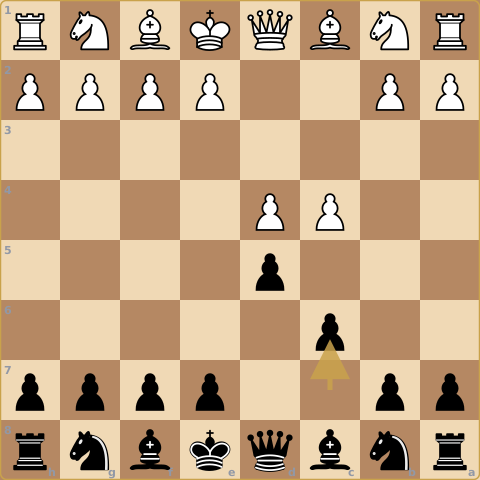
The Slav also handles more than the Queen's Gambit. At 700 to 1700 on Lichess, only 34% of players follow 1.d4 d5 with 2.c4. The rest play 2.Bf4 (21%), 2.Nf3 (15%), 2.e3 (12%) or 2.Nc3 (9%), and the same ...c6, ...Nf6 and ...Bf5 setup works against all of them. So "one defense against 1.d4" quietly covers the London and the other quiet systems too.
Against 1.e4, the Scandinavian is the lightest choice. After 1.e4 d5 2.exd5 Qxd5 3.Nc3 Qa5, White's fourth move spreads out at 400 to 1400 on Lichess (4.Nf3 39.5%, 4.d4 24.8%, 4.d3 10.3%), but you answer all of them with the same ...Nf6, ...c6 and ...Bf5, so one setup covers most of what you'll face.
How many openings by rating
| Rating | How many | Example repertoire from our library |
| Under 1000 | 3 | London (400 to 1400) or Torre (400 to 1800), Scandinavian (400 to 1400), Slav (700 to 1700) |
| 1000 to 1400 | 3 to 4 | Same three, or switch to 1.e4 with the Italian (1000 to 1600). A 1.e4 player adds the Alapin (from 900) next, since the Sicilian is the reply you'll meet most |
| 1400 to 1800 | 4 to 6 | Full 1.e4 set (Scotch or Vienna, Alapin, French Advance, Caro-Kann Advance) or a 1.d4 system, plus the Caro-Kann (800 to 2200) and the Queen's Gambit Accepted (900 to 1800) or Nimzo-Indian (1400 to 2200) |
| 1800 and up | Go deeper, not wider | Openings like the Ruy Lopez Closed (1600 to 2400), Najdorf (1600 to 2400) and Grünfeld (1800 to 2400) reward depth more than breadth |
When to add an opening
Add a new opening when one of these happens:
- You keep reaching positions from the same reply and don't know the plan.
- Your current opening's recommended range runs out. The London and Scandinavian both top out at 1400 in our data, and the Italian at 1600, so that's a natural moment to add something with a longer range.
- You're bored. That counts. You'll study an opening you enjoy far more than one you tolerate.
Don't add one because a strong player on a stream used it, or because you lost one game to it. Go back to the line in your existing repertoire and learn it properly first.
Frequently asked questions
How many chess openings should a beginner learn?
Three: one opening as White, one defense against 1.e4 and one against 1.d4. A low-theory example is the London System, the Scandinavian and the Slav, which comes to 53 practice lines in our library.
How many openings do I need to learn as White?
If you play a 1.d4 system like the London, one opening covers most games, because you build the same setup (d4, Bf4, e3, Nf3, c3) against almost every reply. If you play 1.e4, you need answers to 1...e5, the Sicilian, the French and the Caro-Kann, which comes to 64 lines in our library.
Do I need a separate answer to the London System as Black?
Often not. At 700 to 1700 on Lichess, only 34% of players follow 1.d4 d5 with 2.c4, and 2.Bf4 (the London) comes up in 21% of games. Our Slav trainer answers 2.c4, 2.Bf4, 2.Nf3, 2.e3 and 2.Nc3 with the same ...c6, ...Nf6 and ...Bf5 setup, so one defense covers them all.
Should I learn many openings or a few deeply?
A few deeply. Knowing three openings to move twelve is worth more than knowing six to move six. Add a new one only when a specific reply keeps causing problems or your current opening's recommended range runs out.
Copy the lines (PGN)
Every line in this article in standard PGN, ready to paste into Lichess, Chess.com or any chess database.
[Event "How Many Chess Openings Should a Player Learn for White and Black?: London System"]
[Site "chesscoachacademy.com"]
[Result "*"]

1. d4 d5 2. Bf4 *

[Event "How Many Chess Openings Should a Player Learn for White and Black?: Slav Defense"]
[Site "chesscoachacademy.com"]
[Result "*"]

1. d4 d5 2. c4 c6 *

[Event "How Many Chess Openings Should a Player Learn for White and Black?: Scandinavian Defense"]
[Site "chesscoachacademy.com"]
[Result "*"]

1. e4 d5 2. exd5 Qxd5 3. Nc3 Qa5 4. d4 *
Keep reading
- Best Chess Openings for Beginners: All 36 openings grouped by rating, to help you fill each of your three slots.
Fill your three slots
The quickest route to a complete repertoire is the low-theory set: the London as White, the Scandinavian against 1.e4 and the Slav against 1.d4. Each trainer walks you through every line with a short note on each move. If you want different picks, the opening finder in our library filters all 36 openings by your rating, color and style.
Everything is free during the open beta, and your progress on every line is tracked for free once you sign up.
Practice the London System →
Practice the Scandinavian →
Practice the Slav Defense →
Start with the London: 20 lines built from about 35 million Lichess games. Free during the open beta, with free progress tracking.
Practice the London free →