What Is the London System, and How Do You Counter It as Black?
TL;DR
Short answer The London is White's one-setup system: d4, Bf4, e3, Nf3, c3, Nbd2. You can't refute it, but you can make it awkward. Strike with ...c5 and aim the queen at b2 with ...Qb6, go after the f4 bishop with ...Nh5 or ...Bd6, and watch for the ...Nb4 trick against c2. Games behind this article About 35 million Lichess games played by 400 to 1400 rated players Black's first move vs 1.d4 1...d5 55% · 1...Nf6 10% · 1...e6 9% · 1...e5 8% Black's reply to 1.d4 d5 2.Bf4 2...Nc6 37% · 2...Nf6 20% · 2...e6 15% · 2...Bf5 13% Our London trainer 20 lines, White side, recommended for 400 to 1400 Elo One result worth knowing Against the ...g6 and ...Bg7 setup, White wins 46% of games at 400 to 1400 on Lichess, a bit less than in the other London lines.
What the London System is
The London is less an opening than a routine. White plays d4, gets the dark-squared bishop out to f4 before playing e3, then adds e3, Nf3, c3 and Nbd2, usually with a bishop on d3 or e2. The shape barely changes whatever Black does.
Bishop first, pawn second, so the bishop never gets stuck behind e3. One plan, very little theory, and it's hard to get a bad position on autopilot. At 400 to 1400 on Lichess, 2.Bf4 is played in 22% of games after 1.d4 d5, second only to 2.c4 (27%).
The flip side is ambition. White isn't fighting for a big edge, just a small safe one. That gives Black room to choose the kind of game. Most players at this level simply develop: after 2.Bf4, the most common reply is 2...Nc6 (37%), then 2...Nf6 (20%), 2...e6 (15%) and 2...Bf5 (13%). That's fine, but it rarely bothers White. Note that 2...Nc6 also blocks Black's c-pawn, so the ...c5 break becomes harder.
Plan 1: ...c5 and ...Qb6
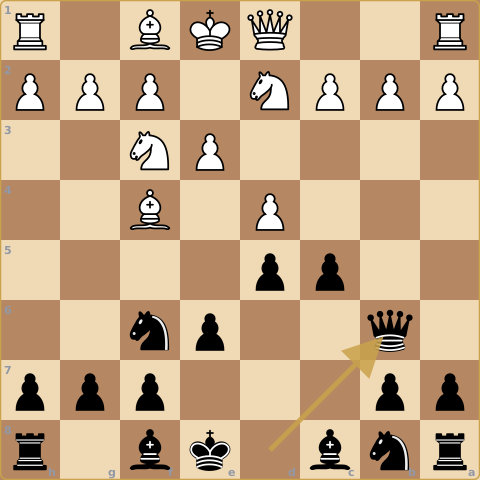
This is the most direct way to punish the London's move order. When the bishop goes to f4, it leaves c1, and suddenly nothing defends b2. The queen on b6 attacks it straight down the b-file. The queen also lines up with d4 for later: once the c-pawns come off, the b6-d4 diagonal opens and d4 comes under fire too.
White has calm answers. Our trainer guards the pawn with 6.Rb1, and the London guide lists Qc1 as the other simple answer. But each one costs White something. The rook leaves its natural square, or the queen goes somewhere passive.
Panicking when the queen hits b2 is on the guide's list of common London mistakes, which is why ...Qb6 is worth playing even though it's objectively just equal.
Plan 2: ...Nh5 against the f4 bishop
The f4 bishop is the London's pride. A knight on h5 attacks it, and if White ignores the threat, ...Nxf4 exf4 takes the bishop and leaves White with doubled f-pawns.
White has two retreats. Stockfish's first choice is 5.Be5, keeping the bishop active in the center. The other is 5.Bg3, and then Black can take it:
Black now has the bishop pair and White has doubled g-pawns. White's compensation is the half-open h-file for the rook and a solid center. It's a fair trade, but not the game a London player wanted.
Plan 3: ...e6 and the ...Bd6 trade
This is the classical way to meet the London head-on. The bishop on d6 stands opposite the one on f4 and offers a straight trade. It's played in 25% of games after 2...e6 3.e3 at this level. Our trainer lets Black go ahead, and at 400 to 1400, 74% of players do take:
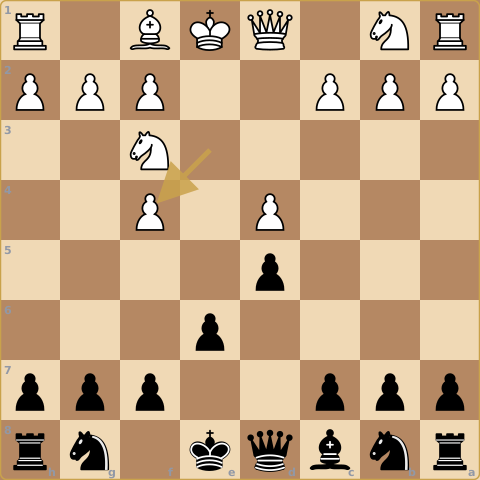
The London's best piece is gone. Stockfish still rates it level, because the pawn on f4 controls e5, a great square for a White knight. (White can dodge the trade with Bg3, but the bishop is less active there.) If you want to keep the London player uncomfortable, follow up with ...c5 and ...Qb6 again: with the bishop traded, b2 is still a target.
Plan 4: a King's Indian setup
If you already play the King's Indian, you can keep it against the London. After 1...Nf6 2.Bf4, 2...g6 is the most common reply at this level (27%), and 3...Bg7 follows in 88% of games. Black castles, plays ...d6 and ...Nbd7, and prepares ...e5. When it arrives, the e5 pawn hits d4 and the f4 bishop at the same time, so White has to react.
This plan also comes with a useful number: White wins 46% of games against this setup at 400 to 1400 on Lichess, a bit less than in the other London lines. White's usual answer is Be2, h3 and castling, with h3 giving the bishop a retreat on h2 if ...Nh5 comes.
A cheap trick: ...Nb4 against c2
With the bishop on f5 and the knight on b4, c2 is attacked twice and defended only by the queen. The threat is ...Nxc2+, forking the king and the a1 rook. About 24% of players at this level jump 4...Nb4 here. The right answer is Na3, guarding c2, or c3 earlier so the knight never reaches b4.
Which anti-London plan should you pick?
- You like sharp positions: ...c5 with ...Qb6, adding ...Nh5 to hunt the bishop.
- You play the Queen's Gambit or Slav: ...d5, ...e6 and ...Bd6. You get your usual structure and the London bishop has to give way or be traded.
- You play the King's Indian: the fianchetto and ...e5, the setup White scores worst against in our London data.
- You want quick, simple development: ...Nc6 and ...Bf5, with the ...Nb4 trick in your pocket.
Whatever you choose, remember what the London player hopes for: six moves on autopilot. Every plan above asks White a question in the first few moves that the routine doesn't answer. That's how you beat a system.
Frequently asked questions
What is the London System in chess?
The London System is a White opening built on one setup: 1.d4, then Bf4 before e3, followed by e3, Nf3, c3 and Nbd2. The bishop goes to f4 before the e-pawn moves so it doesn't get stuck behind its own pawns. It changes very little whatever Black plays, which is why it's popular with club players.
What is the best way to play against the London System as Black?
There's no refutation, but ...c5 followed by ...Qb6 is one of the most testing plans because the London's bishop leaves b2 undefended. At 400 to 1400 on Lichess, the most common replies to 1.d4 d5 2.Bf4 are 2...Nc6 (37%), 2...Nf6 (20%), 2...e6 (15%) and 2...Bf5 (13%). A King's Indian setup with ...g6 and ...Bg7 is the one White scores worst against at this level: White wins 46% of those games.
How do you stop the London System bishop on f4?
Challenge it. ...Nh5 attacks it directly, and ...Bd6 offers to trade it. After 1.d4 d5 2.Bf4 e6 3.e3 Bd6 4.Nf3, 74% of Lichess players at 400 to 1400 take with 4...Bxf4, leaving White with doubled f-pawns. If White retreats to g3 instead, the bishop is less active there.
Can you play the King's Indian against the London System?
Yes. Black fianchettoes with ...g6 and ...Bg7, castles, and prepares ...e5 with ...d6 and ...Nbd7. The pawn on e5 attacks both d4 and the bishop on f4. White's setup handles it, but at 400 to 1400 on Lichess White wins only 46% of games against this setup, a bit less than in the other London lines.
Copy the lines (PGN)
Every line in this article in standard PGN, ready to paste into Lichess, Chess.com or any chess database.
[Event "What Is the London System, and How Do You Counter It as Black?: ...c5 and ...Qb6"]
[Site "chesscoachacademy.com"]
[Result "*"]

1. d4 d5 2. Bf4 Nf6 3. e3 e6 4. Nf3 c5 5. Nbd2 Qb6 6. Rb1 *

[Event "What Is the London System, and How Do You Counter It as Black?: ...Nh5 against the bishop"]
[Site "chesscoachacademy.com"]
[Result "*"]

1. d4 d5 2. Bf4 Nf6 3. e3 Nc6 4. Nf3 Nh5 5. Bg3 Nxg3 6. hxg3 *

[Event "What Is the London System, and How Do You Counter It as Black?: The ...Bd6 trade"]
[Site "chesscoachacademy.com"]
[Result "*"]

1. d4 d5 2. Bf4 e6 3. e3 Bd6 4. Nf3 Bxf4 5. exf4 *

[Event "What Is the London System, and How Do You Counter It as Black?: King's Indian setup"]
[Site "chesscoachacademy.com"]
[Result "*"]

1. d4 Nf6 2. Bf4 g6 3. e3 Bg7 4. Nf3 *

[Event "What Is the London System, and How Do You Counter It as Black?: The ...Nb4 trick"]
[Site "chesscoachacademy.com"]
[Result "*"]

1. d4 d5 2. Bf4 Nc6 3. e3 Bf5 4. Nf3 Nb4 *
Keep reading
- The Most Reliable 1.d4 Defenses for Black: Nine defenses to 1.d4 compared with Lichess game data and Elo ranges.
Learn the London from White's side so you know every plan
The fastest way to beat the London is to know exactly what White wants. Our London System trainer covers 20 lines built from about 35 million Lichess games at 400 to 1400, including White's answers to ...Qb6, ...Nh5, the ...Bd6 trade, the ...g6 setup and the ...Nb4 trick. Play them as White once and you'll see every idea coming as Black.
Want the Black side instead? The Slav trainer and the King's Indian trainer give you a full answer to 1.d4.
Everything is free during the open beta, and you can track your progress on every line for free with an account.
20 lines built from about 35 million Lichess games. Free during the open beta, with free progress tracking.
Practice the London System free →