How Do You Counter Scholar's Mate?
TL;DR
Short answer Cover e5 first with 2...Nc6, then block the queen with 3...g6 (or defend f7 with 3...Qe7). After that, develop with tempo: ...Nf6 and ...Nd4 hit the queen again. The mistake to avoid 2...g6?? too early. 3.Qxe5+ checks the king and hits the rook on h8. The losing move 3...Nf6?? allows 4.Qxf7 mate. Our data Scholar's Mate isn't one of our trainer lines, so there are no Lichess frequencies or results for it here. Every move below was checked for legality and every mate confirmed with a chess rules library. Where to practice the f7 ideas Our Italian Game trainer: 20 lines built from about 131 million Lichess games, recommended from 1000 to 1600 Elo
What Scholar's Mate looks like
The target is f7. At the start of the game it's the weakest square in Black's position, because only the king defends it. White brings two attackers, the queen from h5 and the bishop from c4, and takes on f7 with mate. The king can't capture the queen because the bishop protects it, and it has nowhere else to go.
3...Nf6 is the classic mistake because it looks so natural. It develops a piece and attacks the queen. It just doesn't do anything about f7.
Step one: defend e5 before you do anything else
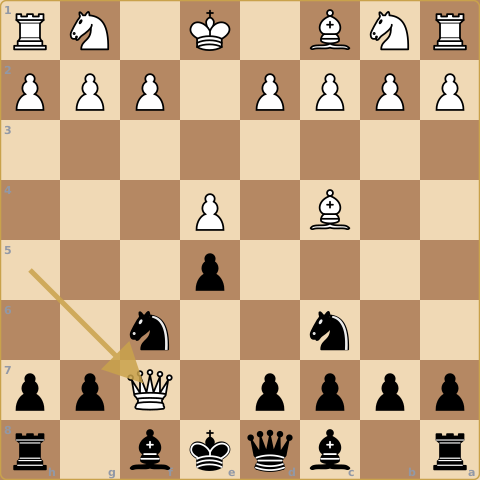
After 2.Qh5 the queen hits two things: f7 and the pawn on e5. It's easy to see only one of them. The tempting wrong answer is to kick the queen straight away:
Now the queen checks the king down the open e-file and attacks the rook on h8 along the long diagonal, which ...g6 has just opened. Black has to block the check, and then the rook on h8 is hanging as well. 2...Nf6? also drops the pawn: 3.Qxe5+ wins it with check.
The right move is 2...Nc6. It develops a piece and protects e5. Now ...g6 becomes a threat of its own.
Step two: block the queen or cover f7
After 3.Bc4 White threatens Qxf7 mate. Black has two good ways to stop it.
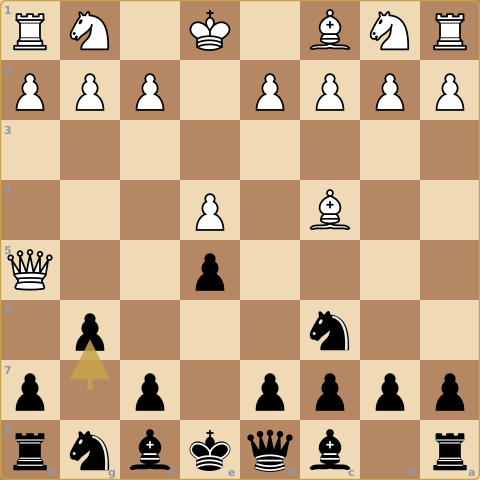
Option 1: 3...g6. The pawn attacks the queen and blocks the h5 to f7 diagonal at the same time. With e5 already covered by the knight, the queen has no free pawn to grab.
Option 2: 3...Qe7. The queen defends f7 and e5 at once. It blocks the f8 bishop for a while, but it's solid, and it lets you play ...Nf6 next with tempo on the queen.
3...Qf6 also defends f7, but it takes the f6 square from your knight. 3...g6 and 3...Qe7 are the cleaner choices.
Step three: chase the queen and win time
This is where you stop defending and start benefiting. White's queen came out on move two, and every time you hit it with a developing move, you gain a tempo. A typical follow-up after 3...g6 is for the queen to retreat to f3, renewing the threat on f7:
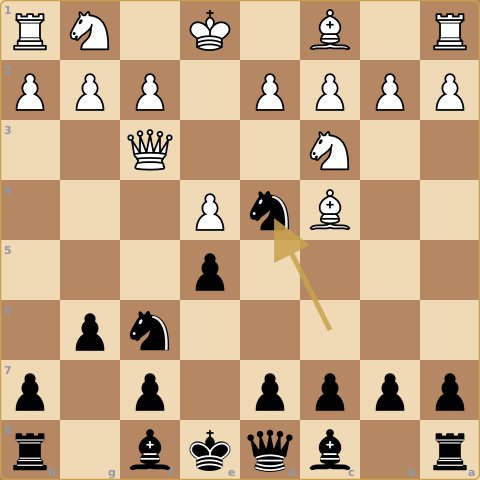
4...Nf6 develops and blocks the f-file, so Qxf7 is off the table. Then 5...Nd4 attacks the queen again and also eyes c2, where a knight check would fork the king and the rook on a1. White has to be careful here: 6.Qg3?? runs straight into 6...Nxc2+, forking the king and the rook on a1. After the sensible 6.Qd1 or 6.Qd3, White's queen has made three moves and Black has both knights out, one of them on a strong central square.
The same idea works against the other move order, 1.e4 e5 2.Bc4 Nc6 3.Qf3, where White aims the queen at f7 along the f-file. Just play 3...Nf6. The knight blocks the file and develops at the same time.
Common mistakes against the early queen
- Kicking the queen before e5 is safe. 2...g6?? and 2...Nf6? both lose the e5 pawn with check.
- Developing without looking at f7. Every move, ask whether White's queen and bishop both hit f7. If they do, block or defend first.
- Grabbing pawns with your own queen. Once you've stopped the mate, the win comes from development, not from matching White's queen sortie with your own.
- Panicking. An early Qh5 is a bad move against correct defense. You're the one who should be happy.
Scholar's Mate is one of several famous traps that look scary and fall apart once you know the answer. For more of them, and the openings that are actually worth playing at fast time controls, see our guide to the best trap-heavy openings for blitz and bullet and the full traps and gambits hub.
Frequently asked questions
How do you stop Scholar's Mate?
Defend e5 with 2...Nc6, then block the queen with 3...g6 or protect f7 with 3...Qe7. Don't play 3...Nf6 while the queen is on h5 and the bishop is on c4, because 4.Qxf7 is checkmate.
What are the moves of Scholar's Mate?
1.e4 e5 2.Qh5 Nc6 3.Bc4 Nf6?? 4.Qxf7#. White's queen and bishop both attack f7, which only Black's king defends. The same idea can also come with 2.Bc4 and 3.Qf3.
Why is 2...g6 a mistake against 2.Qh5?
Because e5 isn't defended yet. After 2...g6 3.Qxe5+ the queen checks the king and attacks the rook on h8 at the same time. Play 2...Nc6 first, then ...g6.
Is 2.Qh5 a good opening for White?
Not against a prepared opponent. After 2...Nc6 3.Bc4 g6 the queen has to retreat, and Black can keep gaining time with moves like ...Nf6 and ...Nd4 that develop and attack it again.
Copy the lines (PGN)
Every line in this article in standard PGN, ready to paste into Lichess, Chess.com or any chess database.
[Event "How Do You Counter Scholar's Mate?: Scholar's Mate"]
[Site "chesscoachacademy.com"]
[Result "*"]

1. e4 e5 2. Qh5 Nc6 3. Bc4 Nf6 4. Qxf7# *

[Event "How Do You Counter Scholar's Mate?: 2...g6 mistake"]
[Site "chesscoachacademy.com"]
[Result "*"]

1. e4 e5 2. Qh5 g6 3. Qxe5+ *

[Event "How Do You Counter Scholar's Mate?: 3...g6 defense and chase"]
[Site "chesscoachacademy.com"]
[Result "*"]

1. e4 e5 2. Qh5 Nc6 3. Bc4 g6 4. Qf3 Nf6 5. Nc3 Nd4 *

[Event "How Do You Counter Scholar's Mate?: 3...Qe7 defense"]
[Site "chesscoachacademy.com"]
[Result "*"]

1. e4 e5 2. Qh5 Nc6 3. Bc4 Qe7 4. Nc3 Nf6 *

[Event "How Do You Counter Scholar's Mate?: Qf3 move order"]
[Site "chesscoachacademy.com"]
[Result "*"]

1. e4 e5 2. Bc4 Nc6 3. Qf3 Nf6 *
Keep reading
- What Are the Best Trap-Heavy Openings for Blitz and Bullet?: Which trap openings hold up when the clock is short.
- Chess Opening Traps & Gambits: The full hub for traps, gambits and their refutations.
Learn the f7 idea the right way
Scholar's Mate is a crude version of a sound idea: the bishop on c4 aimed at f7. The Italian Game uses that same bishop with proper development behind it, and it's the best place to learn what f7 pressure looks like from both sides. We don't have a Scholar's Mate trainer, so this is the closest match.
Our Italian Game trainer covers 20 lines built from about 131 million Lichess games at 1000 to 1600, including the Blackburne Shilling trap, where the queen goes after f7 and g2. If you'd rather drill a Black defense to 1.e4 e5, the Petroff Defense trainer develops the knight to f6 on move two, and it drills a real Scholar's-style threat: after 3.Bc4 Nxe4 4.Nxe5 d5, 29% of White players at 800 to 2400 on Lichess play 5.Qf3, and 5...Be6 is the move that stops Qxf7 mate. Both are free during the open beta, and you can track your progress for free with an account.
20 Italian Game lines from about 131 million Lichess games. Free during the open beta, with free progress tracking.
Practice the Italian Game free →