Is the Benko Gambit (1.d4 Nf6 2.c4 c5 3.d5 b5) Sound?
TL;DR
Short answer Yes. It's one of the most respected gambits in chess. White has no refutation, and Black's compensation is long-term pressure on the queenside that often lasts into the endgame. Stockfish gives White a small edge in the main lines, so it suits patient players more than attackers. Games behind this article About 3.4 million Lichess games at 1300 to 2100 White's 4th move 4.cxb5 51.4% · 4.b3 20.3% · 4.e3 9.5% · 4.Nc3 7.7% White's 5th move after 4.cxb5 a6 5.bxa6 48.4% · 5.Nc3 22.2% · 5.b6 13.9% · 5.e3 12.0% Lichess results 1300 to 2100 on Lichess: half of players answer 3.d5 with 3...b5, and Black wins 52% of those games. After 4.Nc3? b4, Black wins 58%. Recommended range 1300 to 2100 Elo in our library, 13 lines
What Black gives up, and why
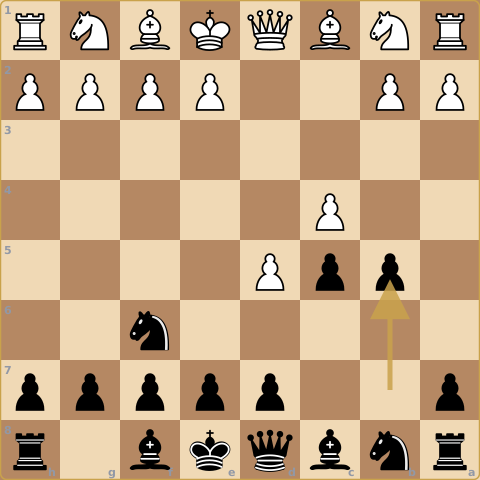
Most gambits give up a pawn for a quick attack. The Benko is different. Black gives up the b-pawn to open the a- and b-files on the queenside, where the rooks can press on White's a- and b-pawns for the rest of the game. It's named after Pal Benko, who did a lot to popularize it, and in Eastern Europe it's also called the Volga Gambit.
At 1300 to 2100 on Lichess, White accepts with 4.cxb5 in 51.4% of games, and 94% of Black players attack the pawn straight away with 4...a6.
The main line: 5.bxa6 Bxa6
White takes a second time in 48.4% of games. Black takes back at once with the bishop, which now looks down the diagonal toward f1.
White develops with 6.Nc3 in 86.3% of games. Count the pawns: Black is one down. Now look at what Black has for it:
- Two half-open files. Black has no a- or b-pawn, so rooks on a8 and b8 point straight at a2 and b2.
- A bishop on the long diagonal. After ...g6 and ...Bg7, the bishop looks toward c3 and b2 once the f6 knight moves.
- Easy development. Black's setup barely changes from game to game: ...g6, ...Bg7, castle, ...Nbd7, queen to a5 or b6, rooks to a8 and b8.
Why 7.e4 costs White the right to castle
White's most common 7th move is 7.e4 (48.5%). It builds a big center, but it also moves the e2 pawn that was blocking the diagonal between Black's bishop on a6 and White's bishop on f1.
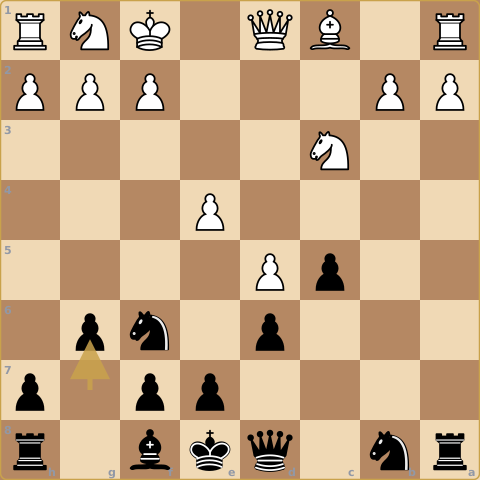
83% of Black players trade bishops with 7...Bxf1, and White must take back with the king, since the knight on g1 still blocks the rook. White can no longer castle, so the king usually walks to g2 after 9.g3 (44.4%). That takes time, and Black uses it to finish developing with ...Bg7 and castling. If White pushes 9.e5? instead, just take: 9...dxe5 wins a pawn.
White's other 7th moves, 7.Nf3 (26.7%) and 7.g3 (16.3%), keep the e-pawn at home so the king can castle. Against both, Black plays 7...g6 and the same setup. If White plays e4 a move later, for example 7.Nf3 g6 8.e4, the ...Bxf1 trade works again.
White's other tries
5.Nc3: developing instead of taking
In 22.2% of games White protects b5 and d5 with 5.Nc3. Black takes back with 5...axb5, opening the a-file. After 6.Nxb5 (79.6%), 6...Ba6 hits the knight, and only 7.Nc3 keeps d5 safe. The sharper 6.e4 needs one precise answer:
6...b4 is the only good move, because slower moves run into e5. After 7.Nb5 (84.9%), don't grab the e4 pawn. 7...Nxe4? runs into 8.Qe2!, and if the knight retreats with 8...Nf6??, 9.Nd6 is checkmate because the e7 pawn is pinned. 20% of players take on e4 here, and White wins 85% of those games on Lichess. 7...d6 takes the d6 square away and is simply solid.
5.b6 and 5.e3
In 13.9% of games White pushes past with 5.b6, keeping the files closed for now. The pawn on b6 is far from home, and Black's queen on d8 already eyes it. Half of Black players grab it at once with ...Qxb6, but Stockfish prefers 5...e6, hitting the d5 pawn first. The b6 pawn can wait.
In 12.0% of games White keeps the pawn on b5 and develops with 5.e3. Black plays the same fianchetto, 5...g6 (35%), then ...Bg7 and castling, and takes on b5 later, when opening the a-file helps most.
When White declines
Almost half of White players don't take on b5 at all. Against 4.b3 (20.3%) and 4.e3 (9.5%), Black takes on c4 anyway. After 4.e3 bxc4 5.Bxc4, material is level and White's b2 pawn sits on a half-open file.
4.Nc3? (7.7%) is a mistake:
The knight is attacked, and on b5 or e4 it would be lost. Only b1 and a4 are safe, and 5.Nb5? runs into 5...a6, when the knight has no square left. Black wins 58% of games after 4...b4 at this level on Lichess.
So is it sound?
Yes, in the way that matters. White has no known refutation, and the compensation is long-term. Unlike most gambits, the Benko doesn't depend on the queens. The pressure down the a- and b-files can last deep into the middlegame and even the endgame. That's the sign of a positional gambit rather than a trick.
It isn't a way to force full equality. Stockfish gives White about half to three quarters of a pawn in the main lines, and if Black drifts, White's extra pawn can decide an endgame. That's why our library recommends it from 1300 up to 2100 Elo, not for complete beginners. In practice, though, Black does well at this level on Lichess, winning 52% of games after 3...b5.
Who should play it?
The Benko suits players who are comfortable a pawn down for a long time and who enjoy active piece play. If you want quick attacks on the king, it will frustrate you, because Black's play is on the other side of the board.
Don't rush to win the pawn back. If you do, you usually give back the pressure that was the whole point. Learn where the pieces belong, stay patient, and let the open files do the work.
Frequently asked questions
Is the Benko Gambit sound?
Yes. White has no refutation, and Black gets long-term pressure on the half-open a- and b-files plus a strong bishop on g7. Stockfish gives White a small edge in the main lines, but it's one of the most respected gambits in chess. At 1300 to 2100 on Lichess, Black wins 52% of games after 3...b5. Our library recommends it from 1300 to 2100 Elo.
What does Black get for the pawn in the Benko Gambit?
Two half-open files on the queenside for the rooks, pressure on a2 and b2, a fianchettoed bishop on g7 and easy development. After 5.bxa6 Bxa6 6.Nc3 d6 7.e4 Bxf1 8.Kxf1, White also loses the right to castle.
Does the Benko Gambit compensation last into the endgame?
It can. Unlike most gambits, Black's pressure doesn't depend on the queens. The rooks on the half-open a- and b-files keep pressing on White's queenside pawns, and that pressure can carry on after the queens come off.
How does White usually play against the Benko Gambit?
At 1300 to 2100 on Lichess, White accepts with 4.cxb5 in 51.4% of games and declines with 4.b3 in 20.3%. After 4.cxb5 a6, White takes again with 5.bxa6 in 48.4%, develops with 5.Nc3 in 22.2%, pushes 5.b6 in 13.9% and plays 5.e3 in 12.0%.
Copy the lines (PGN)
Every line in this article in standard PGN, ready to paste into Lichess, Chess.com or any chess database.
[Event "Is the Benko Gambit (1.d4 Nf6 2.c4 c5 3.d5 b5) Sound?: Benko, main line with 7.e4"]
[Site "chesscoachacademy.com"]
[Result "*"]

1. d4 Nf6 2. c4 c5 3. d5 b5 4. cxb5 a6 5. bxa6 Bxa6 6. Nc3 d6 7. e4 Bxf1 8. Kxf1 g6 9. g3 Bg7 *

[Event "Is the Benko Gambit (1.d4 Nf6 2.c4 c5 3.d5 b5) Sound?: Benko, 7.Nf3 and 8.g3"]
[Site "chesscoachacademy.com"]
[Result "*"]

1. d4 Nf6 2. c4 c5 3. d5 b5 4. cxb5 a6 5. bxa6 Bxa6 6. Nc3 d6 7. Nf3 g6 8. g3 Bg7 9. Bg2 O-O *

[Event "Is the Benko Gambit (1.d4 Nf6 2.c4 c5 3.d5 b5) Sound?: Benko, 5.Nc3 and 6.e4"]
[Site "chesscoachacademy.com"]
[Result "*"]

1. d4 Nf6 2. c4 c5 3. d5 b5 4. cxb5 a6 5. Nc3 axb5 6. e4 b4 7. Nb5 d6 *

[Event "Is the Benko Gambit (1.d4 Nf6 2.c4 c5 3.d5 b5) Sound?: Benko, 5.e3"]
[Site "chesscoachacademy.com"]
[Result "*"]

1. d4 Nf6 2. c4 c5 3. d5 b5 4. cxb5 a6 5. e3 g6 6. Nc3 Bg7 7. Nf3 O-O *

[Event "Is the Benko Gambit (1.d4 Nf6 2.c4 c5 3.d5 b5) Sound?: Benko, 4.Nc3?"]
[Site "chesscoachacademy.com"]
[Result "*"]

1. d4 Nf6 2. c4 c5 3. d5 b5 4. Nc3 b4 *
Keep reading
- Reliable 1.d4 Defenses for Black: How the Benko compares with Black's other main answers to 1.d4.
Practice the Benko against every White try
Our Benko Gambit trainer covers 13 lines built from about 3.4 million Lichess games at 1300 to 2100: the 5.bxa6 Bxa6 main line against 7.e4, 7.Nf3 and 7.g3, plus 5.Nc3, 5.b6, 5.e3 and the declines 4.b3, 4.e3 and 4.Nc3. You play Black against the moves White players really choose, every one of your moves is checked by Stockfish, and a short explanation follows each move.
It's free during the open beta, and your progress on every line is tracked for free once you sign up.
13 lines built from 3.4 million Lichess games. Free during the open beta, with free progress tracking.
Practice the Benko Gambit free →