Is the Dutch Defense (1.d4 f5) Good?
TL;DR
Short answer Yes. The Dutch is a sound, fighting defense. It costs Black a little king safety, so you need to know White's sharp tries, but in return you get an unbalanced game from move one. Games behind this article About 16 million Lichess games played by 1200 to 2000 rated players Black's setups Classical (...e6, ...Bb4) · Stonewall (...e6, ...d5, ...c6) · Leningrad (...g6, ...Bg7) White's reply to 1...f5 2.c4 34% · 2.Bf4 18% · 2.Nf3 15% · 2.e3 9% · 2.Nc3 8%, all covered by our trainer How rare it is 1...f5 is played in about 2% of 1.d4 games at this level Recommended range 1200 to 2000 Elo, 20 lines
What 1...f5 is trying to do
Most answers to 1.d4 keep things flexible for a few moves. The Dutch commits at once. The f-pawn grabs kingside space and, with a knight on f6, puts the e4 square under Black's control, so White can't easily play e2-e4.
The cost is just as clear. With the f-pawn gone, the diagonal from h5 to Black's king on e8 is open, and after castling the a2-g8 diagonal is looser than usual. Every Dutch player has to respect those two lines. That's the whole trade: space and imbalance now, a slightly airier king for the rest of the game.
The three ways to set up
Black's big choice comes a few moves in, and our trainer picks the setup by what White does: ...e6 with ...Bb4 against 2.c4 and Nc3, ...e6 with ...b6 and ...Bb7 against the London, and ...g6 against Nf3 followed by c4, e3 or g3.
The Classical with ...Bb4
This is the most common line at this level: 2.c4 is White's top reply, and 3.Nc3 follows in 71% of games. The bishop on b4 pins the knight that wants to support e4, and trading on c3 leaves White with doubled c-pawns for the rest of the game. It works in practice, too: after 5...Bxc3+, Black wins 53% of games at 1200 to 2000 on Lichess.
The Stonewall
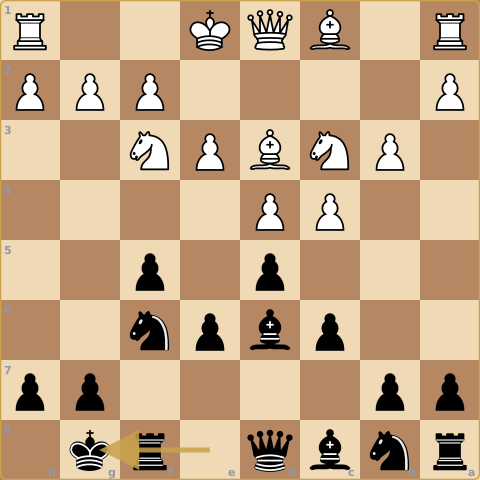
Black builds a wall of pawns on c6, d5, e6 and f5. It's very hard for White to break open, and it hands Black a strong square on e4 for a knight. This is Stockfish's suggested plan in our 2.c4 Nf6 3.e3 line.
It also has two well-known costs. The light-squared bishop on c8 is shut in behind its own pawns, so Black often reroutes it with ...Bd7-e8-h5, or with ...b6 and ...Ba6. And the e5 square is a hole: with Black's pawns already on d5 and f5, no pawn can easily challenge it, so a White knight landing there is hard to shift.
The Leningrad
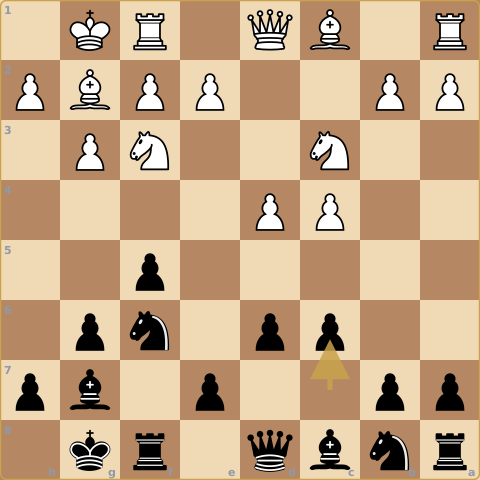
Here Black fianchettoes the dark-squared bishop, much like a King's Indian, and usually looks for ...e5 later, prepared with ...Qe8 or ...Nc6. It's the most active of the three setups. Stockfish gives White about half a pawn here, which is normal for the Leningrad.
The dangers
The Staunton Gambit
White gives up a pawn on move two to open lines toward Black's king before Black's setup is ready. The standard answer is to take the pawn and defend it with 3...Nf6. Then 4.Bg5 threatens Bxf6, removing the piece that guards e4, so White can win the pawn back with Nxe4. Common answers are 4...g6 and 4...c6.
It's rare at this level (about 3.5% of games), and our trainer doesn't cover it, so prepare it on your own. If you don't know this line, it's easy to get blown off the board. If you do, you get a sharp position where the extra pawn is worth fighting for.
The 2.Bg5 trap
2.Bg5 is just as rare and also outside our trainer, but the guide warns about one trap. The natural 2...h6 asks the bishop a question. What you must not do is chase it greedily:
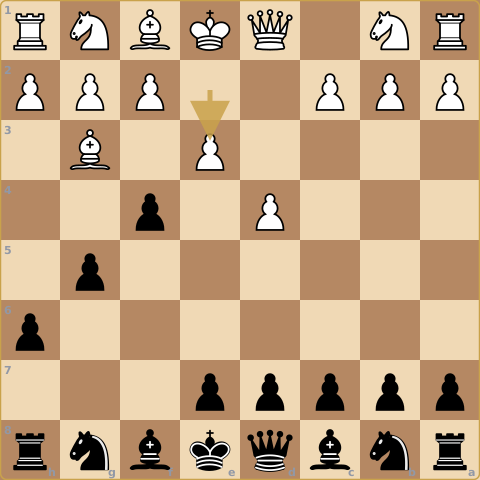
With Black's f-, g- and h-pawns all pushed, nothing can block a check on the h5-e8 diagonal. 5.e3 opens the queen's path to h5 and threatens Qh5 mate. Taking the bishop with 5...fxg3 allows exactly that. Defending with 5...h5 isn't enough either, because after 6.Bd3 Rh6 there's a neat finish:
Black can stop the mate with 5...Nf6, but by then the kingside is full of holes. The lesson isn't that 2...h6 is bad. It's that in the Dutch, you finish development before you push more kingside pawns.
The Nb5 trick
This one is in our trainer, and 18% of players at this level try it. The knight and bishop both hit c7. Block with 4...d6. The natural-looking 4...Bd6? fails to 5.Bxd6 cxd6 6.Nxd6+, and you lose a pawn and the right to castle.
So, is the Dutch good?
It's a respected, sound defense. It's far less popular than 1...d5 and 1...Nf6, and it isn't the safest answer to 1.d4: Stockfish gives White a small edge in most lines, about half a pawn, which is normal for a Black opening. But the Stonewall and Leningrad are serious, well-tested systems in their own right, and because 1...f5 turns up in only about 2% of games, many opponents won't know it well.
Our library recommends it for 1200 to 2000, with 20 lines built from about 16 million Lichess games.
Play the Dutch if:
- you want unbalanced positions against 1.d4, not symmetrical ones
- you're happy committing to a structure early and learning its plans
- you're willing to prepare the Staunton Gambit and the early Bg5 lines on your own
Look elsewhere if you want maximum solidity with the least preparation. The Dutch rewards homework and punishes players who skip it.
Frequently asked questions
Is the Dutch Defense a good opening?
Yes. The Dutch (1.d4 f5) is sound and gives Black an unbalanced, fighting game. It weakens Black's kingside a little, so you need to know White's sharp tries, and Stockfish gives White a small edge of about half a pawn in most lines. Our library recommends it for 1200 to 2000 Elo, with 20 lines built from about 16 million Lichess games.
What is the difference between the Stonewall and the Leningrad Dutch?
The Stonewall puts Black's pawns on c6, d5, e6 and f5, a very solid wall that gives Black the e4 square but leaves a hole on e5 and a hemmed-in light-squared bishop. The Leningrad fianchettoes with ...g6 and ...Bg7, King's Indian style, for a more active game.
How do you meet the Staunton Gambit in the Dutch Defense?
Take the pawn with 2...fxe4 and develop with 3...Nf6 after 3.Nc3. White usually continues 4.Bg5, threatening to take the knight that defends e4, and common answers are 4...g6 and 4...c6. The Staunton is played in only about 3.5% of games at 1200 to 2000 on Lichess, and our Dutch trainer doesn't cover it.
What is the Qh5 trap in the Dutch Defense?
After 1.d4 f5 2.Bg5 h6 3.Bh4 g5 4.Bg3, the greedy 4...f4 walks into 5.e3, threatening Qh5 mate. Taking the bishop with 5...fxg3 allows 6.Qh5#, and after 5...h5 6.Bd3 Rh6, 7.Qxh5+ Rxh5 8.Bg6# is mate as well. The safe rule is to finish development before pushing more kingside pawns.
Copy the lines (PGN)
Every line in this article in standard PGN, ready to paste into Lichess, Chess.com or any chess database.
[Event "Is the Dutch Defense (1.d4 f5) Good?: Classical with ...Bb4"]
[Site "chesscoachacademy.com"]
[Result "*"]

1. d4 f5 2. c4 Nf6 3. Nc3 e6 4. Bg5 Bb4 5. e3 Bxc3+ 6. bxc3 *

[Event "Is the Dutch Defense (1.d4 f5) Good?: Stonewall setup"]
[Site "chesscoachacademy.com"]
[Result "*"]

1. d4 f5 2. c4 Nf6 3. e3 e6 4. Nc3 c6 5. Nf3 d5 6. Bd3 Bd6 7. b3 O-O *

[Event "Is the Dutch Defense (1.d4 f5) Good?: Leningrad setup"]
[Site "chesscoachacademy.com"]
[Result "*"]

1. d4 f5 2. Nf3 Nf6 3. g3 g6 4. c4 d6 5. Bg2 Bg7 6. O-O O-O 7. Nc3 c6 *

[Event "Is the Dutch Defense (1.d4 f5) Good?: Staunton Gambit"]
[Site "chesscoachacademy.com"]
[Result "*"]

1. d4 f5 2. e4 fxe4 3. Nc3 Nf6 4. Bg5 g6 *

[Event "Is the Dutch Defense (1.d4 f5) Good?: 2.Bg5 trap"]
[Site "chesscoachacademy.com"]
[Result "*"]

1. d4 f5 2. Bg5 h6 3. Bh4 g5 4. Bg3 f4 5. e3 h5 6. Bd3 Rh6 7. Qxh5+ Rxh5 8. Bg6# *

[Event "Is the Dutch Defense (1.d4 f5) Good?: Nb5 trick"]
[Site "chesscoachacademy.com"]
[Result "*"]

1. d4 f5 2. Bf4 Nf6 3. Nc3 e6 4. Nb5 d6 *
Keep reading
- The Most Reliable 1.d4 Defenses for Black: How the Dutch compares with the King's Indian, Nimzo-Indian, Slav and others.
Learn the Dutch before your opponent tests it
Our Dutch Defense trainer covers 20 lines built from about 16 million Lichess games at 1200 to 2000: the Classical ...Bb4 setup against 2.c4 and Nc3, the ...b6 plan against the London, the Leningrad against Nf3 systems, and 2.e3 and 2.Nc3, with traps like Nb5 and Qh5+ along the way. You play Black against the moves players at your level really choose, and every one of your moves is checked by Stockfish.
It's free during the open beta, and you can track your progress on every line for free once you sign up.
20 lines built from about 16 million Lichess games. Free during the open beta, with free progress tracking.
Practice the Dutch Defense free →