
Is the King's Gambit Sound? Engine Analysis & Refutation
TL;DR
Games behind this article About 78 million Lichess games at 900 to 2200 Engine verdict Not busted, but not best. After 2.f4 Stockfish rates Black about half a pawn better with accurate defense Practical verdict White wins 53% of games after 2.f4 at 900 to 2200, Black 44%. Among 2200+ players both sides win 47% What Black plays after 3.Nf3 No main move: 3...g5 (17%), 3...Nc6 (17%), Fischer's 3...d6 (16%), then 3...Nf6, 3...d5 and 3...Be7 (about 10% each) Where Black goes wrong In Fischer's own line, 28% answer 4.d4 with 4...Bg4?, and White wins 60% of games after 5.Bxf4 Who should play it White players from 900 to 2200 who enjoy open, attacking games and are happy to be a pawn down for a while
What "busted" actually means
In 1961 a young Bobby Fischer published "A Bust to the King's Gambit," arguing that 3...d6 refutes the whole opening. The quiet pawn move takes e5 away from White's knight and prepares ...g5 to hold the extra pawn. Fischer never faced the King's Gambit as Black again after losing to Spassky against it in 1960, so his bust was never tested by its own author.
Modern engines broadly agree with him: with best play, Black keeps a small edge. But that answers a narrow question, "what happens if both sides play perfectly?" It doesn't tell you how the opening scores in real games, and this site's Lichess data shows how different those two answers are.
What real players do
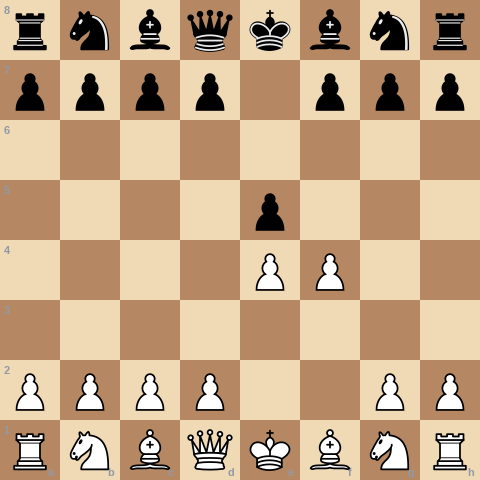
White offers the f-pawn to open the f-file and pull Black's e-pawn away from the center. At 900 to 2200 on Lichess, Black accepts with 2...exf4 in 45% of games. The rest decline: 2...Nc6 in 21%, 2...d6 in 13% and the Falkbeer Countergambit, 2...d5, in 9%.
The standard move, and the one our trainer plays. The knight develops and stops Black's queen from checking on h4. This is the position Fischer's whole argument is about, and here Black's replies split six ways:
- 3...g5, the classical way to hold the extra pawn: 17%
- 3...Nc6, simple development that leaves f4 undefended: 17%
- 3...d6, Fischer's recommended bust: 16%
- 3...Nf6, 3...d5 and 3...Be7: about 10% each
So a Black player who only prepares Fischer's line meets it in about one game in six. A White player has to be ready for all six, but most of them lead to positions where the plan is the same: build the center with d4 and win the f4 pawn back with the c1 bishop.
The sharpest line: 3...g5
White attacks the g5 pawn at once, before Black's kingside pawns settle into a wall. This is the move our trainer plays. After 4...g4, hitting the knight, White has one precise answer:
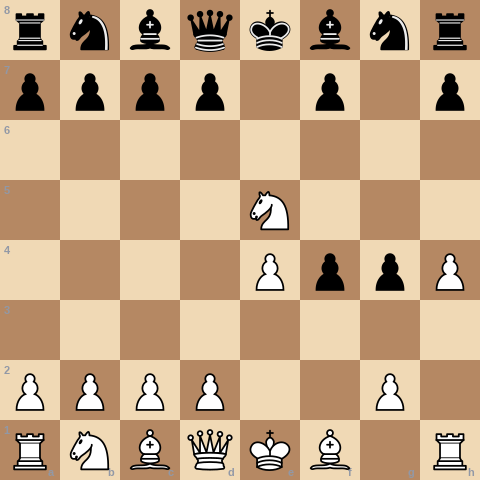
The knight jumps to e5, out of the pawn's reach and onto a strong central square. This is the Kieseritzky Gambit, one of the most deeply analyzed positions in opening history. The tempting 5.Ng5? is a mistake: Stockfish rates Black about a pawn and a half better after it.
Fischer's line, and the mistake most players make in it
White builds the center and opens the c1 bishop toward f4. Fischer's idea is 4...g5, holding the pawn, and 25% of players at this level find it. After 4...g5 5.h4 g4, White retreats with 6.Ng1, because 6.Bxf4? gxf3 loses the knight.
But the most common reply is a mistake. 4...Bg4? (28% of games) develops the bishop and pins the knight, but it gives up on the f4 pawn:
White wins the pawn back with a developing move and has the ideal center. White wins 60% of games after 5.Bxf4 at this level. It gets worse for Black if they now trade on f3: 36% play 5...Bxf3, and after 6. Qxf3 Stockfish rates White two pawns better, with the bishop pair, a big center and the open f-file pointing at f7.
The same idea shows up after 3...Nc6. Following 4.d4, 21% of players answer 4...d6?, and 5.Bxf4 wins the pawn back, with Stockfish rating White almost a pawn better. The lesson for both sides: in the King's Gambit, the f4 pawn is the whole game. If Black stops defending it, White takes it back with a better position.
So, is it sound?
Both answers are true at once. With best play Black keeps a small edge, as Fischer said and Stockfish confirms. And at 900 to 2200 on Lichess, White still wins 53% of games after 2.f4, because Black has to find accurate moves in open positions, and most players spread across six replies instead of knowing one well. Among 2200+ players the results even out at 47% each.
"Busted" in the engine sense and "unplayable" in practice are not the same claim. Our King's Gambit course covers both: Fischer's 3...d6, the Kieseritzky after 3...g5, and every other reply real opponents play. Practice the King's Gambit interactively →
Keep reading
Next in this part of the series:
- How to Beat the King's Gambit as Black: a practical, move-by-move plan for the Black side, built on the same Lichess data.
Frequently asked questions
Is the King's Gambit sound?
Not quite, with perfect play. After 2.f4 Stockfish rates Black about half a pawn better. In practice it scores well: at 900 to 2200 on Lichess, White wins 53% of games after 2.f4 and Black wins 44%.
Did Bobby Fischer refute the King's Gambit?
He claimed to in his 1961 article "A Bust to the King's Gambit," recommending 3...d6. Engines agree that Black keeps a small edge, but the opening is still played at every level, and only 16% of players at 900 to 2200 actually choose 3...d6.
What is the best reply to the King's Gambit?
Accepting with 2...exf4 and then playing accurately, either Fischer's 3...d6 or the classical 3...g5. The key for Black is to keep defending the f4 pawn or give it back on good terms, rather than drift.
What is the most common mistake against the King's Gambit?
Abandoning the f4 pawn without a reason. After 3...d6 4.d4, 28% of players play 4...Bg4?, and 5.Bxf4 wins the pawn back with a strong center. White wins 60% of games after it.
Is the King's Gambit good for beginners?
It's a good choice from about 900 if you like attacking chess and open positions. You'll be a pawn down for a while, so you need to be comfortable playing for activity rather than material. Our King's Gambit course is built for 900 to 2200.
More traps and gambits
Back to the full series:
- Chess Opening Traps & Gambits: Every trap and gambit guide in this series, checked against our data.
Try It Yourself for Free
Every line above, Fischer's engine-approved defense, the sharp Kieseritzky and the other replies real opponents play, is fully interactive on this site. All 38 openings, including the King's Gambit, are free to try, no card and no account needed to start, with your progress tracked for free if you create one.
Every line checked the same way, against real game data, not against what sounds right.
Browse all 38 openings free →