London vs Torre vs Trompowsky: Which 1.d4 System Should White Play?
TL;DR
Short answer Play the London if you want one setup against almost anything. Pick the Torre for the same calm style with a pin, or the Trompowsky if you want to unbalance the game on move two. Games behind this article London: about 35 million Lichess games (400 to 1400) · Torre: about 19 million (400 to 1800) · Trompowsky: about 4.2 million (900 to 1800) London: Black's reply to 1.d4 d5 2.Bf4 2...Nc6 37% · 2...Nf6 20% · 2...e6 15% · 2...Bf5 13% Torre: Black's 2nd move after 1.d4 Nf6 2.Nf3 2...g6 30% · 2...d5 28% · 2...e6 22% Trompowsky: Black's reply to 2.Bg5 2...e6 29% · 2...d5 18% · 2...g6 17% · 2...Ne4 12% Recommended range London 400 to 1400 (20 lines) · Torre 400 to 1800 (17 lines) · Trompowsky 900 to 1800 (20 lines)
The one idea all three share
In a lot of quiet 1.d4 setups, White plays e3 early and the dark-squared bishop on c1 ends up stuck behind its own pawns. All three of these systems fix that the same way: get the bishop out first, then play e3.
The difference is where the bishop goes and when:
- London: Bf4 on move two, with a calm pawn triangle behind it.
- Torre: Bg5 after 2.Nf3, pressing on the f6 knight.
- Trompowsky: Bg5 on move two, before White has developed anything else.
That timing decides how calm or sharp your games will be.
The London: one setup, very few surprises
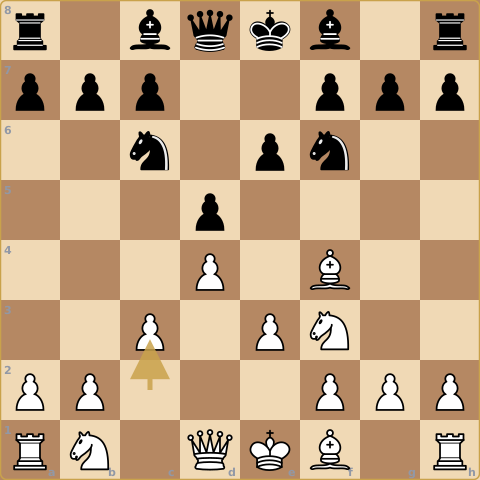
Our London trainer plays 2.Bf4 straight away, then e3, Nf3, c3, Nbd2 and a bishop to d3 or e2, whatever Black does. The line above is the most common one at 400 to 1400 on Lichess: 2...Nc6 (37%), 3...Nf6 (38%) and 4...e6 at each step. The shape of White's position barely changes, and that's the selling point.
The same setup works against 1...Nf6, 1...e6 and 1...d5 alike, while the Trompowsky only exists after 1...Nf6. Against the Englund Gambit (1...e5), the trainer takes the pawn and plays Nc3 before Bf4, so the ...Qb4+ trick never works.
Low theory isn't zero theory, though. You'll need to know a few sharper tries, like ...c5 and ...Qb6 hitting b2, or ...Nh5 chasing the bishop:
With the bishop gone from c1, nothing guarded b2, so the rook steps over to cover it. Qc1 is the other calm answer. Against ...Nh5, Stockfish's choice is to keep the bishop active with Be5, or drop it to g3.
Downside: the London is safe rather than punishing. Black can equalize with sensible moves, so you win by outplaying people later, not in the opening.
The Torre: London calm, with a pin
White develops the knight first, then puts the bishop on g5. Against ...e6 setups it pins the f6 knight to the queen on d8, and that pin keeps shaping the game. White follows with e3, Nbd2, Bd3, c3 and castling.
At 400 to 1800 on Lichess, Black's second move splits three ways: 2...g6 (30%), 2...d5 (28%) and 2...e6 (22%). The same setup handles all three. Against ...g6, Black plays ...Bg7 92% of the time, and White simply builds the usual shape:
Against 2...e6 3.Bg5, Black's replies are more varied: ...Be7 (40%), ...d5 (26%), ...h6 (14%) and ...c5 (7%). Against ...h6, our trainer keeps the pin with 4.Bh4. After 2...d5 3.Bg5 h6, half of White players take on f6 instead, and 41% keep the bishop with Bh4.
Downside: it doesn't force anything. Like the London, it rewards patient middlegame play.
The Trompowsky: a question on move two
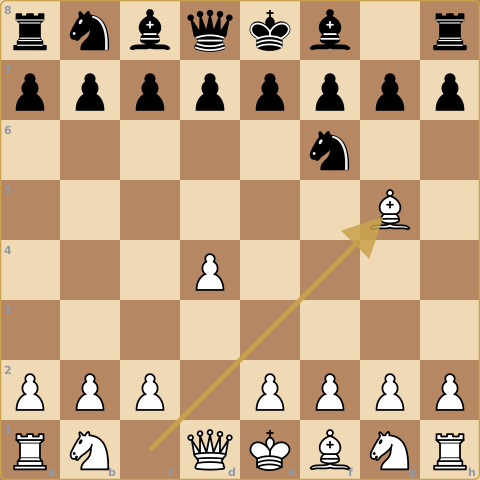
White skips 2.c4 and 2.Nf3 and goes after the knight at once. If White takes on f6, Black ends up with doubled f-pawns whether the e-pawn or g-pawn recaptures. Only about 4% of players at 900 to 1800 choose 2.Bg5, so few opponents prepare for it. And no reply dominates: 2...e6 (29%), 2...d5 (18%), 2...g6 (17%) and 2...Ne4 (12%).
The sharpest answer is 2...Ne4, hitting the bishop. Our trainer retreats with 3.Bf4, and if Black chases it with ...g5, the bishop simply goes home to c1 and the g5 pawn becomes a target:
Against 2...d5, 2...g6, 2...h6 and 2...d6, our trainer takes on f6 and plays against the damaged pawns with e3 and c4. Against 2...e6, Black is ready to recapture with the queen, so White grabs the center with 3.e4 instead. That line has a trap worth knowing: after 3...Be7 4.e5 Ne4 5.Bxe7 Qxe7 6.Bd3, the most common reply is 6...Ng5? (33%), and 7.h4 wins the knight.
It's played at the top, too. Magnus Carlsen opened with it in Game 1 of his 2016 World Championship match against Sergey Karjakin.
Downside: it only works after 1...Nf6, and the positions are less predictable. You need to recognize several different Black replies, each with its own plan.
Which one should you play?
- Under about 1400, or short on study time: the London. Recommended from 400 to 1400, 20 lines, and the same setup works against 1...d5, 1...Nf6 and 1...e6.
- You like the London but want more pressure: the Torre. Our range runs 400 to 1800 with 17 lines.
- You want sharper, less familiar positions: the Trompowsky, recommended for 900 to 1800 with 20 lines.
They also combine well. After 1.d4 Nf6 you can choose 2.Bf4 (London), 2.Nf3 and 3.Bg5 (Torre) or 2.Bg5 (Trompowsky) on the day, and a Trompowsky player can keep the London for games that start 1...d5.
None of this is a claim about which system scores best. Each trainer is built from what players at its own rating range play, so it's about which one fits how you like to play.
Frequently asked questions
Is the London System better than the Trompowsky?
Neither is objectively better. The London is the lower-theory choice: one setup, recommended for 400 to 1400, and it works against 1...d5 as well as 1...Nf6. The Trompowsky (1.d4 Nf6 2.Bg5) is sharper and recommended for 900 to 1800, but it only arises after 1...Nf6. Only about 4% of 900 to 1800 players on Lichess choose 2.Bg5, so opponents rarely prepare for it.
What is the difference between the Torre Attack and the Trompowsky?
Both put the bishop on g5. The Torre plays 2.Nf3 first and then 3.Bg5, building a calm setup with e3, Nbd2, Bd3 and c3. The Trompowsky plays 2.Bg5 straight away, which lets Black hit the bishop with 2...Ne4 and leads to less predictable positions.
How does Black usually respond to the Trompowsky?
At 900 to 1800 on Lichess, Black's replies to 2.Bg5 are spread out: 2...e6 29%, 2...d5 18%, 2...g6 17% and 2...Ne4 12%. Against 2...e6 White usually grabs the center with 3.e4, and against most other replies White takes on f6.
Which 1.d4 system is best for beginners?
The London System. White plays nearly the same setup (Bf4, e3, Nf3, c3, Nbd2 and a bishop to d3 or e2) against almost anything, and our library recommends it from 400 to 1400 Elo.
Copy the lines (PGN)
Every line in this article in standard PGN, ready to paste into Lichess, Chess.com or any chess database.
[Event "London vs Torre vs Trompowsky: Which 1.d4 System Should White Play?: London, most common line"]
[Site "chesscoachacademy.com"]
[Result "*"]

1. d4 d5 2. Bf4 Nc6 3. e3 Nf6 4. Nf3 e6 5. c3 *

[Event "London vs Torre vs Trompowsky: Which 1.d4 System Should White Play?: London vs ...c5 and ...Qb6"]
[Site "chesscoachacademy.com"]
[Result "*"]

1. d4 d5 2. Bf4 Nf6 3. e3 e6 4. Nf3 c5 5. Nbd2 Qb6 6. Rb1 *

[Event "London vs Torre vs Trompowsky: Which 1.d4 System Should White Play?: Torre vs ...g6"]
[Site "chesscoachacademy.com"]
[Result "*"]

1. d4 Nf6 2. Nf3 g6 3. Bg5 Bg7 4. e3 O-O 5. Nbd2 d6 6. Bd3 Nbd7 7. c3 *

[Event "London vs Torre vs Trompowsky: Which 1.d4 System Should White Play?: Trompowsky, 2...Ne4"]
[Site "chesscoachacademy.com"]
[Result "*"]

1. d4 Nf6 2. Bg5 Ne4 3. Bf4 g5 4. Bc1 *

[Event "London vs Torre vs Trompowsky: Which 1.d4 System Should White Play?: Trompowsky, the 6...Ng5 trap"]
[Site "chesscoachacademy.com"]
[Result "*"]

1. d4 Nf6 2. Bg5 e6 3. e4 Be7 4. e5 Ne4 5. Bxe7 Qxe7 6. Bd3 Ng5 7. h4 *
Keep reading
- The Most Reliable 1.d4 Defenses for Black: The other side of the board: what Black plays against 1.d4 and how often.
Try all three systems before you commit
Each trainer lets you play White against the replies players at your level really choose on Lichess, with every one of your moves checked by Stockfish. The London covers 20 lines from about 35 million games, the Torre 17 lines from about 19 million, and the Trompowsky 20 lines from about 4.2 million.
They're all free during the open beta, and progress tracking on every line is free with an account, so you can see which system sticks.
Practice the London System →
Practice the Torre Attack →
Practice the Trompowsky Attack →
London, Torre and Trompowsky lines built from Lichess games. Free during the open beta, with free progress tracking.
Practice the London System free →