Which Chess Openings Require the Least Memorization?
TL;DR
Short answer As White, the London System or the Torre Attack. As Black, the Scandinavian against 1.e4. All three let you play roughly the same setup whatever your opponent does. System openings in our library London System (20 lines), Ponziani (18), Torre Attack (17), Alapin (16). The Torre and Alapin carry the LOW-THEORY tag. Games behind them About 35 million Lichess games for the London (400 to 1400), 19 million for the Torre (400 to 1800), 27 million for the Alapin (900 to 2200) and 12 million for the Ponziani (600 to 1500). Plus about 94 million for the Scandinavian (400 to 1400). Key move data London: 55% of Black players at 400 to 1400 answer 1.d4 with 1...d5. Torre: after 1.d4 Nf6 2.Nf3, Black's second move splits 2...g6 30%, 2...d5 28%, 2...e6 22%. Recommended range London 400 to 1400. Torre 400 to 1800. Scandinavian 400 to 1400. Alapin 900 to 2200.
Line count isn't the same as memorization
Every repertoire in our library is split into practice lines, from 6 in the Danish Gambit to 23 in the Ruy Lopez Closed. It's tempting to assume the opening with the fewest lines is the easiest to learn. It isn't.
The London System has 20 lines, more than most openings we cover. The Danish Gambit has just 6. Yet the London is far easier to play from memory, because across those 20 lines White keeps building the same setup: d4, Bf4, e3, Nf3, c3 and Nbd2. The Danish is a gambit where you play a pawn down, and one wrong move can cost you the game.
So the useful question is how many different plans you need, not how many lines. The openings below keep that number low.
For White: the system openings
Four White openings in our library work as systems: one plan, lightly adjusted to Black's reply.
| Opening | Lines | Lichess games | Range | Plays against |
| London System | 20 | about 35 million | 400 to 1400 | Most Black setups after 1.d4 |
| Torre Attack | 17 | about 19 million | 400 to 1800 | 1.d4 Nf6 setups |
| Alapin Variation | 16 | about 27 million | 900 to 2200 | The Sicilian only |
| Ponziani Opening | 18 | about 12 million | 600 to 1500 | 1...e5 only |
The London System
This is the lowest-maintenance opening we cover. The bishop goes to f4 before e3 so it doesn't get stuck behind the pawns, and the rest of the setup barely changes.
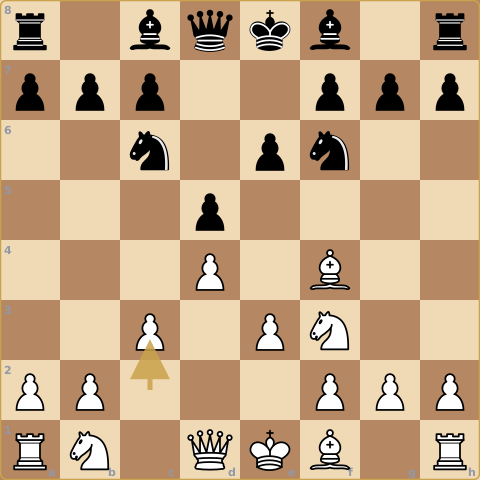
At 400 to 1400 on Lichess, 55% of Black players answer 1.d4 with 1...d5. After 2.Bf4, the replies spread out: 2...Nc6 (37%), 2...Nf6 (20%), 2...e6 (15%) and 2...Bf5 (13%). Against all four you play e3, Nf3 and c3, so you learn small adjustments, not four openings.
The few spots that need exact knowledge are the sharp tries: an early ...Qb6 eyeing the b2 pawn, and the Englund Gambit (1...e5), where Bf4 waits until ...Qb4+ is off the table. Learn those and you're set.
The Torre Attack
The Torre is the London's cousin with the bishop on g5 instead of f4. It starts at 400 like the London, but its range reaches 1800, which gives it a longer shelf life.
At 400 to 1800 on Lichess, Black's second move splits three ways: 2...g6 (30%), 2...d5 (28%) and 2...e6 (22%). The same Bg5, e3, Nbd2, Bd3 and c3 setup works against all three. In the ...g6 branch, Black completes the fianchetto with 3...Bg7 in 92% of games, so the first few moves are close to fixed.
The Alapin and the Ponziani
These two work differently. They don't cover everything, but they each replace one big block of theory with a single plan. The Alapin (1.e4 c5 2.c3) sidesteps the Open Sicilian, and at 900 to 2200 on Lichess Black's most common replies are 2...Nc6 (32%), 2...d6 (18%), and 2...d5 and 2...e6 (14% each). The plan is c3 and d4 against all of them. The Ponziani (1.e4 e5 2.Nf3 Nc6 3.c3) avoids Italian and Ruy Lopez theory, with Black answering 3...Nf6 in 47% of games at 600 to 1500 and 3...Bc5 in 25%.
The catch is that you still need answers to the French, the Caro-Kann and everything else if you open 1.e4. That's why 1.d4 system players usually carry the lightest load.
For Black: pick a defense with one shape
Black has a harder time, because White chooses the first move. The easiest answer to 1.e4 in our library is the Scandinavian, which puts the question to White straight away:
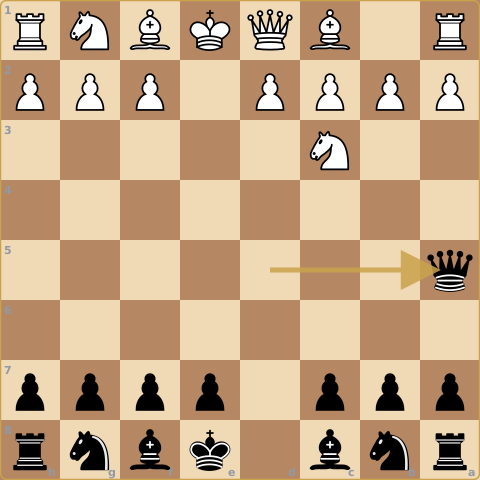
At 400 to 1400 on Lichess, White's fourth move is 4.Nf3 in 39.5% of games, then 4.d4 24.8%, 4.d3 10.3% and 4.Bc4 5.9%. Against all of them you play the same moves: ...Nf6, ...c6, ...Bf5, then ...e6 and castling. You reach similar positions against almost anything White does.
The Pirc is another option with a setup that barely changes: ...d6, ...Nf6, ...g6 and ...Bg7 against 2.d4, which White plays in 41% of games at 750 to 1800 on Lichess. Against the quieter Nf3 and Nc3 setups our trainer switches to a solid ...e5, so there is a little more to learn than in the Scandinavian.
Against 1.d4, the Slav (700 to 1700) is the natural partner if you already play the Caro-Kann, because it's built on the same idea: support d5 with the c-pawn and keep the light-squared bishop free.
What low theory costs you
System openings aren't free. The London doesn't punish slow play by Black, and opponents who know it well can equalize with natural moves. Low-theory openings trade some ambition for fewer surprises. Below about 1400 that's almost always a good trade, since a playable middlegame you understand is worth more than a memorized line you forget under pressure.
Frequently asked questions
What is the easiest chess opening to learn with the least theory?
For White, the London System. You build the same setup (d4, Bf4, e3, Nf3, c3, Nbd2) in almost every game, and at 400 to 1400 on Lichess 55% of Black players answer 1.d4 with 1...d5, where the setup fits best. For Black against 1.e4, the Scandinavian (1...d5) reaches similar positions against almost anything White plays.
Is the London System really low theory?
Yes. Our London repertoire has 20 lines, but White's setup barely changes between them. The main thing to learn is how to handle Black's common replies to 1.d4 d5 2.Bf4 (2...Nc6 37%, 2...Nf6 20%, 2...e6 15%, 2...Bf5 13% at 400 to 1400 on Lichess), the ...Qb6 try against b2 and the Englund Gambit's ...Qb4+ trick.
Does an opening with fewer lines mean less memorization?
Not always. The Danish Gambit has 6 lines in our library and the London has 20, but the Danish is a sharp gambit where exact moves matter, while the London repeats one setup. What counts is how many different plans you need.
What is the Torre Attack?
A White system starting 1.d4 Nf6 2.Nf3 followed by Bg5. It covers 1.d4 Nf6 setups with one consistent plan. At 400 to 1800 on Lichess, Black's second move splits 2...g6 30%, 2...d5 28% and 2...e6 22%, and its recommended range is 400 to 1800.
Copy the lines (PGN)
Every line in this article in standard PGN, ready to paste into Lichess, Chess.com or any chess database.
[Event "Which Chess Openings Require the Least Memorization?: London System"]
[Site "chesscoachacademy.com"]
[Result "*"]

1. d4 d5 2. Bf4 Nc6 3. e3 Nf6 4. Nf3 e6 5. c3 *

[Event "Which Chess Openings Require the Least Memorization?: Torre Attack, 2...g6"]
[Site "chesscoachacademy.com"]
[Result "*"]

1. d4 Nf6 2. Nf3 g6 3. Bg5 Bg7 4. e3 *

[Event "Which Chess Openings Require the Least Memorization?: Alapin Variation"]
[Site "chesscoachacademy.com"]
[Result "*"]

1. e4 c5 2. c3 *

[Event "Which Chess Openings Require the Least Memorization?: Ponziani Opening"]
[Site "chesscoachacademy.com"]
[Result "*"]

1. e4 e5 2. Nf3 Nc6 3. c3 Nf6 *

[Event "Which Chess Openings Require the Least Memorization?: Scandinavian Defense"]
[Site "chesscoachacademy.com"]
[Result "*"]

1. e4 d5 2. exd5 Qxd5 3. Nc3 Qa5 4. d4 Nf6 *

[Event "Which Chess Openings Require the Least Memorization?: Pirc Defense"]
[Site "chesscoachacademy.com"]
[Result "*"]

1. e4 d6 2. d4 Nf6 3. Nc3 g6 *
Keep reading
- Best Chess Openings for Beginners: All 36 openings grouped by rating, with the London as our first pick.
Learn the London in one sitting
Because the setup repeats, the London is the one opening you can get comfortable with in a few short sessions. Our trainer takes you through all 20 lines, including the Englund Gambit trick that catches London players out, with a short note on every move. If you'd rather play Black, the Scandinavian trainer covers 15 lines built from what 400 to 1400 players actually play on Lichess.
Both are free during the open beta, and your progress on every line is tracked for free when you sign up.
Practice the London System →
Practice the Torre Attack →
Practice the Scandinavian →
20 London System lines built from about 35 million Lichess games. Free during the open beta, with free progress tracking.
Practice the London free →