What Are the Most Aggressive Chess Openings for White?
TL;DR
Short answer The Danish Gambit and the King's Gambit are the most aggressive openings White can play against 1...e5. Against the Sicilian Dragon, the Yugoslav Attack is the sharpest. For 1.d4 players, the Trompowsky. How we chose All seven White openings in our library with the "aggressive" style, including the two tagged SHARP Games behind this article From about 2.0 million (Yugoslav Attack, 1700 to 2400) to about 131 million (Italian Game, 1000 to 1600) Lichess games per opening Key move data Danish: 73% of players at 900 to 2000 take the second pawn with 3...dxc3. King's Gambit: Black accepts with 2...exf4 in 45% of games at 900 to 2200. Recommended range Vienna 800 to 1800. Scotch and Trompowsky 900 to 1800. Danish 900 to 2000. King's Gambit 900 to 2200. Italian 1000 to 1600. Yugoslav Attack 1700 to 2400. We rank these by how early and how hard they commit to attacking. Where our Lichess data states a result, we quote it with its rating band.
The seven aggressive White openings in our library
| Opening | Style | Range | Lines | Lichess games |
| Danish Gambit | Aggressive (SHARP tag) | 900 to 2000 | 6 | about 17 million |
| King's Gambit | Aggressive, sharp (SHARP tag) | 900 to 2200 | 14 | about 78 million |
| Yugoslav Attack | Aggressive | 1700 to 2400 | 10 | about 2.0 million |
| Vienna Game | Aggressive, flexible | 800 to 1800 | 12 | about 64 million |
| Scotch Game | Aggressive | 900 to 1800 | 16 | about 73 million |
| Trompowsky Attack | Aggressive | 900 to 1800 | 20 | about 4.2 million |
| Italian Game | Aggressive | 1000 to 1600 | 20 | about 131 million |
1. The Danish Gambit
White offers a pawn on move three to open lines for both bishops, and in the classic version a second pawn on move four.
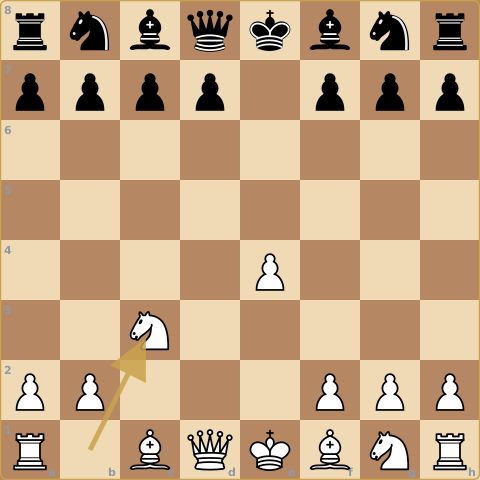
At 900 to 2000 on Lichess, 73% of players take with 3...dxc3. Most White players then offer a second pawn:
79% of White players go for that two-pawn version, and White wins 57% of those games at this level. Stockfish rates it clearly better for Black, though, so our trainer recaptures with 4.Nxc3 (played by 16%, with White winning 53%). You stay one pawn down, and the plan is simple: develop fast, castle, and aim at f7 and the open files.
2. The King's Gambit
White offers the f-pawn on move two to deflect Black's e-pawn and open the f-file toward f7.
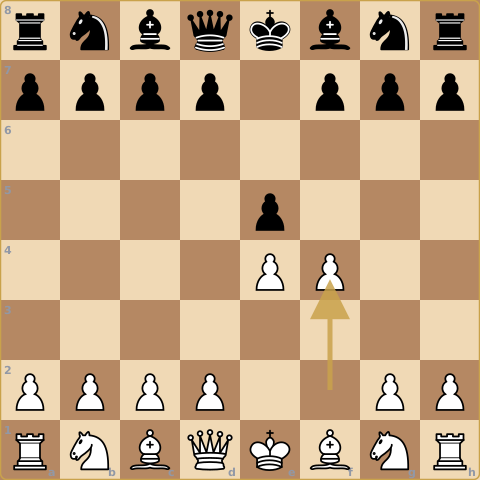
At 900 to 2200 on Lichess, Black accepts with 2...exf4 in 45% of games, declines with 2...Nc6 in 21% and 2...d6 in 13%, and plays the Falkbeer 2...d5 in 9%. White wins 53% of games after 2.f4 at this level and Black wins 44%. After 2...exf4 3.Nf3, the classical try 3...g5 (17%) leads to some of the wildest positions in chess:
That's the Kieseritzky Gambit, and 5.Ne5 is one of the precise moves you need to know. The King's Gambit also moves a pawn away from White's own king, and Stockfish rates 2.f4 as about half a pawn better for Black. It carries our SHARP tag, and it earns it.
3. The Yugoslav Attack against the Dragon
This one only comes up if Black plays the Sicilian Dragon, and it has the highest starting range here, 1700. White castles queenside and throws the kingside pawns at Black's king.
At 1700 to 2400 on Lichess, 61% of players choose 9.O-O-O here, and that's the move our trainer uses. Black's most common replies are 9...d5 (35%), 9...Bd7 (22%), 9...Nxd4 (18%) and 9...a6 (11%). Both sides race to attack, and one slow move can decide the game.
4. The Vienna Gambit
The Vienna starts quietly with 2.Nc3, which is why it's tagged FLEXIBLE. But after 2...Nf6, White can go straight for f4:
At 800 to 1800 on Lichess, the Vienna Gambit 3.f4 scores 58% for White against 2...Nf6, compared with 49% for 3.Nf3. Black takes with 3...exf4 in 43.7% of games, and after 4.e5 the knight has to go back to g8. You get King's Gambit-style play, and because the f4 push is optional, you can choose the calm path instead whenever you like.
5. The Scotch Game
The Scotch doesn't sacrifice anything. It's aggressive because it opens the center on move three.
At 900 to 1800 on Lichess, half of Black players (50.1%) trade knights with 4...Nxd4, followed by 4...Bc5 (18.1%), 4...Nf6 (11.4%) and 4...Qf6 (5.1%). The positions are open and tactical early on, which suits players who like quick development and active pieces.
6. The Trompowsky Attack
For 1.d4 players, the Trompowsky is the attacking choice. After 1.d4 Nf6, White plays 2.Bg5 immediately, offering to take the knight and damage Black's pawns.
Only about 4% of players at 900 to 1800 choose 2.Bg5, so few opponents are ready for it. The most common reply is 2...e6 (29%), and White grabs the center with 3.e4, using the pin on the f6 knight. The positions get sharp quickly, and Black can't steer into the King's Indian or Nimzo-Indian theory they may have prepared.
7. The Italian Game
The Italian carries the aggressive style because the bishop on c4 aims straight at f7. Against 3...Bc5 (27.8% at 1000 to 1600 on Lichess), our trainer goes for the open center at once:
The Italian also has the most famous trap for this level. About 26% of 1000 to 1600 rated players fall for the Blackburne Shilling trap (3...Nd4 4.Nxe5??), and they lose 75% of those games. If you want an even sharper version later, the Evans Gambit (4.b4) is an option, but our trainer doesn't cover it.
Which one should you play?
- Newer players, 800 to 1600: the Vienna, whose range starts at 800, the lowest of the seven, or the Italian from 1000.
- 1.e4 player, 900 to 1800: the Vienna or the Scotch. Both keep the initiative without betting the game on a pawn sacrifice.
- You want maximum chaos: the Danish or the King's Gambit. Learn the main lines well, because if the attack fizzles you're simply a pawn or two down.
- 1.d4 player: the Trompowsky.
- 1700 and up, facing the Dragon: the Yugoslav Attack.
Frequently asked questions
What is the most aggressive chess opening for White?
The Danish Gambit (1.e4 e5 2.d4 exd4 3.c3) gives up material fastest, offering one pawn on move three and, in the classic version, a second on move four for open lines and a lead in development. The King's Gambit (1.e4 e5 2.f4) is the best-known aggressive opening, with about 78 million Lichess games at 900 to 2200 in our data, against about 17 million for the Danish at 900 to 2000.
Is the King's Gambit good for beginners?
It can teach a lot about attacking, but it also weakens White's own king, so it carries our SHARP tag. Its recommended range starts at 900 Elo. Beginners who want attacking chess with less risk often start with the Vienna Game (from 800) or the Italian Game (from 1000).
What is the most aggressive opening for 1.d4 players?
The Trompowsky Attack (1.d4 Nf6 2.Bg5). It develops the bishop outside the pawn chain at once and leads to sharp positions early. Only about 4% of players at 900 to 1800 on Lichess choose 2.Bg5, and the most common reply is 2...e6 (29%), which White meets with 3.e4.
Which aggressive opening is best against 1...e5?
It depends how much risk you want. The Scotch and the Vienna attack without giving up material. The King's Gambit and the Danish Gambit sacrifice pawns for a fast attack. All four have recommended ranges starting between 800 and 900 Elo.
Copy the lines (PGN)
Every line in this article in standard PGN, ready to paste into Lichess, Chess.com or any chess database.
[Event "What Are the Most Aggressive Chess Openings for White?: Danish Gambit"]
[Site "chesscoachacademy.com"]
[Result "*"]

1. e4 e5 2. d4 exd4 3. c3 dxc3 4. Nxc3 *

[Event "What Are the Most Aggressive Chess Openings for White?: Danish Gambit, two pawns"]
[Site "chesscoachacademy.com"]
[Result "*"]

1. e4 e5 2. d4 exd4 3. c3 dxc3 4. Bc4 cxb2 5. Bxb2 *

[Event "What Are the Most Aggressive Chess Openings for White?: King's Gambit, Kieseritzky"]
[Site "chesscoachacademy.com"]
[Result "*"]

1. e4 e5 2. f4 exf4 3. Nf3 g5 4. h4 g4 5. Ne5 *

[Event "What Are the Most Aggressive Chess Openings for White?: Yugoslav Attack"]
[Site "chesscoachacademy.com"]
[Result "*"]

1. e4 c5 2. Nf3 d6 3. d4 cxd4 4. Nxd4 Nf6 5. Nc3 g6 6. Be3 Bg7 7. f3 O-O 8. Qd2 Nc6 9. O-O-O *

[Event "What Are the Most Aggressive Chess Openings for White?: Vienna Gambit"]
[Site "chesscoachacademy.com"]
[Result "*"]

1. e4 e5 2. Nc3 Nf6 3. f4 exf4 4. e5 Ng8 5. Nf3 *

[Event "What Are the Most Aggressive Chess Openings for White?: Scotch Game"]
[Site "chesscoachacademy.com"]
[Result "*"]

1. e4 e5 2. Nf3 Nc6 3. d4 exd4 4. Nxd4 *

[Event "What Are the Most Aggressive Chess Openings for White?: Trompowsky Attack"]
[Site "chesscoachacademy.com"]
[Result "*"]

1. d4 Nf6 2. Bg5 e6 3. e4 Be7 4. e5 Nd5 5. Bxe7 Qxe7 6. c4 *

[Event "What Are the Most Aggressive Chess Openings for White?: Italian Game"]
[Site "chesscoachacademy.com"]
[Result "*"]

1. e4 e5 2. Nf3 Nc6 3. Bc4 Bc5 4. c3 Nf6 5. d4 *
Keep reading
- Best Chess Openings for Beginners: All 36 openings grouped by rating, including the calmer choices if you want a solid base first.
Practice your attacking opening
Gambits punish you for half-knowing them, so the best way to play one is to drill the main lines until they're automatic. Our King's Gambit trainer covers 14 lines, including 3...g5, Fischer's 3...d6 and the Falkbeer, and the Danish trainer covers 6 lines built around the safer 4.Nxc3. If you'd rather attack without sacrificing, the Vienna and Scotch trainers are the place to start.
All of them are free during the open beta, and your progress on each line is tracked for free once you create an account.
Practice the King's Gambit →
Practice the Danish Gambit →
Practice the Vienna Game →
14 King's Gambit lines built from about 78 million Lichess games. Free during the open beta, with free progress tracking.
Practice the King's Gambit free →