Nimzo-Indian vs Queen's Indian vs Bogo-Indian: Which Should Black Play?
TL;DR
Short answer It's not really a choice of one. Play the Nimzo-Indian against 3.Nc3, then add either the Bogo-Indian or the Queen's Indian for when White plays 3.Nf3 instead. Games behind this article Nimzo-Indian: about 10.7 million Lichess games · Queen's Indian: about 1.5 million · Bogo-Indian: about 1.0 million Nimzo, White's 4th move 4.Qc2 18% · 4.Nf3 17% · 4.Bd2 16% · 4.Bg5 16% · 4.e3 12% · 4.a3 10% Bogo-Indian, White's 4th move 4. Bd2 55% · 4.Nc3 36% · 4.Nbd2 9% Queen's Indian, White's 4th move 4.Nc3 37% · 4. g3 35% · 4.Bg5 9% · 4.a3 8% · 4.e3 6% Recommended range Nimzo 1400 to 2200 (20 lines) · Queen's Indian 1400 to 2200 (20 lines) · Bogo 1200 to 2000 (20 lines)
Three openings, one family
All three start the same way. Black plays 1...Nf6 and 2...e6 and waits to see which knight White develops on move three. That single decision by White is what sorts the three openings apart.
If White plays 3.Nc3, you get the Nimzo-Indian. If White plays 3.Nf3, the Nimzo is off the table and Black picks between 3...b6 (the Queen's Indian) and 3...Bb4+ (the Bogo-Indian). So the useful question isn't "which one is best?" It's "which one goes with my Nimzo?"
What the Nimzo-Indian is about
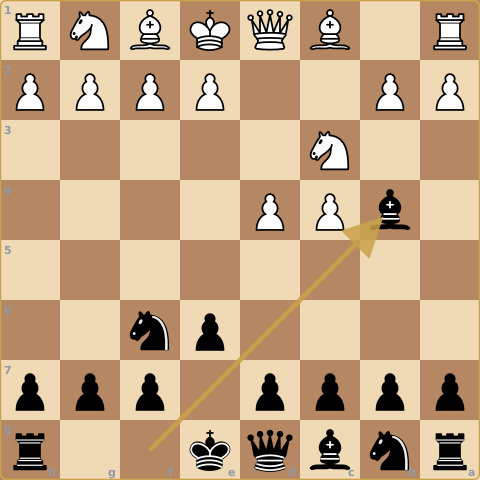
At 1400 to 2200 on Lichess, 50% of players answer 3.Nc3 with 3...Bb4, far more than 3...d5 (32%). Three ideas carry the whole opening.
The pin. With White's d-pawn gone from d2, the bishop on b4 pins the c3 knight to the king on e1. That knight can't move while the pin lasts.
Control of e4. White would love to play e4 and build a big center. The knight on c3 is normally what supports that push. While it's pinned, it can't recapture on e4, so Black's knight on f6 (and later a bishop on b7) can fight for the square with pieces instead of pawns.
Doubled c-pawns. Black is often happy to take on c3 and give White doubled pawns. The clearest example is the Saemisch:
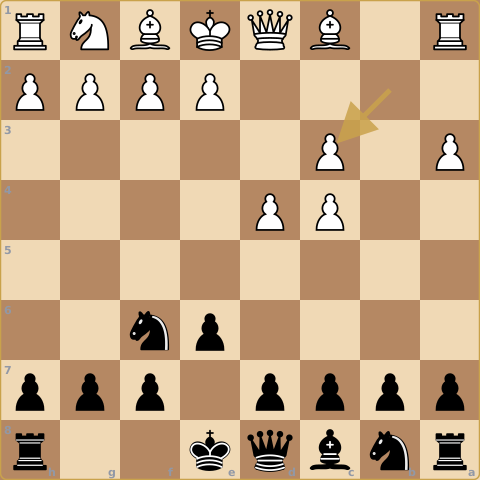
White gets the two bishops and a broad center. Black gets a clear target: the pawn on c4 can't be defended by the pawn on c3 behind it. Our guide lays out the plan as castling and ...c5 to hit d4 and fix the structure, then ...Nc6, ...b6 and ...Ba6 to pile up on c4.
White's other systems are mostly ways to avoid that structure, and they're spread out at this level: 4.Qc2 (18%) lets the queen recapture on c3, 4.e3 (12%) with Ne2 lets a knight do it, and 4.Nf3, 4.Bd2 and 4.Bg5 are all around 16 to 17%. Against nearly all of them, Black's calm answer in our trainer is 4...O-O, castling first and then hitting the center with ...c5 and ...d5.
Why White plays 3.Nf3
Plenty of 1.d4 players don't want to face the pin at all. The simplest fix is to develop the other knight first. With no knight on c3, there's nothing to pin and no doubled pawns to worry about. At 1400 to 2200, Black answers 3.Nf3 with 3...d5 in 43% of games, 3...Bb4+ in 19% and 3...b6 in 18%. Those last two are the Nimzo's natural partners.
The Bogo-Indian: keep the bishop check
The bishop still goes to b4, but now it's a check rather than a pin. At 1200 to 2000 on Lichess, White blocks with 4.Bd2 in 55% of games, plays 4.Nc3 in 36% and 4.Nbd2 in 9%. That 4.Nc3 is good news for a Nimzo player: after 4...O-O you're in a Nimzo-Indian anyway.
Against 4.Bd2, our trainer plays 4...Qe7. The queen protects the bishop, so Black can wait and trade on d2 when it suits, then set up ...d6 and ...e5 with the dark-squared bishops off. It works in practice too: after 4.Bd2, Black wins 47% of games with 4...Qe7 but only 43% with the more common 4...Bxd2+, and Black wins 57% after the line above.
The Queen's Indian: fianchetto instead
Here Black puts the light-squared bishop on the long diagonal, where it watches e4 from b7. The fight for e4 is the same as in the Nimzo, just with a different bishop.
White's replies at 1400 to 2200 split almost evenly between 4.Nc3 (37%) and 4.g3 (35%). Our trainer answers both, and everything else, with 4...Bb7. Against the Fianchetto, the knight jumps to e4:
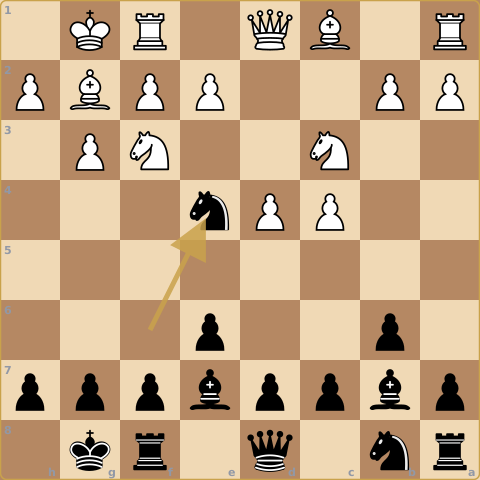
If White adds a second attacker with 8.Qc2, trade with 8...Nxc3 before the knight can be won, then follow up with ...f5 to keep hold of e4. White keeps a small edge here, about a third of a pawn by Stockfish.
Against 4.Nc3 Bb7, watch for the tempting 5.e4?. The pawn is attacked twice and defended once, so 5...Nxe4 wins it. At this level 43% of Black players take, and they win 56% of those games on Lichess.
So which should you play?
- Nimzo-Indian: your main weapon against 3.Nc3. Recommended for 1400 to 2200.
- Add the Bogo-Indian if you want the smallest extra workload. It's the same bishop on the same square, 20 lines in our trainer, and the lowest entry point of the three at 1200 to 2000.
- Add the Queen's Indian if you like solid fianchetto positions and the fight for e4. It's 20 lines in our trainer and pitched at 1400 to 2200, like the Nimzo.
Either partner is a sound choice. The Lichess results we quote are for single lines, so they don't tell you which opening scores better overall. What the move data does show is where your study time goes: the Bogo is mostly 4.Bd2, and its second line, 4.Nc3, drops you into Nimzo positions you already know. The Queen's Indian needs two main plans, one for 4.Nc3 and one for 4.g3.
One caveat. White can also avoid both 3.Nc3 and 3.Nf3 with moves like 3.g3, and the Nimzo trainer doesn't cover 4.f3. Those are outside these three trainers, so you'll need a separate answer for them.
Frequently asked questions
What is the difference between the Nimzo-Indian and the Queen's Indian?
They depend on White's third move. After 1.d4 Nf6 2.c4 e6 3.Nc3, Black pins the knight with 3...Bb4, which is the Nimzo-Indian. After 3.Nf3, there's no knight on c3 to pin, so Black can fianchetto with 3...b6, which is the Queen's Indian. Both fight for the e4 square with pieces rather than pawns.
Why do players avoid the Nimzo-Indian with 3.Nf3?
Because 3...Bb4 against 3.Nc3 pins the knight, fights for e4 and can leave White with doubled c-pawns. Playing 3.Nf3 first means there's nothing on c3 to pin. Black then usually chooses the Queen's Indian (3...b6) or the Bogo-Indian (3...Bb4+), or the Queen's Gambit with 3...d5, which 43% of players pick at 1400 to 2200 on Lichess.
Should I play the Bogo-Indian or the Queen's Indian with the Nimzo-Indian?
The Bogo-Indian is less extra work, because the bishop still goes to b4, the ideas are similar, and White's 4.Nc3 (36% at 1200 to 2000 on Lichess) turns it into a Nimzo. Our library recommends it for 1200 to 2000. The Queen's Indian suits players who like solid fianchetto positions. It's recommended for 1400 to 2200, and White's replies split between 4.Nc3 (37%) and 4.g3 (35%).
What is the best reply to 4.Bd2 in the Bogo-Indian?
Our trainer plays 4...Qe7. The queen defends the bishop, and Black later trades on d2 and follows up with ...d6 and ...e5. At 1200 to 2000 on Lichess, Black wins 47% of games with 4...Qe7 but only 43% with 4...Bxd2+, the most common move at that level.
Copy the lines (PGN)
Every line in this article in standard PGN, ready to paste into Lichess, Chess.com or any chess database.
[Event "Nimzo-Indian vs Queen's Indian vs Bogo-Indian: Which Should Black Play?: Nimzo-Indian, main position"]
[Site "chesscoachacademy.com"]
[Result "*"]

1. d4 Nf6 2. c4 e6 3. Nc3 Bb4 *

[Event "Nimzo-Indian vs Queen's Indian vs Bogo-Indian: Which Should Black Play?: Nimzo-Indian, Saemisch trade"]
[Site "chesscoachacademy.com"]
[Result "*"]

1. d4 Nf6 2. c4 e6 3. Nc3 Bb4 4. a3 Bxc3+ 5. bxc3 *

[Event "Nimzo-Indian vs Queen's Indian vs Bogo-Indian: Which Should Black Play?: Bogo-Indian, 4.Bd2 Qe7"]
[Site "chesscoachacademy.com"]
[Result "*"]

1. d4 Nf6 2. c4 e6 3. Nf3 Bb4+ 4. Bd2 Qe7 5. a3 Bxd2+ 6. Nbxd2 d6 *

[Event "Nimzo-Indian vs Queen's Indian vs Bogo-Indian: Which Should Black Play?: Queen's Indian, Fianchetto"]
[Site "chesscoachacademy.com"]
[Result "*"]

1. d4 Nf6 2. c4 e6 3. Nf3 b6 4. g3 Bb7 5. Bg2 Be7 6. O-O O-O 7. Nc3 Ne4 8. Qc2 Nxc3 9. Qxc3 f5 *

[Event "Nimzo-Indian vs Queen's Indian vs Bogo-Indian: Which Should Black Play?: Queen's Indian, 5.e4 pawn grab"]
[Site "chesscoachacademy.com"]
[Result "*"]

1. d4 Nf6 2. c4 e6 3. Nf3 b6 4. Nc3 Bb7 5. e4 Nxe4 6. Nxe4 Bxe4 *
Keep reading
- The Most Reliable 1.d4 Defenses for Black: How these three compare with the King's Indian, Slav, Dutch and the rest.
Build your Nimzo pair and drill it
Start with the Nimzo-Indian trainer (20 lines built from about 10.7 million Lichess games), then add your partner for 3.Nf3: the Bogo-Indian (20 lines, about 1.0 million games) or the Queen's Indian (20 lines, about 1.5 million games). You play Black against the moves players at your level really choose, and every one of your moves is checked by Stockfish.
All three are free during the open beta, and progress tracking on every line is free too once you create an account.
Practice the Nimzo-Indian →
Practice the Bogo-Indian →
Practice the Queen's Indian →
Nimzo, Bogo and Queen's Indian lines built from Lichess games. Free during the open beta, with free progress tracking.
Practice the Nimzo-Indian free →