The Ponziani Opening Trap: How to Punish Black's Most Common Mistake
TL;DR
- Built from about 12 million Lichess games at 600 to 1500. Only about 4% of players at this level choose 3.c3, so most opponents meet it unprepared.
- Black's replies to 3.c3: 3...Nf6 47%, 3...Bc5 25%, 3...d6 about 10%, and Black's best try, 3...d5, only 6%.
- 3...Bc5 is a mistake: 4.d4 hits e5 and the bishop at the same time, and the trap follows a few moves later.
- After 3...Bc5 4.d4 exd4 5.cxd4 Bb4+ 6.Nc3 d6 7.d5, 70% of players answer 7...Ne5?, and White scores 69% in those games on Lichess. The refutation is 8.Qa4+ and 9.Qxb4.
- White has a trap to avoid too: in the 3...Nf6 main line, blocking ...Bb4+ with 7.Nc3?? loses material. 11% of players at this level do it.
A Trap Hiding Inside a Popular Move
Most chess "traps" described online are either exceedingly rare in practice or simply invented. This one is neither: it grows out of Black's second most popular reply to the Ponziani, and most players at this level fall for it, verified against this site's Lichess data rather than assumed from reputation.
1. e4 e5 2. Nf3 Nc6 3. c3
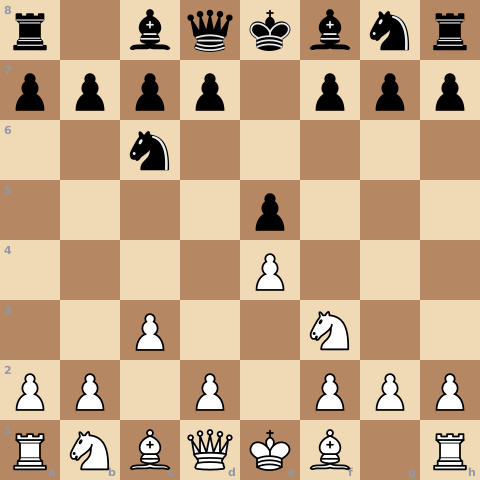
This is the Ponziani's entire idea, preparing a big pawn center with d4 so that if Black ever takes on d4, White can recapture with the c-pawn. At 600 to 1500 on Lichess, Black's response splits four ways:
- 3...Nf6 (developing the knight to attack the e4 pawn), 47%, Black's most popular response.
- 3...Bc5 (developing the bishop toward f2), 25%, natural-looking, and a mistake.
- 3...d6 (supporting e5), about 10%, solid but passive.
- 3...d5 (striking the center at once), only 6%, and Black's best reply. After 4.exd5 Qxd5, White can't chase the queen with Nc3 because the c3 pawn is in the way.
That gap matters. The best reply is the rarest one, and a quarter of opponents choose the move that opens the door to what follows.
Where the Trap Actually Begins
Following 3...Bc5:
4. d4 exd4 5. cxd4
4.d4 attacks e5 and the bishop behind it. Black takes with 4...exd4 in 89% of games, and after 5.cxd4 White has the ideal center and the bishop is attacked again. Black's response splits two ways:
- 5...Bb4+ (the bishop checks from b4), 53%, getting out with tempo.
- 5...Bb6 (the bishop retreats to b6), 37%, keeping it safe and aimed at d4.
After the check, White blocks with 6.Nc3. With no black knight on d5, the block is safe here. The most common replies are 6...Nf6 (31%) and 6...d6 (23%), and the second one is where the danger lives:
6...d6 7. d5
White pushes the d-pawn and kicks the c6 knight. The bishop on b4 is now defended only by that knight. If the knight moves, the bishop is loose, and 70% of players at this level move it to the natural-looking central square:
7...Ne5?
It looks like a good developing move with a threat on the f3 knight. It loses a piece:
8. Qa4+
The queen gives check along the a4 to e8 diagonal and attacks the bishop on b4 at the same time. Black has to deal with the check, and then 9. Qxb4 wins the bishop. (If Black blocks with the knight, 8...Nc6, then 9.dxc6 takes the knight instead.) White scores 69% in these games on Lichess.
One detail matters: don't take on e5 first. After 8.Nxe5? Bxc3+, the bishop escapes with check, and the chance is gone.
What This Means for Each Side
If you're playing White: when the knight lands on e5, check with the queen before anything else. And remember the one trap on your side of the board. In the 3...Nf6 main line, after 4.d4 exd4 5.e5 Nd5 6.cxd4 Bb4+, block with 7.Bd2. The knight block 7.Nc3?? loses to 7...Nxc3 8.bxc3 Bxc3+, which forks your king and the rook on a1.
If you're playing Black: 3...d5 is your best reply to 3.c3. If you do play 3...Bc5, the calm 5...Bb6 avoids the whole problem, and once White has pushed d5, don't move the c6 knight while it's the only defender of the bishop on b4.
The Honest Scope of This Claim
This is a real, verified tactical trap sitting inside a common line, not an exaggerated reputation. Every move above was checked with a chess rules library, and every percentage is quoted exactly from this site's Lichess data for 600 to 1500 rated players: 25% of them play 3...Bc5, 70% of those who reach the position after 7.d5 fall for 7...Ne5?, and White scores 69% in those games.
Read the full Ponziani Opening repertoire →
More traps and gambits
Back to the full series:
- Chess Opening Traps & Gambits: Every trap and gambit guide in this series, checked against our data.
Try It Yourself for Free
Every line above, both sides of the trap and the safer alternatives around it, is fully interactive on this site. All 36 openings, including the Ponziani, are completely unlocked during this site's open beta, no card, no limit, no account required to start, with your progress tracked for free if you create one.
Every line checked the same way, against real game data, not against what sounds right.
Browse all 36 openings free →