The Ponziani Opening: A Low-Theory Plan Against 1...e5 for 600 to 1500 Players
TL;DR: the data
Built from 12 million Lichess games played by 600 to 1500 rated players You play White, 18 practice lines, every move of yours checked by Stockfish Most common line 1. e4 e5 2. Nf3 Nc6 3. c3 Nf6 4. d4 exd4 5. e5 Nd5 6. cxd4 Bb4+ 7. Bd2 Bxd2+ 8. Nbxd2 Replies to 3.c3 3...Nf6 47% · 3...Bc5 25% · 3...d6 11% Worth knowing After 3...Bc5 4.d4 exd4 5.cxd4 Bb4+ 6.Nc3 d6 7.d5, 70% of players answer 7...Ne5?, and White scores 69% in those games. The refutation is 8.Qa4+ and 9.Qxb4.
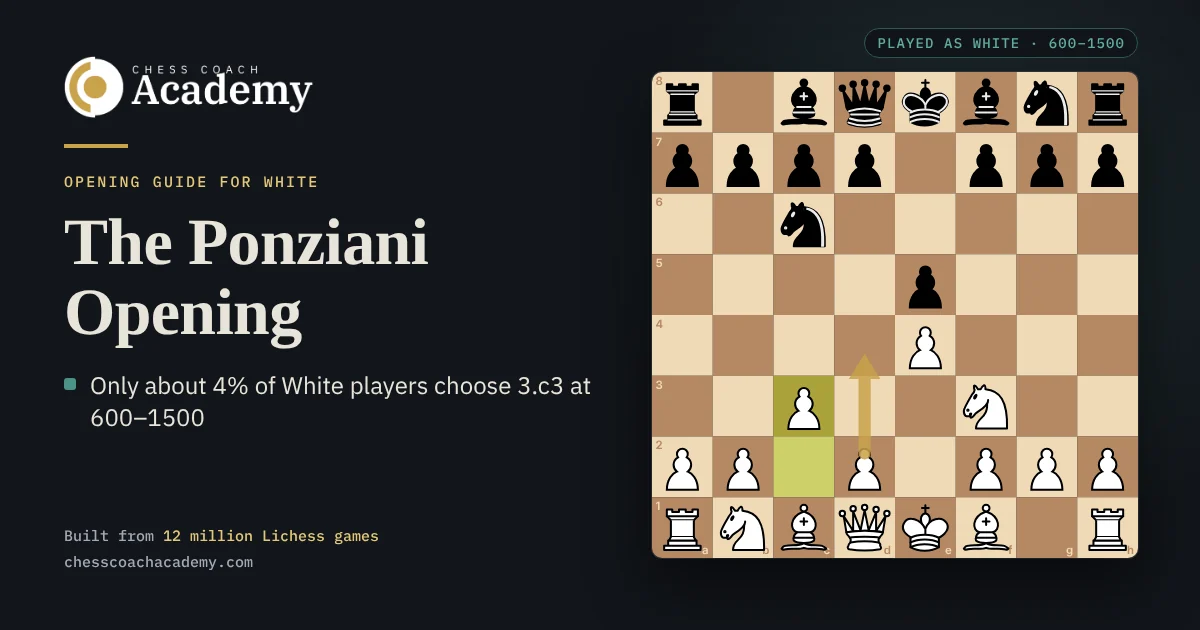
The Ponziani Opening is 1.e4 e5 2.Nf3 Nc6 3.c3. The quiet pawn move has one clear job: prepare d4. If Black ever takes on d4, you take back with the c-pawn and keep two pawns side by side in the center.
We built this guide from 12 million Lichess games played by 600 to 1500 rated players. At this level only about 4% of White players choose 3.c3, so most of your opponents are on their own from move three. And they often go wrong: a quarter of them answer with 3...Bc5, which walks straight into your d4 push.
1. e4 e5 2. Nf3 Nc6 3. c3
Practice the Ponziani Opening free →Who it's for
Players rated roughly 600 to 1500 who want one simple plan against 1...e5 and don't want to learn pages of theory. The idea is always the same: c3, then d4, then develop behind your big center.
It suits you if you like surprising your opponent early. If you prefer quick attacks on f7, the Italian Game gives more of those. The Ponziani is about space and a strong center, with a few sharp tricks along the way.
Why it works at 600 to 1500
- One plan covers almost everything: c3, d4, and recapture with the c-pawn to keep a big center.
- Your opponents rarely see it. With only about 4% of players choosing 3.c3, most Black players have to find the right moves by themselves.
- Common replies lose ground fast. 3...Bc5 runs into d4 with tempo, and 5...Ng4 in the main line strands a knight on the edge.
- 3.c3 takes the c3 square from your knight. After 3...d5 4.exd5 Qxd5 you can't chase Black's queen with Nc3.
- Against best play the Ponziani only gives a level game. It's a practical weapon, not a refutation of 1...e5.
- There's one move you must remember in the main line: after 6...Bb4+, block with 7.Bd2, never 7.Nc3.
What 600 to 1500 players actually play
Almost half of Black players (47%) answer 3.c3 with 3...Nf6, attacking your e4 pawn now that your knight can't defend it from c3. A quarter play 3...Bc5, which is a mistake because d4 hits the bishop and e5 at the same time. 3...d6 is solid but passive, and Black's best reply, 3...d5, shows up in only 6% of games at this level.
Three numbers from the data are worth remembering:
- After 1.e4 e5 2.Nf3 Nc6, only about 4% of players rated around 600-1500 play 3.c3. The Italian's 3.Bc4 (42%) is more than ten times as popular.
- Black's replies to 3.c3 at this level: 3...Nf6 47%, 3...Bc5 25%, 3...d6 about 10%, 3...d5 6%.
- After 3...Bc5 4.d4 exd4 5.cxd4 Bb4+ 6.Nc3 d6 7.d5, 70% of players answer 7...Ne5?, and White scores 69% in those games. The refutation is 8.Qa4+ and 9.Qxb4.
How to play the Ponziani Opening: move by move
Each board below is a decision point from the practice lines. The arrows show Black's most common replies at 600 to 1500, labeled with how often each one is played in that exact position. Under each board you'll find why players choose the move and the answer you play.
After 1. e4 e5 2. Nf3
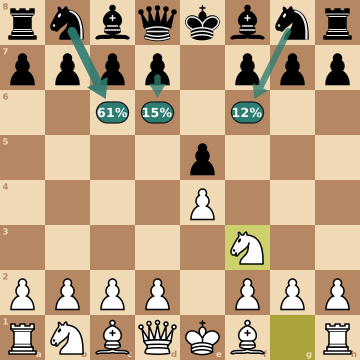
- 2...Nc6 (61%). Nc6 develops and protects e5 at the same time.
Your answer: 3. c3. The Ponziani move: get ready to push d4 and build a big center. - 2...d6 (15%). d6 protects e5 with a pawn instead of a knight.
Your answer: 3. d4. Challenge Black's center right away. - 2...Nf6 (12%). Nf6 ignores the threat to e5 and attacks your e4 pawn instead.
Your answer: 3. d4. Open the center and attack e5 again.
After 1. e4 e5 2. Nf3 Nc6 3. c3
The key position of the Ponziani. Your next move is d4 against nearly everything. Only 3...d5 asks you to do something different.
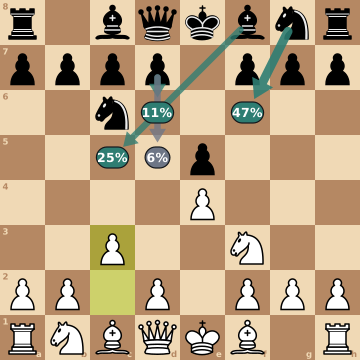
- 3...Nf6 (47%). Your pawn is on c3, so your knight can't go there to defend e4.
Your answer: 4. d4. Carry out the plan and hit e5, instead of defending e4. - 3...Bc5 (25%). Bc5? It walks right into your plan: d4 now attacks e5 and the bishop at the same time.
Your answer: 4. d4. Strike the center and hit the bishop on c5. - 3...d6 (11%). Black's f8 bishop now has less room.
Your answer: 4. d4. Take the center, just as c3 prepared. - 3...d5 (6%). Black opens the center before you get d4 in.
Your answer: 4. exd5. Take the pawn.
After 1. e4 e5 2. Nf3 Nc6 3. c3 Nf6 4. d4
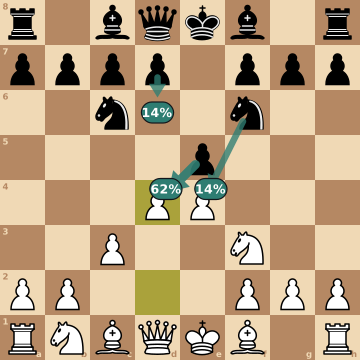
- 4...exd4 (62%). It removes the pawn that was attacking e5.
Your answer: 5. e5. Push forward and kick the knight on f6 before taking back on d4. - 4...Nxe4 (14%). Black grabs your e4 pawn with the knight.
Your answer: 5. Bd3. Attack the knight on e4 and get ready to castle. - 4...d6 (14%). Black holds e5 with d6.
Your answer: 5. d5. Push with tempo and chase the c6 knight away.
After 1. e4 e5 2. Nf3 Nc6 3. c3 Nf6 4. d4 exd4 5. e5
Your pawn kicks the knight before you take back on d4. Where the knight goes decides the game: d5 is best, g4 is a mistake.
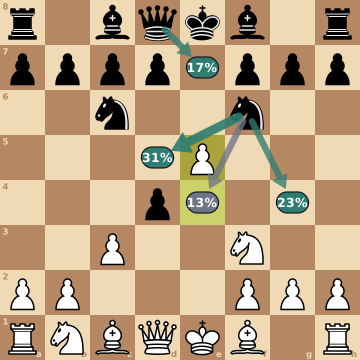
- 5...Nd5 (31%). From d5 the knight is safe and watches c3 and b4.
Your answer: 6. cxd4. Take back and keep two strong pawns on d4 and e5. - 5...Ng4 (23%). Ng4? Your e5 pawn covers f6, so once h3 chases the knight, its only retreat is h6, on the edge.
Your answer: 6. cxd4. Take back and keep your big center. The knight on g4 is in trouble. - 5...Qe7 (17%). But the queen now blocks Black's f8 bishop.
Your answer: 6. cxd4. Take back, and your d4 pawn now protects e5. - 5...Ne4 (13%). The knight looks active, but it can be chased by Bd3 later.
Your answer: 6. cxd4. Take back and keep the center.
After 1. e4 e5 2. Nf3 Nc6 3. c3 Nf6 4. d4 exd4 5. e5 Nd5 6. cxd4
The trap position. If Black checks on b4, block with the bishop. The knight on d5 is waiting to capture on c3.
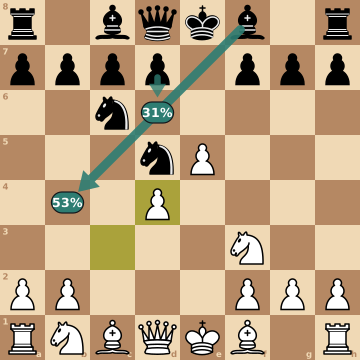
- 6...Bb4+ (53%). Nc3??bxc3 Bxc3+ forks your king and the rook on a1.
Your answer: 7. Bd2. Block the check with the bishop, the safe way. - 6...d6 (31%). But notice the knight on d5: nothing defends it.
Your answer: 7. Bc4. Develop with a threat: the knight on d5 has no defender.
After 1. e4 e5 2. Nf3 Nc6 3. c3 Bc5 4. d4 exd4 5. cxd4
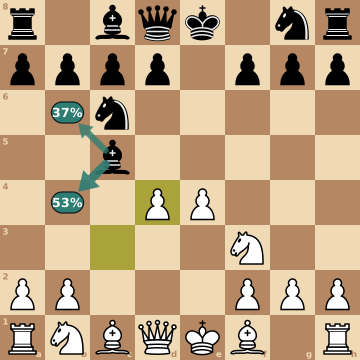
- 5...Bb4+ (53%). Here Black has no knight on d5, so you can safely block with your knight.
Your answer: 6. Nc3. Block the check and develop a piece. - 5...Bb6 (37%). Black retreats the bishop to b6.
Your answer: 6. Nc3. Develop and protect e4.
After 1. e4 e5 2. Nf3 Nc6 3. c3 Bc5 4. d4 exd4 5. cxd4 Bb4+ 6. Nc3
Here the knight block is safe, because no black knight sits on d5. Look at the bishop on b4: only the c6 knight defends it.
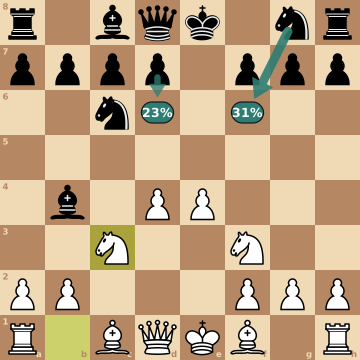
- 6...Nf6 (31%). Black develops Nf6 and attacks e4.
Your answer: 7. Bd3. Protect e4 and get ready to castle. - 6...d6 (23%). Black plays d6, but the b4 bishop is still defended only by the c6 knight.
Your answer: 7. d5. Kick the knight that defends the b4 bishop.
After 1. e4 e5 2. Nf3 Nc6 3. c3 d6 4. d4
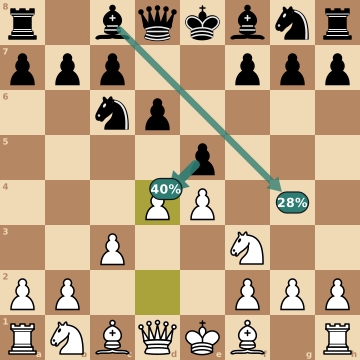
- 4...exd4 (40%). Black takes on d4.
Your answer: 5. cxd4. The ideal center, with pawns on d4 and e4. - 4...Bg4 (28%). But the bishop left c8, and now b7 has no defender.
Your answer: 5. Qb3. Break the pin and attack the b7 pawn.
After 1. e4 e5 2. Nf3 d6 3. d4
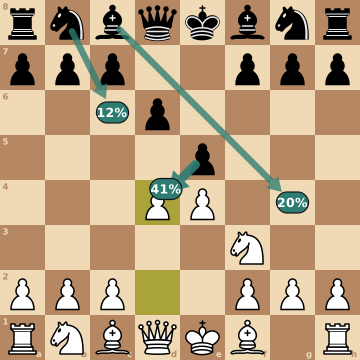
- 3...exd4 (41%). Black takes on d4.
Your answer: 4. Nxd4. Recapture with the knight, strong in the center. - 3...Bg4 (20%). You can punish it by taking on e5.
Your answer: 4. dxe5. Take the pawn. Black can't simply take back. - 3...Nc6 (12%). Black develops Nc6 to pressure d4.
Your answer: 4. d5. Push with tempo and chase the knight away.
After 1. e4 e5 2. Nf3 Nf6 3. d4
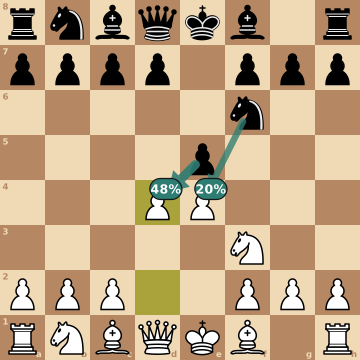
- 3...exd4 (48%). Black takes on d4.
Your answer: 4. e5. Kick the knight on f6 before taking back on d4. - 3...Nxe4 (20%). Black grabs your e4 pawn.
Your answer: 4. dxe5. Take back a pawn. Material is level again.
Your plan after the opening
Against 3...Nf6: push e5, keep the center, block with Bd2
After 4.d4 exd4 5.e5 the knight has to move, and then you take back on d4 with the c-pawn. Your pawns on d4 and e5 take away c5, d6 and f6 from Black's pieces. After 5...Nd5 6.cxd4 Bb4+ 7.Bd2 Bxd2+, recapture with the b1 knight so a new piece joins the game. Then Bb5 or Bc4 and castle. The position is level, but it's easy to play.
If Black answers 6.cxd4 with 6...d6 instead, play 7.Bc4. The knight on d5 has no defender, so Black has to spend a move on it while you castle.
1. e4 e5 2. Nf3 Nc6 3. c3 Nf6 4. d4 exd4 5. e5 Nd5 6. cxd4 Bb4+ 7. Bd2 Bxd2+ 8. Nbxd2 d6 9. Bb5 O-O 10. O-O
Against 3...Bc5: take the center with tempo
This is what 3.c3 was made for. After 4.d4 exd4 5.cxd4 you have pawns on e4 and d4 and the bishop has to move again. If it retreats with 5...Bb6, develop with Nc3 and pin the c6 knight with Bb5. Then castle, play h3 and Be3 to support d4. Stockfish rates you almost a pawn better.
1. e4 e5 2. Nf3 Nc6 3. c3 Bc5 4. d4 exd4 5. cxd4 Bb6 6. Nc3 d6 7. Bb5
Against 3...d5: stay calm, it's Black's best
After 4.exd5 Qxd5 you can't kick the queen with Nc3, because your pawn is on c3. Play 5.d4 to hit e5 and free your bishop. If Black pushes 5...e4, retreat with 6.Nfd2 and then attack the queen with Bc4 or f3. Black is a little more comfortable here, but it's only a small edge.
1. e4 e5 2. Nf3 Nc6 3. c3 d5 4. exd5 Qxd5 5. d4
Against 2...d6 and 2...Nf6: strike with d4 at once
Not everyone plays 2...Nc6. Against the Philidor (15%) and the Petrov (12%) you push 3.d4 right away. After 2...Nf6 3.d4 exd4 4.e5, kick the knight first, then win back the pawn with your queen. If Black grabs e4 with 3...Nxe4 4.dxe5 Bc5, don't be tempted by 5.Qd5. Play 5.Be3 and trade off the bishop that is hitting f2.
1. e4 e5 2. Nf3 Nf6 3. d4 exd4 4. e5 Ne4 5. Qxd4
Traps and common mistakes
The Ponziani trap: 8.Qa4+ wins a bishop
1. e4 e5 2. Nf3 Nc6 3. c3 Bc5 4. d4 exd4 5. cxd4 Bb4+ 6. Nc3 d6 7. d5 Ne5? 8. Qa4+
After 6...d6 the bishop on b4 is defended only by the c6 knight. So kick the knight with 7.d5. Most players (70% at this level) move it to the center with 7...Ne5, and White scores 69% in those games. 8.Qa4+ gives check and attacks the bishop at the same time. Black has to deal with the check, and then 9.Qxb4 wins the piece.
Order matters: don't take the knight with 8.Nxe5 first, because 8...Bxc3+ lets the bishop escape with check.
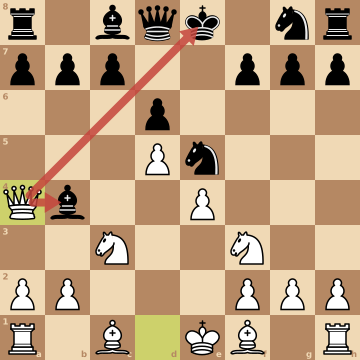
Blocking the check with the knight: 7.Nc3??
1. e4 e5 2. Nf3 Nc6 3. c3 Nf6 4. d4 exd4 5. e5 Nd5 6. cxd4 Bb4+ 7. Nc3?? Nxc3 8. bxc3 Bxc3+
In the main line, 6...Bb4+ is the most common move (53%). Blocking with the knight feels natural, but the black knight on d5 takes it, and after 8.bxc3 Bxc3+ the bishop forks your king and the rook on a1.
Block with 7.Bd2 instead. It offers a bishop trade and keeps everything safe.
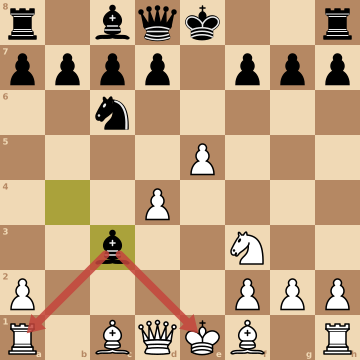
Black's knight on the edge: 5...Ng4?
1. e4 e5 2. Nf3 Nc6 3. c3 Nf6 4. d4 exd4 5. e5 Ng4 6. cxd4 Bb4+ 7. Nc3 d6 8. h3 Nh6 9. Bg5
23% of players answer 5.e5 by jumping to g4. Your e5 pawn covers f6, so once h3 chases the knight, its only retreat is h6, on the edge. Notice that here 7.Nc3 is fine: there is no knight on d5 to take it. Stockfish rates you about two pawns better.
Hunting with the queen after ...Bg4
1. e4 e5 2. Nf3 Nc6 3. c3 d6 4. d4 Bg4 5. Qb3 Nf6 6. Qxb7 Bd7 7. d5
When Black pins your knight with ...Bg4, the c8 bishop has left b7 without a defender. Qb3 breaks the pin and attacks b7. If Black ignores it, take the pawn, then push d5 to kick the c6 knight.
The mistake comes next: after winning one pawn, don't send the queen after more. Bring out your other pieces and castle first.
Frequently asked questions
Is the Ponziani Opening good for beginners?
Yes. It has one clear plan (c3, then d4) and very little theory. At 600 to 1500 it also scores well in practice, because common replies like 3...Bc5 and 5...Ng4 lose ground right away.
Is the Ponziani Opening actually good?
It's sound, but against best play it only gives a level game. Black's strongest reply, 3...d5, shows up in just 6% of games at this level, so in practice you'll usually get the big center you want.
What is the Ponziani trap?
After 3...Bc5 4.d4 exd4 5.cxd4 Bb4+ 6.Nc3 d6 7.d5, 70% of players at 600 to 1500 answer 7...Ne5, and White scores 69% in those games. 8.Qa4+ checks the king and attacks the loose bishop, and 9.Qxb4 wins it.
What is the most common reply to the Ponziani at club level?
At 600 to 1500 on Lichess, it's 3...Nf6 (47%), followed by 3...Bc5 (25%). Against 3...Nf6 you play 4.d4, and after 4...exd4 5.e5 your pawn kicks the knight.
Why is the Ponziani so rarely played?
Most players learn 3.Bc4 or 3.Bb5 first. After 1.e4 e5 2.Nf3 Nc6, only about 4% of players rated around 600-1500 play 3.c3, while the Italian's 3.Bc4 is more than ten times as popular. That rarity is part of its value: your opponents won't have much experience against it.
Keep learning
- All 36 opening guides: every opening on the site, grouped by what you play as White and Black.
- The Ponziani Opening Trap: A deeper look at the 8.Qa4+ trick and why so many players fall for it.
- The best trap-heavy openings for blitz: How the Ponziani compares with other trap-rich openings when the clock is short.
- Best chess openings for beginners: Where the Ponziani fits among openings grouped by rating.
The Coach plays the Ponziani against you with the moves 600 to 1500 players actually choose, including the 3...Bc5 mistake and the Qa4+ trap, and explains every move in plain English. Progress tracking is free during the open beta.
Practice the Ponziani Opening free →