Should Black Accept or Decline the Queen's Gambit (1.d4 d5 2.c4)?
TL;DR
Short answer Both are sound. Accept with 2...dxc4 if you want quick, active piece play and a clear plan. Decline with 2...e6 if you want the most solid center and don't mind a slower, more patient game. Either way, don't try to keep the pawn. Games behind this article About 41 million Lichess games at 900 to 1800 (Queen's Gambit Accepted trainer) and about 177 million at 1300 to 2200 (Queen's Gambit Declined trainer) Black's reply to 2.c4 (900 to 1800) 2...dxc4 31% · 2...e6 23% · 2...Nf6 16% · 2...c6 16% White's 3rd move vs 2...dxc4 3.Nc3 32% · 3.e3 28% · 3.e4 28% · 3.Nf3 7% Recommended range QGA: 900 to 1800 Elo, 13 lines (Black side). QGD: 1300 to 2200 Elo, 14 lines (White side). The pawn-grab in numbers After 3.e3, 23% of players try to keep the pawn with 3...b5. White wins 63% of those games at 900 to 1800 on Lichess, compared with 54% after 3...Nf6.
The myth: 2...dxc4 wins a pawn
It's called a gambit, so it looks like Black can grab a free pawn. It isn't really a gambit at all. White usually gets the pawn back, and if Black tries to hold on to it, things go wrong quickly.
Here's the classic way it goes wrong. After 3.e3, White's bishop threatens to take on c4. Black props the pawn up with ...b5, White undermines it with a4, and the long diagonal opens up:
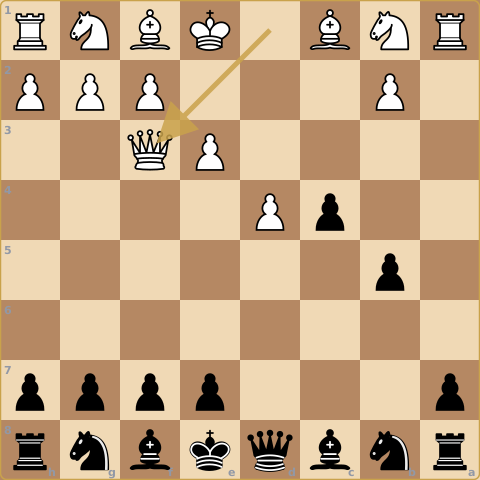
The d-, c- and b-pawns have all left the diagonal, so the queen on f3 hits the rook on a8. Blocking with ...Nc6 or ...Bb7 just drops a piece to the queen. Black ends up losing material, all for a pawn that was never going to stay.
This isn't a rare accident. At 900 to 1800 on Lichess, 23% of players answer 3.e3 with 3...b5, and White wins 63% of those games. After the sensible 3...Nf6, that figure drops to 54%.
The lesson: don't cling to the pawn. Give it back for quick, active development. That's the whole idea of the Queen's Gambit Accepted.
How the Accepted is played properly
This is the Classical main line. Black lets White win the pawn back with Bxc4, but uses that time to develop and hit the center with ...c5. Then ...a6 prepares ...b5, gaining queenside space with tempo on the c4 bishop and opening a good diagonal for Black's light-squared bishop on b7. In our trainer, four different move orders (starting with 3.Nc3, 3.e3 or 3.Nf3) end in exactly this position, so one plan covers a lot of games.
What does White get? One try is to trade queens early:
Black's king can't castle, but with queens off it's safe enough in the middle. If you hate slightly dull endgames, that's a point against the QGA.
The bigger test is an early e4. White plays 3.e4 in 28% of games, and after 3.Nc3 Nf6, 4.e4 comes in 47% of them. The answer is the same both times: hit d4 at once with ...e5.
This is sharper and needs concrete preparation. Only 13% of players at this level find 3...e5, and the passive alternatives let White build a big center for free. Against 3.Nc3 Nf6 4.e4 e5 5.dxe5, trade queens with 5...Qxd1+ first, then win the pawn back.
How the Declined is played
Here Black simply ignores the c4 pawn and backs up d5 with ...e6. The center is rock solid, but there's a cost. The light-squared bishop on c8 is now behind the e6 pawn, and much of Black's early play is about freeing it.
Our Queen's Gambit Declined trainer plays the classical pin with 4.Bg5. At 1300 to 2200 on Lichess, 3...Nf6 is Black's most common move (56%), then 4...Be7 (58%) and 5...O-O (43%):
Black's freeing ideas from here are ...h6 with ...Ne4 to trade pieces, or the ...c5 and ...dxc4 breaks. White's other big option is the Exchange Variation, which leads to the Carlsbad structure:
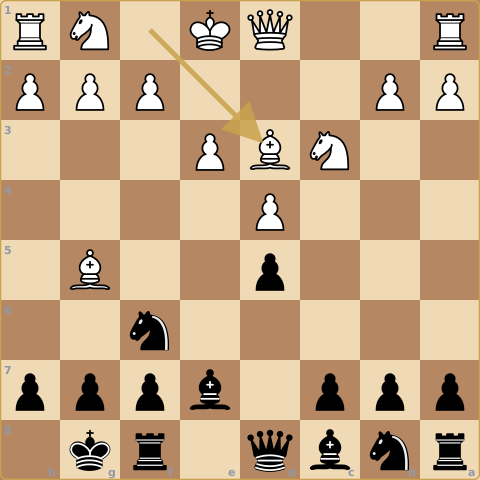
Recapturing with the e-pawn frees Black's bishop, so White changes plans. The famous one is the minority attack: push the b-pawn to b4 and b5 and create a weakness in Black's queenside pawns. It's patient chess. Very little happens fast, and that's the point.
The QGD has a huge pedigree. Of the 34 games in the 1927 Alekhine versus Capablanca World Championship match, all but the first and third began with it.
Which one suits you?
Accept (2...dxc4) if:
- You want active pieces and a simple plan: develop, hit the center with ...c5, give the pawn back on your terms.
- You'd rather learn one setup and the ...e5 answer to e4 than a whole family of slow structures.
- You're roughly 900 to 1800. That's the range our library recommends for it.
Decline (2...e6) if:
- You like solid centers and long strategic games.
- You're happy to defend patiently and wait for the ...c5 or ...e5 break.
- You don't mind spending time on the light-squared bishop problem.
There's a third way to decline too: 2...c6, the Slav, which supports d5 without shutting in the bishop (we have a Slav trainer as well). And the Accepted is far from a sideline. At 900 to 1800 on Lichess, 2...dxc4 is the most popular reply to 2.c4 (31%). At 1300 to 2200 it's second (24%), just behind 2...e6 (27%).
If you're still unsure, start with the Accepted. The ideas are easier to learn, and the pieces come out quickly, which makes it a good first answer to 1.d4 for most club players.
Frequently asked questions
Should you accept the Queen's Gambit as Black?
You can. The Queen's Gambit Accepted (2...dxc4) is fully sound and was played by World Champions such as Alekhine, Smyslov and Kramnik. The key is to give the pawn back for active development rather than trying to keep it. Our library recommends it for 900 to 1800 Elo.
Does Black win a pawn in the Queen's Gambit Accepted?
Not for long. White almost always wins it back with Bxc4, and trying to hold it with ...b5 is risky. After 3.e3 b5 4.a4 c6 5.axb5 cxb5 6.Qf3, White's queen attacks the rook on a8 and Black loses material. At 900 to 1800 on Lichess, White wins 63% of games after 3.e3 b5, compared with 54% after 3...Nf6.
Is the Queen's Gambit Accepted or Declined better?
Neither is objectively better. The Accepted gives quicker piece play and a clear plan. The Declined gives a more solid center but a more passive light-squared bishop. Choose based on style: active and concrete, or solid and patient.
What is White's most common reply to the Queen's Gambit Accepted?
At 900 to 1800 on Lichess, White plays 3.Nc3 in 32% of games, 3.e3 in 28%, 3.e4 in 28% and the classical 3.Nf3 in only 7%. Early e4 lines, whether 3.e4 or 3.Nc3 and 4.e4, are the sharpest and are best met with ...e5.
Copy the lines (PGN)
Every line in this article in standard PGN, ready to paste into Lichess, Chess.com or any chess database.
[Event "Should Black Accept or Decline the Queen's Gambit (1.d4 d5 2.c4)?: QGA Classical main line"]
[Site "chesscoachacademy.com"]
[Result "*"]

1. d4 d5 2. c4 dxc4 3. e3 Nf6 4. Bxc4 e6 5. Nf3 c5 6. O-O a6 7. Nc3 b5 *

[Event "Should Black Accept or Decline the Queen's Gambit (1.d4 d5 2.c4)?: QGA early queen trade"]
[Site "chesscoachacademy.com"]
[Result "*"]

1. d4 d5 2. c4 dxc4 3. Nf3 Nf6 4. e3 e6 5. Bxc4 c5 6. O-O a6 7. dxc5 Bxc5 8. Qxd8+ Kxd8 *

[Event "Should Black Accept or Decline the Queen's Gambit (1.d4 d5 2.c4)?: QGA 3.e4"]
[Site "chesscoachacademy.com"]
[Result "*"]

1. d4 d5 2. c4 dxc4 3. e4 e5 4. Nf3 exd4 5. Bxc4 Nc6 6. O-O Be6 *

[Event "Should Black Accept or Decline the Queen's Gambit (1.d4 d5 2.c4)?: QGA pawn-grab trap"]
[Site "chesscoachacademy.com"]
[Result "*"]

1. d4 d5 2. c4 dxc4 3. e3 b5 4. a4 c6 5. axb5 cxb5 6. Qf3 *

[Event "Should Black Accept or Decline the Queen's Gambit (1.d4 d5 2.c4)?: QGD with 4.Bg5"]
[Site "chesscoachacademy.com"]
[Result "*"]

1. d4 d5 2. c4 e6 3. Nc3 Nf6 4. Bg5 Be7 5. e3 O-O 6. Nf3 *

[Event "Should Black Accept or Decline the Queen's Gambit (1.d4 d5 2.c4)?: QGD Exchange, Carlsbad"]
[Site "chesscoachacademy.com"]
[Result "*"]

1. d4 d5 2. c4 e6 3. Nc3 Nf6 4. cxd5 exd5 5. Bg5 Be7 6. e3 O-O 7. Bd3 *
Keep reading
- The Most Reliable 1.d4 Defenses for Black: How the Queen's Gambit Accepted compares with eight other answers to 1.d4.
Practice the Queen's Gambit Accepted the right way
Our Queen's Gambit Accepted trainer covers 13 lines built from about 41 million Lichess games at 900 to 1800: 3.Nc3 (with 4.e4, 4.e3, 4.Nf3, 4.Bg5 and 4.Bf4), 3.e3, the sharp 3.e4 and 3.Nf3. You play Black against the moves players at your level really choose, with every one of your moves checked by Stockfish.
Curious about the Declined? Our Queen's Gambit Declined trainer plays it from White's side with the 4.Bg5 pin, which is a quick way to learn the plans you'll be defending against.
Both are free during the open beta, and you can track your progress on every line for free with an account.
13 lines built from about 41 million Lichess games. Free during the open beta, with free progress tracking.
Practice the QGA free →