The Queen's Gambit Accepted: Take the Pawn, Then Hit the Center (900 to 1800)

TL;DR: the data
Built from 41 million Lichess games played by 900 to 1800 rated players You play Black, 13 practice lines, every move of yours checked by Stockfish Most common line 1. d4 d5 2. c4 dxc4 3. Nc3 Nf6 4. e4 e5 Replies to 2...dxc4 3. Nc3 32% · 3. e3 28% · 3. e4 28% Worth knowing After 3.e3, 23% of players try to keep the pawn with 3...b5, and White wins 63% of those games, compared with 54% after 3...Nf6.
In the Queen's Gambit Accepted you simply take the pawn White offers: 1.d4 d5 2.c4 dxc4. The idea is not to keep it. White will win it back, but that costs White time, and you use that time to develop and then hit White's center with ...c5 or ...e5.
This guide is built from 41 million Lichess games played by 900 to 1800 rated players. At that level 2...dxc4 is actually Black's most popular answer to the Queen's Gambit, and White's replies look very different from the books. The classical 3.Nf3 turns up in only 7% of games. Instead you'll mostly meet 3.Nc3, 3.e3 and 3.e4, and this guide shows you one clear answer to each.
1. d4 d5 2. c4 dxc4
Practice the Queen's Gambit Accepted free →Who it's for
Players rated about 900 to 1800 who want an active answer to the Queen's Gambit without a mountain of theory. Most lines lead back to one setup: ...Nf6, ...e6, ...c5, ...a6 and ...b5. Several different White move orders end in exactly the same position.
You need to be comfortable giving the pawn back. If the idea of an extra pawn makes you want to hang on to it at all costs, the data below will change your mind. You also need one sharp answer, ...e5, for when White builds a big center with e4.
Why it works at 900 to 1800
- Fast, free development. White spends a move winning the pawn back, and your light-squared bishop gets a great diagonal on b7 instead of being stuck behind your pawns.
- One setup covers most lines. Against 3.e3, 3.Nf3 and most of 3.Nc3, you play ...Nf6, ...e6, ...c5, ...a6 and ...b5, and you reach the same main position again and again.
- White's natural moves can go wrong. After 3.Nc3 Nf6 4.Nf3 e6 5.e4, your ...Bb4 pin leaves e4 hanging, and in the main line a careless d5 by White just loses a bishop.
- Most lines are level. Stockfish rates the main positions about even, so you win by playing better in the middlegame.
- You have to give the pawn back. Trying to keep it with an early ...b5 is the classic mistake at this level, and the numbers show how badly it goes.
- Against e4 you must act. White's e4 push comes in a large share of games, and passive moves let White keep a big center for free. You need to know the ...e5 counter.
What 900 to 1800 players actually play
After 2...dxc4, White's three favorite moves are almost tied: 3.Nc3 (32%), 3.e3 (28%) and 3.e4 (28%). Only 7% play the classical 3.Nf3. That means you'll face the aggressive e4 push in a big share of your games, either straight away with 3.e4 or one move later after 3.Nc3 Nf6 4.e4. Against both, your answer is the same: ...e5.
Three numbers from the data explain how to play this opening:
- After 1.d4 d5 2.c4, 2...dxc4 is the most popular reply at this rating range (31%), ahead of 2...e6 (23%), 2...Nf6 (16%) and 2...c6 (16%).
- After 2...dxc4, White's most common moves are 3.Nc3 (32%), 3.e3 (28%) and 3.e4 (28%). The classical 3.Nf3 is played in only 7% of games at this level.
- After 3.e3, 23% of players try to keep the pawn with 3...b5, and White wins 63% of those games, compared with 54% after 3...Nf6.
How to play the Queen's Gambit Accepted: move by move
Each board below comes from the practice lines and is shown from your side. The arrows show White's most common replies at 900 to 1800, labeled with how often each one is played in that exact position. Under every board you'll find why White plays the move and the answer you give.
After 1. d4 d5 2. c4 dxc4
Three replies, each in more than a quarter of games. Against 3.Nc3 and 3.e3 you develop with 3...Nf6. Against 3.e4 you strike back straight away with 3...e5.
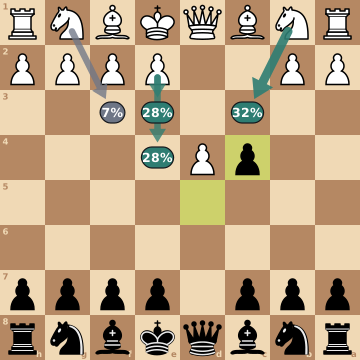
- 3. Nc3 (32%). It doesn't win the c4 pawn back yet.
Your answer: 3...Nf6. Develop and keep an eye on the e4 square. - 3. e3 (28%). It's a calm, sensible way to win the pawn back.
Your answer: 3...Nf6. Develop instead of trying to keep the pawn. - 3. e4 (28%). dxc4.
Your answer: 3...e5. Hit back at d4 before White gets organized. - 3. Nf3 (7%). e5 and keeps White's options open.
Your answer: 3...Nf6. Develop your knight to its best square.
After 1. d4 d5 2. c4 dxc4 3. Nc3 Nf6
Nearly half of White players push 4.e4 here. Answer it with 4...e5. Against everything else, 4...e6 prepares ...c5 or ...Bb4.
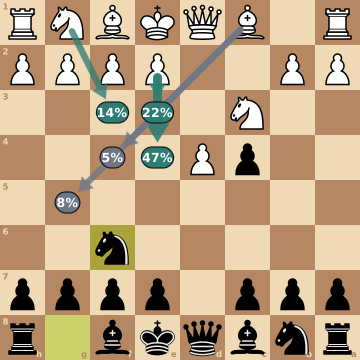
- 4. e4 (47%). The e4 pawn is protected by the c3 knight, and White now has two big pawns in the center.
Your answer: 4...e5. Hit back at d4 straight away. - 4. e3 (22%). e4.
Your answer: 4...e6. Open a path for your f8 bishop. - 4. Nf3 (14%). Nc3.
Your answer: 4...e6. Free your bishop, which is ready to come to b4. - 4. Bg5 (8%). White hasn't won back the c4 pawn yet.
Your answer: 4...e6. Now your queen can recapture on f6, and the f8 bishop is free. - 4. Bf4 (5%). Stockfish already rates the position slightly better for you.
Your answer: 4...e6. c5.
After 1. d4 d5 2. c4 dxc4 3. e3 Nf6
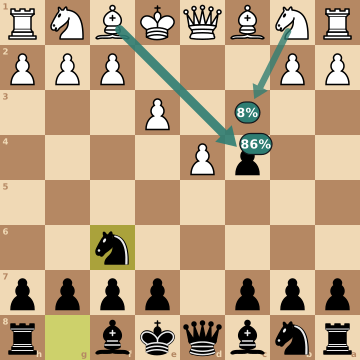
- 4. Bxc4 (86%). White takes the pawn back with Bxc4.
Your answer: 4...e6. Open your bishop and get ready to castle. - 4. Nc3 (8%). e3.
Your answer: 4...e6. Open the bishop, as always.
After 1. d4 d5 2. c4 dxc4 3. e3 Nf6 4. Bxc4 e6
The pawn is back and material is level. Whatever White plays next, your move is 5...c5, the key move of the whole opening.
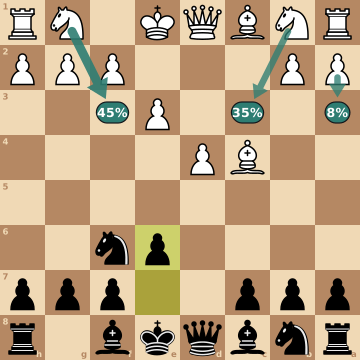
- 5. Nf3 (45%). Bxc4.
Your answer: 5...c5. Hit d4, the key move of the opening. - 5. Nc3 (35%). Bxc4, just with a different move order.
Your answer: 5...c5. Challenge d4, as always. - 5. a3 (8%). It doesn't develop a piece.
Your answer: 5...c5. Strike the center while White plays pawn moves.
After 1. d4 d5 2. c4 dxc4 3. e3 Nf6 4. Bxc4 e6 5. Nf3 c5
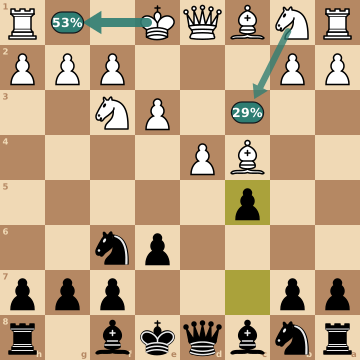
- 6. O-O (53%). White castles.
Your answer: 6...a6. b5. - 6. Nc3 (29%). O-O.
Your answer: 6...a6. b5.
After 1. d4 d5 2. c4 dxc4 3. Nf3 Nf6
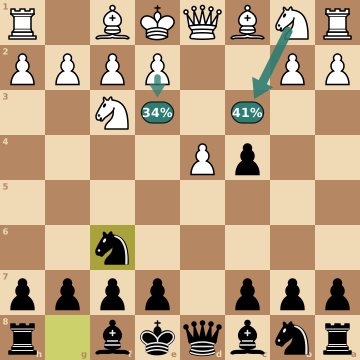
- 4. Nc3 (41%). Nf3.
Your answer: 4...e6. Get your bishop ready for b4. - 4. e3 (34%). White plays e3 to win the pawn back with the bishop.
Your answer: 4...e6. Open the f8 bishop.
Your plan after the opening
Against 3.e3, 3.Nf3 and quiet 3.Nc3 lines: the Classical setup
Let White take back on c4 while you play ...Nf6 and ...e6. Then hit d4 with ...c5. Next comes ...a6 and ...b5, kicking White's bishop and making room for your own bishop on b7, where it looks straight at White's kingside.
Four different White move orders in this guide reach the same position after ...b5. Stockfish rates it level. Two tricks don't work for White there: Nxb5? axb5 Bxb5+ gives up a knight for two pawns, and d5? is met by ...bxc4, winning the bishop.
1. d4 d5 2. c4 dxc4 3. e3 Nf6 4. Bxc4 e6 5. Nf3 c5 6. O-O a6 7. Nc3 b5 8. Be2 Nbd7 9. e4 cxd4 10. Qxd4 Bc5 11. Qd3 Bb7
Against e4: strike back with ...e5
When White builds a big center with e4, don't sit back. ...e5 attacks d4 at once and opens your f8 bishop. After 3.e4 e5 4.Nf3 exd4 5.Bxc4 Nc6 6.O-O, play 6...Be6 to trade off White's dangerous bishop on c4.
The same idea works after 3.Nc3 Nf6 4.e4 e5. If White takes with 5.dxe5, trade queens first with 5...Qxd1+ and then win the pawn back with ...Nxe4 or ...Ng4. Stockfish rates both lines roughly level, and even gives you a tiny edge after 3.Nc3 Nf6 4.e4 e5.
1. d4 d5 2. c4 dxc4 3. e4 e5 4. Nf3 exd4 5. Bxc4 Nc6 6. O-O Be6
Against 4.Nf3 and 5.e4: pin and win e4
After 3.Nc3 Nf6 4.Nf3 e6 5.e4, the knight on c3 is the only piece guarding e4. Pin it with 5...Bb4, and now ...Nxe4 is a real threat. If White protects e4 with 6.Bd3??, just take the bishop with your c4 pawn.
1. d4 d5 2. c4 dxc4 3. Nc3 Nf6 4. Nf3 e6 5. e4 Bb4
Against 4.Bg5 and 4.Bf4: ...e6, ...c5 and play against d4
Play ...e6 so your queen can recapture on f6 if White takes, then hit d4 with ...c5. If White pushes 5.e4 after 4.Bg5 e6, 5...c5 is still the answer. If White plays e3 instead, the trades on d4 often leave White with a lone pawn there, with no pawns beside it to protect it. Put a piece on d5 to block it and aim your pieces at it.
1. d4 d5 2. c4 dxc4 3. Nc3 Nf6 4. Bg5 e6 5. e3 c5 6. Bxc4 cxd4 7. exd4 Nc6 8. Nf3 Be7
Traps and common mistakes
Trying to keep the extra pawn with ...b5
1. d4 d5 2. c4 dxc4 3. e3 b5? 4. a4 c6 5. axb5 cxb5 6. Qf3
This is the big one. After 3.e3, 23% of players at this level try to hold the pawn with 3...b5, and White wins 63% of those games, compared with 54% after 3...Nf6. White breaks up your pawns with a4, and once the b- and c-pawns have moved, 6.Qf3 hits your rook on a8 down the long diagonal.
Play 3...Nf6, let White take back the pawn, and use the time to develop.
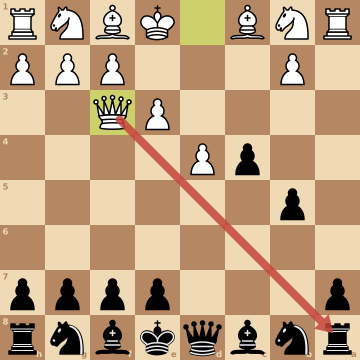
Playing ...b5 before ...a6
1. d4 d5 2. c4 dxc4 3. e3 Nf6 4. Bxc4 e6 5. Nf3 c5 6. O-O b5? 7. Bxb5+
With White's bishop on c4, ...b5 right away just drops a pawn, and it's taken with check. Play ...a6 first, so the pawn on b5 is protected. Only then push ...b5.
Meeting 4.e4 passively
1. d4 d5 2. c4 dxc4 3. Nc3 Nf6 4. e4 e5 5. dxe5 Qxd1+ 6. Nxd1 Nxe4
Many players at this level answer 4.e4 with the quiet 4...e6, but 4...e5 is Stockfish's clear choice. If White takes on e5, swap queens first with 5...Qxd1+, then collect the e4 pawn (or play ...Ng4 if the king took on d1).
Don't retreat with 5...Nfd7?. It doesn't win anything back, and you're just a pawn down.
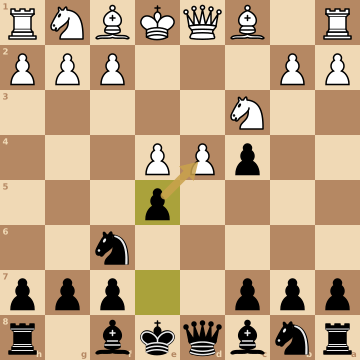
Missing the pin on e4
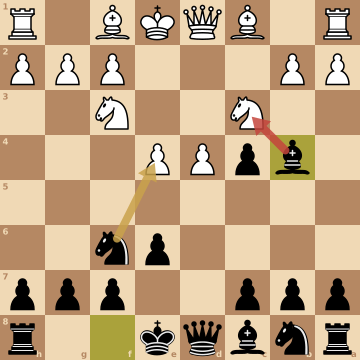
1. d4 d5 2. c4 dxc4 3. Nc3 Nf6 4. Nf3 e6 5. e4 Bb4 6. Bd3?? cxd3
This one is a gift from White, but you have to see it. After 5...Bb4 the c3 knight can't defend e4 without exposing the king, so ...Nxe4 is threatened. Defending with 6.Bd3 walks into your c4 pawn.
Frequently asked questions
Is the Queen's Gambit Accepted good for beginners?
Yes, for players from about 900 to 1800. The plan is easy to remember (take, develop, then ...c5 or ...e5), and many White move orders lead to the same position. The one rule to learn early is not to hang on to the extra pawn.
Should Black try to keep the extra pawn in the Queen's Gambit Accepted?
No. After 3.e3, 23% of players at this level try with 3...b5, and White wins 63% of those games, compared with 54% after 3...Nf6. Let White win the pawn back and spend that time developing.
What is the most common reply to the Queen's Gambit Accepted at club level?
At 900 to 1800 on Lichess it's 3.Nc3 (32%), with 3.e3 and 3.e4 close behind at 28% each. The classical 3.Nf3 is played in only 7% of games at this level.
Is the Queen's Gambit really a gambit?
Not really. White can almost always win the pawn back, usually with e3 and Bxc4. That's why this guide doesn't try to keep it: the pawn is a way to gain time, not material.
What's the difference between the Queen's Gambit Accepted and Declined?
In the Accepted you take on c4 and play for quick development and central pawn breaks. In the Declined you keep your pawn on d5 with 2...e6, which is very solid but can leave your c8 bishop stuck. At this level 2...dxc4 (31%) is played more often than 2...e6 (23%).
Keep learning
- All 36 opening guides: every opening on the site, grouped by what you play as White and Black.
- Should Black accept or decline the Queen's Gambit?: Why 2...dxc4 doesn't really win a pawn, and which choice suits your style.
- The most reliable 1.d4 defenses for Black: How the Accepted compares with eight other answers to 1.d4.
The Coach plays the Queen's Gambit against you with the moves 900 to 1800 players actually choose, including 3.e4 and 4.e4, and explains every one of your moves in plain English. Progress tracking is free during the open beta.
Practice the Queen's Gambit Accepted free →