The Queen's Indian Defense: How 1400 to 2200 Players Really Meet 3...b6

TL;DR: the data
Built from 1.5 million Lichess games played by 1400 to 2200 rated players You play Black, 20 practice lines, every move of yours checked by Stockfish Most common line 1. d4 Nf6 2. c4 e6 3. Nf3 b6 4. Nc3 Bb7 5. Bg5 Be7 6. e3 O-O 7. Bd3 d5 8. O-O Nbd7 Replies to 4...Bb7 5. Bg5 40% · 5. e3 20% · 5. g3 13% Worth knowing After 4.Nc3 Bb7 5.e4?, 43% of Black players grab the pawn with 5...Nxe4 and win 56% of those games; 28% play 5...Bb4 instead, which lets White off the hook.
The Queen's Indian is built around one square: e4. White would love to push a pawn there and take over the center. You stop it with pieces instead of pawns. Your knight on f6 and your bishop on b7 both watch e4, and most of your moves for the next ten turns are about keeping that grip.
Most guides teach this opening from games between masters. This one uses 1.5 million Lichess games played by 1400 to 2200 rated players, so the lines follow what White really does against you. At this level, two replies to 3...b6 dominate (4.Nc3 and 4.g3), and one popular-looking push, 5.e4, simply loses a pawn.
1. d4 Nf6 2. c4 e6 3. Nf3 b6
Practice the Queen's Indian Defense free →Who it's for
Players rated roughly 1400 to 2200 who already play 1...Nf6 and 2...e6 against 1.d4, and want a calm, reliable answer when White avoids the Nimzo-Indian with 3.Nf3. It pairs naturally with the Nimzo: same first two moves, same fight for e4.
It suits you if you're happy to win in the middlegame by outplaying your opponent. You won't get many quick knockouts, but you will get solid positions where the plan is always clear. If you want sharper play against 3.Nf3, the Bogo-Indian's ...Qe7 and ...e5 plan is the alternative.
Why it works at 1400 to 2200
- It's very solid. Almost every line in the Coach's tree ends level by Stockfish, and your king is rarely in danger.
- The plan repeats. Bishop to b7, knight or pawn control of e4, castle, then ...d5 or ...Ne4 depending on White's setup. Several move orders lead to the same positions.
- White players at this level push e4 too early. The 5.e4 mistake after 4.Nc3 Bb7 is common enough to show up in the data, and it hands you a clean extra pawn.
- It isn't sharp. You win by playing better later, not with opening traps, so it asks for patience.
- In the main Fianchetto line (4.g3 with Qxc3 later), White keeps a small edge of about a third of a pawn. It's a comfortable game for you, but not an equal one on paper.
- It only covers 3.Nf3. After 3.Nc3 you need another answer, and the natural partner is the Nimzo-Indian with 3...Bb4.
What 1400 to 2200 players actually play
Here is what White plays once your bishop reaches b7 in the 4.Nc3 line. The pin 5.Bg5 leads clearly at 40%, followed by the quiet 5.e3 at 20% and the fianchetto 5.g3 at 13%. Further down, 5.Qc2 and 5.Bf4 each show up in fewer than one game in ten, and at the bottom is 5.e4 at 5%. That last one is a counting mistake: e4 is attacked twice and defended once, and you simply take it.
Three numbers from the data are worth remembering:
- At this rating range, 18% of players answer 3.Nf3 with 3...b6, behind 3...d5 (43%) and 3...Bb4+ (19%).
- White's most common replies to 3...b6 are 4.Nc3 (37%) and 4.g3 (35%), well ahead of 4.Bg5 (9%) and 4.a3 (8%).
- After 4.Nc3 Bb7 5.e4?, 43% of Black players grab the pawn with 5...Nxe4 and win 56% of those games; 28% play 5...Bb4 instead, which lets White off the hook.
How to play the Queen's Indian Defense: move by move
Every position below comes straight from the practice lines. The boards are shown from your side, and the arrows mark White's most common replies at 1400 to 2200, labeled with how often each one is played in that exact position. Under each board you'll find the reply, why White plays it, and the move you answer with.
After 1. d4 Nf6 2. c4 e6 3. Nf3 b6
Your answer is the same against all five common replies: 4...Bb7. What changes is the next move, depending on whether White has a knight on c3 to pin.
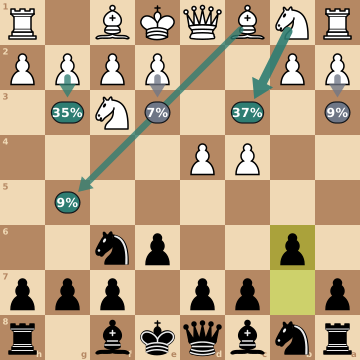
- 4. Nc3 (37%). The knight protects e4, so White can think about pushing e2-e4 later.
Your answer: 4...Bb7. Your bishop joins the fight for e4. - 4. g3 (35%). White's bishop on g2 will fight your bishop for the long diagonal.
Your answer: 4...Bb7. Your bishop claims the long diagonal first. - 4. Bg5 (9%). White pins your knight with Bg5 right away.
Your answer: 4...Bb7. Stick to the plan and put pressure on e4. - 4. a3 (9%). Bb4 before playing Nc3.
Your answer: 4...Bb7. Your bishop takes the long diagonal. - 4. e3 (7%). White plays quietly with e3.
Your answer: 4...Bb7. Same plan: fianchetto and watch e4.
After 1. d4 Nf6 2. c4 e6 3. Nf3 b6 4. Nc3 Bb7
The most varied position in the opening. Against the pin 5.Bg5 and the quiet 5.e3 you play ...Be7. Against 5.g3, 5.Qc2 and 5.Bf4 you pin the c3 knight with ...Bb4, because it's the only White piece guarding e4.
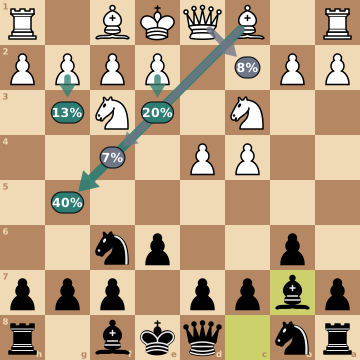
- 5. Bg5 (40%). Your f6 knight can't move without exposing your queen on d8, which weakens your control of e4.
Your answer: 5...Be7. Breaks the pin and gets ready to castle. - 5. e3 (20%). White gets ready to castle before doing anything sharp.
Your answer: 5...Be7. Develop and get ready to castle. - 5. g3 (13%). White prepares to fianchetto (develop the bishop on the long diagonal) with g3 and Bg2.
Your answer: 5...Bb4. Pins the knight on c3 to White's king. - 5. Qc2 (8%). Right now White is threatening to play e2-e4 and take over the center.
Your answer: 5...Bb4. Pin the knight, and e4 no longer works for White. - 5. Bf4 (7%). It doesn't pin your knight, so you're free to do what you like.
Your answer: 5...Bb4. Pin the knight on c3 again. - 5. e4 (5%). e4? The e4 pawn is attacked twice (knight on f6 and bishop on b7) and defended only once (knight on c3).
Your answer: 5...Nxe4. Take the free pawn.
After 1. d4 Nf6 2. c4 e6 3. Nf3 b6 4. Nc3 Bb7 5. Bg5 Be7
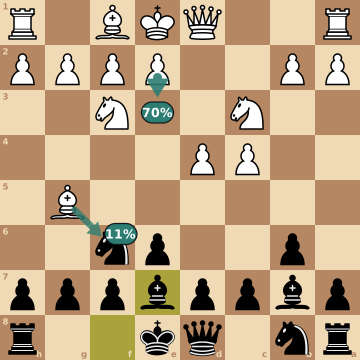
- 6. e3 (70%). White gets ready to develop the bishop and castle.
Your answer: 6...O-O. King to safety first. - 6. Bxf6 (11%). White gives up the bishop for your knight with Bxf6.
Your answer: 6...Bxf6. Recapture with the bishop, now aimed at d4.
After 1. d4 Nf6 2. c4 e6 3. Nf3 b6 4. Nc3 Bb7 5. Bg5 Be7 6. e3 O-O
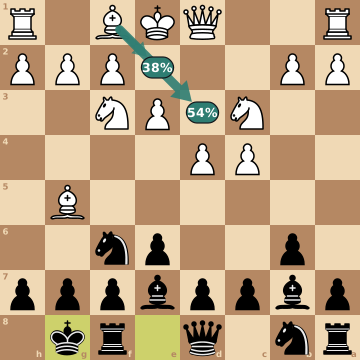
- 7. Bd3 (54%). The bishop points toward h7 and supports a later e3-e4 push.
Your answer: 7...d5. Takes a firm share of the center and stops e4. - 7. Be2 (38%). The bishop doesn't aim at your king.
Your answer: 7...d5. The same central claim as against Bd3.
After 1. d4 Nf6 2. c4 e6 3. Nf3 b6 4. Nc3 Bb7 5. e3 Be7
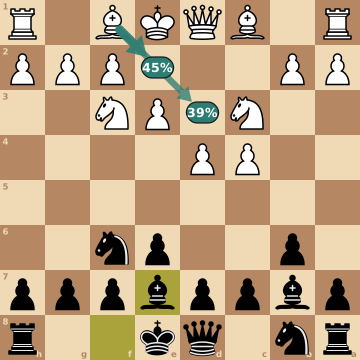
- 6. Be2 (45%). White plans to castle next.
Your answer: 6...O-O. Castle. - 6. Bd3 (39%). White puts the bishop on d3, aiming to push e4.
Your answer: 6...d5. Stop e4 before it happens.
After 1. d4 Nf6 2. c4 e6 3. Nf3 b6 4. g3 Bb7 5. Bg2 Be7
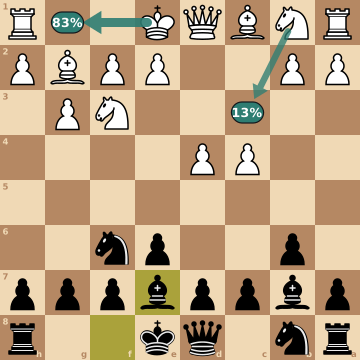
- 6. O-O (83%). White castles.
Your answer: 6...O-O. Castle as well. - 6. Nc3 (13%). White will usually castle next move.
Your answer: 6...O-O. Castle.
After 1. d4 Nf6 2. c4 e6 3. Nf3 b6 4. g3 Bb7 5. Bg2 Be7 6. O-O O-O
The main Fianchetto position. White has a knight on c3 in 77% of games next move, and your answer is the jump ...Ne4.
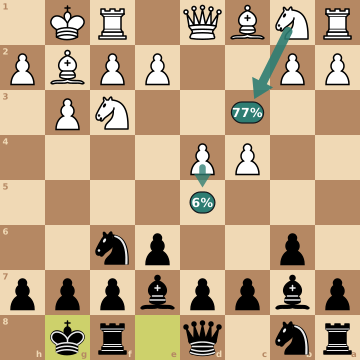
- 7. Nc3 (77%). The knight covers e4 and White is ready for Qc2 and e4.
Your answer: 7...Ne4. Jump into the square White wants, and offer a trade. - 7. d5 (6%). White wants to shut your b7 bishop out and use the open lines for the pieces.
Your answer: 7...exd5. Take the pawn.
After 1. d4 Nf6 2. c4 e6 3. Nf3 b6 4. g3 Bb7 5. Bg2 Be7 6. O-O O-O 7. Nc3 Ne4
Count the pieces on e4. After 8.Qc2 your knight is attacked twice and defended once, so you trade it at once with ...Nxc3.
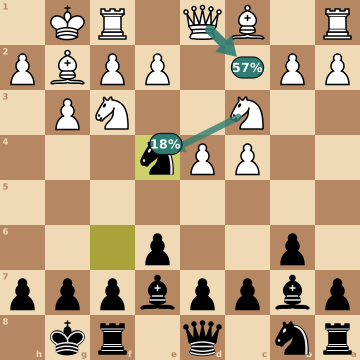
- 8. Qc2 (57%). You need to act now.
Your answer: 8...Nxc3. Trade knights before you lose the one on e4. - 8. Nxe4 (18%). Your bishop recaptures and lands on a great central square.
Your answer: 8...Bxe4. Recapture with the bishop, right in the center.
After 1. d4 Nf6 2. c4 e6 3. Nf3 b6 4. g3 Bb7 5. Bg2 Be7 6. O-O O-O 7. Nc3 Ne4 8. Qc2 Nxc3
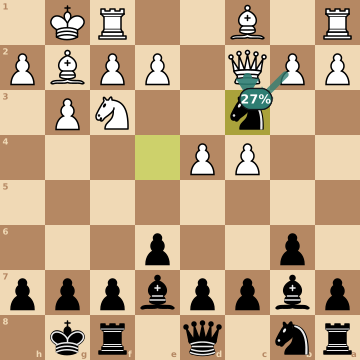
- 9. Qxc3 (73%). White recaptures with the queen.
Your answer: 9...f5. Keep control of e4 with a pawn. - 9. bxc3 (27%). White recaptures toward the center with the b-pawn.
Your answer: 9...f5. The same idea: hold e4 with a pawn.
After 1. d4 Nf6 2. c4 e6 3. Nf3 b6 4. Bg5 Bb7
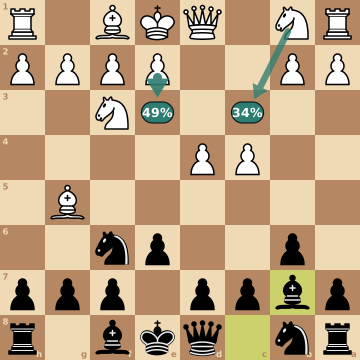
- 5. e3 (49%). White plays e3, opening the f1 bishop.
Your answer: 5...Be7. Break the pin and prepare to castle. - 5. Nc3 (34%). White develops Nc3.
Your answer: 5...Be7. Break the pin.
After 1. d4 Nf6 2. c4 e6 3. Nf3 b6 4. a3 Bb7 5. Nc3 d5
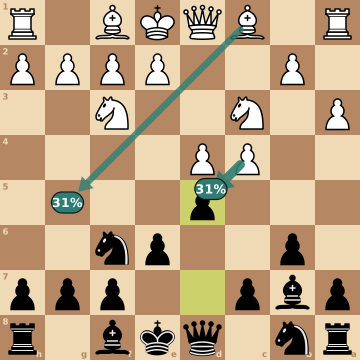
- 6. cxd5 (31%). Now you choose how to recapture.
Your answer: 6...Nxd5. Recapture with the knight and keep the diagonal open. - 6. Bg5 (31%). White pins your knight with Bg5.
Your answer: 6...Be7. Break the pin, as always.
After 1. d4 Nf6 2. c4 e6 3. Nf3 b6 4. e3 Bb7
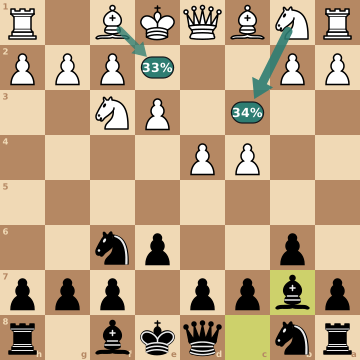
- 5. Nc3 (34%). White develops Nc3.
Your answer: 5...Be7. Develop and get ready to castle. - 5. Be2 (33%). White castles next.
Your answer: 5...Be7. Mirror White's calm development.
Your plan after the opening
Against 4.Nc3 and 5.Bg5: break the pin, then ...d5
Play ...Be7 to take your queen out from behind the knight, castle, and then claim the center with ...d5. Your d5 pawn and f6 knight both guard e4, so White's e3-e4 push is off for now. Finish with ...Nbd7.
The plan from there is ...dxc4 and ...c5, hitting White's d4 pawn. Once the c-file opens, put a rook on c8. The same setup works whether White's bishop goes to d3 or e2.
1. d4 Nf6 2. c4 e6 3. Nf3 b6 4. Nc3 Bb7 5. Bg5 Be7 6. e3 O-O 7. Bd3 d5 8. O-O Nbd7
Against the Fianchetto (4.g3): ...Ne4, trade, then ...f5
When White's knight arrives on c3, jump into e4 with your own knight. If White adds a second attacker with Qc2, trade on c3. With the knights gone, your f5 pawn takes over the job of guarding e4, together with the b7 bishop.
Next, ...Bf6 challenges White's queen and d4 pawn along the long diagonal, and ...Be4 blocks White's g2 bishop. Follow with ...d6 and a rook to e8 or f7. White keeps a small edge, but your position has no weaknesses.
1. d4 Nf6 2. c4 e6 3. Nf3 b6 4. g3 Bb7 5. Bg2 Be7 6. O-O O-O 7. Nc3 Ne4 8. Qc2 Nxc3 9. Qxc3 f5
Against 5.g3, 5.Qc2 and 5.Bf4: pin the knight
In these lines the c3 knight is White's only defender of e4, so ...Bb4 pins it to the king and makes your grip on e4 even stronger. Against 5.g3, castle and then take on c3 once White has castled, leaving doubled c-pawns. Play ...d6 to cover the dark squares you gave up, then aim your pieces at c4.
1. d4 Nf6 2. c4 e6 3. Nf3 b6 4. Nc3 Bb7 5. g3 Bb4 6. Bg2 O-O 7. O-O Bxc3 8. bxc3 d6
Against 4.a3: stop d4-d5 with ...d5
White spends a move on a3 so the knight can come to c3 without being pinned, and the next idea is d4-d5 to cut off your b7 bishop. Put your own pawn on d5 first. If White takes on d5, recapture with the knight to keep your bishop's diagonal open, then castle and look for ...c5.
1. d4 Nf6 2. c4 e6 3. Nf3 b6 4. a3 Bb7 5. Nc3 d5 6. cxd5 Nxd5
Traps and common mistakes
Not taking the free pawn after 5.e4?
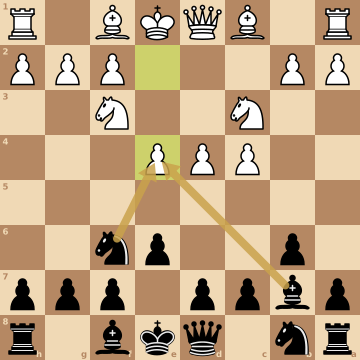
1. d4 Nf6 2. c4 e6 3. Nf3 b6 4. Nc3 Bb7 5. e4? Nxe4 6. Nxe4 Bxe4
After 4.Nc3 Bb7, 5% of White players push 5.e4 anyway. Count the pieces: e4 is attacked by your knight and your bishop, and defended only by the c3 knight. Take it with 5...Nxe4, and after 6.Nxe4 Bxe4 you're a clean pawn up. Stockfish rates you about a pawn better.
The data shows how often this chance is missed. 43% of Black players grab the pawn and win 56% of those games, while 28% play 5...Bb4 instead. That lets White off the hook: 6.e5 kicks your knight and Stockfish prefers White.
Giving the extra pawn back
1. d4 Nf6 2. c4 e6 3. Nf3 b6 4. Nc3 Bb7 5. e4 Nxe4 6. Nxe4 Bxe4 7. Bd3 Bb4+ 8. Bd2? Bxd3
Once you're a pawn up, White will look for tricks. After 6.Nxe4 Bxe4 7.Bd3, don't just retreat: 7...Bb4+ is strong. If White blocks with 8.Bd2 or 8.Nd2, the queen on d1 no longer defends d3, and 8...Bxd3 wins more material. After 8.Nd2 you win a whole piece. After 8.Bd2 Bxd3 9.Bxb4 Bxc4 the bishops come off and you're two pawns up. White's best is 8.Kf1, giving up castling.
If White plays 6.Bd3 instead of taking, your knight on e4 is attacked twice. Don't retreat it. Trade with 6...Nxc3 7.bxc3 and keep the extra pawn.
Leaving the knight on e4 when it's attacked twice
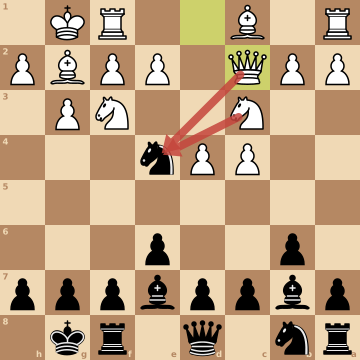
1. d4 Nf6 2. c4 e6 3. Nf3 b6 4. g3 Bb7 5. Bg2 Be7 6. O-O O-O 7. Nc3 Ne4 8. Qc2 Nxc3
In the Fianchetto line, ...Ne4 is the right idea, but it comes with a follow-up you can't forget. White plays 8.Qc2 in 57% of games, and now your knight is attacked by the c3 knight and the queen, and defended only by the b7 bishop.
Trade right away with 8...Nxc3. Then ...f5 takes over the defense of e4 with a pawn.
Forgetting that a pinned knight can't recapture
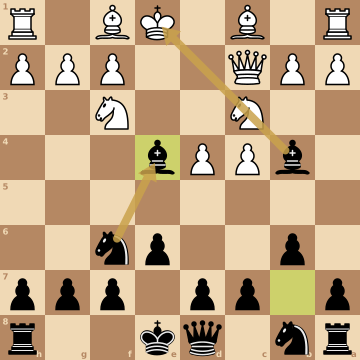
1. d4 Nf6 2. c4 e6 3. Nf3 b6 4. Nc3 Bb7 5. Qc2 Bb4 6. e4? Bxe4
After 5.Qc2 Bb4, White may still push 6.e4, counting the queen and the knight as two defenders. But the knight is pinned to the king, so it doesn't really defend anything. 6...Bxe4 wins a pawn: the knight can't take back, and 7.Qxe4 loses the queen to 7...Nxe4.
The same rule works for you in every Queen's Indian line. When your bishop is on b4 and there's nothing on d2, White's c3 knight is not a real defender of e4.
Frequently asked questions
Is the Queen's Indian Defense good for club players?
Yes, if you like solid positions. The plan is easy to remember (control e4 with your bishop and knight, castle, then ...d5 or ...Ne4), and almost every line in the Coach's tree ends level by Stockfish. At 1400 to 2200 it's a less common choice: 18% of players answer 3.Nf3 with 3...b6, behind 3...d5 (43%) and 3...Bb4+ (19%).
What is the most common reply to the Queen's Indian at club level?
At 1400 to 2200 on Lichess, White answers 3...b6 with 4.Nc3 (37%) or the Fianchetto 4.g3 (35%) in most games. 4.Bg5 and 4.a3 are much rarer. Your reply to all of them is the same: 4...Bb7.
What's the difference between the Queen's Indian and the Nimzo-Indian?
They start the same way, 1.d4 Nf6 2.c4 e6, and split on White's third move. If White plays 3.Nc3, you can pin it with 3...Bb4, the Nimzo-Indian. If White plays 3.Nf3, the pin isn't available, so you play 3...b6 and fight for e4 with the bishop instead. Many players use both as one repertoire.
What should Black do against 5.e4 in the Queen's Indian?
Take the pawn with 5...Nxe4. It's attacked twice and defended once, so after 6.Nxe4 Bxe4 you're a pawn up and Stockfish rates you about a pawn better. At this level 43% of Black players find it and win 56% of those games.
Is the Queen's Indian too drawish?
It's solid, not dead. Most lines are level, but they're full of pieces, and at 1400 to 2200 the player who understands the e4 square usually outplays the one who doesn't. White's early pushes also give you chances, like the free pawn after 5.e4.
Keep learning
- All 36 opening guides: every opening on the site, grouped by what you play as White and Black.
- Nimzo-Indian vs Queen's Indian vs Bogo-Indian: How the Queen's Indian fits next to the Nimzo, and when the Bogo-Indian is the better partner.
- The most reliable 1.d4 defenses for Black: Nine 1.d4 defenses compared with Lichess data at club level.
The Coach plays White against your Queen's Indian with the moves 1400 to 2200 players actually choose, from 4.Nc3 and 4.g3 to the 5.e4 mistake, and explains every move in plain English. Progress tracking is free during the open beta.
Practice the Queen's Indian Defense free →