Slav vs Queen's Gambit Declined: Which ...d5 Defense Should Black Play?
TL;DR
Short answer Play the Slav (2...c6) if you want your light-squared bishop active and a plan you can learn quickly. Play the QGD (2...e6) if you want the most solid center and are happy with a slower, patient game. For most club players the Slav is the easier start. Games behind this article About 26 million Lichess games at 700 to 1700 (Slav trainer) · about 177 million at 1300 to 2200 (Queen's Gambit Declined trainer) White vs the Slav (after 2.c4 c6) 3.Nc3 51% · 3.Nf3 16% · 3.e3 12% · 3.cxd5 12% After 3.Nc3 Nf6 4.Nf3 37% · 4.Bg5 23% · 4.e3 13% · 4.Bf4 10% Black in the QGD main line (1300 to 2200) 3...Nf6 56% · then 4...Be7 58% after 4.Bg5 · then 5...O-O 43% after 5.e3 Our trainers Slav: Black side, 18 lines, 700 to 1700 Elo · QGD: White side, 14 lines, 1300 to 2200 Elo
The one-move difference
Both moves defend d5 with a pawn. Both keep a firm grip on the center. The difference is what they do to Black's light-squared bishop on c8.
After 2...e6, the bishop is shut in behind the e6 pawn. After 2...c6, its diagonal stays open, so it can come out to f5 or g4 before Black plays ...e6. That single detail shapes almost everything else in these two openings.
The Slav: bishop out first, when it's safe
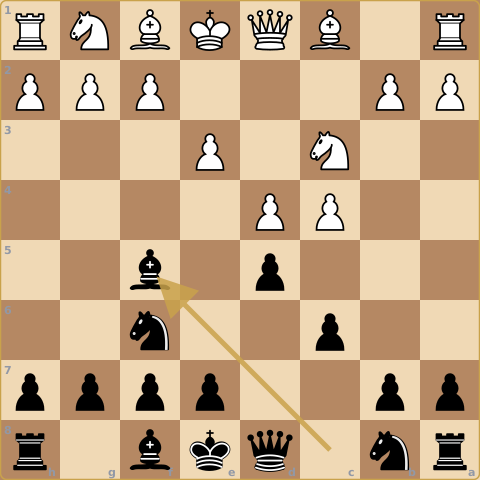
Against 4.e3, the c8 bishop goes to f5 before ...e6 closes the diagonal. Compare the diagram with a QGD position and the difference is obvious: the bishop is outside the pawn chain, not stuck behind it. Next come ...e6, ...Nbd7 and castling.
The Slav has its own cost, though. Once the bishop leaves c8, nothing defends b7, and White's queen loves the b3 square. That's why our trainer handles the most common line, 4.Nf3 (37% at 700 to 1700), differently. The natural 4...Bf5 runs into this:
The queen hits b7 and d5 at once. So against 4.Nf3 the trainer plays 4...e6, the Semi-Slav, and the bishop comes out later on b7:
Against 4.Bg5 (23%) and 4.Bf4 (10%), Black can grab the c4 pawn and hold it with ...b5, and Stockfish rates those lines slightly better for Black:
The Exchange Slav, 3.cxd5 (12%), is the other system you have to know. It's symmetrical and very safe. Develop with ...Nc6, ...Bf5 and ...e6, and if White's queen jumps to b3 against b7, the knight answers with tempo:
One more thing about the Slav at club level: only 34% of players at 700 to 1700 actually play 2.c4 after 1.d4 d5. Our trainer also shows how the same ...c6, ...Nf6 and ...Bf5 setup works against 2.Bf4, 2.Nf3, 2.e3 and 2.Nc3.
The Queen's Gambit Declined: solid first
This is the traditional pin, 4.Bg5, and it's what our QGD trainer plays from White's side. At 1300 to 2200 on Lichess, 3...Nf6, 4...Be7 and 5...O-O are Black's most common choices at each step. Black's position is rock solid. The pawns on d5 and e6 hold the center and the king is safe. The cost is the c8 bishop, which is stuck behind e6. Much of Black's middlegame is about freeing it, with the ...c5 break, ...dxc4, or ...h6 and ...Ne4 to trade pieces.
White's other big system is the Exchange Variation, 4.cxd5. Once Black recaptures with the e-pawn, the bishop is free. But White is ready for that:
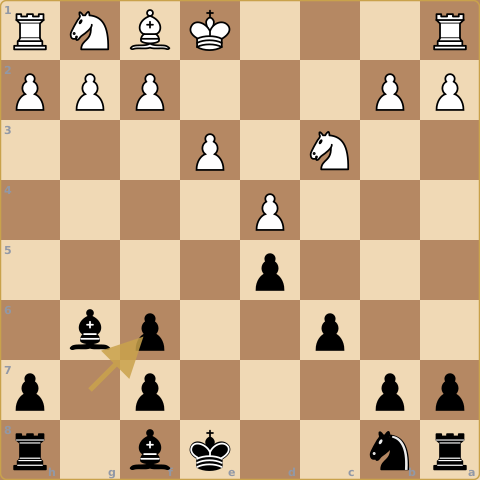
Here Black got the bishop out, but White's 7.Qf3 attacked it, and the game went into an endgame where Black's f-pawns are doubled. In the main Exchange lines, Black keeps the pieces on and White goes for the minority attack, pushing the b-pawn to b4 and b5.
The QGD has a huge pedigree. Of the 34 games in the 1927 Alekhine versus Capablanca World Championship match, all but the first and third began with it.
Side by side
| Slav | QGD | |
| Light-squared bishop | Out to f5 or g4 early | Behind e6 until freed |
| Weak spot | b7 once the bishop leaves | Passive c8 bishop |
| Share of replies to 2.c4 | 16% at 700 to 1700 · 20% at 1300 to 2200 | 23% at 700 to 1700 · 27% at 1300 to 2200 |
| Lichess games in our data | About 26 million | About 177 million |
Which should you play?
Choose the Slav if you want active pieces without taking big risks, or you already play the Caro-Kann against 1.e4. The two share the same idea: support the center with the c-pawn and get the bishop out before ...e6. Our library recommends the Slav from 700 to 1700 Elo, and our Black trainer covers 3.Nc3, 3.Nf3, 3.e3 and the Exchange Slav, plus White's non-2.c4 systems, in 18 lines.
Choose the QGD if you like long strategic games, don't mind defending, and want the most classical structure there is. Our QGD trainer is from White's side (recommended for 1300 to 2200), so we don't have a Black trainer for it yet. Practicing the White side is still a quick way to learn the plans you'll face.
One more thing: you don't have to choose forever. Players often combine ...c6 and ...e6 in the Semi-Slav, and our Slav trainer does exactly that against 4.Nf3. Start with one, learn its structures, and branch out later.
Frequently asked questions
What is the difference between the Slav and the Queen's Gambit Declined?
Both defend d5 against 2.c4 with a pawn. The Slav uses 2...c6, which keeps the light-squared bishop free to go to f5 or g4. The Queen's Gambit Declined uses 2...e6, which gives a very solid center but shuts that bishop in behind the e6 pawn.
Is the Slav or the Queen's Gambit Declined better for beginners?
The Slav is usually easier to start with, because the bishop problem doesn't arise and the plan is simple: support the center, develop the bishop, take on c4 when it suits. Our library recommends the Slav for 700 to 1700 Elo.
What does White play against the Slav Defense?
At 700 to 1700 on Lichess, after 1.d4 d5 2.c4 c6 White plays 3.Nc3 in 51% of games, 3.Nf3 in 16%, 3.e3 in 12% and the Exchange 3.cxd5 in 12%. After 3.Nc3 Nf6, the most common moves are 4.Nf3 (37%), 4.Bg5 (23%), 4.e3 (13%) and 4.Bf4 (10%). Only 34% of players at this level play 2.c4 at all after 1.d4 d5.
What is the most common line against the Queen's Gambit Declined?
In the classical main line, 1.d4 d5 2.c4 e6 3.Nc3 Nf6 4.Bg5 Be7 5.e3 O-O 6.Nf3, the moves 3...Nf6, 4...Be7 and 5...O-O are Black's most frequent choices at 1300 to 2200 on Lichess (56%, 58% and 43%). White's other main system is the Exchange Variation with 4.cxd5.
Copy the lines (PGN)
Every line in this article in standard PGN, ready to paste into Lichess, Chess.com or any chess database.
[Event "Slav vs Queen's Gambit Declined: Which ...d5 Defense Should Black Play?: Slav with 4.e3 Bf5"]
[Site "chesscoachacademy.com"]
[Result "*"]

1. d4 d5 2. c4 c6 3. Nc3 Nf6 4. e3 Bf5 *

[Event "Slav vs Queen's Gambit Declined: Which ...d5 Defense Should Black Play?: Why not 4...Bf5 against 4.Nf3"]
[Site "chesscoachacademy.com"]
[Result "*"]

1. d4 d5 2. c4 c6 3. Nc3 Nf6 4. Nf3 Bf5 5. cxd5 cxd5 6. Qb3 *

[Event "Slav vs Queen's Gambit Declined: Which ...d5 Defense Should Black Play?: Slav vs 4.Bf4"]
[Site "chesscoachacademy.com"]
[Result "*"]

1. d4 d5 2. c4 c6 3. Nc3 Nf6 4. Bf4 dxc4 5. e3 b5 *

[Event "Slav vs Queen's Gambit Declined: Which ...d5 Defense Should Black Play?: Exchange Slav"]
[Site "chesscoachacademy.com"]
[Result "*"]

1. d4 d5 2. c4 c6 3. cxd5 cxd5 4. Nc3 Nf6 5. Bf4 Nc6 6. e3 Bf5 7. Qb3 Na5 *

[Event "Slav vs Queen's Gambit Declined: Which ...d5 Defense Should Black Play?: QGD with 4.Bg5"]
[Site "chesscoachacademy.com"]
[Result "*"]

1. d4 d5 2. c4 e6 3. Nc3 Nf6 4. Bg5 Be7 5. e3 O-O *

[Event "Slav vs Queen's Gambit Declined: Which ...d5 Defense Should Black Play?: QGD Exchange with Qf3"]
[Site "chesscoachacademy.com"]
[Result "*"]

1. d4 d5 2. c4 e6 3. Nc3 Nf6 4. cxd5 exd5 5. Bg5 c6 6. e3 Bf5 7. Qf3 Bg6 8. Bxf6 Qxf6 9. Qxf6 gxf6 *
Keep reading
- The Most Reliable 1.d4 Defenses for Black: The Slav and eight other defenses to 1.d4, compared by Lichess data and Elo range.
Practice the Slav against White's main systems
Our Slav trainer covers 18 lines built from about 26 million Lichess games at 700 to 1700: 3.Nc3 with 4.Nf3, 4.Bg5, 4.e3 and 4.Bf4, plus 3.Nf3, 3.e3, the Exchange Slav, and the same setup against 2.Bf4, 2.Nf3, 2.e3 and 2.Nc3. You play Black against the moves players at your level really choose, and every one of your moves is checked by Stockfish.
Leaning toward the QGD? Our Queen's Gambit Declined trainer lets you play it from White's side and see every plan Black has to meet.
Both are free during the open beta, and you can track your progress on every line for free with an account.
18 Slav lines built from about 26 million Lichess games. Free during the open beta, with free progress tracking.
Practice the Slav free →