What Is the Stafford Gambit, and How Does White Refute It?
TL;DR
Short answer Take the pawn, take on c6, and then cover the g4 square. 5. Nc3 Bc5 6. h3 stops ...Ng4 and ...Bg4, and White stays a clean pawn up. The Stafford move order 1. e4 e5 2. Nf3 Nf6 3. Nxe5 Nc6 4. Nxc6 dxc6 Traps to avoid 6.Bg5?? (mate on g4) · 7.dxe4?? after 5.e5 (loses the queen) · 7.g3?? after ...Qh4 (loses the exchange) How often it happens At 1000 to 1600 on Lichess, 3...Nc6 is Black's most common reply to 3.Nxe5: 34.1% of games, ahead of 3...Nxe4 (23.9%) and the correct 3...d6 (18.6%). After 4.Nxc6, Black takes back with 4...dxc6 in 98%. Where we cover it Italian trainer (White side, 1000 to 1600, 20 lines, about 131 million Lichess games) · Petroff trainer (Black side, 800 to 2400, 22 lines, about 98 million Lichess games)
What the Stafford Gambit is
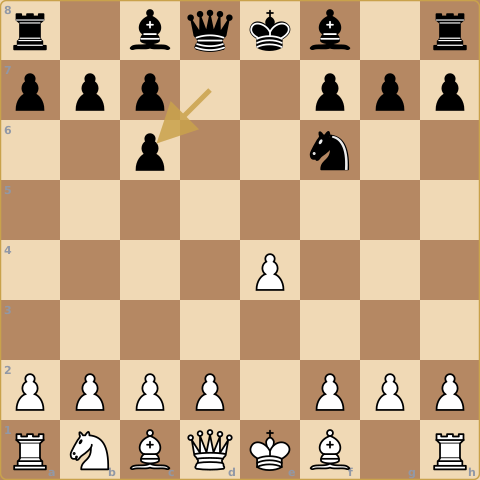
It starts as a Petroff Defense. After 3.Nxe5, the correct move is 3...d6, kicking the knight. On Lichess only 26% of 800 to 2400 rated players find it, while 69% of 2200+ players do. The Stafford throws in 3...Nc6 instead, offering the e5 pawn for good. After 4.Nxc6 dxc6, Black is a pawn down but has open lines for both bishops and the queen.
Almost every Stafford idea aims at one square: f2. Black wants ...Bc5, then ...Ng4 or ...Qh4 to pile onto it, often with ...h5 thrown in so that taking a knight on g4 opens the h-file. It's a trap opening in the purest sense. The tricks are strong, but the position without them is simply a pawn down.
Trap 1: 6.Bg5?? and mate on g4
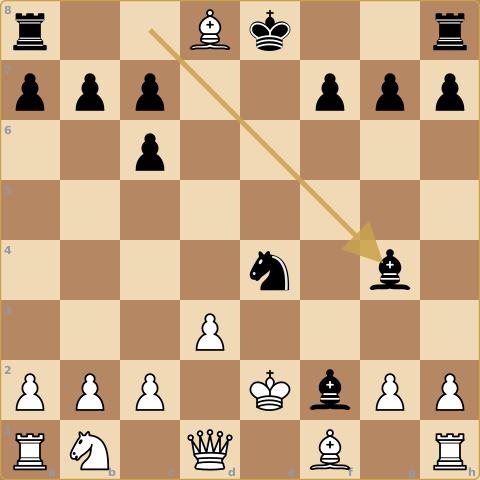
6.Bg5 looks like a good developing move that pins the knight to the queen. The pin doesn't hold. The knight jumps to e4 anyway, because grabbing the queen gets White mated. If White grabs the queen with 7.Bxd8, the bishop checks on f2 and the other bishop mates on g4. And 7.dxe4 doesn't help either: 7...Qxg5 simply wins the bishop back and the material is level.
Trap 2: the queen that goes missing
5.e5 kicks the knight, and 6.d3 attacks it again. Taking it looks free, but 7.dxe4?? opens the d-file. After 7...Bxf2+, if the king takes the bishop, 8...Qxd1 wins the queen straight away. If the king goes to e2, 8...Bg4+ skewers the king and the queen behind it, and the only legal move, 9.Kxf2, drops the queen to 9...Qxd1.
Trap 3: 7.g3?? against ...Qh4
After 6...Qh4, Black threatens ...Qxf2 mate. Kicking the queen with 7.g3 feels natural, but the knight takes on g3, and after 8.fxg3 the queen checks from e4 and hits the rook on h1 at the same time. Black wins the exchange. The calm defenses, 7.Qe2, 7.Qf3 or 7.Be3, all cover f2 without opening the long diagonal to your rook.
A clean refutation: cover g4 early
You don't need to memorize a long engine line. You need to take away Black's favorite square. Here's one simple, low-theory setup:
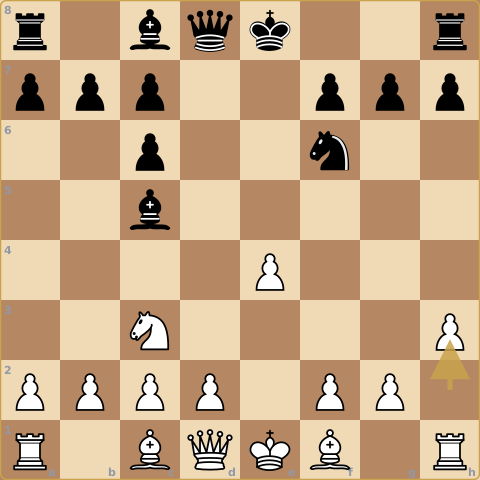
5.Nc3 develops and defends e4. Our Italian trainer uses the equally simple 5.d3, which also protects e4, but then you must remember Trap 1 and skip Bg5. 6.h3 covers g4, so neither ...Ng4 nor ...Bg4 can land there without losing a piece. Without those two moves, most of Black's play against f2 disappears.
What if Black tries to force matters anyway?
The queen on d4 attacks the knight on e4 and lines up with the bishop against f2, but 8.Qe2 defends both. Black has given up a knight for a pawn, and White keeps the extra piece. After that, finish development with d3, Be3 and Be2. Before you castle short, check whether Black can open the h-file with ...h5 and a piece sacrifice on g4.
What to remember as White
- f2 is the target. Every Stafford trick hits it. Keep it defended.
- Don't pin with Bg5. The pin doesn't hold, and the queen grab gets you mated.
- Check open files before capturing. Trap 2 works because dxe4 opens the d-file onto your own queen.
- A pawn up is enough. You don't need to punish the gambit. Develop, trade pieces, and let the extra pawn win the endgame.
For more traps worth knowing at fast time controls, see the best trap-heavy openings for blitz and bullet and the full traps and gambits hub.
Frequently asked questions
What is the Stafford Gambit PGN?
1.e4 e5 2.Nf3 Nf6 3.Nxe5 Nc6 4.Nxc6 dxc6. Black gives up the e5 pawn for open lines and quick attacking chances against f2.
How do you beat the Stafford Gambit?
Keep f2 and g4 covered. One simple setup is 5.Nc3 Bc5 6.h3, which stops ...Ng4 and ...Bg4. Then develop with d3, Be3 and Be2 and keep the extra pawn.
What is the Stafford Gambit trap with Bg5?
After 5.d3 Bc5 6.Bg5?? Black plays 6...Nxe4!. If 7.Bxd8, then 7...Bxf2+ 8.Ke2 Bg4 is checkmate. If 7.dxe4, then 7...Qxg5 wins the bishop back.
Is the Stafford Gambit sound?
No. Against accurate play Black is simply a pawn down. Its strength is the traps, which makes it far more dangerous in fast games than against an opponent who knows them. It's popular anyway: at 1000 to 1600 on Lichess, 3...Nc6 is Black's most common reply to 3.Nxe5, at 34.1% of games.
Copy the lines (PGN)
Every line in this article in standard PGN, ready to paste into Lichess, Chess.com or any chess database.
[Event "What Is the Stafford Gambit, and How Does White Refute It?: Stafford Gambit"]
[Site "chesscoachacademy.com"]
[Result "*"]

1. e4 e5 2. Nf3 Nf6 3. Nxe5 Nc6 4. Nxc6 dxc6 *

[Event "What Is the Stafford Gambit, and How Does White Refute It?: Trap 1, 6.Bg5"]
[Site "chesscoachacademy.com"]
[Result "*"]

1. e4 e5 2. Nf3 Nf6 3. Nxe5 Nc6 4. Nxc6 dxc6 5. d3 Bc5 6. Bg5 Nxe4 7. Bxd8 Bxf2+ 8. Ke2 Bg4# *

[Event "What Is the Stafford Gambit, and How Does White Refute It?: Trap 2, 7.dxe4"]
[Site "chesscoachacademy.com"]
[Result "*"]

1. e4 e5 2. Nf3 Nf6 3. Nxe5 Nc6 4. Nxc6 dxc6 5. e5 Ne4 6. d3 Bc5 7. dxe4 Bxf2+ 8. Ke2 Bg4+ 9. Kxf2 Qxd1 *

[Event "What Is the Stafford Gambit, and How Does White Refute It?: Trap 3, 7.g3"]
[Site "chesscoachacademy.com"]
[Result "*"]

1. e4 e5 2. Nf3 Nf6 3. Nxe5 Nc6 4. Nxc6 dxc6 5. e5 Ne4 6. d4 Qh4 7. g3 Nxg3 8. fxg3 Qe4+ *

[Event "What Is the Stafford Gambit, and How Does White Refute It?: Refutation with 6.h3"]
[Site "chesscoachacademy.com"]
[Result "*"]

1. e4 e5 2. Nf3 Nf6 3. Nxe5 Nc6 4. Nxc6 dxc6 5. Nc3 Bc5 6. h3 Nxe4 7. Nxe4 Qd4 8. Qe2 *
Keep reading
- What Are the Best Trap-Heavy Openings for Blitz and Bullet?: The trap openings that still hold up when the opponent knows them.
- Chess Opening Traps & Gambits: The full hub for traps, gambits and refutations.
Learn the sound version of 2...Nf6
The Stafford is a Petroff with the key move swapped out. If you play Black and like 2...Nf6, the real Petroff gives you the same counterattack on e4 without giving away a pawn. If you play White, knowing the proper 3...d6 lines tells you exactly when Black has left the main road.
Our Petroff Defense trainer covers 22 lines built from about 98 million Lichess games at 800 to 2400, including the Classical main line after 3.Nxe5 d6, the Four Knights after 3.Nc3 and the careless 3.Bc4. Playing White? Our Italian Game trainer meets the Stafford with 4.Nxc6 dxc6 5.d3 and keeps the extra pawn. Both are free during the open beta, and you can track your progress on every line for free with an account.
22 Petroff lines from about 98 million Lichess games. Free during the open beta, with free progress tracking.
Practice the Petroff free →