The Torre Attack: A Simple System Against 1...Nf6, From 400 to 1800 Games
TL;DR: the data
Built from 19 million Lichess games played by 400 to 1800 rated players You play White, 17 practice lines, every move of yours checked by Stockfish Most common line 1. d4 Nf6 2. Nf3 g6 3. Bg5 Bg7 4. e3 O-O 5. Nbd2 d6 6. Bd3 Nbd7 7. c3 Replies to 3.Bg5 3...e6 31% · 3...Nc6 15% · 3...h6 13% Worth knowing After 1.d4 Nf6 2.Nf3, 400-1800 rated players on Lichess choose 2...g6 in 30% of games, 2...d5 in 28% and 2...e6 in 22%.
The Torre Attack is a system against 1...Nf6. You play 1.d4 and 2.Nf3, then bring your dark-squared bishop to g5 before you play e3. That way the bishop gets outside your pawn chain, pressing on the f6 knight, and e3 no longer shuts it in. Then you finish with Nbd2, Bd3, c3 and castling.
This guide is built from 19 million Lichess games played by 400 to 1800 rated players, so it covers what your opponents actually play: the King's Indian setup with ...g6, the classical ...d5, the flexible ...e6, and the early ...h6 that asks your bishop to make a choice. Your setup barely changes against any of them.
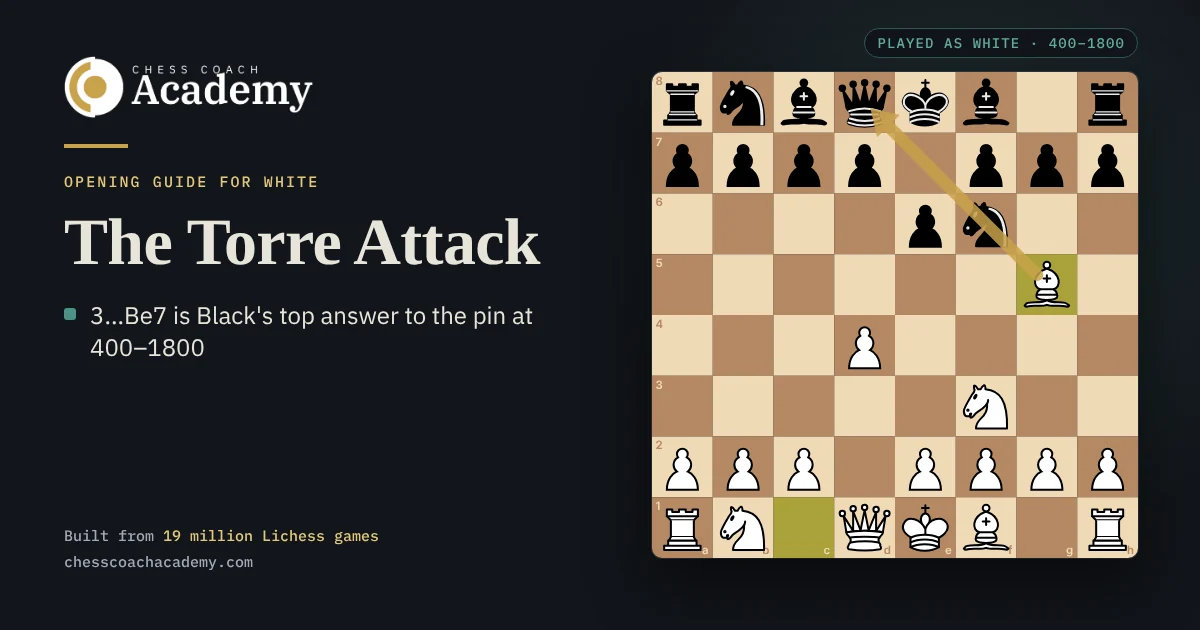
1. d4 Nf6 2. Nf3 g6 3. Bg5
Practice the Torre Attack free →Who it's for
Players rated roughly 400 to 1800 who would rather learn one plan than a lot of separate lines. The same few moves come up again and again, often in a different order, and your king castles early.
It suits you if you like solid positions with a little kingside pressure. It doesn't win material by force, and against good play the games are level, so it's best for players who enjoy outplaying opponents in the middlegame.
Why it works at 400 to 1800
- One setup for every reply: Bg5, e3, Nbd2, Bd3, c3 and castle. Different move orders keep landing in the same positions.
- Your bishop gets out before e3. It's active on g5, and against ...e6 it pins the f6 knight to Black's queen.
- Your position is always solid. Black has no easy targets, and your king castles quickly.
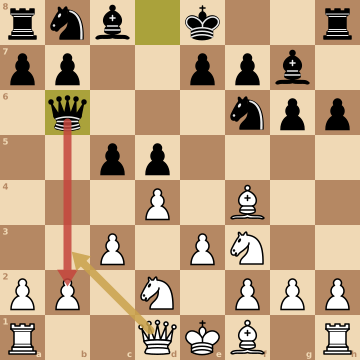
- Once the c1 bishop leaves, nothing guards b2. Black's ...c5 and ...Qb6 is the main practical try, so learn the c3 and Qb3 answer.
- Black can chase your bishop with ...h6, ...g5 or ...Ne4. You need to know when to keep it and where it goes.
- The Torre only covers 1...Nf6. At this level just 14% of players answer 1.d4 that way, so pair it with another system against 1...d5.
What 400 to 1800 players actually play
Against the classical 2...d5, your bishop move gets a wide spread of answers. 3...e6 is the most common at 31%, followed by 3...Nc6 (15%) and 3...h6 (13%). Then come three moves that each show up in 8 or 9% of games: 3...Bf5, 3...Bg4 and 3...Ne4. Against almost all of them you simply continue with e3. The two exceptions are 3...h6 and 3...Ne4, where you keep the bishop with Bh4.
Three numbers from the data worth remembering:
- After 1.d4 Nf6 2.Nf3, 400-1800 rated players on Lichess choose 2...g6 in 30% of games, 2...d5 in 28% and 2...e6 in 22%.
- After 2...g6 3.Bg5, Black plays 3...Bg7 in 92% of games.
- After 2...d5 3.Bg5 h6, half of White players take on f6, and 41% keep the bishop with 4.Bh4.
How to play the Torre Attack: move by move
Each board below is a real decision point from the practice lines. The arrows show Black's most common replies at 400 to 1800, labeled with how often each is played in that exact position. Under each board you'll find why players choose the move and the answer the Coach teaches.
After 1. d4 Nf6 2. Nf3
Black's three main replies are close in popularity. Against all four moves shown here, your answer is the same: 3.Bg5.
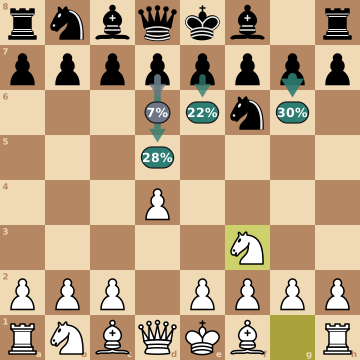
- 2...g6 (30%). Black wants to put the bishop on the long diagonal and castle quickly.
Your answer: 3. Bg5. The Torre bishop comes out before e3 can lock it in. - 2...d5 (28%). Black stops e4 and gets a solid share of the center.
Your answer: 3. Bg5. Bishop out first, same as always. - 2...e6 (22%). b6 later.
Your answer: 3. Bg5. Now the f6 knight is pinned to Black's queen. - 2...d6 (7%). e5.
Your answer: 3. Bg5. Same plan: bishop out before e3.
After 1. d4 Nf6 2. Nf3 g6 3. Bg5 Bg7 4. e3
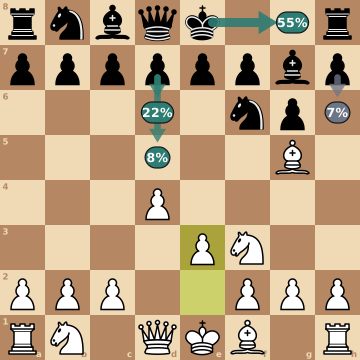
- 4...O-O (55%). Black's king is safe, so the game becomes a quiet fight for the center.
Your answer: 5. Nbd2. Develop the knight and support a later e4. - 4...d6 (22%). Black usually castles on the next move anyway.
Your answer: 5. Nbd2. Keep building your setup. - 4...d5 (8%). c5.
Your answer: 5. Nbd2. Develop and keep c3 available. - 4...h6 (7%). Black plays h6 to question your bishop.
Your answer: 5. Bh4. Keep the bishop and its pressure on f6.
After 1. d4 Nf6 2. Nf3 g6 3. Bg5 Bg7 4. e3 O-O 5. Nbd2
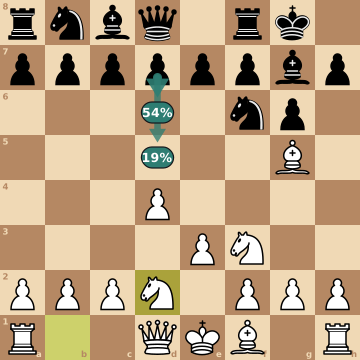
- 5...d6 (54%). e5 to fight for the center.
Your answer: 6. Bd3. Develop the last minor piece and get ready to castle. - 5...d5 (19%). It's a solid choice.
Your answer: 6. Bd3. Same setup: bishop out, castling next.
After 1. d4 Nf6 2. Nf3 d5 3. Bg5
Six different replies each show up in at least 8% of games. Four of them are answered with e3. Against ...h6 and ...Ne4, drop the bishop back to h4 first.
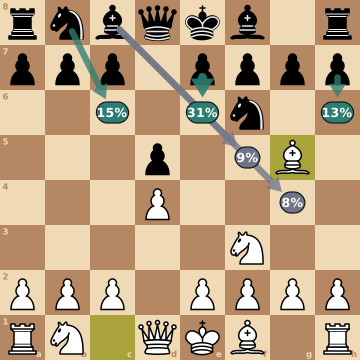
- 3...e6 (31%). It opens the f8 bishop, but it also locks in Black's c8 bishop.
Your answer: 4. e3. Support d4 and free your f1 bishop. - 3...Nc6 (15%). c5 push isn't coming soon.
Your answer: 4. e3. Stick to the plan. - 3...h6 (13%). Black plays h6 to kick your bishop.
Your answer: 4. Bh4. Keep your bishop on the same diagonal. - 3...Bf5 (9%). e6 can lock it in. That's the same idea as your Bg5.
Your answer: 4. e3. Support d4 and get ready for Bd3. - 3...Bg4 (8%). After e3, the bishop will pin your f3 knight to your queen.
Your answer: 4. e3. Calmly continue your setup. - 3...Ne4 (8%). g5.
Your answer: 4. Bh4. Keep the bishop, and don't play e3 yet.
After 1. d4 Nf6 2. Nf3 e6 3. Bg5
With the e-pawn gone from e7, the f6 knight is pinned to Black's queen. That's why so many players break the pin at once with ...Be7.
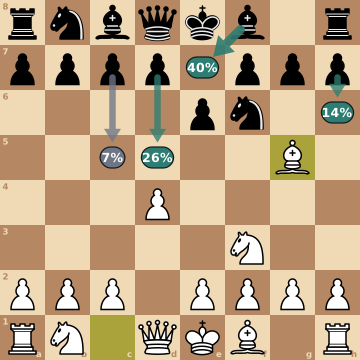
- 3...Be7 (40%). The bishop blocks the diagonal, so the knight is free to move again.
Your answer: 4. e3. Support d4 and free the f1 bishop. - 3...d5 (26%). The knight on f6 now defends d5, and your bishop keeps it pinned to the queen.
Your answer: 4. e3. Solid center, and your f1 bishop can come out. - 3...h6 (14%). Black plays h6 to kick your bishop.
Your answer: 4. Bh4. Keep the pin on the f6 knight. - 3...c5 (7%). Black attacks your d4 pawn with c5.
Your answer: 4. e3. Support d4 with a pawn.
After 1. d4 Nf6 2. Nf3 e6 3. Bg5 Be7 4. e3
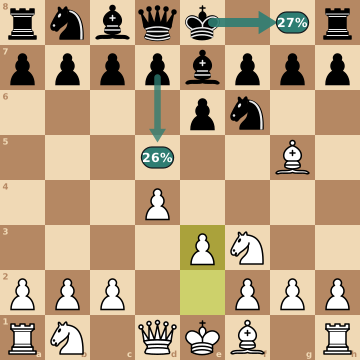
- 4...O-O (27%). Black castles.
Your answer: 5. Nbd2. Develop and keep c3 available. - 4...d5 (26%). e6 line, just by a different move order.
Your answer: 5. Nbd2. Keep building your setup.
Your plan after the opening
Against ...g6: the full Torre setup, then e4
Play e3, Nbd2, Bd3 and c3, then castle. The knight on d2 and the bishop on d3 both support the push e3-e4, which is your main central idea. c3 makes d4 rock-solid, so Black's ...e5 doesn't open lines against you.
After castling, Qc2 or Qe2 prepares e4. If Black ever pushes ...e4 to fork your bishop and knight, the Coach's note is that Nxe4 just wins a pawn, because your d2 knight and d3 bishop both guard e4.
1. d4 Nf6 2. Nf3 g6 3. Bg5 Bg7 4. e3 O-O 5. Nbd2 d6 6. Bd3 Nbd7 7. c3
Against ...d5 and ...e6: aim at the kingside
Here your bishop on d3 points straight at h7, and your bishop on g5 adds to the pressure. A typical plan is Ne5 and f4, bringing more force toward Black's king. Black's c8 bishop is stuck behind the e6 pawn, which is one reason you're a little more comfortable.
1. d4 Nf6 2. Nf3 d5 3. Bg5 e6 4. e3 Be7 5. Nbd2 O-O 6. Bd3 c5 7. c3 Nc6 8. Ne5 Nd7 9. Bxe7 Qxe7 10. f4
When Black plays ...c5 and ...Qb6: c3 and Qb3
Your c1 bishop has left, so b2 has no defender. Once c3 is in, answer ...Qb6 with Qb3. It guards b2 and offers a queen trade, which takes the sting out of Black's play. Qc1 is another calm option.
1. d4 Nf6 2. Nf3 g6 3. Bg5 Bg7 4. e3 d5 5. Nbd2 c5 6. c3 h6 7. Bf4 Qb6 8. Qb3
Traps and common mistakes
Playing e3 before Bg5
The whole point of the Torre is to get the c1 bishop out before e3 blocks its path. If you play e3 first, the bishop is stuck behind your own pawn and you have a quiet setup with no pressure on f6. Bg5 first, e3 second, every time.
Sacrificing on g5 after ...h6 and ...g5
1. d4 Nf6 2. Nf3 e6 3. Bg5 h6 4. Bh4 g5 5. Bg3
When Black chases your bishop with ...h6 and ...g5, taking with Nxg5 looks tempting. After ...hxg5 Bxg5 you have two pawns for a knight, and that isn't enough. Just retreat Bg3.
Black's pawn moves are not free either: they loosen the pawns in front of Black's own king, which your pieces can use later.
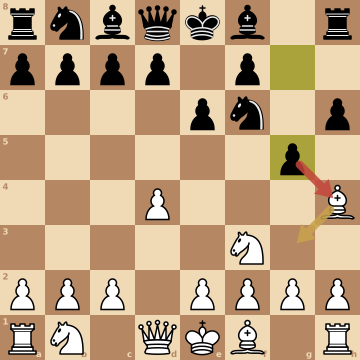
Answering 3...Ne4 with 4.e3
1. d4 Nf6 2. Nf3 d5 3. Bg5 Ne4 4. Bh4
3...Ne4 attacks your bishop straight away. Your knight on f3 defends it, but Black wants to follow up with ...h6 and ...g5, or ...f6. If you play 4.e3 now, you take away the bishop's way home to d2 and c1, so it has fewer places to hide when those pawns arrive.
Play 4.Bh4 and then Nbd2 to challenge the e4 knight. If Black ever takes your bishop on g3, recapture with the h-pawn: your rook gets a half-open h-file.
Forgetting about b2
Once your c1 bishop has left, nothing guards b2. Watch for ...c5 followed by ...Qb6, which also adds pressure to d4. Play c3 early so your queen can go to b3, or use Qc1 if the queen can't get there.
Doubling your pawns after ...Bg4
3...Bg4 mirrors your bishop move and pins your f3 knight to your queen. The pin isn't dangerous. If Black takes on f3, recapture with the queen or the d2 knight so your kingside pawns stay healthy, rather than with the g-pawn.
Frequently asked questions
Is the Torre Attack good for beginners?
Yes. You play the same setup (Bg5, e3, Nbd2, Bd3, c3, castle) against almost everything, and there are very few lines to memorize. At 400 to 1800 it gives you a solid, healthy position nearly every game.
What is the most common reply to the Torre Attack?
At 400 to 1800 on Lichess, Black answers 2.Nf3 with 2...g6 in 30% of games, 2...d5 in 28% and 2...e6 in 22%. After 2...g6 3.Bg5, Black plays 3...Bg7 in 92% of games.
Should I take on f6 or play Bh4 after ...h6?
The Coach teaches Bh4, keeping the bishop and its pressure on f6. At this level players are split: after 2...d5 3.Bg5 h6, half of White players take on f6 and 41% keep the bishop with 4.Bh4. If Black follows up with ...g5, retreat to g3.
What's the difference between the Torre Attack and the London System?
Both are 1.d4 systems where the c1 bishop comes out before e3. In the London the bishop goes to f4 against almost anything. In the Torre it goes to g5 against 1...Nf6, where it presses on the f6 knight and often pins it to Black's queen.
What if Black doesn't play 1...Nf6?
The Torre only works against 1...Nf6, which about 14% of players at this level choose after 1.d4. Against 1...d5 and other first moves you need a partner system. Many players pair the Torre with the London, because the setups are so similar.
Keep learning
- All 36 opening guides: every opening on the site, grouped by what you play as White and Black.
- London vs Torre vs Trompowsky: Three low-theory 1.d4 systems compared, with how Black actually replies to each on Lichess.
- Which Chess Openings Require the Least Memorization?: Where the Torre sits among the openings with the fewest lines to learn.
The Coach answers your 3.Bg5 with the moves 400 to 1800 players actually choose, from ...g6 to ...Ne4, and explains every move in plain English. Progress tracking is free during the open beta.
Practice the Torre Attack free →