The Alapin Sicilian (2.c3): One Plan Against 1...c5, Built From 900 to 2200 Games

TL;DR: the data
Built from 27 million Lichess games played by 900 to 2200 rated players You play White, 16 practice lines, every move of yours checked by Stockfish Most common line 1. e4 c5 2. c3 Nc6 3. d4 cxd4 4. cxd4 d5 5. exd5 Qxd5 6. Nf3 Bg4 7. Be2 e6 8. Nc3 Replies to 4.cxd4 4...d5 34% · 4...e6 29% · 4...d6 15% Worth knowing After 2...Nc6 3.d4 cxd4 4.cxd4 g6 5.d5, over half of players (54%) answer with 5...Ne5?, which runs into 6.f4 trapping the knight. White wins 63% of games after 5...Ne5.
The Alapin is White's way of saying no to the Open Sicilian. Instead of 2.Nf3 and 3.d4, where you take back on d4 with a knight and walk into a huge amount of theory, you play 2.c3 first. When d4 comes and Black takes, you recapture with the c-pawn and keep two pawns in the center.
This guide is built from 27 million Lichess games played by 900 to 2200 rated players, so every line follows the moves your opponents really choose. The same plan repeats almost everywhere: d4, take back with a pawn, develop, castle. And two of the most popular replies after 4.cxd4 are real mistakes that one pawn push punishes.
1. e4 c5 2. c3 Nc6 3. d4 cxd4 4. cxd4
Practice the Alapin Variation free →Who it's for
Players rated roughly 900 to 2200 who meet 1...c5 a lot and don't want to learn the Najdorf, Dragon, Sveshnikov and everything else that comes with the Open Sicilian. You learn one idea and a handful of move orders, and you can start playing it this week.
It suits you if you like a clear, healthy center and positions you understand. It is not a knockout weapon against well-prepared opponents: against Black's best replies you get a small edge or a level game, and you win later by playing better chess, not by a forced line.
Why it works at 900 to 2200
- One plan covers almost everything. Play d4, take back with the c-pawn, develop the knights and bishops, castle. Black's move order changes, your ideas don't.
- Common mistakes are easy to punish. When Black puts a knight on c6 and then plays ...d6 or ...g6, the push d4-d5 kicks it, and Stockfish rates you clearly better.
- Very little theory. Your opponents at this level usually know much less about 2.c3 than about the Open Sicilian, so the game is decided by understanding, not memory.
- You often end up with an isolated pawn on d4. It gives your pieces room, but you must keep it protected and not let it be blockaded.
- Early on, the pawn on c3 takes your queen's knight's best square. After 2...d5 Black's queen comes to d5 and you can't hit it with Nc3 until the c-pawns are traded.
- Against 2...Nf6 you cannot play the normal d4 at once. You have to push 3.e5 first, so learn that move order separately.
What 900 to 2200 players actually play
This is the position that decides a lot of Alapin games. After 4.cxd4 the good reply 4...d5 is the most common at 34%, and 4...e6 follows at 29%. But look at the next two: 4...d6 (15%) and 4...g6 (9%) together make up about a quarter of games, and both are mistakes. In each case d4-d5 hits the knight on c6, and the knight has nowhere comfortable to go.
What the Lichess data says about the Alapin at this level:
- After 1.e4 c5 2.c3, the most common replies at 900-2200 are 2...Nc6 (32%), 2...d6 (18%), 2...d5 and 2...e6 (14% each), and 2...Nf6 (9%).
- After 2...Nc6 3.d4 cxd4 4.cxd4 g6 5.d5, over half of players (54%) answer with 5...Ne5?, which runs into 6.f4 trapping the knight. White wins 63% of games after 5...Ne5.
- 2.c3 is played in about 5% of games after 1.e4 c5 at this level, and in about 7% among players rated 2200 and above.
How to play the Alapin Variation: move by move
Each board below is a position where Black has a choice. The arrows show the most common replies at 900 to 2200, labeled with how often each one is played in that exact position. Under each board you'll see why players pick the move and the answer the Coach teaches.
After 1. e4 c5 2. c3
Six different replies each show up in at least 5% of games. The good news: against five of them your next move is still d4. Only 2...Nf6 needs a different answer (3.e5).
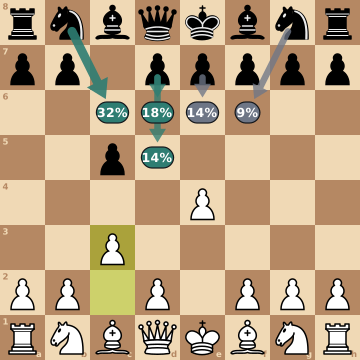
- 2...Nc6 (32%). Nc6 develops and adds a second guard to d4.
Your answer: 3. d4. Put a second pawn in the center, just as c3 prepared. - 2...d6 (18%). Nf6 without letting you push e5. But it doesn't stop your main idea, d4.
Your answer: 3. d4. Straight into the center. - 2...d5 (14%). Black will recapture with the queen.
Your answer: 3. exd5. Take the pawn. - 2...e6 (14%). d5 to challenge your e4 pawn.
Your answer: 3. d4. Build the center. - 2...Nf6 (9%). Black attacks e4 with Nf6.
Your answer: 3. e5. Push the pawn and chase the knight. - 2...e5 (5%). It stops e4-e5, but it leaves a hole on d5, and the d-pawn left behind on d7 can become weak.
Your answer: 3. d4. Challenge Black's center at once.
After 1. e4 c5 2. c3 Nc6 3. d4
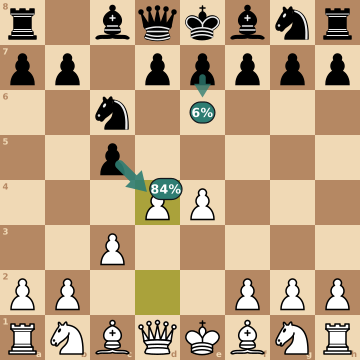
- 3...cxd4 (84%). Now you take back with the pawn and keep a strong center.
Your answer: 4. cxd4. Take back with the pawn. Now you have pawns on e4 and d4. - 3...e6 (6%). d5, but it allows your d-pawn to push forward and kick the knight on c6.
Your answer: 4. d5. Push with tempo and chase the knight.
After 1. e4 c5 2. c3 Nc6 3. d4 cxd4 4. cxd4
The key position of the whole opening. Remember the pattern: a knight on c6 plus a slow pawn move (...d6 or ...g6) means d4-d5.
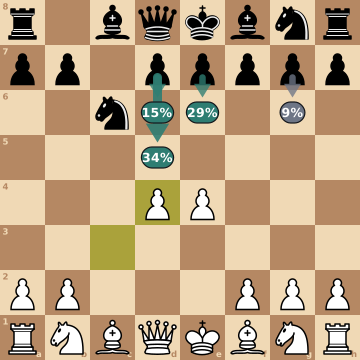
- 4...d5 (34%). Black hits your center right away with d5.
Your answer: 5. exd5. Take the pawn. - 4...e6 (29%). d5.
Your answer: 5. Nf3. Develop and protect d4. - 4...d6 (15%). d6?
Your answer: 5. d5. Kick the knight and take lots of space. - 4...g6 (9%). g6?Bg7, but it gives you time for d4-d5, and it weakens the long diagonal toward the rook on h8.
Your answer: 5. d5. Kick the knight. Watch for the trap on e5.
After 1. e4 c5 2. c3 d6 3. d4 cxd4 4. cxd4
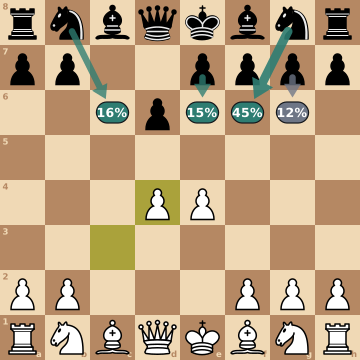
- 4...Nf6 (45%). Your e4 pawn is not protected yet.
Your answer: 5. Nc3. Protect e4 by developing a piece. - 4...Nc6 (16%). Nc6?
Your answer: 5. d5. Kick the knight and grab space. - 4...e6 (15%). Black plays e6, a passive setup.
Your answer: 5. Nf3. Develop naturally. - 4...g6 (12%). Black prepares a fianchetto with g6.
Your answer: 5. Nf3. Protect d4 before the bishop arrives.
After 1. e4 c5 2. c3 d5 3. exd5 Qxd5 4. d4
Black's queen sits in the center, and your knight can't use c3 yet. Keep calm: Nf3, Be2 and castle, and if the c-pawns are ever traded, Nc3 comes with tempo on the queen.
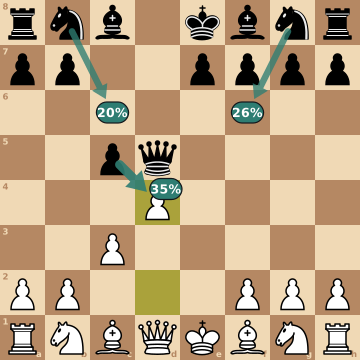
- 4...cxd4 (35%). Black takes on d4.
Your answer: 5. cxd4. Recapture, and c3 is free for your knight again. - 4...Nf6 (26%). Black develops Nf6.
Your answer: 5. Nf3. Develop and guard d4. - 4...Nc6 (20%). Black develops Nc6 and adds pressure to d4.
Your answer: 5. Nf3. Protect d4 and develop.
After 1. e4 c5 2. c3 e6 3. d4
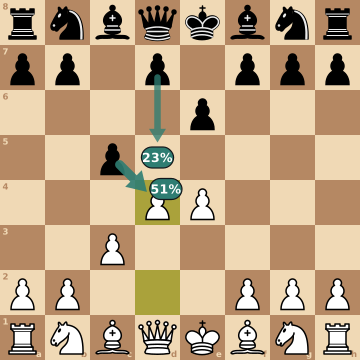
- 3...cxd4 (51%). Black takes on d4.
Your answer: 4. cxd4. Recapture and keep two pawns in the center. - 3...d5 (23%). Black attacks e4 with d5.
Your answer: 4. exd5. Trade pawns and open the position.
Your plan after the opening
Against 2...Nc6 with 4...d5: play with the isolated pawn
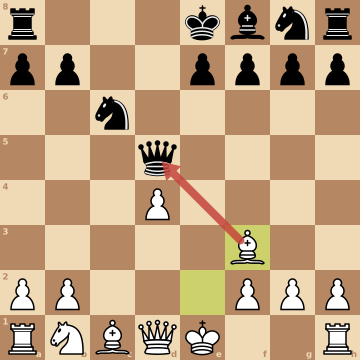
After the queen recaptures on d5, protect d4 with Nf3, break the ...Bg4 pin with Be2, then play Nc3 to hit the queen. Castle, put the bishop on e3 and a rook on c1 or d1.
Your d4 pawn is isolated, but it controls e5 and c5 and gives your pieces space. Keep it defended, keep your pieces active, and avoid swapping into an endgame where the pawn is only a weakness. The Coach's line ends with a small edge for you.
1. e4 c5 2. c3 Nc6 3. d4 cxd4 4. cxd4 d5 5. exd5 Qxd5 6. Nf3 Bg4 7. Be2 e6 8. Nc3
Against ...e6 and ...d5: push e5 and build a French-style chain
When Black plays ...e6 and then ...d5, push past with e5. Your pawns on d4 and e5 take the f6 square from Black's knight and give you space on the kingside.
Black will attack d4 with ...Nc6, ...Nge7-f5 and ...Qb6. Count attackers and defenders before every move, and keep d4 covered with Nf3, Nc3 and a bishop on e2 or d3.
1. e4 c5 2. c3 e6 3. d4 cxd4 4. cxd4 d5 5. e5
Against 2...d6: take the ideal center and keep it
Here Black allows pawns on e4 and d4 with nothing to hit them. Defend e4 with Nc3, add Nf3, and play h3 so Black's bishop can't pin your knight from g4. Then Bd3, castle and Be3. If Black ever plays ...e5, push past with d5 and enjoy the space.
1. e4 c5 2. c3 d6 3. d4 cxd4 4. cxd4 Nf6 5. Nc3 g6 6. Nf3 Bg7 7. h3 O-O 8. Bd3
Traps and common mistakes
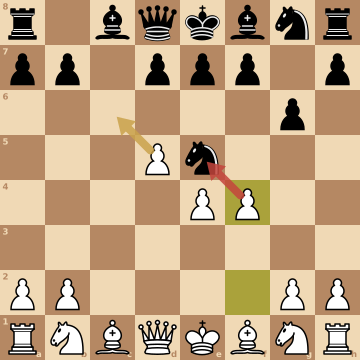
The knight trap after 4...g6 (5.d5 Ne5? 6.f4!)
1. e4 c5 2. c3 Nc6 3. d4 cxd4 4. cxd4 g6? 5. d5 Ne5? 6. f4!
This is the trap to remember from this guide. After 4...g6 you push 5.d5, and more than half of Black players (54%) put the knight on e5. Then 6.f4 attacks it, and every square it can reach is covered: c4 by your bishop, d3 by the bishop and queen, f3 and g4 by your pieces, and c6 by the d5 pawn. White wins 63% of games after 5...Ne5 at this level.
If Black retreats with 5...Nb8 instead, 6.Qd4 hits the rook on h8 along the long diagonal that ...g6 weakened.
Missing d4-d5 after 4...d6
1. e4 c5 2. c3 Nc6 3. d4 cxd4 4. cxd4 d6? 5. d5! Nb8
4...d6 looks solid, but with a pawn on d6 the knight on c6 has no good retreat. 5.d5 attacks it, and the usual answer is the sad 5...Nb8, all the way home. If it goes to e5, f4 kicks it again.
The same thing happens after 2...d6 3.d4 cxd4 4.cxd4 Nc6. Stockfish rates you about a pawn and a half ahead in both lines. Don't rush afterwards: develop with Nf3, Nc3 and Be2, castle, and let your space do the work.
Playing 3.d4 against 2...Nf6
1. e4 c5 2. c3 Nf6 3. d4? Nxe4
This is the one reply where your usual move is wrong. The knight on f6 attacks e4, and because your pawn sits on c3, your knight can't come to c3 to defend it. After 3.d4? Black simply takes the pawn.
Push 3.e5 first. The knight has to move (almost always to d5), and then 4.d4 supports your e5 pawn.
Taking back on f3 with the g-pawn
1. e4 c5 2. c3 Nc6 3. d4 cxd4 4. cxd4 d5 5. exd5 Qxd5 6. Nf3 Bg4 7. Be2 Bxf3 8. Bxf3!
In the main line Black sometimes gives up the bishop on f3. Recapture with the bishop, not the g-pawn. 8.Bxf3 attacks the queen on d5, so Black loses more time, and d4-d5 is coming to kick the knight on c6.
Don't worry about 8...Qxd4: 9.Bxc6+ bxc6 10.Qxd4 wins Black's queen, because the bishop takes the knight with check first.
Grabbing back the pawn with the queen after 2...e5
1. e4 c5 2. c3 e5 3. d4 cxd4 4. cxd4 exd4 5. Nf3 Nc6 6. Nxd4
After 4...exd4 most White players recapture at once with 5.Qxd4, and then 5...Nc6 hits the queen and Black gains time. Develop first with 5.Nf3 and take on d4 with the knight next move. Material is level and your knight stands in the center.
Frequently asked questions
Is the Alapin good for beginners?
Yes. It uses one plan against almost every reply: d4, take back with the c-pawn, develop and castle. It avoids the long theory of the Open Sicilian, and at 900 to 2200 two popular replies (4...d6 and 4...g6 after 2...Nc6) are mistakes that d4-d5 punishes.
What is the most common reply to the Alapin at club level?
At 900 to 2200 on Lichess, 2...Nc6 is the most common answer to 2.c3 (32%). Next come 2...d6 (18%), then 2...d5 and 2...e6 (14% each), and 2...Nf6 (9%).
Is 2...d5 a good response to the Alapin?
Yes, it's one of Black's best. It uses the fact that your pawn on c3 blocks your knight, so the queen can recapture on d5 safely. You answer with 4.d4, Nf3, Be2 and castling, and the Coach's lines end in a level position with no weaknesses on your side.
How popular is the Alapin on Lichess?
It's a specialist choice. At 900 to 2200, 2.c3 is played in about 5% of games after 1.e4 c5, and in about 7% among players rated 2200 and above. That means many opponents will have less experience against it than against the Open Sicilian.
Does the Alapin really avoid Sicilian theory?
Mostly. You still need the move orders on this page, and 2...Nf6 needs its own answer (3.e5). But the ideas repeat so often that there is far less to memorize than in any Open Sicilian line.
Keep learning
- All 36 opening guides: every opening on the site, grouped by what you play as White and Black.
- Open Sicilian vs Alapin: The two main choices compared side by side.
- How to Play Against the Sicilian Defense: Where the Alapin fits among White's answers to 1...c5.
- Transposition and move orders: How the Alapin's lines meet in the same positions, and how to use that.
The Coach plays the Sicilian against you with the moves 900 to 2200 players actually choose, from 2...Nc6 to 2...Nf6, and explains every answer in plain English. Progress tracking is free during the open beta.
Practice the Alapin Variation free →