How to Play Against the Sicilian Defense (1.e4 c5) as White
TL;DR
Question What should White play against 1.e4 c5? Short answer Below about 1800, play the Alapin, 2. c3. If you already enjoy sharp, theory-heavy chess, go for the Open Sicilian with 2. Nf3 and 3. d4. Games behind this article About 45 million Lichess games across three trainers: Alapin (about 27 million at 900 to 2200), Najdorf (about 17 million at 1600 to 2400) and Yugoslav Attack vs the Dragon (about 2.0 million at 1700 to 2400) Black's replies to 2.c3 2...Nc6 32.4%, 2...d6 17.5%, 2...d5 14.5%, 2...e6 14.3%, 2...Nf6 9.1%, 2...e5 5.2% Open Sicilian workload After 5...a6 alone, White picks between six main systems at 1600 to 2400. The whole Alapin trainer is 16 lines. Lichess results Yugoslav Attack, 1700 to 2400 on Lichess: White wins 62% of games after 9...a6. Alapin, 900 to 2200 on Lichess: White wins 63% of games after the 5...Ne5? trap. Recommended range Alapin 900 to 2200 Elo. Yugoslav Attack 1700 to 2400 Elo. We only quote results for specific positions where our data states them, never an overall win rate for the Open Sicilian or the Alapin.
Why the Sicilian is such a problem for White
If you open with 1.e4, the Sicilian is one of the replies you'll see most. In our Alapin data (900 to 2200 on Lichess), 17.1% of players answer 1.e4 with 1...c5, second only to 1...e5. What makes it awkward isn't that it's hard to play against in theory. It's that "the Sicilian" is really a dozen different openings that happen to start with the same move.
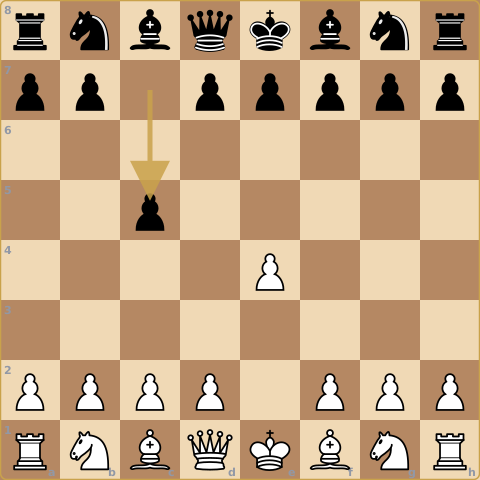
Black gives up a share of the center for an unbalanced game. If White opens things up with d4, Black trades the c-pawn for White's d-pawn, which leaves Black with two central pawns against one and a half-open c-file to attack along. That trade is the heart of almost every Sicilian.
So White has a decision to make on move two, and it comes down to one question: do you want to meet Black on their home ground, or change the ground?
Option 1: The Open Sicilian (2.Nf3 and 3.d4)
This is the main road. White develops, opens the center and gets a lead in development plus more space. Most of the famous attacking games against the Sicilian come from here.
The catch is that Black gets to pick the battlefield. After move five, Black can go into the Najdorf (5...a6), the Dragon (5...g6), the Classical (with ...Nc6), the Scheveningen setups with ...e6 and more. And Black can steer toward other systems earlier with 2...Nc6 or 2...e6. Each of those needs its own plan from White, and in several of them White's best line is a sharp, forcing sequence you have to know by heart.
Our Najdorf data shows how deep this goes. After 5...a6, players at 1600 to 2400 on Lichess choose between six main systems: 6.Bg5 (24.2%), 6.Be3 (19.1%), 6.Bc4 (13.8%), 6.Be2 (12.4%), 6.f3 (7.8%) and 6.Bd3 (7.5%). Each one has its own plans, and that's one Black system out of many.
The Dragon is the other end of the scale. Against it, White's sharpest answer is the Yugoslav Attack:
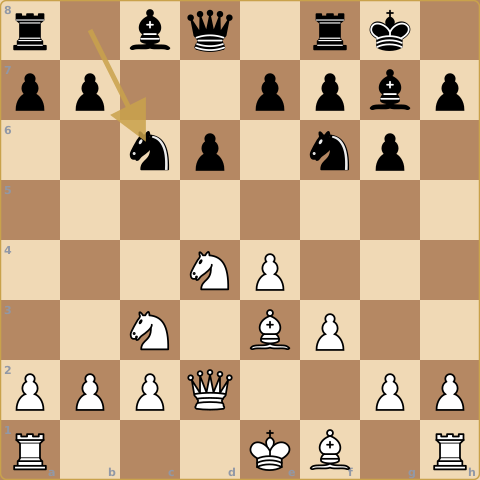
Here most White players at 1700 to 2400 on Lichess castle at once: 9.O-O-O is much more common than 9.Bc4 (61% against 20%). Either way you get a race where each side storms the other's king, and one slow move can decide it: after 9.O-O-O a6, White wins 62% of games at this level on Lichess.
The Open Sicilian suits you if you like that kind of chess and you're willing to put in the study time. If you're rated 1700 or more and you enjoy calculating, it's the most ambitious choice White has.
Option 2: The Alapin (2.c3)
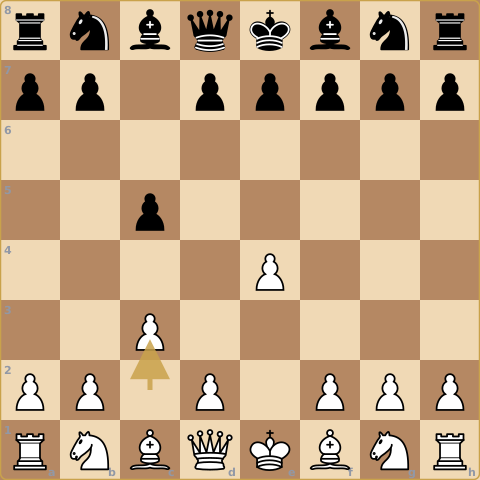
The Alapin skips all of that. White plays c3 and then d4, so if Black takes on d4, White takes back with the c-pawn instead of the knight. There's no open d-file, no half-open c-file for Black, and none of the Najdorf, Dragon or Sveshnikov theory at all.
In our Alapin data (about 27 million Lichess games at 900 to 2200), Black answers 2.c3 in six main ways. The four you'll meet most (2...Nf6 and 2...e5 follow the same ideas):
- 2...Nc6 (32.4%). White plays 3.d4 cxd4 4.cxd4 and keeps two pawns in the center. Against 4...d6 or 4...g6, d4-d5 chases the knight away.
- 2...d6 (17.5%). Solid but slow. After 3.d4 cxd4 4.cxd4 White has the ideal center.
- 2...d5 (14.5%). After 3.exd5 Qxd5 4.d4, the c3 pawn takes away the square White's knight would normally use to hit the queen. Once the c-pawns are traded, c3 is free again and Nc3 comes with tempo.
- 2...e6 (14.3%). After 3.d4 cxd4 4.cxd4 d5 5.e5 you reach a French Advance structure with the c-pawns already gone.
The plan barely changes from line to line: build the center, develop, castle, and use your space. In a lot of lines White ends up with an isolated pawn on d4, which sounds bad but comes with open files and active bishops. You're learning one plan well instead of five sharp systems badly.
It has a serious track record too. Deep Blue played 2.c3 against Garry Kasparov in their 1996 match to get away from his Open Sicilian preparation, and several world champions have used it since.
Which one should you pick?
Be honest about how much time you have for openings.
- Under about 1800, or short on study time: play the Alapin. The whole trainer is 16 lines across six Black replies, and the plans repeat.
- 1800 and up, and you love sharp positions: the Open Sicilian gives you more ways to win and teaches you a huge amount about attacking chess. Budget real time for it.
- Somewhere in between: start with the Alapin now and add Open Sicilian lines one Black system at a time later. Nothing about the Alapin stops you from switching.
One thing to avoid: playing 2.Nf3 and 3.d4 without knowing what to do against the main Black systems. That's the worst of both worlds, because the Sicilian player almost certainly knows their own lines better than you do.
The other anti-Sicilians, briefly
The Alapin isn't the only way around the Open Sicilian. The Closed Sicilian (2.Nc3 and g3), the Grand Prix Attack (2.Nc3 and f4), the Smith-Morra Gambit (2.d4 cxd4 3.c3) and the Rossolimo (2.Nf3 Nc6 3.Bb5) all have their fans. At 1600 to 2400 on Lichess, 2.Nc3 turns up in 9% of games and 2.d4 in 7%, but the Alapin is the only one we've built a White trainer for, so we're not going to rank the others.
Going deeper
If you're torn between the two main choices, our Open Sicilian vs Alapin comparison goes through the differences move by move. And if your opponents keep playing ...g6 setups, our guide to the Maróczy Bind shows how White clamps down on the center with c4 and e4.
Frequently asked questions
What is the best move against the Sicilian Defense?
There isn't one best move for everyone. 2.Nf3 followed by 3.d4 (the Open Sicilian) is the most ambitious and the most theory-heavy. 2.c3 (the Alapin) is a popular way to avoid that theory and is the better practical choice for most players under about 1800.
Is the Alapin good against the Sicilian?
Yes. It's fully sound, it's been used by world champions and Deep Blue played it against Kasparov. In our data from about 27 million Lichess games at 900 to 2200, Black's most common replies are 2...Nc6 (32.4%), 2...d6 (17.5%), 2...d5 (14.5%) and 2...e6 (14.3%), and the same plan of d4 with a pawn recapture works against all of them, so there's much less to learn than in the Open Sicilian.
How much theory do I need for the Open Sicilian?
A lot. You need a plan against the Najdorf, the Dragon, the Classical, the Scheveningen, the Sveshnikov, the Taimanov and the Kan, plus Black's second-move alternatives. Against the Najdorf alone, players at 1600 to 2400 on Lichess use six main sixth moves: 6.Bg5 (24%), 6.Be3 (19%), 6.Bc4 (14%), 6.Be2 (12%), 6.f3 and 6.Bd3 (8% each).
Can I play the Alapin if my opponent likes ...e6 or ...d6 setups?
The Alapin is 2.c3 on move two, so it works against any first move by Black after 1...c5. If you play 2.Nf3 first, some Black setups (like 2...d6) make c3 less effective, which is why most Alapin players go 2.c3 straight away.
Copy the lines (PGN)
Every line in this article in standard PGN, ready to paste into Lichess, Chess.com or any chess database.
[Event "How to Play Against the Sicilian Defense (1.e4 c5) as White: Alapin, 2...Nc6"]
[Site "chesscoachacademy.com"]
[Result "*"]

1. e4 c5 2. c3 Nc6 3. d4 cxd4 4. cxd4 d5 5. exd5 Qxd5 6. Nf3 Bg4 7. Be2 e6 8. Nc3 *

[Event "How to Play Against the Sicilian Defense (1.e4 c5) as White: Alapin, 2...d6"]
[Site "chesscoachacademy.com"]
[Result "*"]

1. e4 c5 2. c3 d6 3. d4 cxd4 4. cxd4 Nf6 5. Nc3 g6 6. Nf3 Bg7 7. h3 O-O 8. Bd3 *

[Event "How to Play Against the Sicilian Defense (1.e4 c5) as White: Alapin, 2...Nf6"]
[Site "chesscoachacademy.com"]
[Result "*"]

1. e4 c5 2. c3 Nf6 3. e5 Nd5 4. d4 cxd4 5. cxd4 *

[Event "How to Play Against the Sicilian Defense (1.e4 c5) as White: Alapin, 2...d5"]
[Site "chesscoachacademy.com"]
[Result "*"]

1. e4 c5 2. c3 d5 3. exd5 Qxd5 4. d4 Nf6 5. Nf3 *

[Event "How to Play Against the Sicilian Defense (1.e4 c5) as White: Alapin, 2...e6"]
[Site "chesscoachacademy.com"]
[Result "*"]

1. e4 c5 2. c3 e6 3. d4 cxd4 4. cxd4 d5 5. e5 *

[Event "How to Play Against the Sicilian Defense (1.e4 c5) as White: Open Sicilian, Najdorf"]
[Site "chesscoachacademy.com"]
[Result "*"]

1. e4 c5 2. Nf3 d6 3. d4 cxd4 4. Nxd4 Nf6 5. Nc3 a6 *

[Event "How to Play Against the Sicilian Defense (1.e4 c5) as White: Open Sicilian, Yugoslav Attack"]
[Site "chesscoachacademy.com"]
[Result "*"]

1. e4 c5 2. Nf3 d6 3. d4 cxd4 4. Nxd4 Nf6 5. Nc3 g6 6. Be3 Bg7 7. f3 O-O 8. Qd2 Nc6 9. O-O-O *
Keep reading
- Open Sicilian vs Alapin: What's the Difference?: The two main choices side by side, including the structures each one leads to.
- The Maróczy Bind Explained: How White keeps a space advantage with pawns on c4 and e4 against ...g6 Sicilians.
- What Is the Best Defense Against 1.e4?: The full picture from Black's side, including where the Sicilian fits.
Practice the Alapin against every Sicilian reply
The quickest way to stop worrying about the Sicilian is to play the Alapin against all of Black's main replies until the plans feel automatic. Our trainer walks you through all 16 lines, built from about 27 million Lichess games at 900 to 2200 and checked by Stockfish, one move at a time, with a plain-English note on each move. If you want to go sharp instead, the Yugoslav Attack trainer covers the Dragon race from White's side.
It's all free during the open beta, and if you make an account we'll track your progress on every line for free.
Practice the Alapin Variation →
Practice the Yugoslav Attack →
16 Alapin lines built from 27 million Lichess games. Free during the open beta, with free progress tracking.
Practice the Alapin free →