The Maróczy Bind: How White Keeps a Space Advantage
TL;DR
What it is White pawns on c4 and e4 against a Sicilian, usually with no pawn on d4. Together they control d5 and cramp Black. Main way to reach it 1. e4 c5 2. Nf3 Nc6 3. d4 cxd4 4. Nxd4 g6 5. c4 (the Accelerated Dragon) White's plan Be3, Nc3, Be2, O-O, Qd2, then f3 and b3 to lock the pawns in place. Keep d5 and b5 under control. Black's breaks to stop ...b5 and ...d5 above all. Also ...f5 once Black's knight leaves f6. Also arises from The English Opening (1.c4 c5 with an early d4 and e4) and the Kan Sicilian (...a6 met by c4) About our data We don't have a dedicated Maróczy repertoire yet, so this article sticks to plans and verified move sequences rather than frequencies.
What is the Maróczy Bind?
The Maróczy Bind is a pawn setup, not a single opening. White puts pawns on c4 and e4 and uses them to control the d5 square. It's named after Géza Maróczy, the Hungarian grandmaster who showed how strong the setup was in the early 1900s.
The reason it matters is simple. In most Sicilians, Black's main freeing move is ...d5. Pawns on c4 and e4 both hit d5, so that break becomes very hard to achieve. Black's other big idea, ...b5, is also harder because the c4 pawn covers b5. Take away both of those and Black can end up with a solid but cramped position and not much to do.
How White gets there
The most common route is against the Accelerated Dragon, where Black plays ...g6 before ...d6:
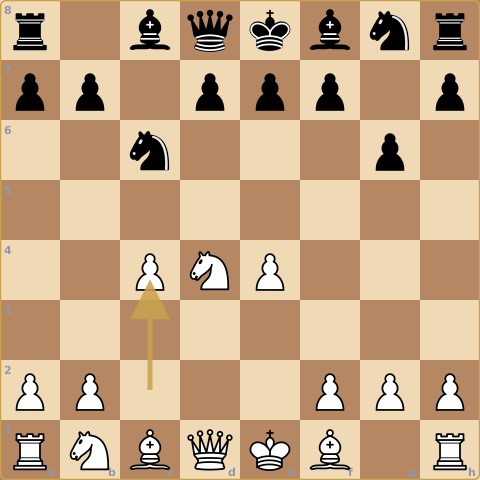
You'll also see the same structure in the Kan (1.e4 c5 2.Nf3 e6 3.d4 cxd4 4.Nxd4 a6 5.c4) and in the English Opening, where White starts with 1.c4 and later adds e4.
White's setup, step by step
Here's a standard way the pieces come out in the main line:
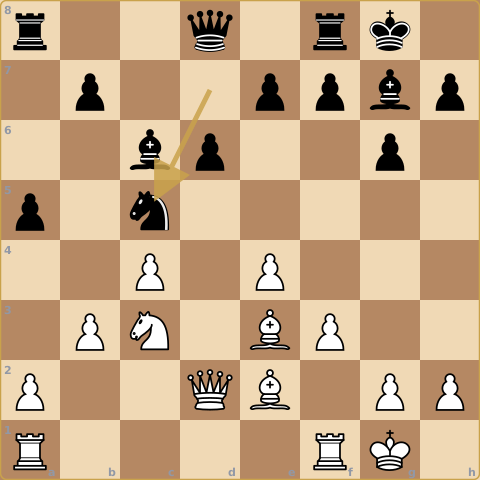
Look at what each White move is for:
- Be3 and Nc3: natural development, and the knight adds a third guard on d5.
- Be2 and O-O: the bishop goes to e2, not d3, so it doesn't block the queen and can later support a pawn on c4 or go to f3 or g4.
- Qd2: connects the rooks and eyes the dark squares around Black's king, with ideas of Bh6 to trade Black's strong bishop on g7.
- f3: supports e4 and takes the g4 square away, so a Black knight can't jump there to hit the bishop on e3.
- b3: supports c4 against pressure from ...Be6 and ...Qb4, and keeps a Black knight on c5 out of a4 and b3.
Once the wall is up, White usually has a choice of plans: expand on the queenside with a3 and b4 to kick Black's pieces, or play on the kingside with f4 and f5. The space advantage means White's pieces can switch sides faster than Black's.
Black's counterplay: what to watch for
Black isn't helpless, and knowing Black's ideas is most of the work of playing the bind well.
- Trade pieces. A cramped side usually wants fewer pieces. That's why Black often plays ...Nxd4 early. White should avoid trades that don't help, especially of the knight that controls d5.
- ...a5 and ...Nc5. Black fixes White's queenside pawns and puts a knight on c5, where it hits e4 and b3. The pawn on a5 also stops White's b4 plan for a while.
- ...Be6 or ...Bc6 and pressure on c4 and e4. Black lines up pieces against the two pawns that hold the bind together.
- ...b5 as a pawn sacrifice. Sometimes Black gives a pawn with ...b5 to break the bind open and get the long diagonal working. Keep a close eye on it once Black has ...a6 and a rook on b8.
- ...f5. Once Black's knight has moved from f6, ...f5 can hit e4 from the other side.
A tactic White has to know: 7...Ng4
If Black gets the bishop to g7 before ...Nf6, there's a known trick when White develops in the obvious way:
7...Ng4 hits the bishop on e3, and with the f6 knight gone, the bishop on g7 now bears down the long diagonal at White's knight on d4. The clean answer is to take the knight with 8.Qxg4. After 8...Nxd4, Black's knight is eyeing c2, where it would fork the king and rook, so the queen drops back with 9.Qd1 to cover it. The position is fine for White, but it's a line you want to have seen before the game, not during it.
Is the Maróczy Bind good for White?
Yes. It's one of the most respected ways to meet ...g6 Sicilians, and it's the main reason the Accelerated Dragon has a reputation as a patient, defensive opening for Black. That said, it doesn't win by itself. The bind gives you space and time. If you don't use them with a plan, Black will slowly untangle, trade pieces and reach an endgame where your pawns on c4 and e4 are more of a target than a strength.
If you'd rather not face the Accelerated Dragon at all, there's the other route: meet 1...c5 with 2.c3 and keep the game in Alapin territory from move two.
Frequently asked questions
What is the Maróczy Bind in chess?
It's a pawn structure where White has pawns on c4 and e4 against a Sicilian-type setup, controlling the d5 square. It makes Black's usual freeing breaks, ...d5 and ...b5, very hard to play.
Who is the Maróczy Bind named after?
Géza Maróczy, a Hungarian grandmaster who was one of the strongest players in the world in the early 1900s.
How does Black break the Maróczy Bind?
Mainly by trading pieces, putting a knight on c5 supported by ...a5, pressuring c4 and e4 with ...Be6 or ...Bc6, and looking for ...b5 or ...f5 at the right moment.
Which openings lead to the Maróczy Bind?
Most often the Accelerated Dragon (1.e4 c5 2.Nf3 Nc6 3.d4 cxd4 4.Nxd4 g6 5.c4). It also appears in the Kan Sicilian and in many English Opening lines.
Copy the lines (PGN)
Every line in this article in standard PGN, ready to paste into Lichess, Chess.com or any chess database.
[Event "The Maróczy Bind: How White Keeps a Space Advantage: Setting up the bind"]
[Site "chesscoachacademy.com"]
[Result "*"]

1. e4 c5 2. Nf3 Nc6 3. d4 cxd4 4. Nxd4 g6 5. c4 *

[Event "The Maróczy Bind: How White Keeps a Space Advantage: Main line to 14...Nc5"]
[Site "chesscoachacademy.com"]
[Result "*"]

1. e4 c5 2. Nf3 Nc6 3. d4 cxd4 4. Nxd4 g6 5. c4 Bg7 6. Be3 Nf6 7. Nc3 O-O 8. Be2 d6 9. O-O Bd7 10. Qd2 Nxd4 11. Bxd4 Bc6 12. f3 a5 13. b3 Nd7 14. Be3 Nc5 *

[Event "The Maróczy Bind: How White Keeps a Space Advantage: The 7...Ng4 trick"]
[Site "chesscoachacademy.com"]
[Result "*"]

1. e4 c5 2. Nf3 Nc6 3. d4 cxd4 4. Nxd4 g6 5. c4 Bg7 6. Be3 Nf6 7. Nc3 Ng4 8. Qxg4 Nxd4 9. Qd1 *
Keep reading
- How to Play Against the Sicilian Defense: Where the Maróczy Bind fits among White's choices against 1...c5.
- What Is the Best Defense Against 1.e4?: The big-picture view of Black's options against 1.e4.
Practice a Sicilian system you can play tomorrow
We haven't built a Maróczy trainer yet, but if you want a complete, ready-to-play answer to the Sicilian right now, our Alapin trainer covers Black's six most common replies to 2.c3 in 16 lines, built from what 900 to 2200 rated players actually play on Lichess and checked by Stockfish. You get the same kind of space advantage with a lot less theory. And if you like the idea of a c4 pawn clamping down on d5, our English Opening trainer builds its whole plan around that square from 1.c4. It uses a g3 and Bg2 setup rather than the full bind with e4, so treat it as a cousin of the Maróczy, not the same thing.
Every trainer is free during the open beta, and your progress is tracked for free when you make an account.
Practice the Alapin Variation →
Practice the English Opening →
Move-by-move lines from what players at your level really play on Lichess. Free during the open beta, with free progress tracking.
Practice the Alapin free →