What Is the Best Defense Against 1.e4? The 7 Most Reliable Options for Black
TL;DR
Short answer There's no single best defense. Pick by rating and style: the Caro-Kann for a solid game at any level, the Scandinavian if you're under about 1400, the Petroff against 1.e4 e5 specialists, and the Sicilian Najdorf if you're 1600+ and want the sharpest fight. Games behind this article About 391 million Lichess games across seven Black trainers, each built from what players at its rating range actually play Largest dataset Petroff, about 98 million games (recommended 800 to 2400 Elo) Lowest entry point Scandinavian, from 400 Elo (about 94 million games at 400 to 1400) Widest range Petroff, 800 to 2400 Elo. Caro-Kann, 800 to 2200 (about 37 million games). What "reliable" means here Well tested in real games, with players converging on the same key moves. It's not a win-rate claim: we only quote Lichess results for specific positions, never an overall score for a defense.
The quick answer by rating and style
| Under 1000 | Scandinavian (400+) or Caro-Kann (800+). Simple plans, few early traps. |
| 1000 to 1600 | Caro-Kann, Petroff or Pirc. Solid structures that hold up as opponents get stronger. |
| 1600 and up | Any of them except the Scandinavian, which our library tops out at 1400. The Najdorf becomes a realistic choice if you like sharp positions and have time to study. |
| You want safety | Caro-Kann or Petroff |
| You want to fight for a win | Sicilian Najdorf, Alekhine's Defense or the Modern Defense |
What Makes a 1.e4 Defense "Reliable"
Not every opening described as a reply to 1.e4 actually is one, several well-known Black defenses (the King's Indian, the Grünfeld, the Nimzo-Indian) are actually responses to 1.d4, despite sometimes getting lumped in with "e4 defenses" in casual writing. Every opening in this article was checked directly against its own real move data to confirm it, no exceptions.
"Reliable" in this context means two real, verifiable things: how many real games actually back the repertoire, and how consistently real players converge on the same key moves, which suggests well-established, well-tested theory rather than a rarely-tried idea. It does not mean "wins more often". Our data gives results only for specific positions, not an overall score for a defense, so this article doesn't make that claim.
Sicilian Najdorf
Recommended range: 1600 to 2400 Elo · Lichess games behind this trainer: about 17 million (Lichess, 1600 to 2400) · Style: Aggressive
The Najdorf is the most famous Sicilian system in chess, and the sharpest of these seven defenses. It's built around one quiet-looking move that prepares genuine flexibility on the queenside.
1. e4 c5 2. Nf3 d6 3. d4 cxd4 4. Nxd4 Nf6 5. Nc3 a6
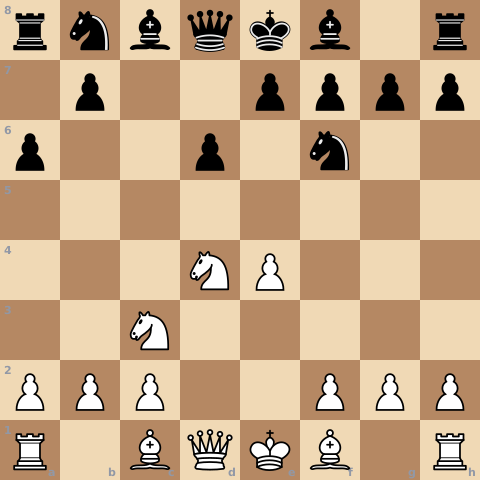
This trainer covers White's six main replies at 1600 to 2400 on Lichess: 6.Bg5 (24%), 6.Be3 (19%), 6.Bc4 (14%), 6.Be2 (12%), 6.f3 and 6.Bd3 (8% each). And because only about 57% of White players at this level answer 1...c5 with 2.Nf3, it also covers the anti-Sicilians you'll actually meet, such as 3.Bb5+, 3.Bc4, the Grand Prix Attack and the Smith-Morra Gambit.
Practice the Sicilian Najdorf interactively →
Caro-Kann Advance
Recommended range: 800 to 2200 Elo · Lichess games behind this trainer: about 37 million (Lichess, 800 to 2200) · Style: Solid, positional
Against White's most common response to the Caro-Kann at 800 to 2200 on Lichess, the Advance Variation (42% of games), Black's main plan is well-established in real games.
1. e4 c6 2. d4 d5 3. e5
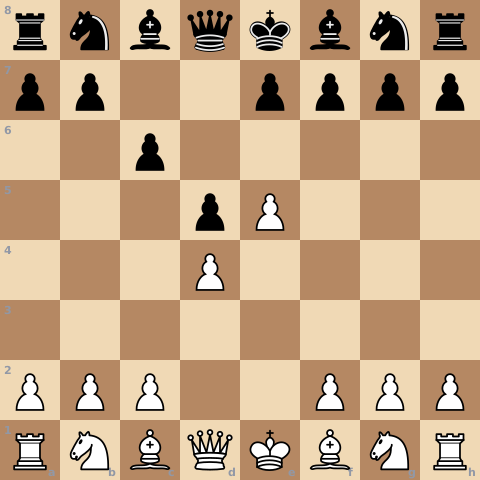
From here, the split in real games:
- 3...Bf5 (developing the bishop before the pawn on e6 could trap it), the classical main line and the move this trainer uses, played in 64% of games at 800 to 2200.
- 3...c5 (pushing the c-pawn to challenge White's center), striking directly at the center, 24% of games at 900 to 1800 in our White-side Caro-Kann data.
This is one of the widest recommended ranges of the seven, 800 to 2200, reflecting how the same solid structure genuinely holds up from a near-beginner level through advanced play.
Want the reasoning behind its reputation? Read why the Caro-Kann is considered so solid.
Practice the Caro-Kann as Black interactively →
Petroff Defense
Recommended range: 800 to 2400 Elo · Lichess games behind this trainer: about 98 million (Lichess, 800 to 2400) · Style: Solid, positional
The Petroff is a symmetrical, counter-attacking reply, meeting White's central pawn with an equally direct central pawn of its own, then meeting the knight attack with a knight of its own rather than defending passively.
1. e4 e5 2. Nf3 Nf6
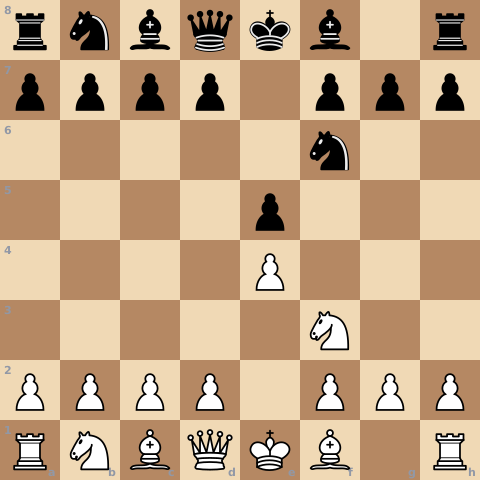
White's most common answers at 800 to 2400 on Lichess are 3.Nc3 (33%), 3.Nxe5 (32%) and 3.Bc4 (18%). This trainer covers all of them, plus 3.d3 and 3.d4.
Worried it's too drawish? We looked at that in is the Petroff Defense really drawish?
Practice the Petroff Defense interactively →
Modern Defense
Recommended range: 900 to 1800 Elo · Lichess games behind this trainer: about 54 million (Lichess, 900 to 1800) · Style: Flexible
The Modern Defense fianchettoes the bishop immediately, without committing to a specific pawn structure first, keeping real flexibility for several moves.
1. e4 g6 2. d4
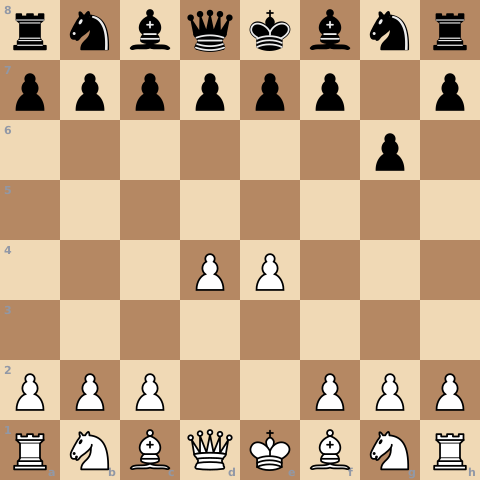
This central response is White's most common reply at 900 to 1800 on Lichess, but only in 38% of games: 2.Nf3 (29%), 2.Bc4 (10%) and 2.Nc3 (6%) are all common too, and this trainer covers them. Following the main line:
2...Bg7 3. Nf3 d6
Black fianchettoes the bishop, then White develops the knight, then Black pushes the d-pawn one square. 3.Nf3 is White's most common third move here (40.6%), with the early 3.e5 next (23.2%), and Black meets both with ...d6.
Practice the Modern Defense interactively →
Pirc Defense
Recommended range: 750 to 1800 Elo · Lichess games behind this trainer: about 63 million (Lichess, 750 to 1800) · Style: Flexible
Closely related to the Modern Defense, the Pirc commits to the knight development first, letting White build a large pawn center before attacking it with pieces.
1. e4 d6 2. d4 Nf6 3. Nc3
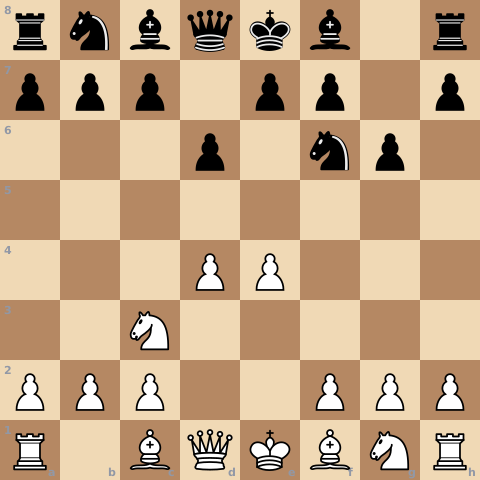
That developing move is played in 65.4% of games reaching this position at 750 to 1800 on Lichess. Black's natural follow-up:
3...g6
Preparing to fianchetto the dark-squared bishop. From here White's most common tries are the Classical System with 4.Nf3 (33.6%), the active 4.Bg5 (18.6%), the Austrian Attack with 4.f4 (8.6%), 4.Bc4 (6.4%) and 4.Be3 (6.1%), which leads to 150 Attack setups with Qd2 and Bh6. This trainer covers all of them.
Practice the Pirc Defense interactively →
Alekhine's Defense
Recommended range: 1200 to 2000 Elo · Lichess games behind this trainer: about 29 million (Lichess, 1200 to 2000) · Style: Flexible
A provocative reply that invites White's pawns forward before attacking them with pieces, rather than contesting the center directly on move one.
1. e4 Nf6
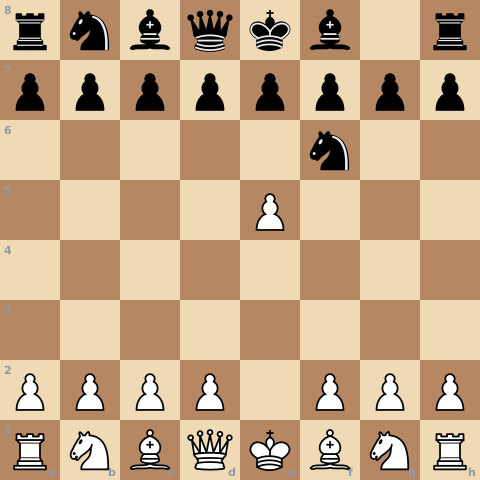
White's two real responses split clearly:
- 2. e5 (pushing the pawn to chase the knight), chasing the knight immediately, the main choice at 46% of games at 1200 to 2000 on Lichess.
- 2. Nc3 (developing the knight instead), a calmer developing alternative, 33%.
Following the main line, 2...Nd5 3. d4 (the knight retreats to d5, then White claims the center with the d-pawn) is the most common choice at 41.8% of games reaching that position, with 3.c4 close behind at 36.2%. The trainer covers the Modern Variation (4.Nf3), the Exchange Variation, the Four Pawns Attack, the Chase Variation, 4.f4, 4.Bc4, 3.Bc4 and 3.Nf3, plus 2.Nc3 met by ...d5.
Practice Alekhine's Defense interactively →
Scandinavian Defense
Recommended range: 400 to 1400 Elo · Lichess games behind this trainer: about 94 million (Lichess, 400 to 1400) · Style: Solid, aggressive
One of the oldest openings in chess, and the most accessible of these seven, with the lowest recommended starting point by a wide margin.
1. e4 d5 2. exd5 Qxd5
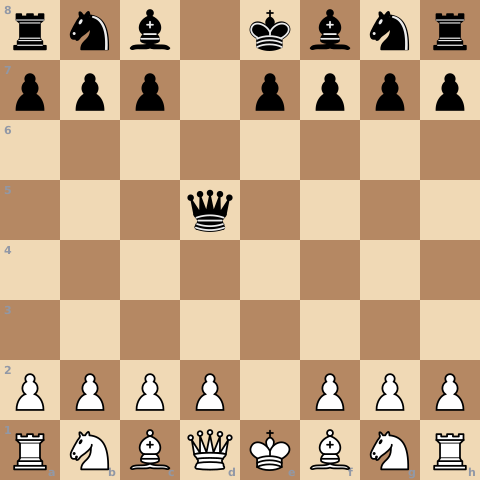
After 3.Nc3 this trainer puts the queen on a5, and White's most common reply at 400 to 1400 on Lichess is 4.Nf3 (39.5%), ahead of 4.d4 (24.8%). Black then develops with ...Nf6, ...c6 and ...Bf5 against both. The result is a healthy, Caro-Kann-like structure with an early queen that's harder to harass than it looks. For more on how it holds up against stronger players, see is the Scandinavian Defense sound at higher levels?
Practice the Scandinavian Defense interactively →
Frequently asked questions
What is the best defense against 1.e4?
There isn't one best defense for everyone. The Caro-Kann is the most reliable all-round choice, the Scandinavian is the easiest for beginners, the Petroff is the most solid answer to 1.e4 e5 lines, and the Sicilian Najdorf is the most ambitious for players rated 1600 and up.
What is the safest defense against 1.e4?
The Caro-Kann and the Petroff are the two safest on this site. Both give Black a sound pawn structure with no obvious weaknesses. The Caro-Kann is recommended from 800 to 2200 Elo, the Petroff from 800 to 2400.
What is the best defense against 1.e4 for beginners?
The Scandinavian (from 400 Elo) and the Caro-Kann (from 800 Elo). Both have clear plans and few early traps.
Is the Sicilian the best answer to 1.e4?
It's one of the most popular and the most ambitious, but it carries the most theory. Our Najdorf trainer is built for 1600 to 2400 because White has six main systems against 5...a6, plus many anti-Sicilians.
More on individual openings
- Pirc vs Modern Defense: Two flexible ...g6 defenses compared, and which one fits you.
- Is Alekhine's Defense Good?: White's main tries against 1...Nf6 and what Black needs to know.
- Is the Scotch Game Good for White?: A lower-theory alternative to the Ruy Lopez against 1...e5.
- Is the Vienna Game Good for Beginners?: Quiet and sharp options against 1...e5, including a trap to know.
- Is the Bishop's Opening Good?: A flexible move order that sidesteps the Petroff.
Playing White against these defenses
If you're on the other side of the board, these guides cover White's best practical answers:
- How to play against the Sicilian Defense, including the Open Sicilian vs Alapin choice and the Maróczy Bind.
- How to beat the Caro-Kann with the Advance Variation.
- How to counter the French Defense, plus the pawn breaks Black will try in the Advance.
- Italian Game vs Ruy Lopez for when Black answers 1.e4 with 1...e5.
Try All Seven for Free
Every defense above, and the full 36-opening library, is completely unlocked during this site's open beta. No card, no limit, no account required to start, just real, move-by-move practice lines built from the same data cited in this article, with your progress tracked for free if you create an account.
Every line checked the same way, against real game data, not against what sounds right.
Browse all 36 openings free →