Is the Scotch Game Good for White?
TL;DR
Short answer Yes. The Scotch is a sound, direct way to meet 1...e5. It opens the center early, gives White quick development and needs far less memorization than the Ruy Lopez. Garry Kasparov brought it back to world championship level. Games behind this article About 73 million Lichess games at 900 to 1800 Black's 4th move after 3...exd4 4.Nxd4 4...Nxd4 50.1% · 4...Bc5 18.1% · 4...Nf6 11.4% · 4...Qf6 5.1% Main lines 4...Nxd4 5.Qxd4 with Nc3, Bf4 and O-O-O, and 4...Bc5 5.Be3 Qf6 6.c3 Lichess results 900 to 1800 on Lichess: 3.d4 scores 53% wins for White. After 4...Nxd4 5.Qxd4 Nf6, 6.e5 wins 61% of games for White. Against 4...Bc5, 5.Be3 wins 54%, compared with 47% for 5.Nxc6. Recommended range 900 to 1800 Elo, 16 lines
What the Scotch does differently
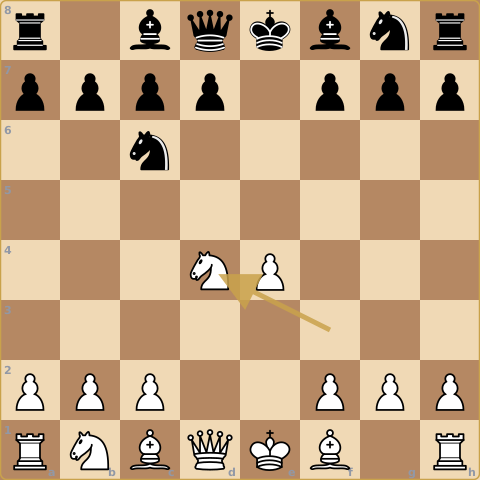
Against 1...e5, most White players develop a bishop on move three, either 3.Bc4 (the Italian) or 3.Bb5 (the Ruy Lopez), and keep the pawns on e4 and e5 facing each other for a long time. The Scotch strikes with 3.d4 straight away. At 900 to 1800 on Lichess, Black takes with 3...exd4 in 70% of games, White recaptures with the knight, and by move four the center is open.
That's a trade. White gives up the slow squeeze of the Ruy Lopez and gets fast, easy development and open lines in return. The Scotch was popular in the 19th century, faded for a long time, and then Kasparov revived it, including against Anatoly Karpov in their 1990 World Championship match. It has been a respected top-level weapon ever since.
Line 1: 4...Nxd4, the club player's favorite
At this level, half of all Black players (50.1%) simply trade knights. It looks harmless, but it hands White a big, centralized queen.
An early queen move is usually risky because enemy pieces can kick it with tempo. Here the knight on c6 is gone, so the only quick way to chase the queen is ...c5, which weakens Black's position. The most common reply is 5...d6 (30.9%). White defends e4 with 6.Nc3, and after 6...Nf6 (51.8%), 7.Bf4 develops and clears the way for queenside castling, with a rook landing on the d-file right away. At this level Bf4 scores 59% for White on Lichess, better than the more popular Bg5.
The second most common reply, 5...Nf6 (24.3%), is a real mistake:
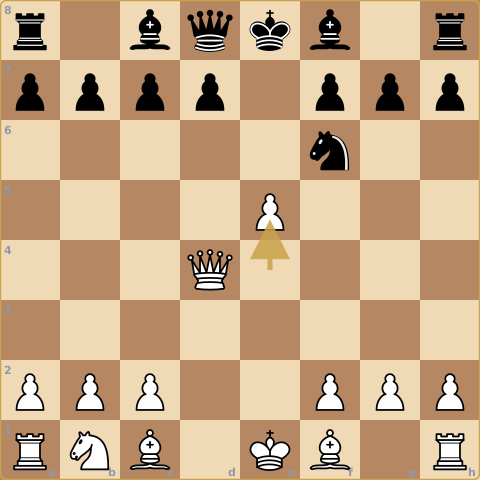
Look at the knight's squares. On d5, e4 or g4 the queen on d4 simply takes it, and on h5 it gets trapped by g4. That leaves the passive retreat to g8. White wins 61% of games from here at 900 to 1800 on Lichess. 5...c5? (15.0%) is another common slip: after 6.Qe3 the d5 square becomes a hole no black pawn can ever cover, and a white knight will land there.
Line 2: 4...Bc5, the Classical
Here Black develops the bishop and attacks the knight on d4, which only the queen defends. White adds a defender with 5.Be3.
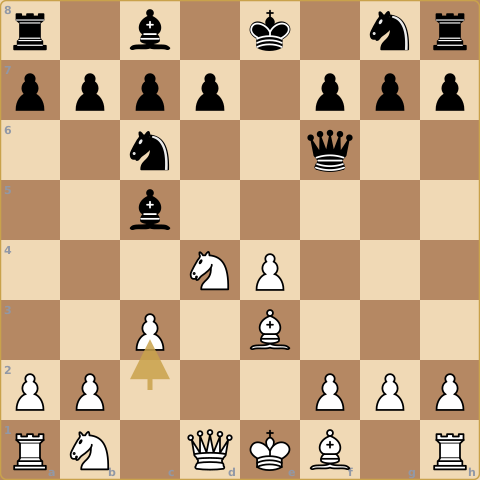
5.Be3 doesn't attack Black's bishop, because White's own knight on d4 blocks the diagonal. But it sets up a threat. If the knight ever takes on c6, the bishop on e3 suddenly attacks the loose bishop on c5. That's why 5...Nf6? is a mistake here.
5...Qf6 is the most common and best answer (36.6%). Now d4 is attacked three times (knight, bishop and queen) and defended twice (queen and bishop), so 6.c3 adds a third defender. Don't play the natural 6.Nc3?? here, because Black takes on d4 and wins a piece. The same position also comes from 4...Qf6 5.Be3 Bc5, which is Black's choice in 77% of those games. After 6.c3, White has a simple setup: develop, castle, and keep d4 safe. It's a level position, not a quick win, but it's an easy one to play.
Line 3: 4...Nf6 and the Scotch Four Knights
Black's most natural-looking reply develops a knight and attacks e4. Our trainer answers calmly with 5.Nc3, defending e4 with a new piece.
Black's best move here is 5...Bb4, pinning the knight, which gives a normal, balanced game. But 44.3% of players trade on d4 anyway, and White gets the same dominant queen as in Line 1. At top level, White often meets 4...Nf6 with 5.Nxc6 and e5 instead, the plan Kasparov made famous against Karpov. 5.Nc3 is simpler to learn and keeps you in positions you already know.
Why it's lower theory than the Ruy Lopez
The Ruy Lopez is one of the deepest openings in chess. Black has several major defenses (the Berlin, the Open, the Closed main lines, the Marshall Attack), and each has long forcing sequences that White has to know. The central tension on e4 and e5 can last for many moves, and the plans change with every pawn structure.
The Scotch cuts most of that out:
- The center is settled by move four. There are far fewer pawn structures to learn.
- Black's choices are concentrated. Half of players trade on d4, and our repertoire covers the four common fourth moves plus 3...d6, 2...d6 and 2...Nf6 in 16 lines.
- The plans are easy to explain. Develop fast, count attackers and defenders on d4, and castle queenside when your queen lands in the center.
The trade-off is that the Scotch rarely gives the long, grinding pressure of the Ruy Lopez. Against the best defenses you get a normal, balanced game. For most players between 900 and 1800, that's a good deal, because it means fewer lines to remember and games where the plan is clear from move five.
Who should play it?
- Players who want an active game against 1...e5 without the theory load of the Ruy Lopez.
- Players who like open positions and quick development over slow maneuvering.
- Anyone rated about 900 to 1800, our recommended range. Several of Black's popular replies at this level are mistakes, so knowing how to punish them pays off quickly.
If you'd rather keep the tension and build up slowly, the Italian or the Ruy Lopez will suit you better. If you want to open the center and play, the Scotch is a good fit.
Frequently asked questions
Is the Scotch Game good for White?
Yes. It's a sound, direct answer to 1...e5 that opens the center on move three and gives White quick development. Garry Kasparov revived it at world championship level, including against Anatoly Karpov in 1990. At 900 to 1800 on Lichess, 3.d4 scores 53% wins for White, and our library recommends it for that range.
Is the Scotch Game easier than the Ruy Lopez?
Yes, for most players. The center is resolved by move four, so there are far fewer pawn structures to learn than in the Ruy Lopez. Our Scotch repertoire covers the four common fourth moves for Black, plus 3...d6, 2...d6 and 2...Nf6, in 16 lines.
What is the main line of the Scotch Game?
At club level the most common line is 4...Nxd4 5.Qxd4, played by half of Black players at 900 to 1800 on Lichess. White follows with Nc3, Bf4 and queenside castling. Against the Classical 4...Bc5, the main line is 5.Be3 Qf6 6.c3.
What should White play against 4...Bc5 in the Scotch?
5.Be3, adding a second defender to the knight on d4. After 5...Qf6, play 6.c3 so d4 has three defenders against three attackers. 6.Nc3?? loses the knight on d4. At 900 to 1800 on Lichess, 5.Be3 wins 54% of games for White, compared with 47% for 5.Nxc6.
Copy the lines (PGN)
Every line in this article in standard PGN, ready to paste into Lichess, Chess.com or any chess database.
[Event "Is the Scotch Game Good for White?: Scotch starting position"]
[Site "chesscoachacademy.com"]
[Result "*"]

1. e4 e5 2. Nf3 Nc6 3. d4 exd4 4. Nxd4 *

[Event "Is the Scotch Game Good for White?: 4...Nxd4 with 5...d6"]
[Site "chesscoachacademy.com"]
[Result "*"]

1. e4 e5 2. Nf3 Nc6 3. d4 exd4 4. Nxd4 Nxd4 5. Qxd4 d6 6. Nc3 Nf6 7. Bf4 *

[Event "Is the Scotch Game Good for White?: 4...Nxd4 with 5...Nf6?"]
[Site "chesscoachacademy.com"]
[Result "*"]

1. e4 e5 2. Nf3 Nc6 3. d4 exd4 4. Nxd4 Nxd4 5. Qxd4 Nf6 6. e5 *

[Event "Is the Scotch Game Good for White?: Classical 4...Bc5"]
[Site "chesscoachacademy.com"]
[Result "*"]

1. e4 e5 2. Nf3 Nc6 3. d4 exd4 4. Nxd4 Bc5 5. Be3 Qf6 6. c3 *

[Event "Is the Scotch Game Good for White?: Scotch Four Knights"]
[Site "chesscoachacademy.com"]
[Result "*"]

1. e4 e5 2. Nf3 Nc6 3. d4 exd4 4. Nxd4 Nf6 5. Nc3 Nxd4 6. Qxd4 *
Keep reading
- What Is the Best Defense Against 1.e4?: The Black side of the story: how 1...e5 compares with the Caro-Kann, Sicilian and other defenses.
Practice the Scotch against Black's real replies
Our Scotch trainer covers 16 lines built from about 73 million Lichess games at 900 to 1800, including the popular 4...Nxd4 trade and its common mistakes, the Classical 4...Bc5, 4...Nf6 and calm answers to 2...d6 and 2...Nf6. You play White against the moves Black players really choose, every one of your moves is checked by Stockfish, and each move has a plain-English explanation.
It's free during the open beta, and once you sign up we track your progress on every line for free.
16 lines built from 73 million Lichess games. Free during the open beta, with free progress tracking.
Practice the Scotch free →