Alekhine's Defense for 1200 to 2000 Players: Let White's Pawns Come, Then Hit Them
TL;DR: the data
Built from 29 million Lichess games played by 1200 to 2000 rated players You play Black, 21 practice lines, every move of yours checked by Stockfish Most common line 1. e4 Nf6 2. e5 Nd5 3. d4 d6 4. c4 Nb6 5. exd6 cxd6 Replies to 3...d6 4. c4 39% · 4. Nf3 22% · 4. f4 13% Worth knowing White's most common replies to 1...Nf6 are 2.e5 (46%) and 2.Nc3 (33%), followed by 2.d3 and 2.Nf3 (6% each).
Alekhine's Defense answers 1.e4 with 1...Nf6, attacking the e4 pawn with a knight on move one. The idea is a little cheeky: you invite White to chase the knight with e5, c4 and d4. White gets a big pawn center, and then you spend the next few moves attacking it with ...d6, ...Nc6, ...Bg4 and ...c5.
This guide is built from 29 million Lichess games at 1200 to 2000. At that level only about 1.3% of players choose 1...Nf6, so most White players are on their own from move two. A big share of them don't chase the knight at all: 2.Nc3 is almost as popular as 2.e5, and it needs a completely different answer. Both are covered here, along with every main pawn-chase line.
1. e4 Nf6 2. e5 Nd5 3. d4 d6
Practice the Alekhine's Defense free →Who it's for
Players rated roughly 1200 to 2000 who like to counterattack and don't mind letting White grab space early. If you enjoy finding targets in your opponent's position rather than building your own center, it suits you.
It's also a strong surprise weapon. Only about 1.3% of players at this level answer 1.e4 with 1...Nf6, so most opponents rarely face it, and many of them over-push their pawns or pick natural-looking moves that give you easy play.
Why it works at 1200 to 2000
- The same few ideas work in almost every line: hit e5 with ...d6, then hit d4 with ...Nc6, ...Bg4 or ...c5.
- White's pawns often get overextended. In the Four Pawns Attack, the most common White move after 6...Nc6 is 7.Nf3, which lets your bishop pin the knight that holds the center together.
- Some replies simply lose material. 2.Nf3 drops the e4 pawn, and after 2.Nc3 there's a trap in the main line that you can set, not fall into.
- Against careful play White keeps a small edge in the main lines, usually about half a pawn by Stockfish, because of the extra space.
- The Exchange Variation needs patience. The position is solid but quiet, and you win it slowly by pressing on d4.
- After 2.Nc3 d5 3.e5 the game turns into a French Defense structure, which is a different kind of position to learn.
What 1200 to 2000 players actually play
This chart shows what White plays at 1200 to 2000 once you've hit the center with 3...d6. 4.c4, kicking your knight again, is the favorite at 39%. The calm 4.Nf3 is next at 22%, then 4.f4 and the early trade 4.exd6 at 13% each, and 4.Bc4 at 10%. Five real options, but your answers all follow the same logic: retreat to b6 when a pawn kicks the knight, and take on e5 when White supports the pawn with a piece.
Three numbers from the data that shape this guide:
- At this rating range, about 1.3% of players answer 1.e4 with 1...Nf6.
- White's most common replies to 1...Nf6 are 2.e5 (46%) and 2.Nc3 (33%), followed by 2.d3 and 2.Nf3 (6% each).
- After 2.Nf3?, 69% of players grab the e4 pawn with 2...Nxe4, and Black wins 55% of those games.
How to play the Alekhine's Defense: move by move
Each board below is from the practice lines and is shown from your side. The arrows are White's most common replies at 1200 to 2000, labeled with how often each one is played in that exact position. Under each board you'll find why White plays it and the answer the Coach teaches.
After 1. e4 Nf6
Four replies are common. Only 2.e5 leads to the classic pawn chase. 2.Nc3 is met with ...d5, 2.d3 with ...e5, and 2.Nf3 simply loses the e4 pawn.
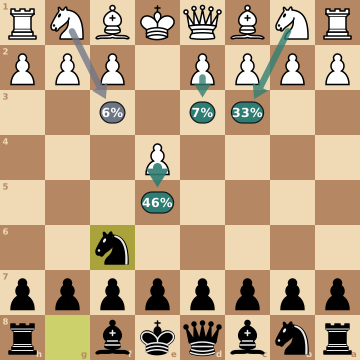
- 2. e5 (46%). e5 gains space with tempo, meaning it attacks your knight so you have to spend a move on it.
Your answer: 2...Nd5. The knight jumps to the center, where no pawn can hit it right now. - 2. Nc3 (33%). Nc3 avoids the pawn chase.
Your answer: 2...d5. Strike in the center. - 2. d3 (7%). It blocks White's f1 bishop.
Your answer: 2...e5. Take your share of the center. - 2. Nf3 (6%). Nf3? develops but leaves e4 undefended.
Your answer: 2...Nxe4. Take the free pawn.
After 1. e4 Nf6 2. e5 Nd5
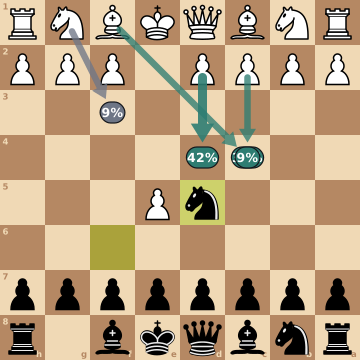
- 3. d4 (42%). d4 supports e5 and builds a big center.
Your answer: 3...d6. Hit the e5 pawn right away. - 3. c4 (36%). c4 attacks the knight on d5 at once.
Your answer: 3...Nb6. The same safe retreat. - 3. Bc4 (9%). Bc4 hits the knight on d5, which has no defender.
Your answer: 3...Nb6. Retreat and attack the bishop. - 3. Nf3 (9%). Nf3 is a calm move that protects e5.
Your answer: 3...d6. Challenge e5 as usual.
After 1. e4 Nf6 2. e5 Nd5 3. d4 d6
The key position of the pawn-chase lines. You've attacked e5, and White now picks between five quite different setups.
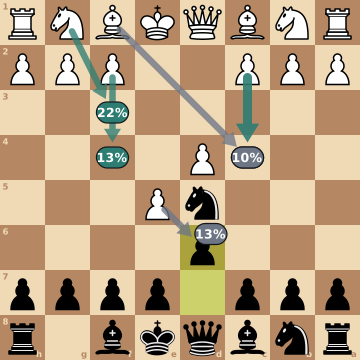
- 4. c4 (39%). c4 attacks the knight on d5 and adds a third big pawn to White's center.
Your answer: 4...Nb6. Retreat to a safe square that still eyes the center. - 4. Nf3 (22%). Nf3 defends e5 with a piece instead of a pawn.
Your answer: 4...dxe5. Trade on e5 and make White recapture. - 4. f4 (13%). f4 builds a big center, but without c4 your knight stays on its great d5 square.
Your answer: 4...dxe5. Take, and make White's pawn recapture. - 4. exd6 (13%). exd6 releases the tension early. Without c4, White isn't chasing your knight any further.
Your answer: 4...cxd6. Take back toward the center. - 4. Bc4 (10%). Bc4 hits the knight on d5, and nothing defends it: your d6 pawn blocks the queen's view.
Your answer: 4...Nb6. Retreat and attack the bishop at the same time.
After 1. e4 Nf6 2. e5 Nd5 3. d4 d6 4. c4 Nb6
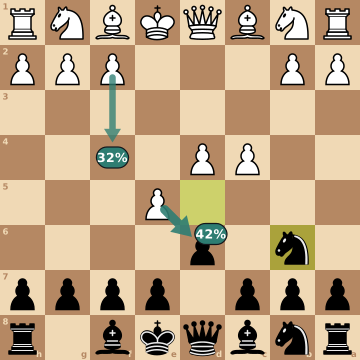
- 5. exd6 (42%). exd6 releases the tension. White keeps pawns on c4 and d4, but the e5 pawn that was chasing your knight is gone.
Your answer: 5...cxd6. Take back toward the center. - 5. f4 (32%). f4 builds a huge center with pawns on c4, d4, e5 and f4. It looks scary, but big pawn centers are hard to hold, and White's king side gets loose.
Your answer: 5...dxe5. Take on e5 so White has to recapture with the f-pawn.
After 1. e4 Nf6 2. e5 Nd5 3. c4 Nb6
White kicked the knight before playing d4. 4.d4 usually leads back to the main lines, while 4.c5 chases the knight a third time.
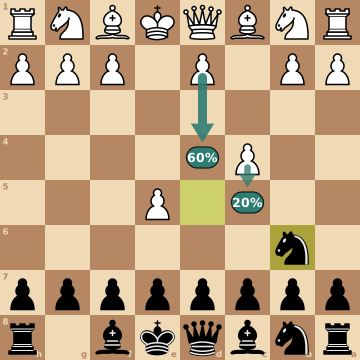
- 4. d4 (60%). c4.
Your answer: 4...d6. Hit e5, just like in the main line. - 4. c5 (20%). c5 kicks your knight for the third time. It gains space, but White's pawns on c5 and e5 are far from home.
Your answer: 4...Nd5. Back to the center, where White's pawns can't chase it now.
After 1. e4 Nf6 2. e5 Nd5 3. c4 Nb6 4. d4 d6
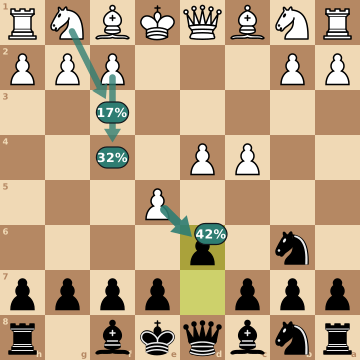
- 5. exd6 (42%). White trades off the e5 pawn for a simple position with pawns on c4 and d4.
Your answer: 5...cxd6. Take back with the c-pawn. - 5. f4 (32%). f4 puts four pawns in the center. White's center is big, but it needs a lot of care to hold.
Your answer: 5...dxe5. Take, so the f-pawn has to recapture. - 5. Nf3 (17%). Nf3 defends e5 with a piece.
Your answer: 5...dxe5. Trade on e5 so White's pawn center shrinks.
After 1. e4 Nf6 2. e5 Nd5 3. c4 Nb6 4. d4 d6 5. exd6 cxd6
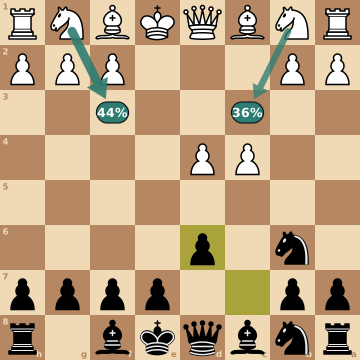
- 6. Nf3 (44%). White develops and supports d4.
Your answer: 6...g6. Prepare to put your bishop on the long diagonal. - 6. Nc3 (36%). The knight supports d5 and e4.
Your answer: 6...g6. Same plan: bishop to g7, then castle.
After 1. e4 Nf6 2. Nc3 d5
White has avoided the chase. You strike the center at once, and after 3.exd5 or 3.e5 the game takes on a different shape.
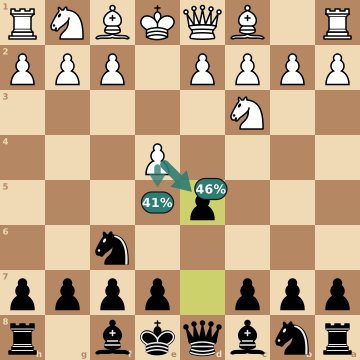
- 3. exd5 (46%). White takes on d5.
Your answer: 3...Nxd5. Recapture with the knight. - 3. e5 (41%). e5 attacks your knight again.
Your answer: 3...Nfd7. e6.
After 1. e4 Nf6 2. Nc3 d5 3. exd5 Nxd5
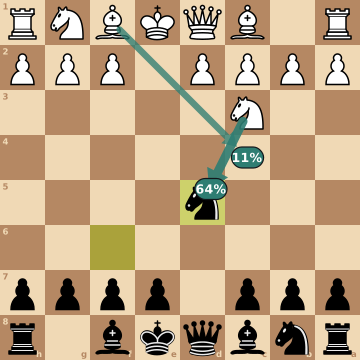
- 4. Nxd5 (64%). White trades knights.
Your answer: 4...Qxd5. Take back with the queen, strong in the center. - 4. Bc4 (11%). Your knight on d5 is attacked twice (knight and bishop) and defended once (queen).
Your answer: 4...Nb6. Retreat and attack the bishop.
After 1. e4 Nf6 2. Nc3 d5 3. exd5 Nxd5 4. Nxd5 Qxd5
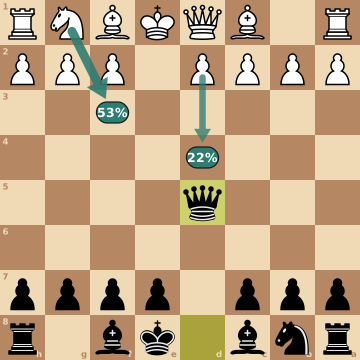
- 5. Nf3 (53%). White develops Nf3.
Your answer: 5...Bg4. Pin the knight to White's queen. - 5. d4 (22%). It gives White a central pawn, but it can also become a target.
Your answer: 5...Nc6. Develop and attack d4 again.
After 1. e4 Nf6 2. Nc3 d5 3. e5 Nfd7
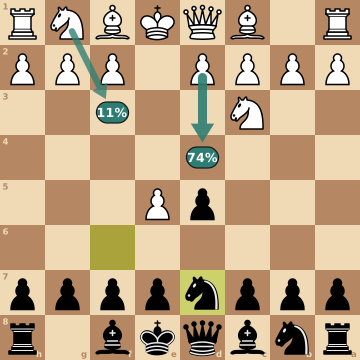
- 4. d4 (74%). White supports e5 with d4.
Your answer: 4...e6. Build a solid pawn chain. - 4. Nf3 (11%). White keeps d4 in reserve.
Your answer: 4...e6. Build your pawn chain.
After 1. e4 Nf6 2. Nc3 d5 3. e5 Nfd7 4. d4 e6
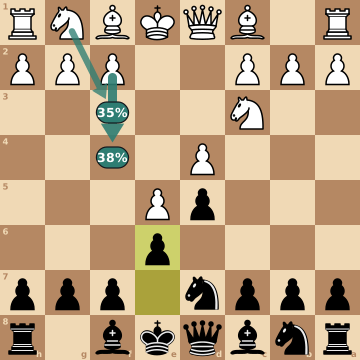
- 5. f4 (38%). You're now in the Steinitz Variation of the French Defense.
Your answer: 5...c5. Attack the base of White's pawn chain. - 5. Nf3 (35%). It's calmer than f4.
Your answer: 5...c5. Attack d4 right away.
Your plan after the opening
The Exchange Variation: fianchetto and press on d4
After 5.exd6, recapture 5...cxd6 to keep your e-pawn at home and a pawn on d6. Then play ...g6, ...Bg7 and castle, and bring your pieces to squares that hit d4: ...Nc6, and ...Bg4 or ...Bf5. The half-open c-file helps you press on c4 later. White is slightly better because of the space, but your plan is clear and your position is solid.
1. e4 Nf6 2. e5 Nd5 3. d4 d6 4. c4 Nb6 5. exd6 cxd6 6. Nf3 g6 7. h3 Bg7 8. Be2 O-O 9. Nc3 Nc6
The Four Pawns Attack: make the f-pawn take, then pin
Take with 5...dxe5 so White has to recapture with the f-pawn, then play 6...Nc6 to hit d4. White's most common move is now 7.Nf3 (66%), and 7...Bg4 pins that knight to the queen, so it can't really defend d4 or e5. If White tries 8.d5?, then 8...Nxe5 wins a pawn because the pinned knight can't take back.
After the usual 8.Be3, play 8...e6 and keep your pieces aimed at d4 and e5. If White continues 9.Be2, then 9...Bxf3 10.Bxf3 Nxc4 wins a pawn, because nothing defends c4 any more.
1. e4 Nf6 2. e5 Nd5 3. d4 d6 4. c4 Nb6 5. f4 dxe5 6. fxe5 Nc6 7. Nf3 Bg4 8. Be3 e6
The Modern Variation (4.Nf3): ...g6 and ...c6
Against 4.Nf3, take on e5 and let the knight recapture. Your knight on d5 is still a great piece. Play ...g6, then ...c6 to give the d5 knight a second defender, then ...Bg7 and castle. White is slightly better, but the position is simple to play.
1. e4 Nf6 2. e5 Nd5 3. d4 d6 4. Nf3 dxe5 5. Nxe5 g6 6. Bc4 c6 7. O-O Bg7
Against 2.Nc3: hit the center with ...d5
After 3.exd5 Nxd5 4.Nxd5 Qxd5 your queen is safe in the center, because White's c3 knight is gone. Pin with ...Bg4, develop with ...Nc6 and castle queenside. Stockfish rates it level or a touch better for you.
After 3.e5 Nfd7 4.d4 e6 you get a French-style pawn chain. Your plan is ...c5, ...Nc6 and ...Qb6, all aimed at d4, while White tries to attack on the kingside.
1. e4 Nf6 2. Nc3 d5 3. exd5 Nxd5 4. Nxd5 Qxd5 5. Nf3 Bg4 6. Be2 Nc6 7. O-O O-O-O
Traps and common mistakes
Grabbing d4 in the wrong order after 2.Nc3
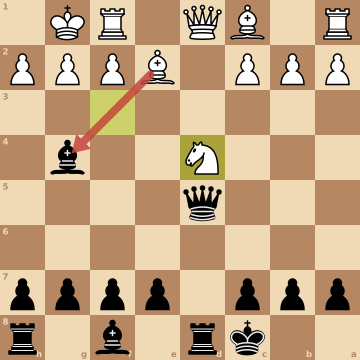
1. e4 Nf6 2. Nc3 d5 3. exd5 Nxd5 4. Nxd5 Qxd5 5. Nf3 Bg4 6. Be2 Nc6 7. O-O O-O-O 8. d4 Nxd4 9. Nxd4 Qxd4?? 10. Bxg4+
In this line your bishop on g4 and White's bishop on e2 face each other. After 8.d4 Nxd4 9.Nxd4, taking the knight with your queen looks natural, but 10.Bxg4+ wins your bishop with check.
Trade the bishops first: 9...Bxe2 10.Qxe2 Qxd4 wins a clean pawn. Stockfish notes that 11.Bg5 gives White some play for it, but you're the one with the extra material.
Forgetting f7 in the Modern Variation
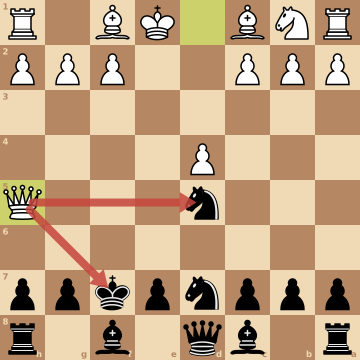
1. e4 Nf6 2. e5 Nd5 3. d4 d6 4. Nf3 dxe5 5. Nxe5 Nd7? 6. Nxf7 Kxf7 7. Qh5+
After 4.Nf3 dxe5 5.Nxe5, challenging the knight with 5...Nd7? looks sensible, but White sacrifices on f7. After 6...Kxf7 7.Qh5+ your king is dragged into the open, and Stockfish gives White about a pawn and a half.
Play 5...g6 and ...c6 instead, and castle before you worry about the e5 knight.
Moving the knight again in the Chase Variation
1. e4 Nf6 2. e5 Nd5 3. c4 Nb6 4. c5 Nd5 5. Bc4 e6
After 3.c4 Nb6, 20% of White players kick the knight a third time with 4.c5. Go back to d5, where no pawn can reach it. When 5.Bc4 attacks it, support it with 5...e6. Moving it again with 5...Nf4? or 5...Nb4? wastes time, and Stockfish gives White a big advantage after either. With the knight defended, the position is level, and you can go after the far-advanced c5 pawn with ...b6 or ...d6.
Putting the knight on the wrong square after 2.e5
When White kicks the knight with 2.e5, it belongs on d5, in the center where no pawn can hit it yet. 2...Ne4 gets kicked again by d3, and 2...Ng8 just undoes your development. The whole opening depends on the knight being hard to chase while you attack White's pawns.
Missing the free pawn after 2.Nf3
1. e4 Nf6 2. Nf3 Nxe4 3. Bc4 d5
2.Nf3 develops but leaves e4 undefended. 69% of players at this level grab the pawn with 2...Nxe4, and Black wins 55% of those games. If White then plays 3.Bc4, 3...d5 attacks the bishop, blocks its path to f7 and protects your knight. Stockfish rates you about a pawn and a half better.
Frequently asked questions
Is Alekhine's Defense good for club players?
Yes, especially as a surprise weapon. At 1200 to 2000 only about 1.3% of players answer 1.e4 with 1...Nf6, so opponents rarely know the lines. White keeps a small edge in the main lines with perfect play, but the plans are clear and White's pawns often become targets.
What is the most common reply to Alekhine's Defense?
At 1200 to 2000 on Lichess, White's most common reply is 2.e5 (46%), chasing the knight. 2.Nc3 is close behind at 33%, and 2.d3 and 2.Nf3 are next at 6% each.
How do you play against the Four Pawns Attack?
Take with ...dxe5 so White recaptures with the f-pawn, then play ...Nc6 to hit d4. After the common 7.Nf3, pin the knight with 7...Bg4, then play ...e6 and keep your pieces aimed at d4 and e5.
What should Black play against 2.Nc3 in Alekhine's Defense?
Play 2...d5 and strike the center. After 3.exd5 Nxd5 4.Nxd5 Qxd5, develop with ...Bg4 and ...Nc6 and castle queenside. After 3.e5, retreat with 3...Nfd7 and build a French-style chain with ...e6 and ...c5.
How should Black answer the Exchange Variation?
Recapture with 5...cxd6, then set up with ...g6, ...Bg7, castling and ...Nc6. Aim your pieces at d4. White keeps a small space edge, but your position is solid and easy to play.
Keep learning
- All 36 opening guides: every opening on the site, grouped by what you play as White and Black.
- Is Alekhine's Defense (1.e4 Nf6) Good?: How sound 1...Nf6 really is, and who it suits best.
- What Is the Best Defense Against 1.e4?: How Alekhine's Defense compares with six other defenses.
The Coach plays White against your Alekhine's Defense with the moves 1200 to 2000 players actually choose, including 2.Nc3 and the Four Pawns Attack, and explains every move in plain English. Progress tracking is free during the open beta.
Practice the Alekhine's Defense free →