Is Alekhine's Defense (1.e4 Nf6) Good?
TL;DR
Short answer Yes. It's a sound, respected defense that gives White space on purpose and then attacks it. It suits players who know a few concrete lines and don't mind their knight being pushed around early. It's less suited to newer players. Games behind this article About 29 million Lichess games at 1200 to 2000 White's 2nd move 2.e5 46.1% · 2.Nc3 33.4% · 2.d3 6.5% · 2.Nf3 6.4% After 2.e5 Nd5 3.d4 d6 4.c4 39.4% · 4.Nf3 (Modern) 21.5% · 4.f4 13.1% After 4.c4 Nb6 5.exd6 (Exchange) 41.6% · 5.f4 (Four Pawns) 32.2% Lichess results 1200 to 2000 on Lichess: after 2.Nf3?, 69% of players grab the pawn with 2...Nxe4, and Black wins 55% of those games Recommended range 1200 to 2000 Elo, 21 lines
What Black is trying to do
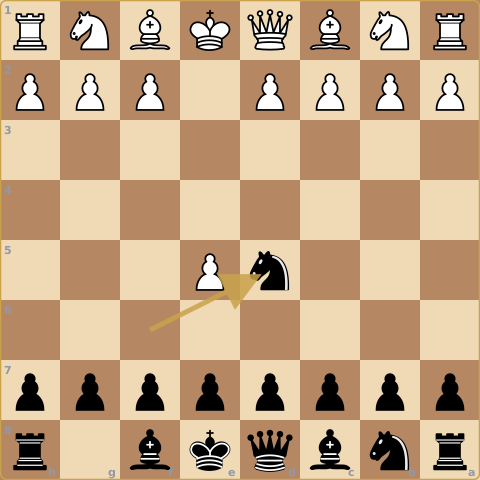
1...Nf6 attacks e4 and invites White to chase the knight. At 1200 to 2000 on Lichess, White takes up the offer with 2.e5 in 46.1% of games. The knight hops to d5, the right square: 2...Ne4 and 2...Ng8 each show up in about 5% of games, and Black wins only 38% and 41% of those. From d5, White can keep kicking the knight with c4 or build a wide center with d4 and f4.
The idea is that pawns can't move backward. Every pawn White pushes gains space, but it also leaves squares behind it and gives Black something to hit with ...d6, ...c5, ...Nc6 and ...Bg4. The opening is named after Alexander Alekhine, and Bobby Fischer used it twice against Boris Spassky in their 1972 World Championship match. It's a serious defense, not a trick.
The catch is that Black has to know how to meet each of White's systems. Here are the five that matter.
1. The Exchange Variation: 5.exd6
After 2...Nd5, White plays 3.d4 in 41.8% of games and Black answers 3...d6. White's most common choice is then 4.c4 (39.4%), kicking the knight to b6.
Then 5.exd6 (41.6% at this point) trades off the advanced e-pawn before it can become a target. Our repertoire recaptures 5...cxd6, which keeps a pawn on d6 and the e-pawn at home, so Black has more central pawns than after ...exd6. The half-open c-file helps Black press on c4 later. White develops with 6.Nf3 (43.6%) or 6.Nc3 (36.4%), and Black's setup stays the same either way: ...g6, ...Bg7, castle and ...Nc6. White keeps a little more space, so Black has to be patient.
2. The Four Pawns Attack: 5.f4
This is the test of whether you believe in the Alekhine. White puts pawns on c4, d4, e5 and f4 and dares Black to prove they're weak.
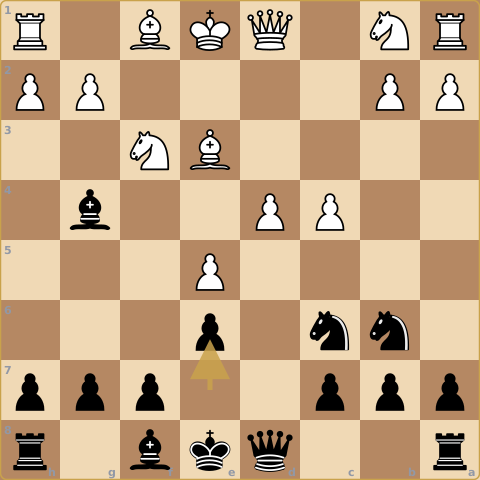
White plays 5.f4 in 32.2% of games after 4.c4 Nb6. Black trades on e5 at once, and after 6.fxe5 (98.9%) the knight on c6 and the queen both hit d4. Here's where club players go wrong: 7.Nf3 is White's most common move (65.7%), but it lets Black pin the knight with 7...Bg4. That knight is the main defender of d4 and e5, and if White tries 8.d5?, then 8...Nxe5 wins a pawn because the pinned knight can't take back. White usually plays 8.Be3 (72.4%), and 8...e6 frees Black's f8 bishop.
It's sharp. If you don't know it, White's center can roll you over. If you do, those pawns become targets.
3. The Modern Variation: 4.Nf3
With 4.Nf3 (21.5%), White defends e5 with a piece instead of a pawn. Our repertoire trades straight away with 4...dxe5. After 5.Nxe5 White's knight is active, but the big pawn center is gone and Black's knight on d5 is still a fine piece. The follow-up is ...g6 and ...c6. The natural-looking 5...Nd7? runs into 6.Nxf7! Kxf7 7.Qh5+, and Black's king is dragged into the open.
4. The Chase Variation: 3.c4 Nb6 4.c5
After 3.c4 (36.2%) Nb6, most White players go back to the main lines with 4.d4 (59.7%). But 19.8% skip d4 and kick the knight a third time with 4.c5. The knight comes back to d5, where White's pawns can no longer reach it. 5.Bc4 (58.9%) attacks it, and 5...e6 defends it with a pawn. Don't move the knight again: 5...Nf4? and 5...Nb4? lose time, and Stockfish gives White a big advantage after either. White has lots of space on the queenside, but the c5 and e5 pawns are far from home and the d-pawn is still on d2.
5. The Two Knights: 2.Nc3
White can avoid all of this with 2.Nc3, and at this level it's very common (33.4%). Black answers 2...d5, and the game becomes a different kind of fight.
3.e5 (41.1%) leads to French-style structures. After 4.d4 (74.4%), Black builds a chain with ...e6 and then hits the base on d4 with ...c5. The other main option is 3.exd5 (45.9%) Nxd5, when 4.Nxd5 (63.6%) Qxd5 gives a Scandinavian-style position where White can't gain time on the queen with Nc3. You need a short plan here too, but it's a separate branch from the 2.e5 systems.
And if White plays 2.Nf3?, just take the e4 pawn. Nothing defends it.
So is it good?
Objectively, yes. It's been played at world championship level, and in every main line Black gets a playable position with clear targets. Against accurate play White keeps a small edge because of the extra space, usually about half a pawn by Stockfish, which is normal for a defense to 1.e4.
In practice, whether it's good for you depends on two things. First, your rating. The ideas make most sense once you understand why space can be a weakness, and our library places it at 1200 to 2000 Elo. Second, your temperament. You'll move your knight three or four times in some lines. If that bothers you, the Pirc or Modern apply the same hypermodern thinking without it.
The data also shows that only about 1.3% of players at this level answer 1.e4 with 1...Nf6, so many opponents won't know the lines well. Your preparation has a clear order: learn 2.e5 with the Exchange and the Four Pawns first, then 2.Nc3, then the Modern and the Chase.
Frequently asked questions
Is Alekhine's Defense a good opening?
Yes. It's a sound, respected answer to 1.e4. Black lets White gain space and then attacks the advanced pawns. Bobby Fischer used it twice against Boris Spassky in the 1972 World Championship match. Our library recommends it for 1200 to 2000 Elo.
What is the most common reply to Alekhine's Defense?
2.e5, kicking the knight, in 46.1% of games at 1200 to 2000 on Lichess, followed by 2.Nc3 at 33.4%. After 2.e5 Nd5 3.d4 d6, White's most common choice is 4.c4 (39.4%), followed by the Modern Variation with 4.Nf3 (21.5%).
How do you play against the Four Pawns Attack in the Alekhine?
After 1.e4 Nf6 2.e5 Nd5 3.d4 d6 4.c4 Nb6 5.f4, Black plays 5...dxe5 6.fxe5 Nc6, attacking d4. If White plays the common 7.Nf3, pin it with 7...Bg4, and after 8.Be3 continue with 8...e6. If White pushes 8.d5 instead, 8...Nxe5 wins a pawn.
Is Alekhine's Defense good for beginners?
It's better for players around 1200 and up. The ideas are sound, but Black has to know how to meet the Four Pawns Attack and the Chase Variation. Newer players may find the Pirc or Modern an easier introduction to the same hypermodern idea.
Copy the lines (PGN)
Every line in this article in standard PGN, ready to paste into Lichess, Chess.com or any chess database.
[Event "Is Alekhine's Defense (1.e4 Nf6) Good?: Exchange Variation"]
[Site "chesscoachacademy.com"]
[Result "*"]

1. e4 Nf6 2. e5 Nd5 3. d4 d6 4. c4 Nb6 5. exd6 cxd6 6. Nf3 g6 *

[Event "Is Alekhine's Defense (1.e4 Nf6) Good?: Four Pawns Attack"]
[Site "chesscoachacademy.com"]
[Result "*"]

1. e4 Nf6 2. e5 Nd5 3. d4 d6 4. c4 Nb6 5. f4 dxe5 6. fxe5 Nc6 7. Nf3 Bg4 8. Be3 e6 *

[Event "Is Alekhine's Defense (1.e4 Nf6) Good?: Modern Variation"]
[Site "chesscoachacademy.com"]
[Result "*"]

1. e4 Nf6 2. e5 Nd5 3. d4 d6 4. Nf3 dxe5 5. Nxe5 *

[Event "Is Alekhine's Defense (1.e4 Nf6) Good?: Chase Variation"]
[Site "chesscoachacademy.com"]
[Result "*"]

1. e4 Nf6 2. e5 Nd5 3. c4 Nb6 4. c5 Nd5 5. Bc4 e6 *

[Event "Is Alekhine's Defense (1.e4 Nf6) Good?: Two Knights with 3.e5"]
[Site "chesscoachacademy.com"]
[Result "*"]

1. e4 Nf6 2. Nc3 d5 3. e5 Nfd7 4. d4 e6 5. f4 c5 *

[Event "Is Alekhine's Defense (1.e4 Nf6) Good?: Two Knights with 3.exd5"]
[Site "chesscoachacademy.com"]
[Result "*"]

1. e4 Nf6 2. Nc3 d5 3. exd5 Nxd5 4. Nxd5 Qxd5 5. Nf3 Bg4 6. Be2 Nc6 *
Keep reading
- What Is the Best Defense Against 1.e4?: How the Alekhine compares with the Caro-Kann, Scandinavian, Petroff, Sicilian and others.
Practice the Alekhine against all five White systems
Our Alekhine trainer covers 21 lines built from about 29 million Lichess games at 1200 to 2000: the Exchange Variation, the Four Pawns Attack, the Modern, the Chase, 2.Nc3, and how to punish 2.Nf3. You play Black against the moves White players really choose, every one of your moves is checked by Stockfish, and each move comes with a plain-English note so you know why the knight goes where it goes.
It's free during the open beta, and once you create an account your progress on every line is tracked for free.
21 lines built from 29 million Lichess games. Free during the open beta, with free progress tracking.
Practice the Alekhine free →