The Sicilian Najdorf at 1600 to 2400: The Main Lines and the Sidelines You'll Really Face
TL;DR: the data
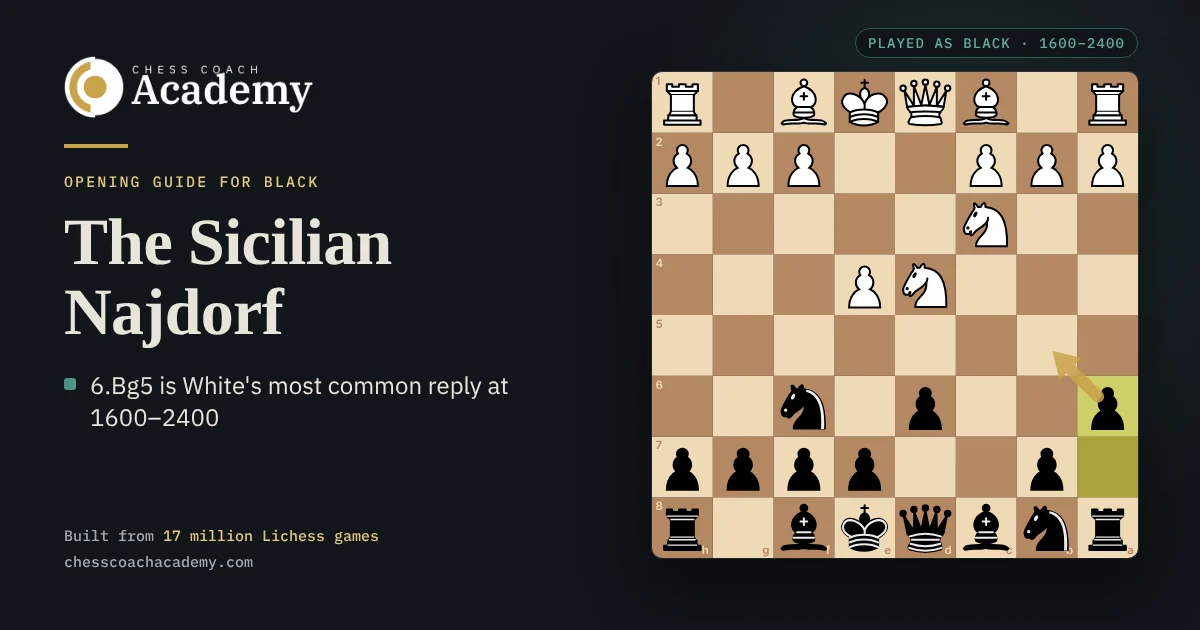
Built from 17 million Lichess games played by 1600 to 2400 rated players You play Black, 20 practice lines, every move of yours checked by Stockfish Most common line 1. e4 c5 2. Nf3 d6 3. d4 cxd4 4. Nxd4 Nf6 5. Nc3 a6 6. Bg5 e6 7. f4 h6 Replies to 5...a6 6. Bg5 24% · 6. Be3 19% · 6. Bc4 14% Worth knowing After 1.e4 c5, 57% of White players at 1600-2400 play 2.Nf3. The rest choose sidelines such as 2.Nc3 (9%), 2.Bc4 (8%), 2.d4 (7%), 2.c3 (6%) and 2.f4 (5%).
The Najdorf is the Sicilian for players who want to win with Black. After 1.e4 c5 2.Nf3 d6 3.d4 cxd4 4.Nxd4 Nf6 5.Nc3, the small move 5...a6 takes the b5 square away from White's knights and bishop. That lets you play ...e5 without worrying about Nb5, and it prepares ...b5 to grab space on the queenside.
Most Najdorf books start at move six and stay there. This guide is built from 17 million Lichess games at 1600 to 2400, and at that level the Najdorf position is only part of the story. Just 57% of White players answer 1...c5 with 2.Nf3, and not all of those play 3.d4. So besides the six main replies to 5...a6, you'll learn the sidelines that actually show up: 3.Bc4, 3.Bb5+, 2.Nc3, 2.Bc4, 2.c3, 2.f4 and the Smith-Morra Gambit.
1. e4 c5 2. Nf3 d6 3. d4 cxd4 4. Nxd4 Nf6 5. Nc3 a6
Practice the Sicilian Najdorf free →Who it's for
Players rated roughly 1600 to 2400 who want unbalanced positions and real winning chances with Black. You should be comfortable with sharp tactics and happy to put some study time in, because the main lines punish slow moves.
If you'd rather have one quiet setup against everything, this isn't it. But if you like opposite-side castling races and positions where both players are playing for a win, the Najdorf rewards the work.
Why it works at 1600 to 2400
- Unbalanced positions from move five. White can't easily steer the game into a dull draw.
- A few ideas repeat everywhere: ...e5 and ...Be6 to control d5, or ...e6 and ...b5 against a bishop on c4 or b3.
- The sidelines are friendly. Against 3.Bc4, 3.Bb5+, 3.c3 and the Grand Prix, Stockfish rates your position level with simple development.
- The main lines are sharp. In the English Attack and the 6.Bg5 line, White keeps a small edge with best play and one slow move can decide the game.
- You need answers to many different second and third moves, not just the Najdorf position itself.
- The Smith-Morra Gambit has a nasty trick on f7. You must play ...e6 before your knight or bishop comes out on the kingside.
What 1600 to 2400 players actually play
Here is how White answers 5...a6 at 1600 to 2400. The sharpest line, 6.Bg5, is also the most popular at 24%. The English Attack with 6.Be3 is next at 19%, then 6.Bc4 at 14% and the quiet 6.Be2 at 12%. 6.f3 and 6.Bd3 each show up in 8% of games. That's six real options, and they split into three families: the attacks (Bg5, Be3, f3), the bishop on c4, and the calm setups (Be2, Bd3).
Three numbers from the data worth knowing:
- After 1.e4 c5, 57% of White players at 1600-2400 play 2.Nf3. The rest choose sidelines such as 2.Nc3 (9%), 2.Bc4 (8%), 2.d4 (7%), 2.c3 (6%) and 2.f4 (5%).
- After 5...a6, White's most common replies are 6.Bg5 (24%), 6.Be3 (19%), 6.Bc4 (14%) and 6.Be2 (12%).
- In the Smith-Morra after 5.Nf3 Nf6 6.Bc4, Black scores 43% with 6...e6 but only 35% with 6...g6, which allows White's e5 and Bxf7+ trick.
How to play the Sicilian Najdorf: move by move
Every board below is from the practice lines and is shown from your side. The arrows are White's most common replies at 1600 to 2400, labeled with how often each one is played in that exact position. Under each board you'll find why White plays it and the answer the Coach teaches.
After 1. e4 c5
Only a little over half of White players head for the Open Sicilian here. Six different second moves are common, so this is where your preparation starts.
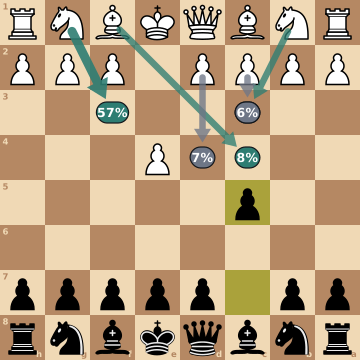
- 2. Nf3 (57%). Nf3 gets ready for d4 and the Open Sicilian.
Your answer: 2...d6. Controls e5 and opens a path for your light-squared bishop. - 2. Nc3 (9%). Nc3, avoiding the Open Sicilian for now.
Your answer: 2...d6. Nf3. - 2. Bc4 (8%). It's popular at club level, but Black scores well against it.
Your answer: 2...d6. Solid development, and it opens your c8 bishop. - 2. d4 (7%). d4, offering a pawn.
Your answer: 2...cxd4. Take the pawn. - 2. c3 (6%). cxd4 White can recapture with the c-pawn.
Your answer: 2...Nf6. Attack e4 right away. - 2. f4 (5%). f4, an early Grand Prix setup.
Your answer: 2...d6. Controls e5 and keeps things flexible.
After 1. e4 c5 2. Nf3 d6
3.d4 is the main road to the Najdorf, but 3.Bc4 alone is played in 14% of games. Against every sideline, ...Nf6 attacking e4 is a good start.
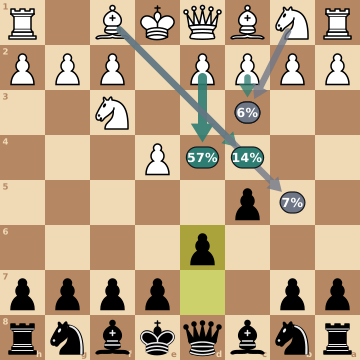
- 3. d4 (57%). White opens the center and hopes to use the lead in development.
Your answer: 3...cxd4. Trade your side pawn for White's center pawn. - 3. Bc4 (14%). It skips d4 and points the bishop at your weak f7 square.
Your answer: 3...Nf6. Develop and attack the e4 pawn. - 3. c3 (9%). cxd4 with cxd4, keeping two pawns in the center.
Your answer: 3...Nf6. Attack e4 right away. - 3. Bb5+ (7%). White plans to trade light-squared bishops.
Your answer: 3...Bd7. Block the check and offer a trade. - 3. Nc3 (6%). White can still play d4 next.
Your answer: 3...Nf6. Develop and keep your Najdorf plans ready.
After 1. e4 c5 2. Nf3 d6 3. d4 cxd4
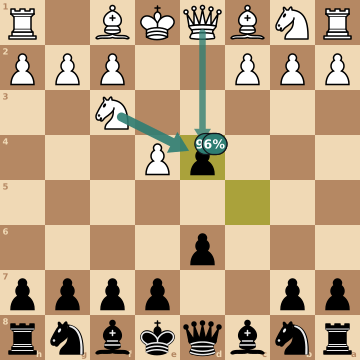
- 4. Nxd4 (90%). The knight is centralized, but the e4 pawn now has no defender.
Your answer: 4...Nf6. Develops and attacks the undefended e4 pawn. - 4. Qxd4 (6%). The queen is strong in the center, but your pieces can develop while attacking it, gaining time.
Your answer: 4...Nf6. Develop and attack the e4 pawn.
After 1. e4 c5 2. Nf3 d6 3. d4 cxd4 4. Nxd4 Nf6 5. Nc3 a6
The Najdorf position. Against the attacking setups you pick ...e6 (after 6.Bg5) or ...e5 (after 6.Be3 or 6.f3). Against the quiet ones, ...e5 is almost always right.
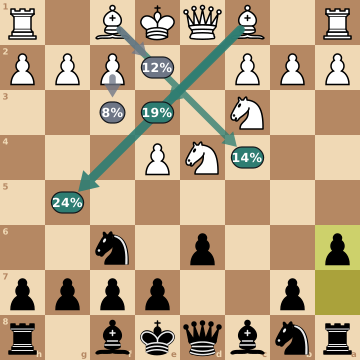
- 6. Bg5 (24%). The bishop attacks the f6 knight and prepares f4 and e5 to push it away.
Your answer: 6...e6. Controls d5 and opens the way for your bishop to e7. - 6. Be3 (19%). White develops Be3, the English Attack setup.
Your answer: 6...e5. Kick the d4 knight and grab space in the center. - 6. Bc4 (14%). White often follows with Bb3, O-O and a quick f4-f5.
Your answer: 6...e6. Blunt the bishop so it hits a wall. - 6. Be2 (12%). White develops quietly with Be2.
Your answer: 6...e5. Kick the d4 knight and claim the center. - 6. f3 (8%). White plays f3, protecting e4 and preparing g4.
Your answer: 6...e5. Kick the knight away from d4. - 6. Bd3 (8%). The bishop defends e4 but doesn't pressure anything on your side.
Your answer: 6...e5. Kick the knight and take the center.
After 1. e4 c5 2. Nf3 d6 3. Bc4 Nf6
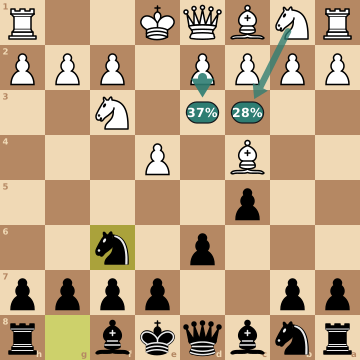
- 4. d3 (37%). White will castle and play c3.
Your answer: 4...a6. b5 to chase the bishop. - 4. Nc3 (28%). White protects e4 with Nc3.
Your answer: 4...a6. b5 and take b5 away from White's pieces.
After 1. e4 c5 2. Nc3 d6
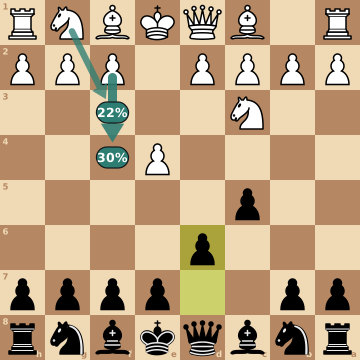
- 3. f4 (30%). White pushes f4, the Grand Prix Attack.
Your answer: 3...Nf6. Develop and pressure e4. - 3. Nf3 (22%). White develops Nf3.
Your answer: 3...Nf6. Develop, and wait for d4.
After 1. e4 c5 2. d4 cxd4
White's 2.d4 usually means the Smith-Morra Gambit with 3.c3. Take the pawn, but learn the move order that keeps f7 safe.
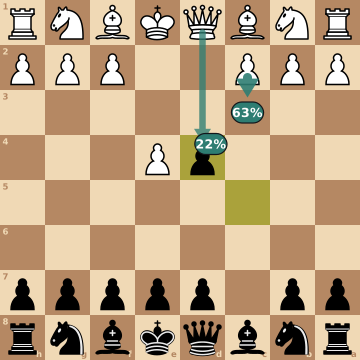
- 3. c3 (63%). dxc3, so White can recapture with the knight and develop fast.
Your answer: 3...dxc3. Accept the gambit. - 3. Qxd4 (22%). Your pieces can gain time by attacking it.
Your answer: 3...d6. Solid, and it opens your c8 bishop.
After 1. e4 c5 2. d4 cxd4 3. c3 dxc3 4. Nxc3 d6
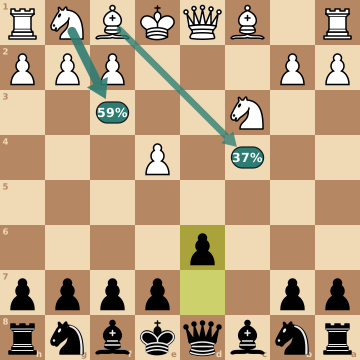
- 5. Nf3 (59%). Bc4, O-O and Qe2 usually follow.
Your answer: 5...Nf6. Develop, but know the next move matters. - 5. Bc4 (37%). Nf6?e5! dxe5??Qxd8 wins your queen.
Your answer: 5...e6. Nf6.
Your plan after the opening
Against 6.Bg5: ...e6, then ...h6 and ...Qb6
After 6...e6 your f6 knight is pinned to the queen, and 7.f4 prepares e5 to push it away. Ask the bishop with 7...h6. If it takes on f6, you get the bishop pair. If it drops back to h4, your queen steps out of the pin with 8...Qb6, hitting b2 and the d4 knight. After 9.a3, don't take on b2 (see the traps below). Play 9...Be7, then ...Qc7 and ...b5. Stockfish rates White only slightly better, about a third of a pawn.
1. e4 c5 2. Nf3 d6 3. d4 cxd4 4. Nxd4 Nf6 5. Nc3 a6 6. Bg5 e6 7. f4 h6 8. Bh4 Qb6 9. a3 Be7
Against the English Attack (6.Be3 or 6.f3): ...e5, ...Be6, then race
Kick the knight with 6...e5, put your bishop on e6 to guard the d5 hole, then ...Be7 and castle. White usually castles queenside and throws the g-pawn at your king. Your answer is the queenside pawns: ...Nbd7, ...b5 and ...b4. Stockfish gives White a small edge, about half a pawn, but it's a race you can win if you don't waste moves.
One useful idea when White starts with 6.f3: after 9.Qd2, the move 9...h5 stops the g4 push before it begins.
1. e4 c5 2. Nf3 d6 3. d4 cxd4 4. Nxd4 Nf6 5. Nc3 a6 6. Be3 e5 7. Nb3 Be6 8. f3 Be7 9. Qd2 O-O
Against 6.Bc4, 6.Be2 and 6.Bd3: simple development
Against 6.Bc4, play 6...e6 so the bishop hits a wall on e6, then ...b5, ...Be7, castle and ...Bb7. Against the quiet 6.Be2 and 6.Bd3, play 6...e5 to gain space with a gain of time, then ...Be7, castle, ...Be6 and ...Nbd7. If White plants a knight on d5, trading it with ...Bxd5 is often the answer. All three lines are level by Stockfish.
1. e4 c5 2. Nf3 d6 3. d4 cxd4 4. Nxd4 Nf6 5. Nc3 a6 6. Be2 e5 7. Nb3 Be7
Against the sidelines: ...Nf6 and develop
Against 3.Bc4, attack e4 with 3...Nf6, then play ...a6 to prepare ...b5. Against 3.Bb5+, block with 3...Bd7, and after 4.Bxd7+ recapture with the queen so your knight can come to c6. Against 2.Nc3 and the Grand Prix with f4, play ...d6, ...Nf6 and ...Nc6. Against 2.c3, hit e4 with 2...Nf6. Stockfish rates every one of these level.
Many of them also transpose. After 2.Nc3 d6 3.Nf3 Nf6 4.d4 cxd4 5.Nxd4 a6 you're back in the Najdorf.
1. e4 c5 2. Nf3 d6 3. Bb5+ Bd7 4. Bxd7+ Qxd7 5. O-O Nf6
Traps and common mistakes
The Smith-Morra trick on f7
1. e4 c5 2. d4 cxd4 3. c3 dxc3 4. Nxc3 d6 5. Nf3 Nf6 6. Bc4 g6? 7. e5! dxe5?? 8. Bxf7+ Kxf7 9. Qxd8
In the Smith-Morra, White's bishop on c4 and queen on d1 set up a trick. If you play ...g6 or ...Nf6 at the wrong moment, e5 opens the d-file, and after ...dxe5 Bxf7+ your king has to take, leaving your queen to be captured on d8. In the 5.Nf3 Nf6 6.Bc4 line, Black scores 43% with 6...e6 but only 35% with 6...g6, which allows White's e5 and Bxf7+ trick.
The rule is simple: play ...e6 before the kingside pieces come out when White's bishop is on c4. If White still pushes e5, take with ...dxe5 (not ...Nfd7), and after the queen trade your king is safe on e7 or e8.
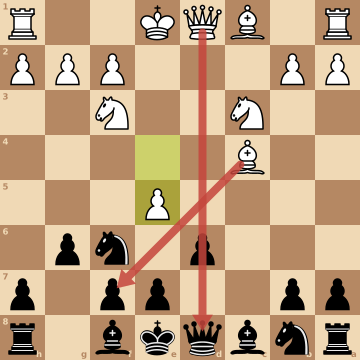
Grabbing the poisoned b2 pawn after 9.a3
1. e4 c5 2. Nf3 d6 3. d4 cxd4 4. Nxd4 Nf6 5. Nc3 a6 6. Bg5 e6 7. f4 h6 8. Bh4 Qb6 9. a3 Qxb2?? 10. Na4
In the 6.Bg5 line your queen goes to b6 and eyes b2. After 9.a3, taking the pawn is a blunder: 10.Na4 attacks the queen, and it has no safe square to go to. Play 9...Be7 and keep the queen where it is.
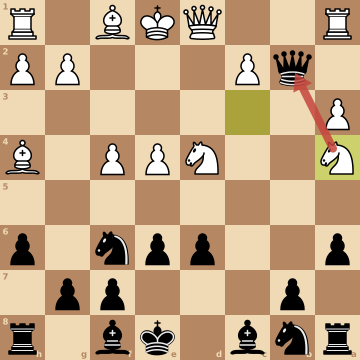
Taking on e4 before you've castled in the 6.Bc4 line
1. e4 c5 2. Nf3 d6 3. d4 cxd4 4. Nxd4 Nf6 5. Nc3 a6 6. Bc4 e6 7. Bb3 b5 8. O-O b4? 9. Na4 Nxe4? 10. Re1
With White's bishop on b3 and a rook coming to e1, your king is the target. Kicking the knight with 8...b4 and then grabbing e4 looks like a free pawn, but 10.Re1 attacks the knight and opens the e-file while your king is still in the center, with the b3 bishop and d4 knight already aiming at e6. Stockfish rates White about a pawn and a half better. Develop with ...Be7 and castle first, then think about pawns.
Frequently asked questions
Is the Najdorf too hard for club players?
It's demanding, which is why this guide starts at 1600. You need to know the sharp lines against 6.Bg5 and the English Attack. The good news is that at 1600 to 2400 many White players avoid the main lines altogether, and those sidelines give you simple, level positions.
What is the most common reply to the Najdorf?
At 1600 to 2400 on Lichess, White's most common replies to 5...a6 are 6.Bg5 (24%), 6.Be3 (19%), 6.Bc4 (14%) and 6.Be2 (12%). 6.f3 and 6.Bd3 each appear in 8% of games.
What if White doesn't play 2.Nf3 and 3.d4?
That happens a lot. After 1.e4 c5, 57% of White players at 1600 to 2400 play 2.Nf3, and the rest choose sidelines such as 2.Nc3 (9%), 2.Bc4 (8%), 2.d4 (7%), 2.c3 (6%) and 2.f4 (5%). This guide covers each of them, plus 3.Bc4 and 3.Bb5+ after 2.Nf3 d6.
Should I accept the Smith-Morra Gambit?
Yes. Take with 3...dxc3, and after 4.Nxc3 d6 you're a pawn up. The one thing to remember: once White's bishop is on c4, play ...e6 before ...g6 (or before ...Nf6 if the knight isn't out yet), so White's e5 and Bxf7+ trick doesn't work. With that order Stockfish rates the position level, and you keep the extra pawn.
How do you play against the English Attack in the Najdorf?
Play ...e5, ...Be6 to guard d5, ...Be7 and castle. When White castles queenside and pushes the g-pawn, push your own queenside pawns with ...b5 and ...b4 as fast as you can.
Keep learning
- All 36 opening guides: every opening on the site, grouped by what you play as White and Black.
- What Is the Best Defense Against 1.e4?: How the Najdorf compares with six other defenses.
- Best Chess Openings for Beginners (Under 1000 Elo and Up): Where the Najdorf fits among openings grouped by rating.
The Coach plays White against your Najdorf with the moves 1600 to 2400 players actually choose, from 6.Bg5 to the Smith-Morra, and explains every move in plain English. Progress tracking is free during the open beta.
Practice the Sicilian Najdorf free →