Is the Vienna Game (1.e4 e5 2.Nc3) Good for Beginners?
TL;DR
Short answer Yes, from around 800 Elo. There's one main idea to learn (the f4 push), it skips the heavy 2.Nf3 theory, and the Vienna Gambit sets traps that players at this level fall into all the time. Learn the calm 2...Nc6 setup and the gambit against 2...Nf6 first. Games behind this article About 64 million Lichess games at 800 to 1800 Black's second move 2...Nc6 33.0% · 2...Nf6 31.8% · 2...d6 9.8% · 2...Bc5 9.6% Vienna Gambit (2...Nf6 3.f4) 3...exf4 43.7% · 3...d6 19.9% · 3...Nc6 15.9% · 3...d5 9.9% Lichess results 800 to 1800 on Lichess: against 2...Nf6, 3.f4 scores 58% for White, compared with 49% for 3.Nf3. After 3.f4 exf4 4.e5 Qe7? 5.Qe2, White wins 72% of games. Recommended range 800 to 1800 Elo in our library, 12 lines
What the Vienna asks of you
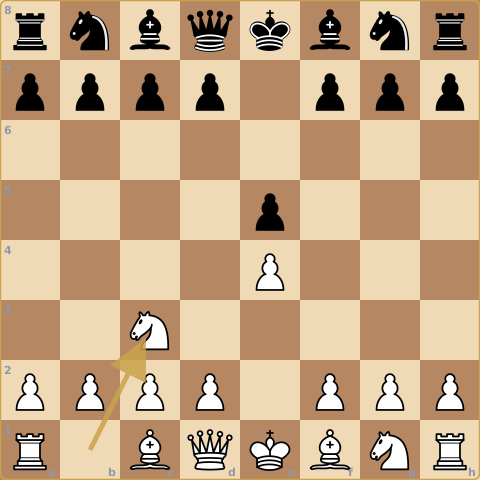
Most players meet 1...e5 with 2.Nf3. That's a fine move, but it leads into the Italian, the Ruy Lopez, the Petroff and the Scotch, each with a lot of theory. The Vienna takes a different path. The knight goes to c3, defends the e4 pawn, and leaves the f-pawn free to push to f4.
That one idea, a well-timed f4, is the thread that runs through the whole opening. You attack e5 with a pawn, open the f-file toward Black's king, and get your pieces out quickly.
Why it suits newer players
- The plan repeats. Against 2...Nf6, 2...d6 and 2...Bc5, our lines all push 3.f4. Against 2...Nc6 you play a calm 3.Bc4 and develop.
- Black's options are narrow. At 800 to 1800 on Lichess, Black answers 2.Nc3 with 2...Nc6 (33.0%) or 2...Nf6 (31.8%) in about two games out of three, and 2...d6 or 2...Bc5 in most of the rest.
- Black goes wrong early. Two popular replies to the Vienna Gambit, 3...Nc6 and 4...Qe7, are real mistakes. You'll see both below.
The quiet route: 2...Nc6
Against the most common reply, our trainer keeps things calm. The bishop comes to c4 and aims at f7, the square only Black's king defends. Then you follow with d3, a knight to f3 or e2, and castling. It looks a lot like an Italian Game, except the knight is already on c3 and the f-pawn is still free for later.
This is the Vienna at its most beginner-friendly. There's nothing to memorize beyond the setup, and you get a safe position where you can look for your chances in the middlegame.
The sharp route: the Vienna Gambit
Against 2...Nf6, our repertoire goes for the Vienna Gambit. It's the practical choice at this level: 3.f4 scores 58% for White at 800 to 1800 on Lichess, compared with 49% for the quieter 3.Nf3.
Taking the pawn is the most common reaction (43.7%), but it lets White kick the knight with tempo.
The knight on f6 is attacked, and four of its squares simply drop it: d5 and e4 to the knight on c3, g4 and h5 to the queen on d1. Most players retreat 4...Ng8 (58.0%), undoing Black's development. White continues 5.Nf3, which also covers h4 so Black's queen can't check there. After 5...d6 6.d4 dxe5, the check 7.Bb5+ makes Black block awkwardly. Black is two pawns up for the moment, but the pawns on e5 and f4 are both loose and White is well ahead in development.
The trap: 4...Qe7?
About a quarter of players (25.3%) try to save the knight another way:
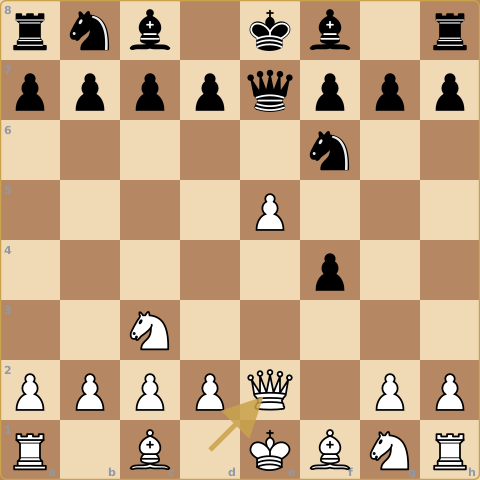
4...Qe7 pins the e5 pawn to White's king, so exf6 is illegal for now. But 5.Qe2 steps in front of the king, and the threat is back. Black has to retreat the knight anyway, usually 5...Ng8 (71.1%). Now Black has no piece developed and the queen on e7 blocks the f8 bishop. White wins 72% of games from here at 800 to 1800 on Lichess. Next come d4, Nf3 and Bxf4, with Nd5 in the air to hit the queen and c7.
Black's other answers to 3.f4
3...Nc6? (15.9%) develops but ignores the pawn. After 4.fxe5 the pawn attacks the f6 knight, and White's pawns go on to chase both knights back home.
3...d6 (19.9%) holds e5 with a pawn. It's solid, but it blocks the f8 bishop. White develops with Nf3 and follows with d4.
3...d5 is Black's best answer, and only 9.9% of players find it:
After 4.fxe5 Nxe4 (90.4%), 5.Nf3 develops and stops ...Qh4+. Avoid 5.Nxe4: after 5...dxe4 the pawn on e4 cramps you, and White scores only 41% with it at this level on Lichess. Against 3...d5 you get a level position, not a quick win. That's fine. It's still a normal game with open lines.
Where beginners go wrong
The big one is forgetting what f4 does to your own king. Once the f-pawn has moved, the e1 to h4 diagonal is open, so watch for ...Qh4+. Developing Nf3 early covers h4, and against 2...Bc5 3.f4 Qh4+ you can block with 4.g3, when the pawn attacks the queen.
The second is trying to castle kingside while a black bishop sits on c5. After f4, that bishop hits g1, so you can't castle there until you trade or block it.
One more practical point: the Vienna only covers 1...e5. You'll still need a plan against the Sicilian, French, Caro-Kann and other replies to 1.e4.
The verdict
Yes, the Vienna Game is a good choice for beginners, and our library recommends it from 800 up to 1800 Elo. It has a clear plan, fewer lines to memorize than 2.Nf3, and a gambit where two of Black's most popular replies are mistakes.
The best order to learn it: start with the calm 2...Nc6 3.Bc4 setup, then add the Vienna Gambit against 2...Nf6. Once you know the 4.e5 idea against 3...exf4 and the 5.Qe2 answer to 4...Qe7, the gambit becomes one of the most fun weapons you can have against 1...e5.
Frequently asked questions
Is the Vienna Game good for beginners?
Yes. It has one main idea, the f4 push, avoids most of the theory that follows 2.Nf3, and the Vienna Gambit sets traps that club players often fall into. Our library recommends it for players from 800 to 1800 Elo.
What is the Vienna Gambit?
It's 1.e4 e5 2.Nc3 Nf6 3.f4. White offers the f-pawn to open lines. Taking with 3...exf4 lets White play 4.e5, kicking the knight, which can't safely go to d5, e4, g4 or h5. At 800 to 1800 on Lichess, 3.f4 scores 58% for White, compared with 49% for 3.Nf3.
What is the 4...Qe7 trap in the Vienna Gambit?
After 1.e4 e5 2.Nc3 Nf6 3.f4 exf4 4.e5, Black sometimes plays 4...Qe7 to pin the e5 pawn. 5.Qe2 breaks the pin, so exf6 is threatened again and the knight has to go back to g8. About 25% of players at 800 to 1800 fall into it, and White wins 72% of games after 5.Qe2 on Lichess.
How does Black usually respond to the Vienna Game?
At 800 to 1800 on Lichess, Black plays 2...Nc6 in 33.0% of games and 2...Nf6 in 31.8%, with 2...d6 and 2...Bc5 at about 10% each. Against 2...Nf6, 3...d5 is Black's best answer to the gambit, but only 9.9% of players choose it.
Copy the lines (PGN)
Every line in this article in standard PGN, ready to paste into Lichess, Chess.com or any chess database.
[Event "Is the Vienna Game (1.e4 e5 2.Nc3) Good for Beginners?: Vienna, quiet setup"]
[Site "chesscoachacademy.com"]
[Result "*"]

1. e4 e5 2. Nc3 Nc6 3. Bc4 *

[Event "Is the Vienna Game (1.e4 e5 2.Nc3) Good for Beginners?: Vienna Gambit, 4...Ng8"]
[Site "chesscoachacademy.com"]
[Result "*"]

1. e4 e5 2. Nc3 Nf6 3. f4 exf4 4. e5 Ng8 5. Nf3 d6 6. d4 dxe5 7. Bb5+ *

[Event "Is the Vienna Game (1.e4 e5 2.Nc3) Good for Beginners?: Vienna Gambit, 4...Qe7 trap"]
[Site "chesscoachacademy.com"]
[Result "*"]

1. e4 e5 2. Nc3 Nf6 3. f4 exf4 4. e5 Qe7 5. Qe2 Ng8 6. d4 *

[Event "Is the Vienna Game (1.e4 e5 2.Nc3) Good for Beginners?: Vienna Gambit, 3...d5"]
[Site "chesscoachacademy.com"]
[Result "*"]

1. e4 e5 2. Nc3 Nf6 3. f4 d5 4. fxe5 Nxe4 5. Nf3 *
Keep reading
- What Is the Best Defense Against 1.e4?: The same fight from Black's side, including how 1...e5 compares with the other main defenses.
Practice the Vienna, line by line
Our Vienna Game trainer covers 12 lines built from about 64 million Lichess games at 800 to 1800: the Vienna Gambit, the common 4...Qe7 and 3...Nc6 mistakes, and calm answers to 2...Nc6, 2...d6 and 2...Bc5. You play White against the moves Black players really choose, every one of your moves is checked by Stockfish, and a short note after each move explains the idea.
It's free during the open beta, and once you sign up your progress on every line is tracked for free.
12 lines built from 64 million Lichess games. Free during the open beta, with free progress tracking.
Practice the Vienna Game free →