The Benko Gambit: Playing a Pawn Down Against Real 1300 to 2100 Opponents
TL;DR: the data
Built from 3.4 million Lichess games played by 1300 to 2100 rated players You play Black, 13 practice lines, every move of yours checked by Stockfish Most common line 1. d4 Nf6 2. c4 c5 3. d5 b5 4. cxb5 a6 5. bxa6 Bxa6 6. Nc3 d6 7. e4 Bxf1 8. Kxf1 g6 9. g3 Bg7 Replies to 3...b5 4. cxb5 51% · 4. b3 20% · 4. e3 10% Worth knowing After 4.cxb5 a6 5.Nc3 axb5 6.e4 b4 7.Nb5, 20% of Black players grab 7...Nxe4?, and White wins 85% of those games.
The Benko Gambit gives away a pawn for something that lasts. After 3...b5 and ...a6, the a- and b-files open for your rooks, your bishop settles on g7 looking down the long diagonal, and White's queenside pawns on a2 and b2 become targets for the rest of the game.
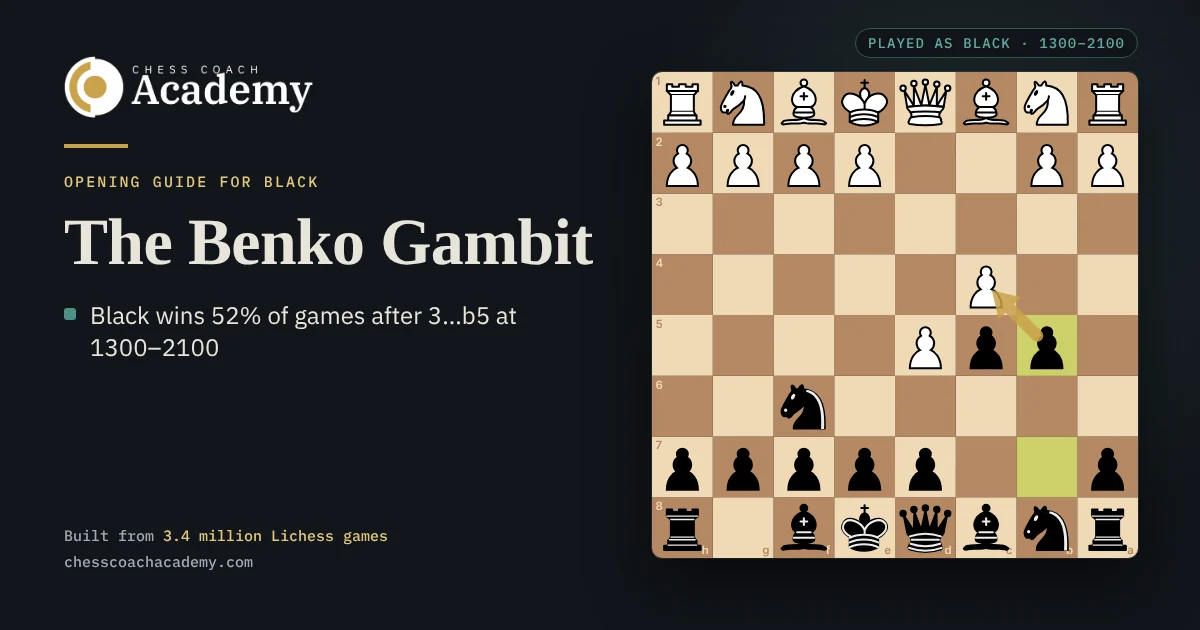
Most guides teach this opening from games between masters. This one is built from 3.4 million Lichess games played by 1300 to 2100 rated players, and the data is encouraging. Half of Black players at this level choose 3...b5 after 3.d5, and they win 52% of those games. White accepts the pawn only about half the time, and many of the other replies are either harmless or simply bad.
1. d4 Nf6 2. c4 c5 3. d5 b5
Practice the Benko Gambit free →Who it's for
Players rated roughly 1300 to 2100 who like active piece play and don't mind being a pawn down for a long time. The pressure in the Benko builds slowly, over ten or twenty moves, rather than in a quick attack.
It suits you if you want the same setup in almost every game. Your pieces go to the same squares whatever White does: ...g6, ...Bg7, castle, ...Nbd7, queen to a5 or b6, rooks to a8 and b8. If you'd rather not give up material, the Nimzo-Indian or Queen's Indian are calmer answers to 1.d4.
Why it works at 1300 to 2100
- Your setup barely changes. Once you know where each piece goes, you can play the opening well even against a move you haven't seen.
- White often loses the right to castle. When White plays e4 in the main line, ...Bxf1 forces the king to take back, and it needs several moves to get safe.
- Many White players go wrong early. 4.Nc3? walks into ...b4, and pushing e5 too soon in the main line simply drops a pawn.
- In the accepted lines you're a real pawn down. Stockfish gives White a small edge, about half to three quarters of a pawn, and if you drift, White's extra pawn can win the endgame.
- The 5.Nc3 and 6.e4 line needs care. One natural capture there walks into a mating trap, covered below.
- It asks for patience. Your pressure comes from rooks and queen on open files, not a direct attack on White's king, so you need to be comfortable with long games.
What 1300 to 2100 players actually play
Here is what White plays after 3...b5. Just over half of White players take the pawn with 4.cxb5 (51%). The rest decline: 4.b3 is the most common way at 20%, then 4.e3 at 10%. At the bottom is 4.Nc3 at 8%, which looks natural but is a real mistake, because ...b4 kicks the knight and it has no good square.
Four numbers from the data are worth remembering:
- After 1.d4 Nf6 2.c4 c5 3.d5, half of the players at 1300-2100 choose 3...b5, and Black wins 52% of those games.
- After 3...b5, White accepts with 4.cxb5 in 51% of games. After 4...a6, 48% take again with 5.bxa6, and 86% of those follow 5...Bxa6 with 6.Nc3.
- After 5.bxa6 Bxa6 6.Nc3 d6 7.e4, 83% of Black players trade with 7...Bxf1, so White's king has to recapture and can no longer castle.
- After 4.cxb5 a6 5.Nc3 axb5 6.e4 b4 7.Nb5, 20% of Black players grab 7...Nxe4?, and White wins 85% of those games.
How to play the Benko Gambit: move by move
Every position below comes straight from the practice lines. The boards are shown from your side, and the arrows mark White's most common replies at 1300 to 2100, labeled with how often each one is played in that exact position. Under each board you'll find the reply, why White plays it, and the move you answer with.
After 1. d4 Nf6 2. c4 c5 3. d5 b5
The gambit is offered. Against the accepting 4.cxb5 you offer a second pawn with ...a6. Against the declines 4.b3 and 4.e3 you take on c4 and play a normal game with material level.
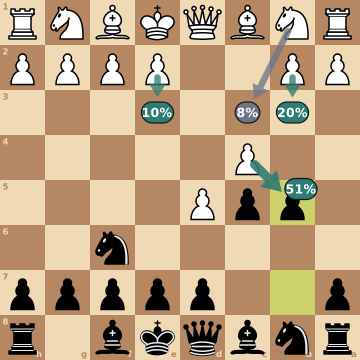
- 4. cxb5 (51%). Now you keep going with the gambit.
Your answer: 4...a6. Offer a second pawn to rip open the queenside. - 4. b3 (20%). If you take on c4, White can take back with a pawn.
Your answer: 4...bxc4. Take anyway and open the b-file. - 4. e3 (10%). White declines with e3, ready to take back on c4 with the bishop.
Your answer: 4...bxc4. Take on c4 and open the b-file. - 4. Nc3 (8%). Nc3?b4 with tempo, and the knight has no good square to go to.
Your answer: 4...b4. Kick the knight away from c3.
After 1. d4 Nf6 2. c4 c5 3. d5 b5 4. cxb5 a6
White has four common choices here, and only 5.bxa6 leads to the classical Benko. The other three each need their own answer, so this is the position to know best.
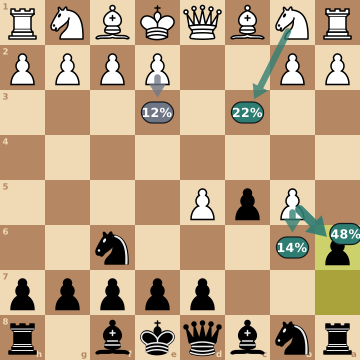
- 5. bxa6 (48%). That pawn won't last: your bishop takes it back right away.
Your answer: 5...Bxa6. Take back with the bishop, which now eyes White's f1 bishop. - 5. Nc3 (22%). White develops Nc3 instead of taking on a6.
Your answer: 5...axb5. Take the pawn back and open the a-file. - 5. b6 (14%). White pushes the pawn on to b6 instead of taking.
Your answer: 5...e6. Attack d5 first; the b6 pawn can wait. - 5. e3 (12%). White calmly plays e3, declining the second pawn.
Your answer: 5...g6. Get ready to put your bishop on the long diagonal.
After 1. d4 Nf6 2. c4 c5 3. d5 b5 4. cxb5 a6 5. bxa6 Bxa6 6. Nc3 d6
The main Benko position. Watch whether White moves the e-pawn: if it goes to e4, your a6 bishop can take on f1 and White loses the right to castle.
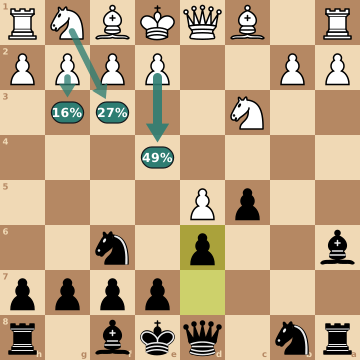
- 7. e4 (49%). White builds a big center with e4, and now the bishops face each other.
Your answer: 7...Bxf1. Trade bishops, and White loses the right to castle. - 7. Nf3 (27%). White develops Nf3 and keeps the e-pawn at home.
Your answer: 7...g6. Prepare the long-diagonal bishop. - 7. g3 (16%). White starts the fianchetto with g3.
Your answer: 7...g6. Mirror White and fianchetto your own bishop.
After 1. d4 Nf6 2. c4 c5 3. d5 b5 4. cxb5 a6 5. bxa6 Bxa6 6. Nc3 d6 7. e4 Bxf1 8. Kxf1 g6
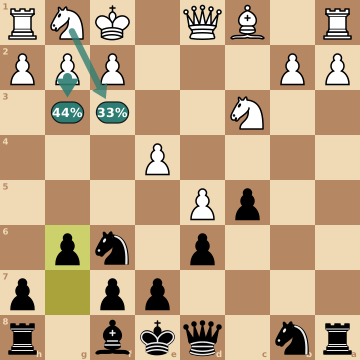
- 9. g3 (44%). White plays g3 to walk the king to g2.
Your answer: 9...Bg7. Your bishop takes the long diagonal. - 9. Nf3 (33%). The king still plans g3 and Kg2.
Your answer: 9...Bg7. Complete the fianchetto.
After 1. d4 Nf6 2. c4 c5 3. d5 b5 4. cxb5 a6 5. bxa6 Bxa6 6. Nc3 d6 7. Nf3 g6
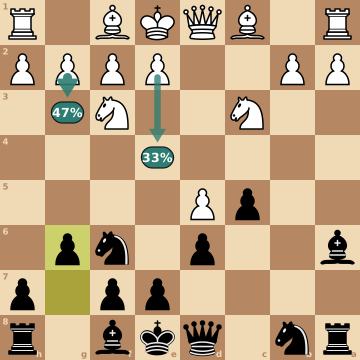
- 8. g3 (47%). Bxf1 trick here.
Your answer: 8...Bg7. Your bishop joins the long diagonal. - 8. e4 (33%). White pushes e4, and now the bishops face each other.
Your answer: 8...Bxf1. Trade bishops and make White give up castling.
After 1. d4 Nf6 2. c4 c5 3. d5 b5 4. cxb5 a6 5. Nc3 axb5
White's knight now wants to take on b5. Against 6.e4, don't play slowly: push 6...b4 at once.
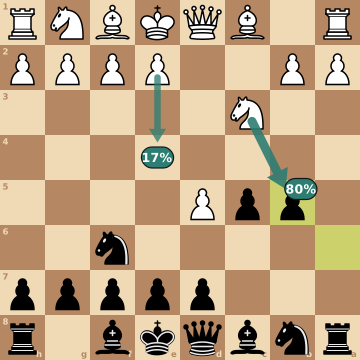
- 6. Nxb5 (80%). Nxb5. White is a pawn up again, but the knight on b5 isn't protected by anything.
Your answer: 6...Ba6. Attack the knight and aim at f1. - 6. e4 (17%). White ignores b5 and grabs the center with e4.
Your answer: 6...b4. Push past with tempo, attacking the c3 knight.
After 1. d4 Nf6 2. c4 c5 3. d5 b5 4. Nc3 b4
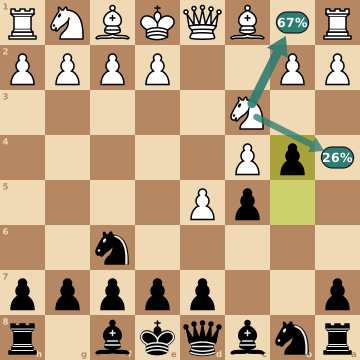
- 5. Nb1 (67%). White retreats the knight all the way home to b1.
Your answer: 5...g6. Put your bishop on the long diagonal. - 5. Na4 (26%). But on a4 the knight is stuck on the rim.
Your answer: 5...d6. Protect c5 and open your c8 bishop.
Your plan after the opening
Against 7.e4: take on f1, then build pressure
After 7...Bxf1 8.Kxf1, White's king has to walk to g2 with g3 and Kg2, and the h1 rook stays out of play for a while. Use that time. Fianchetto with ...g6 and ...Bg7, castle, then bring the queen to b6 or a5 and the rooks to a8 and b8.
Your targets are a2 and b2. A knight on d7 or a6 joins in, and once your f6 knight moves, the g7 bishop hits c3 and b2 behind it. If White pushes e5 before it's supported, just take it with ...dxe5.
1. d4 Nf6 2. c4 c5 3. d5 b5 4. cxb5 a6 5. bxa6 Bxa6 6. Nc3 d6 7. e4 Bxf1 8. Kxf1 g6 9. g3 Bg7
Against the Fianchetto (7.Nf3 and 8.g3, or 7.g3): the same setup
Here White keeps the e-pawn at home, so there's no ...Bxf1 trick and White castles normally. Your plan doesn't change: ...g6, ...Bg7, castle, ...Nbd7, queen to a5 or b6, rooks to a8 and b8. White ends up spending moves like Rb1 and b3 just to hold the queenside, and that is your compensation for the pawn.
1. d4 Nf6 2. c4 c5 3. d5 b5 4. cxb5 a6 5. bxa6 Bxa6 6. Nc3 d6 7. Nf3 g6 8. g3 Bg7 9. Bg2 O-O
Against 5.Nc3: take back on b5 and chase the knight
After 5...axb5 6.Nxb5, the knight on b5 has no defender, so 6...Ba6 attacks it at once. White's best retreat is 7.Nc3, which keeps d5 protected. White usually trades bishops on a6 to keep the right to castle, and your knight recaptures and heads for c7 or b4.
1. d4 Nf6 2. c4 c5 3. d5 b5 4. cxb5 a6 5. Nc3 axb5 6. Nxb5 Ba6 7. Nc3 g6 8. e4 d6 9. Bxa6 Nxa6
Against the declines: take on c4 and play a normal game
Against 4.b3 and 4.e3 you simply take on c4. Material is level, the b-file is half open for your rook, and your usual ...g6, ...Bg7, castle setup still works. Stockfish rates both lines level or close to it. Against 5.b6 in the accepted line, play ...e6 to hit d5 first and win the b6 pawn back later.
1. d4 Nf6 2. c4 c5 3. d5 b5 4. b3 bxc4 5. bxc4 g6
Traps and common mistakes
Grabbing e4 and walking into mate
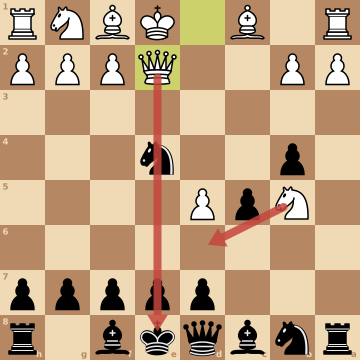
1. d4 Nf6 2. c4 c5 3. d5 b5 4. cxb5 a6 5. Nc3 axb5 6. e4 b4 7. Nb5 Nxe4? 8. Qe2 Nf6?? 9. Nd6#
After 6.e4 b4 7.Nb5, the e4 pawn looks free, and 20% of Black players take it. White then wins 85% of those games. The reason is 8.Qe2!: the queen attacks your knight and lines up with your king on the e-file. If the knight retreats with 8...Nf6??, your e7 pawn is pinned and 9.Nd6 is checkmate.
Play 7...d6 first. It covers d6, so the mate is gone, and you can build with ...g6, ...Bg7 and castling. Stockfish rates the position level.
Answering 6.e4 slowly
1. d4 Nf6 2. c4 c5 3. d5 b5 4. cxb5 a6 5. Nc3 axb5 6. e4 b4
In the 5.Nc3 line, 6.e4 sets up two threats at once: Bxb5, and e4-e5 kicking your f6 knight. A developing move like 6...Ba6 runs straight into 7.e5.
6...b4! is the only good move. It attacks the c3 knight with tempo, and material is level because your b-pawn has traded itself for White's c-pawn.
Moving the knight when White pushes e5 too early
1. d4 Nf6 2. c4 c5 3. d5 b5 4. cxb5 a6 5. bxa6 Bxa6 6. Nc3 d6 7. e4 Bxf1 8. Kxf1 g6 9. e5? dxe5
In the classical line, White sometimes pushes e5 before the king is safe and before the pawn is supported. It attacks your f6 knight, and the natural reflex is to move the knight. Don't. 9...dxe5 simply wins a pawn, which gets your gambit pawn back.
The same idea applies later in the game: if White pushes e5 before it's properly supported, ...dxe5 usually just wins it.
White's 4.Nc3? and the trapped knight
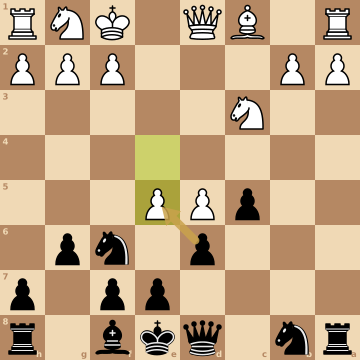
1. d4 Nf6 2. c4 c5 3. d5 b5 4. Nc3 b4 5. Nb5? a6
4.Nc3 looks like normal development, but 4...b4 kicks the knight, and its only safe squares are b1 and a4. If it jumps to b5 instead, 5...a6 leaves it with nowhere to go.
After 5.Nb1, White has spent two moves to put the knight back home, and Stockfish rates you slightly better. After 5.Na4, protect c5 with ...d6, and the knight is stuck on the rim.
Frequently asked questions
Is the Benko Gambit sound?
It's a real gambit: Stockfish gives White a small edge in the accepted lines, about half to three quarters of a pawn. But at 1300 to 2100 on Lichess the results favor Black. Half of players choose 3...b5 after 3.d5, and Black wins 52% of those games.
What is the most common reply to the Benko Gambit at club level?
At 1300 to 2100 on Lichess, White accepts with 4.cxb5 in 51% of games. The most common decline is 4.b3 at 20%, followed by 4.e3 at 10%. After 4.cxb5 a6, 48% take again with 5.bxa6.
What should Black do if White declines the Benko Gambit?
Take on c4 with ...bxc4. Against 4.b3 and 4.e3 you get a level game with material even and a half-open b-file for your rook, and you can use your normal ...g6, ...Bg7 and castle setup.
Why does Black play ...Bxf1 in the Benko Gambit?
When White plays e4, the a6 bishop can take on f1, and White has to recapture with the king, so castling is gone. At this level 83% of Black players make that trade after 7.e4. White's king then needs g3 and Kg2 to reach safety, which buys you time for your queenside pressure.
Is the Benko Gambit good for club players?
Yes, if you're happy to play a pawn down. The setup is the same in almost every line, so there's less to memorize than in most gambits, and several of White's common replies at 1300 to 2100 are mistakes you can punish. You do need patience in the long games that follow.
Keep learning
- All 36 opening guides: every opening on the site, grouped by what you play as White and Black.
- Is the Benko Gambit sound?: What Black gets for the pawn, and how White tries to hold it or decline it.
- The most reliable 1.d4 defenses for Black: Nine 1.d4 defenses compared with Lichess data at club level.
The Coach plays White against your Benko Gambit with the moves 1300 to 2100 players actually choose, from 4.cxb5 to the 4.b3 decline, and explains every move in plain English. Progress tracking is free during the open beta.
Practice the Benko Gambit free →