
Is the Budapest Gambit Sound? Engine vs. Practical Play
TL;DR
Games behind this article About 8.1 million Lichess games at 900 to 2100 Engine verdict Not quite sound. With best play Stockfish gives White a small edge, around half a pawn in most main lines What White plays Takes with 3.dxe5 in 58% of games. Declines with 3.d5 (20%), 3.Nc3 (11%) or 3.e3 (6%) Main line 3...Ng4 4.Nf3 (55%) Bc5 5.e3 (95%) Nc6, and Black wins the pawn back within a few moves White's toughest try 4.Bf4 (19%). White wins 53% of games after it The famous trap 4.Bf4 Nc6 5.Nf3 Bb4+ 6.Nbd2 Qe7 7.a3 Ngxe5 8.axb4?? Nd3#. 42% of White players fall for it
The game that made it famous
At a four-player tournament in Berlin in April 1918, Milan Vidmar faced Akiba Rubinstein, then one of the best players in the world and Emanuel Lasker's agreed challenger for the World Championship. Shortly before the round, the Hungarian master Istvan Abonyi showed Vidmar a new pawn sacrifice that he, Barász and Breyer had been working on since 1916. Vidmar played it and beat Rubinstein in 24 moves.
That's a real, documented result, but it's over a century old. Whether the gambit still works is a separate question, and this site's Lichess data answers it.
The gambit
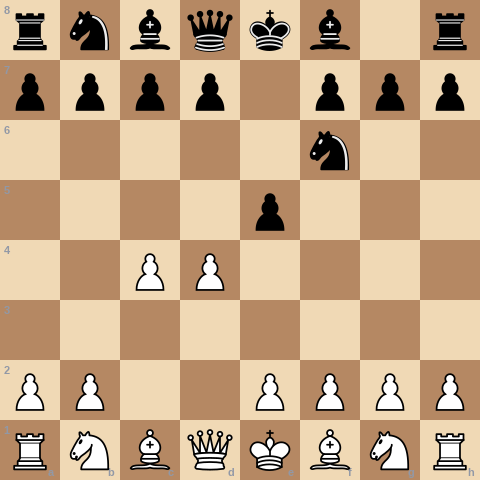
Black offers the e-pawn at once to break open the center and get pieces out fast. At 900 to 2100 on Lichess, most White players take it with 3.dxe5 (58%). The main ways to decline are 3.d5 (20%), 3.Nc3 (11%) and 3.e3 (6%).
Declining with 3.d5 doesn't lose material, but it closes the center and leaves Black's e5 pawn safe. White gives up the edge that 3.dxe5 offers, and Black wins 52% of games after 3.d5.
The knight jumps back to attack the e5 pawn. This is the point of the whole gambit, and the move our course plays. White's replies at this level:
- 4. Nf3, developing and defending e5: 55%
- 4. Bf4, defending with the bishop instead: 19%. This is White's toughest try, and White wins 53% of games after it
- 4. e4, giving the pawn straight back (the Alekhine Variation): 7%
The main line: 4.Nf3
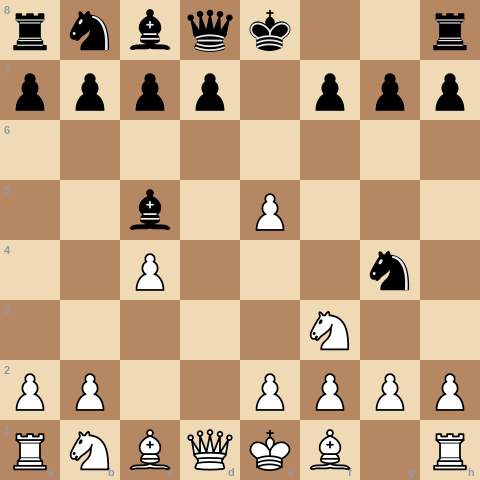
Black's bishop and the knight on g4 now both aim at f2. A natural developing move like 5.Nc3? allows ...Bxf2+, winning a pawn and dragging White's king to d2.
White shuts the bishop out of f2 with 5.e3 in 95% of games, and Black brings a second attacker to e5. From here White most often plays 6.Nc3 (29%), 6.Be2 (22%), 6.Qd5 (16%) or 6.a3 (13%), and against the first three Black wins the pawn back within a few moves with ...Ngxe5. Against 6.a3, the calm 6...a5 stops b4 for good.
The trap: 4.Bf4
White's toughest try, and the line where the Budapest's most famous trap lives. Black now has three pieces on e5, and the queen on e7 lines up with White's king. White's two main moves here are the safe 7.e3 (47%) and 7.a3 (44%), which attacks the bishop.
Black ignores the attack on the bishop and takes the pawn back. Now 8.axb4?? looks like it simply wins a piece, and 42% of White players at this level take it. But after 8...Nd3# it's checkmate: the e2 pawn can't capture on d3 because the queen on e7 pins it to White's king. Black wins 99% of those games, and 60% of all games after 7.a3.
So, is it sound?
On the engine side, not quite: with best play Stockfish gives White a small edge, around half a pawn in most main lines. On the practical side, it's a strong choice. Black wins the gambit pawn back in almost every line, White's most popular way to decline (3.d5) hands Black a comfortable game, and White's toughest try (4.Bf4) contains a trap that 42% of White players fall into.
The Budapest isn't a refutation of 1.d4, but below the top level it's a very practical way to get an active game as Black. Our Budapest Gambit course covers the main line, 4.Bf4 with the trap, 4.e4 and every common way White declines. Practice the Budapest Gambit interactively →
Keep reading
Next in this part of the series:
- How to Refute the Englund Gambit and Other Early 1.d4 Gambits: the Englund's ...Qb4+ trap, the clean way to meet it, and notes on other early tries.
Frequently asked questions
Is the Budapest Gambit sound?
Not quite, with perfect play: Stockfish gives White a small edge, around half a pawn in most main lines. In practice it works well below the top level, because Black wins the pawn back in almost every line and White's toughest try contains a well-known trap.
What is the Budapest Gambit trap?
After 4.Bf4 Nc6 5.Nf3 Bb4+ 6.Nbd2 Qe7 7.a3 Ngxe5, the bishop on b4 looks free. If White takes it with 8.axb4??, then 8...Nd3 is checkmate, because the queen on e7 pins the e2 pawn. 42% of White players at 900 to 2100 on Lichess fall for it.
What is the best way for White to meet the Budapest Gambit?
Take the pawn with 3.dxe5 and develop calmly. The main line 3...Ng4 4.Nf3 Bc5 5.e3 keeps a small edge, and 4.Bf4 is White's toughest try as long as you avoid 8.axb4??. Declining with 3.d5 is the most common way to throw the edge away.
Does Black get the pawn back in the Budapest Gambit?
Usually, within a few moves. In the main line Black piles up on e5 with ...Nc6, ...Qe7 or ...Re8 and recaptures with the knight, usually ...Ngxe5.
Who should play the Budapest Gambit?
Black players from about 900 to 2100 who want an active answer to 1.d4 2.c4 and don't mind a little risk. Our course is built from what players at that level actually play on Lichess.
More traps and gambits
Back to the full series:
- Chess Opening Traps & Gambits: Every trap and gambit guide in this series, checked against our data.
Try It Yourself for Free
Every line above, from Vidmar's original idea to the modern main line, is fully interactive on this site. All 38 openings, including the Budapest Gambit, are free to try, no card and no account needed to start, with your progress tracked for free if you create one.
Every line checked the same way, against real game data, not against what sounds right.
Browse all 38 openings free →