How Do You Refute Early Sideline Gambits Against 1.d4, Like the Englund Gambit?
TL;DR
Short answer Take the pawn with 2. dxe5 and develop. After 2...Nc6 3.Nf3 Qe7, play 4. Nc3 so ...Qb4 is no longer check. If you've already played 4.Bf4 Qb4+, block with 5.Bd2 and after 5...Qxb2 play 6. Nc3. Never 6.Bc3??, which runs into mate. The trap to know 6.Bc3?? Bb4! 7.Qd2 Bxc3 8.Qxc3 Qc1# Our data At 400 to 1400 on Lichess, 1...e5 comes up in 7.8% of 1.d4 games. After 2.dxe5 Nc6 3.Nf3 Qe7, 47% of players play 4.Bf4 and win only 39% of those games. With 4.Nc3, White wins 53%. Where to practice it London System trainer, which covers the Englund: 20 lines built from about 35 million Lichess games, recommended from 400 to 1400 Elo
What the Englund Gambit is
Black answers 1.d4 by throwing a pawn at it. After 2.dxe5, 2...Nc6 is the most common follow-up at 400 to 1400 (40%), and after 3.Nf3 the key move is 3...Qe7 (55%). Now the e5 pawn is attacked twice, by the knight and the queen, and defended only once. White has to decide how to deal with that, and the most natural answer is the one the whole gambit is built to punish.
On Lichess, 47% of White players at this level defend with 4.Bf4 and win only 39% of those games. That's the character of most early sideline gambits against 1.d4. They aren't sound, but they're full of short tactical tricks, and they work best against players who develop on autopilot.
The trap: Qb4+ and mate on c1
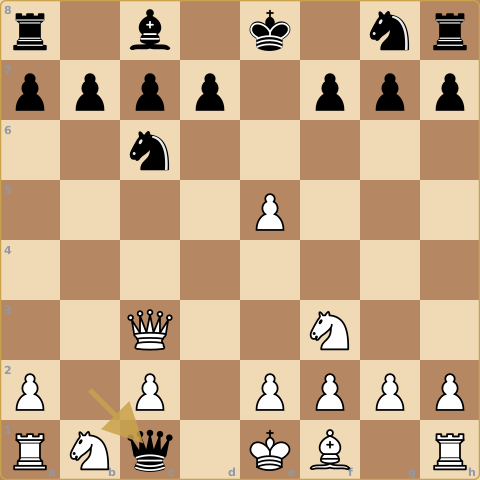
Here's how it happens, one natural move at a time:
- 4.Bf4 defends e5. Sensible, but it puts the bishop on a square the queen can hit.
- 4...Qb4+ checks the king and attacks both the bishop on f4 and the pawn on b2.
- 5.Bd2 Qxb2. Black takes the pawn and now eyes the rook on a1.
- 6.Bc3?? attacks the queen, and it looks like it wins time. It loses.
- 6...Bb4! pins the bishop to the king. White defends with 7.Qd2, but after 7...Bxc3 8.Qxc3, the queen drops to c1 with mate.
The refutation: 6.Nc3
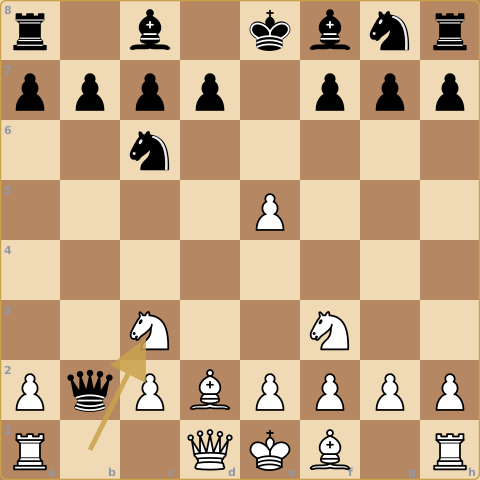
Instead of attacking the queen with the bishop, just develop. The rook on a1 looks loose, but with the knight gone from b1 the queen on d1 guards it along the first rank, so 6...Qxa1?? 7.Qxa1 loses Black's queen for a rook.
Material is level, since Black won the b2 pawn back. But White has three pieces out, and Black's queen is stuck on b2 with few safe squares. A natural try is 6...Bb4, pinning the knight, and White answers with 7.Rb1, hitting the queen again. After 7...Qa3 the queen is still offside, and White simply keeps developing.
Better still, skip the queen raid entirely with 4.Nc3. The knight blocks the line from b4 to your king, so ...Qb4 is no longer check. Black gets the pawn back with 4...Nxe5, but White has easy development and far fewer tricks to watch, and White wins 53% of games after 4.Nc3 at 400 to 1400 on Lichess. It's the move our London trainer plays.
Other early gambits against 1.d4
The Budapest Gambit is the most respected of the group. It's covered in depth in Is the Budapest Gambit Sound?, but one trap belongs here because it looks just like the Englund trick. After 1.d4 Nf6 2.c4 e5 3.dxe5 Ng4 4.Bf4 Nc6 5.Nf3 Bb4+ 6.Nbd2 Qe7, White's safest move is 7.e3, played in 47% of games at 900 to 2100 on Lichess. 7.a3 is almost as common (44%), and the greedy follow-up loses on the spot:
The knight on d3 is mate because the queen on e7 pins the e2 pawn, so nothing can take it. 42% of White players at this level take the bishop with 8.axb4??, and Black wins 99% of those games.
The Albin Countergambit (1.d4 d5 2.c4 e5) has the most famous trap of all, the Lasker Trap:
The pawn marches from d5 to g1 and promotes to a knight with check. If 8.Rxg1, then 8...Bg4+ skewers the king and the queen on d1. White's first mistake was 4.e3, which gave the d4 pawn something to capture. The standard 4.Nf3 simply develops a piece.
How to handle any early gambit against 1.d4
- Take the pawn if it's safe, then develop. An extra pawn plus normal development is already a good position.
- Watch the e1 to a5 diagonal. The Englund, Budapest and Albin traps all use a check or pin on it: ...Qb4+ or ...Bb4+.
- Don't chase the queen with pieces that can be pinned. 6.Bc3 in the Englund is the classic example.
- Count before you capture. 8.axb4 in the Budapest and 6.Bxb4 in the Albin both grab a bishop and lose the game.
For more traps and gambits, and how they hold up in real games, see the traps and gambits hub.
Frequently asked questions
How do you refute the Englund Gambit?
Take the pawn with 2.dxe5 and develop. After 2...Nc6 3.Nf3 Qe7, the simplest move is 4.Nc3, so ...Qb4 is no longer check; at 400 to 1400 on Lichess White wins 53% of games after it. If you've played 4.Bf4 Qb4+ 5.Bd2 Qxb2, play 6.Nc3. Avoid 6.Bc3??, which loses to 6...Bb4 and mate on c1.
What is the Englund Gambit trap?
1.d4 e5 2.dxe5 Nc6 3.Nf3 Qe7 4.Bf4 Qb4+ 5.Bd2 Qxb2 6.Bc3?? Bb4! 7.Qd2 Bxc3 8.Qxc3 Qc1#. The bishop on c3 is pinned, and the queen mates on c1.
What is the Lasker Trap?
It's a trap in the Albin Countergambit: 1.d4 d5 2.c4 e5 3.dxe5 d4 4.e3? Bb4+ 5.Bd2 dxe3 6.Bxb4?? exf2+ 7.Ke2 fxg1=N+. Black's pawn promotes to a knight with check, and 8.Rxg1 Bg4+ wins White's queen.
Is the Englund Gambit good?
It isn't sound, and a prepared White player simply ends up with better development or an extra pawn. Its value is surprise: at 400 to 1400 on Lichess, 47% of White players answer 3...Qe7 with 4.Bf4 and win only 39% of those games, because of 4...Qb4+.
Copy the lines (PGN)
Every line in this article in standard PGN, ready to paste into Lichess, Chess.com or any chess database.
[Event "How Do You Refute Early Sideline Gambits Against 1.d4, Like the Englund Gambit?: Englund Gambit trap"]
[Site "chesscoachacademy.com"]
[Result "*"]

1. d4 e5 2. dxe5 Nc6 3. Nf3 Qe7 4. Bf4 Qb4+ 5. Bd2 Qxb2 6. Bc3 Bb4 7. Qd2 Bxc3 8. Qxc3 Qc1# *

[Event "How Do You Refute Early Sideline Gambits Against 1.d4, Like the Englund Gambit?: Englund refutation, 6.Nc3"]
[Site "chesscoachacademy.com"]
[Result "*"]

1. d4 e5 2. dxe5 Nc6 3. Nf3 Qe7 4. Bf4 Qb4+ 5. Bd2 Qxb2 6. Nc3 Bb4 7. Rb1 Qa3 *

[Event "How Do You Refute Early Sideline Gambits Against 1.d4, Like the Englund Gambit?: Englund, 4.Nc3"]
[Site "chesscoachacademy.com"]
[Result "*"]

1. d4 e5 2. dxe5 Nc6 3. Nf3 Qe7 4. Nc3 Nxe5 *

[Event "How Do You Refute Early Sideline Gambits Against 1.d4, Like the Englund Gambit?: Budapest trap"]
[Site "chesscoachacademy.com"]
[Result "*"]

1. d4 Nf6 2. c4 e5 3. dxe5 Ng4 4. Bf4 Nc6 5. Nf3 Bb4+ 6. Nbd2 Qe7 7. a3 Ngxe5 8. axb4 Nd3# *

[Event "How Do You Refute Early Sideline Gambits Against 1.d4, Like the Englund Gambit?: Lasker Trap"]
[Site "chesscoachacademy.com"]
[Result "*"]

1. d4 d5 2. c4 e5 3. dxe5 d4 4. e3 Bb4+ 5. Bd2 dxe3 6. Bxb4 exf2+ 7. Ke2 fxg1=N+ 8. Rxg1 Bg4+ *
Keep reading
- Is the Budapest Gambit Sound? Engine vs. Practical Play: The most respected early gambit against 1.d4, checked against about 8.1 million Lichess games.
- Chess Opening Traps & Gambits: The full hub for traps, gambits and refutations.
Build a 1.d4 setup that shrugs off tricks
Our London System trainer covers the Englund Gambit directly: take on e5, play Nf3, and bring the knight to c3 before the bishop goes to f4, so the ...Qb4+ trick never works. It also drills the same Nf3 and Bf4 development against 1...d5, 1...Nf6 and 1...e6. It covers 20 lines built from about 35 million Lichess games and is recommended from 400 to 1400 Elo.
It's free during the open beta, and you can track your progress on every line for free with an account.
20 London System lines from about 35 million Lichess games. Free during the open beta, with free progress tracking.
Practice the London System free →