What Is a Fork in Chess? The Double Attack Explained With Examples
TL;DR
In one sentence A fork is one piece attacking two (or more) of your opponent's pieces at the same time. Why it works Your opponent can only move one piece per turn, so they save one and you win the other. Best forking piece The knight, because its L-shaped jump is the hardest move to see coming Strongest kind A fork with check: the king has to move, so the other piece falls Other names Royal fork (king and queen), family fork (king, queen and rook), double attack
What a fork is
A fork is the simplest and most common tactic in chess: one of your pieces attacks two of your opponent's pieces at once. Your opponent gets one move, so they can only rescue one of them. The other is yours.
Any piece can fork, even a pawn or the king. The fork works best when the pieces you attack are worth more than the piece doing the attacking, or when one of them is the king and the fork comes with check.
The knight fork
Knights are the kings of forks. A knight jumps over everything in its way and lands on squares that no other piece attacks in the same way, so a knight fork often appears out of nowhere.
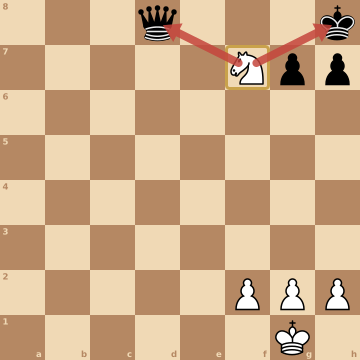
This is a royal fork: check to the king and an attack on the queen. Black's only legal move is ...Kg8, and then Nxd8 wins the queen for a knight.
The quick way to spot knight forks: look for two enemy pieces that sit a knight's jump away from the same empty square. If you can get a knight to that square, it's a fork.
The pawn fork
Pawns are the cheapest pieces, so a pawn fork almost always wins something. The famous example in the openings is the fork trick, from the Four Knights and Petroff positions:
1. e4 e5 2. Nf3 Nf6 3. Nc3 Nc6 4. Bc4 Nxe4 5. Nxe4 d5
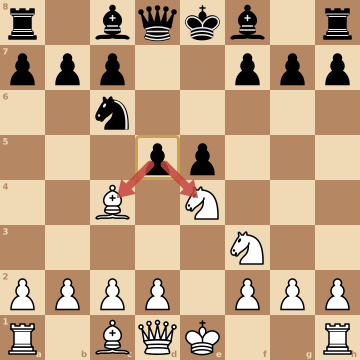
Black seems to lose a knight with 4...Nxe4, but the pawn fork 5...d5 wins a piece straight back. In our Petroff course, built from Lichess games at 800 to 2400, 51% of White players take with 6.Bxd5 here, and Black then scores 59%. The lesson for White: when a pawn forks two pieces, you will lose one of them, so pick the move that keeps the position healthy.
The queen fork
The queen moves in every direction, so she's always looking for two things to hit at once. A queen fork with check is especially common in the opening. One trap catches thousands of players at club level, in the Englund Gambit:
1. d4 e5 2. dxe5 Nc6 3. Nf3 Qe7 4. Bf4 Qb4+
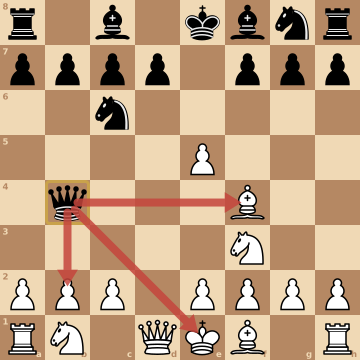
White's natural-looking 4.Bf4 walks straight into it. At 400 to 1400 on Lichess, 47% of players play 4.Bf4 and win only 39% of those games, because of 4...Qb4+. With 4.Nc3 instead, White wins 53%. Our Englund Gambit guide shows the safe way through.
Another queen fork shows up in the Ponziani. After 1.e4 e5 2.Nf3 Nc6 3.c3 Bc5 4.d4 exd4 5.cxd4 Bb4+ 6.Nc3 d6 7.d5, 70% of players at 600 to 1500 answer 7...Ne5?, and White scores 69% in those games. The refutation is 8.Qa4+, a check that also hits the bishop on b4, followed by 9.Qxb4. See the Ponziani trap for the full line.
Other kinds of fork
- Bishop fork: a bishop on a diagonal attacking two pieces, often a rook and a king.
- Rook fork: a rook attacking two pieces along a rank or file, common in endgames.
- King fork: yes, the king can fork too, usually two loose pawns or pieces in the endgame.
- Family fork: a knight attacking the king, queen and a rook all at once.
How to spot (and avoid) forks
- Look for loose pieces. A piece nobody defends is the first target of a fork. Two loose pieces at once is an invitation.
- Check the knight squares. Before you move, ask where your opponent's knights can jump next, and what they would attack from there.
- Look for checks first. A fork that comes with check is the hardest to answer, so check every check your opponent has.
- Keep king and queen apart. A king and queen a knight's jump from the same square are a royal fork waiting to happen.
Practice it
Forks are pattern recognition, and patterns come from repetition. Start with our fork puzzles, taken from real games and sorted easiest first, and each opening Coach points out the forks that real opponents at your rating fall for. Related terms: pin, skewer and fianchetto.
FAQ
What is a fork in chess?
A fork is when one piece attacks two or more enemy pieces at the same time. Your opponent can usually save only one of them, so you win the other.
What is a royal fork?
A knight fork that attacks the king and the queen at once. Because the king is in check, your opponent has to move it, and you take the queen next move. A fork of king, queen and rook is sometimes called a family fork.
Which piece is best at forking?
The knight. It jumps over other pieces and attacks squares that bishops, rooks and queens can't reach, so its forks are the hardest to see coming. Queens fork often too, because they move in every direction.
What is the difference between a fork and a double attack?
A fork is a double attack made by one piece. A double attack can also come from two different pieces, for example when a move uncovers an attack from a piece behind it (a discovered attack).
How do I stop getting forked?
Before every move, check which squares an enemy knight can jump to next, and avoid leaving two undefended pieces a knight's jump apart. Keep your king and queen off squares that one piece could attack together.
Our puzzles come from real games, and the Coach shows the forks hidden in each opening before they happen to you.
Try 1,000 fork puzzles →