What Is a Pin in Chess? Absolute and Relative Pins Explained
TL;DR
In one sentence A pin is when a piece can't move without exposing a more valuable piece behind it. Absolute pin The piece behind is the king. The pinned piece is not allowed to move off the line. Relative pin The piece behind is something else, like the queen. Moving is legal, but costly. Who can pin Bishops, rooks and queens How to break it Move the piece behind, block the line, defend the pinned piece, or chase the pinning piece away
What a pin is
A pin happens when a bishop, rook or queen attacks a piece, and directly behind that piece on the same line stands something more valuable. The piece in front is "pinned": if it moves, the attacker gets a clear shot at the piece behind it.
Pins are everywhere in the opening. Bishops love pinning knights, because knights usually stand right in front of the king or queen early in the game.
The absolute pin
When the piece behind is the king, the pin is absolute: the pinned piece is not allowed to move off the line, because that would put its own king in check. Here's the defining move of the Nimzo-Indian Defense:
1. d4 Nf6 2. c4 e6 3. Nc3 Bb4
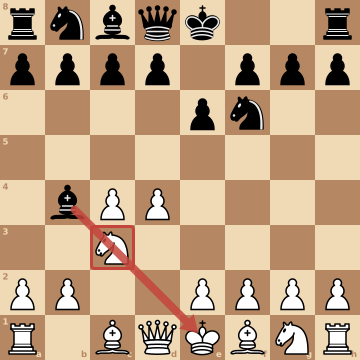
White's knight on c3 is pinned to the king, so it can't jump to e4 or d5 to fight for the center. That's the whole point of the opening: Black stops White's knight from doing its job. At 1400 to 2200 on Lichess, 50% of players answer 3.Nc3 with this 3...Bb4. Our guide to the Nimzo-Indian and its neighbors explains the plans.
The relative pin
When the piece behind is not the king, the pin is relative. The pinned piece is allowed to move, but if it does, you lose whatever is behind it. Here's a common example from the London System:
1. d4 d5 2. Bf4 Nc6 3. e3 Nf6 4. Nf3 Bg4
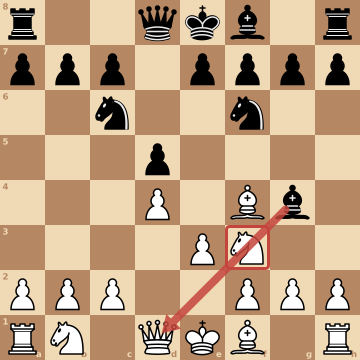
White's knight on f3 is pinned to the queen on d1. It could legally move, but that would hand over the queen. Black also threatens ...Bxf3, which would wreck White's pawns if White had to recapture with the g-pawn.
How to break a pin
There are four ways out of a pin. In the London position above, White uses the calmest one:
5. c3 e6 6. Nbd2
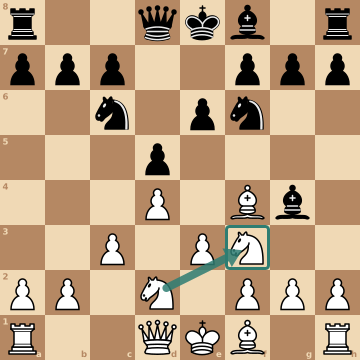
In our London course, Black plays 5...e6 in 52% of games here, and 6.Nbd2 is the Coach's answer. The four ways to break a pin are:
- Defend the pinned piece, so that if your opponent takes it, you recapture with a piece and lose nothing (that's 6.Nbd2).
- Move the piece behind, so the pin no longer matters. Here, moving the queen off d1 would do it.
- Block the line with another piece, for example Be2 between f3 and d1.
- Attack the pinning piece, often with a pawn: h3, asking the bishop on g4 to take or retreat.
Against an absolute pin, the second option is the usual one: castling or stepping the king aside turns it into nothing.
How to use pins
- Pile up on the pinned piece. A pinned piece can't run away, so attack it again, ideally with a pawn.
- Pin knights in the opening. A bishop pinning a knight to the king or queen is one of the most common ideas in chess, as in the Nimzo-Indian and many ...Bg4 or Bg5 lines.
- Remember the pinned piece still defends. A pinned piece still attacks squares and protects other pieces, so don't count it as gone.
Practice it
To see pins in action, try the Nimzo-Indian or London System Coach: both teach the pin and how to answer it, with the replies real opponents at your rating choose. Then drill the pattern with our pin puzzles from real games, and see the guides to forks, skewers and the fianchetto.
FAQ
What is a pin in chess?
A pin is when a bishop, rook or queen attacks a piece that can't move without exposing a more valuable piece behind it on the same line.
What is the difference between an absolute pin and a relative pin?
In an absolute pin, the piece behind is the king, so the pinned piece can't move off the line: that would be an illegal move. In a relative pin, the piece behind is something else, like the queen. The pinned piece is allowed to move, but you would lose the more valuable piece.
Can a pinned piece give check?
Yes. A pinned piece still attacks the squares it normally attacks, so it can give check and it still defends other pieces. It just can't move off the pin line without exposing what's behind it (and in an absolute pin, it can't move off that line at all).
How do you break a pin?
Move the piece behind out of the line (so the pin becomes harmless), block the line with another piece, defend the pinned piece so trading it costs nothing, or attack the pinning piece, often with a pawn.
What is the difference between a pin and a skewer?
In a pin, the less valuable piece is in front and can't move. In a skewer, the more valuable piece is in front, has to move, and the piece behind it is lost.
The Nimzo-Indian and the London System both turn on pins. Their free Coaches show you how to use them and how to break them.
Browse all 36 openings free →