What Is a Fianchetto in Chess? Meaning, Examples and When to Use It
TL;DR
In one sentence A fianchetto (fee-an-KET-oh) is when you push the knight's pawn one square and put the bishop behind it, on the long diagonal. The moves White: g3 and Bg2 (or b3 and Bb2). Black: ...g6 and ...Bg7 (or ...b6 and ...Bb7). Why play it The bishop aims across the whole board at the center, and your castled king gets an extra defender. The catch If that bishop is traded, the squares it guarded (f3 and h3, or f6 and h6) become weak. Openings that use it King's Indian, Grünfeld, Modern, Pirc, Catalan, English, Réti
What a fianchetto is
Normally a bishop comes out along the diagonal it already has open, to c4, b5, e2 or d3. In a fianchetto it goes somewhere else: you move the pawn in front of your knight one square, and the bishop slides into the gap that pawn left.
That gap is on the long diagonal, the longest line on the board (a1 to h8, or h1 to a8). From there the bishop looks straight through the center to the far corner. The word is Italian for "little flank", because the bishop develops on the side of the board instead of the middle.
Here's the most famous example, from the King's Indian Defense:
1. d4 Nf6 2. c4 g6 3. Nc3 Bg7
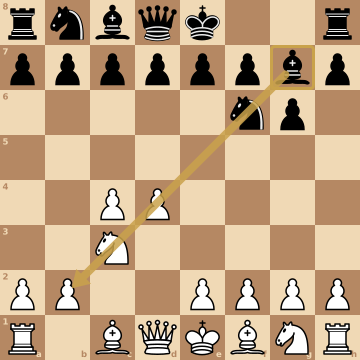
Black played ...g6 to open a square, then ...Bg7 to fill it. The bishop is safe behind its pawns, and the moment the f6 knight moves away, it presses on White's center at e5 and d4.
How to play a fianchetto
It takes two moves, in this order:
- Push the knight's pawn one square: g3 or b3 as White, ...g6 or ...b6 as Black.
- Put the bishop behind it: Bg2 or Bb2 as White, ...Bg7 or ...Bb7 as Black.
Usually you then castle on the same side, so the bishop sits right next to your king. It's one of the most natural setups in chess. At 400 to 1800 on Lichess, after 1.d4 Nf6 2.Nf3 g6 3.Bg5, Black plays 3...Bg7 in 92% of games: once the g-pawn has moved, almost everyone finishes the fianchetto.
White can fianchetto too. In the Catalan, White puts the bishop on g2 to aim at Black's queenside:
1. d4 Nf6 2. c4 e6 3. g3 d5 4. Bg2
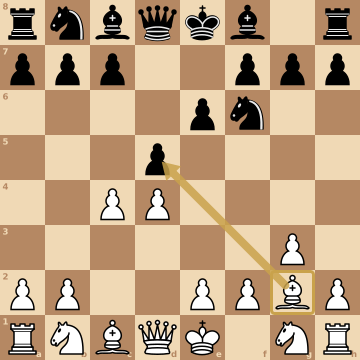
It's a rare choice at club level: at 1400 to 2200, only 3% of players choose 3.g3 in this position. That's part of why it works as a surprise.
Why the fianchetto is so strong
- The bishop sees the whole board. On the long diagonal it controls the center and the far corner at once, often for the whole game.
- It's hard to block. To shut it out, your opponent has to put pawns on the diagonal, which usually costs them something elsewhere.
- Your king gets a bodyguard. After castling, the bishop on g2 or g7 covers the light or dark squares right in front of your king.
- It's flexible. You can set it up against almost anything, which is why so many opening systems start with it.
The weakness: the holes it leaves
Moving the g-pawn to g6 leaves the squares f6 and h6 without a pawn to guard them. While the bishop is on g7, that doesn't matter, because the bishop guards them instead. But if the bishop gets traded, those squares become holes: places where an enemy queen or knight can land next to your king.
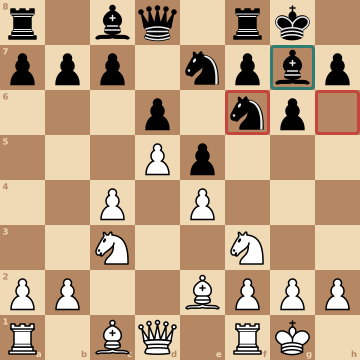
That gives you two simple rules:
- Don't trade your fianchettoed bishop cheaply. Keep it unless you win something real for it.
- Watch for Bh6 or Bh3. This is the classic attacking idea against a fianchetto: your opponent offers to trade bishops so that the holes appear. Often the right answer is to keep your bishop by moving it away, or to trade only when your other pieces cover the dark (or light) squares.
Openings that use a fianchetto
| Black against 1.d4 | King's Indian, Grünfeld, Dutch (Leningrad setup), Benko Gambit, Queen's Indian (...b6 and ...Bb7) |
| Black against 1.e4 | Modern Defense, Pirc Defense, and the Dragon in the Sicilian (see our Yugoslav Attack course for White's answer) |
| White | Catalan, English, Réti, and the King's Indian Attack |
A double fianchetto puts both bishops on the long diagonals, b2 and g2 (or b7 and g7). It's solid and flexible but slow, and it suits patient players.
Practice it
The easiest way to understand a fianchetto is to play one. Each of our opening Coaches shows the plan behind the bishop move by move, with the replies real opponents at your rating choose. Start with the King's Indian as Black or the English Opening as White. For more terms like this, see our guides to forks, pins and skewers.
FAQ
What does fianchetto mean in chess?
A fianchetto is a way of developing a bishop: you move the pawn in front of the knight one square (g3, b3, g6 or b6) and put the bishop on the square behind it (g2, b2, g7 or b7). From there the bishop controls the long diagonal across the center of the board.
How do you pronounce fianchetto?
Fee-an-KET-oh. It's Italian, meaning "little flank", because the bishop develops on the side of the board instead of in the center.
Is a fianchetto good for beginners?
Yes. It's easy to set up, it's hard for your opponent to stop, and it makes your castled king safer. The one rule to remember is not to trade the fianchettoed bishop cheaply, because the squares around your king get weak without it.
What is a double fianchetto?
Fianchettoing both bishops, on g2 and b2 for White or g7 and b7 for Black. Both long diagonals point at the center at the same time. It's flexible but slow, so it suits players who like quiet, maneuvering games.
Which openings use a fianchetto?
For Black: the King's Indian, the Grünfeld, the Modern Defense, the Pirc, the Leningrad Dutch and the Benko Gambit. For White: the Catalan, the English, the Réti and the King's Indian Attack.
The King's Indian, Catalan, Modern, Pirc and English all have free Coaches that teach the plans behind the bishop.
Browse all 36 openings free →