The Catalan Opening: How It Really Goes at 1400 to 2200 on Lichess
TL;DR: the data
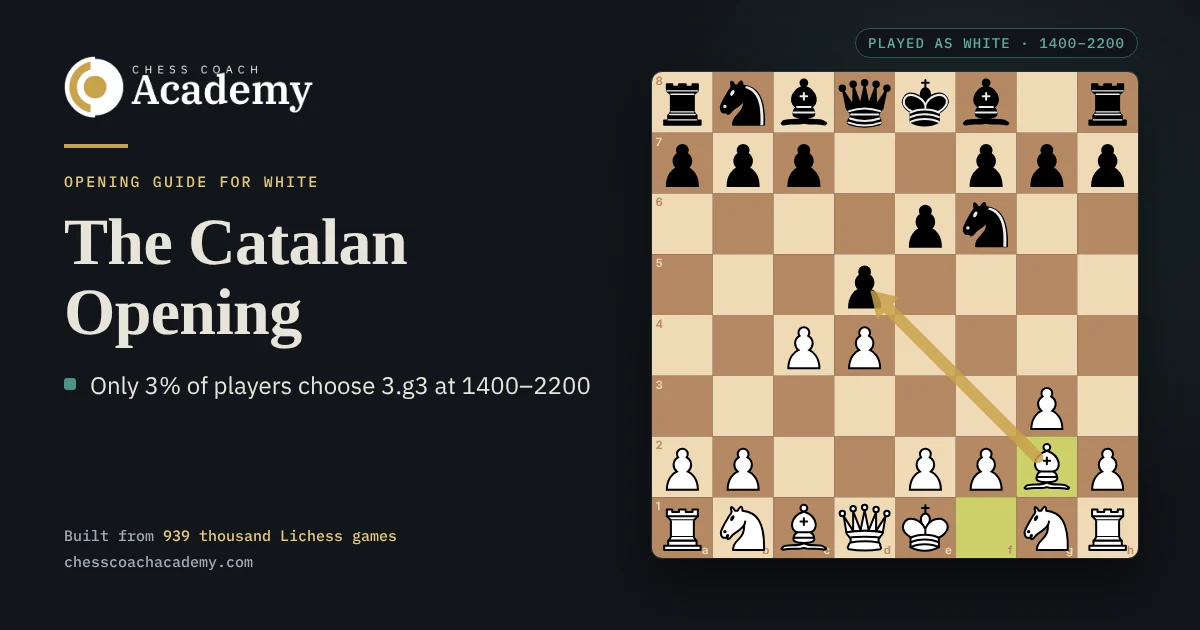
Built from 939 thousand Lichess games played by 1400 to 2200 rated players You play White, 17 practice lines, every move of yours checked by Stockfish Most common line 1. d4 Nf6 2. c4 e6 3. g3 d5 4. Bg2 c6 5. Nf3 Be7 6. O-O O-O 7. Qc2 Replies to 4.Bg2 4...c6 26% · 4...Be7 22% · 4...Bb4+ 13% Worth knowing After 3.g3, Black answers 3...d5 in 49% of games, 3...Bb4+ in 22% and 3...c5 in 12%. After 3...d5, White wins 52% of games and loses 42%.
The Catalan starts 1.d4 Nf6 2.c4 e6 3.g3. Your light-squared bishop goes to g2, where it looks down the long diagonal at d5, b7 and a8. Then you play Nf3, castle, and often Qc2. The setup barely changes from game to game, and your king is safe early.
This guide is built from about 939,000 Lichess games between 1400 and 2200 rated players. At that level only 3% of players choose 3.g3, while two thirds go for 3.Nc3. That's good news for you: most opponents know the Catalan from its name, not from experience. The one thing you must know well is how to get the c4 pawn back when Black takes it, and what to do when Black tries to hold on to it with ...b5.
1. d4 Nf6 2. c4 e6 3. g3 d5 4. Bg2
Practice the Catalan Opening free →Who it's for
Positional players rated roughly 1400 to 2200 who like safe kings and slow pressure. You don't need to memorize long forcing lines, because the same moves (g3, Bg2, Nf3, castle, Qc2) come up almost every game.
It asks for patience. Most lines end level or with a small edge, and you win by squeezing, not by trapping. If you prefer quick attacks, look elsewhere. If you enjoy grinding in the middlegame with a bishop that never stops pressing, this fits.
Why it works at 1400 to 2200
- Your bishop on g2 works all game. When Black takes on c4, the long diagonal opens and it aims straight at b7 and a8.
- The routine is simple. Bishop to g2, knight to f3, castle, queen to c2, then look for e4. Against 3...Bb4+ you block with Bd2 and carry on.
- It punishes greed. Black's attempts to keep the c4 pawn with ...b5 tend to open the diagonal toward the a8 rook, and Stockfish rates several of those positions clearly better for you.
- Solid setups with ...c6 and ...Be7 are hard to break down. Expect long games.
- You play a pawn down for a few moves in the Open Catalan. You need to know the recaptures with Qc2, Qa4 and a4, or Black gets to keep it.
- 3...c5 leads to a Benoni pawn structure, which feels different from the rest of the opening. You need to know the e4 plan there.
What 1400 to 2200 players actually play
Once your bishop reaches g2, Black has five real choices, and none of them dominates. The solid 4...c6 leads at 26%, the classical 4...Be7 follows at 22%, then 4...Bb4+ at 13% and both 4...c5 and 4...dxc4 at 12%. In other words, roughly one game in eight Black grabs c4 right away, and many more take it a move or two later. That's why the pawn recaptures get so much space below.
Three numbers from the data that shape this repertoire:
- At 1400-2200 on Lichess, only 3% of players choose 3.g3 after 1.d4 Nf6 2.c4 e6; 3.Nc3 is played 66% of the time.
- After 3.g3, Black answers 3...d5 in 49% of games, 3...Bb4+ in 22% and 3...c5 in 12%. After 3...d5, White wins 52% of games and loses 42%.
- In the Open Catalan after 4.Bg2 Be7 5.Nf3 O-O 6.O-O dxc4 7.Qc2, 45% of players answer 7...a6 and 17% try 7...b5 at once.
How to play the Catalan Opening: move by move
Every position below comes from the practice lines. The arrows on each board show Black's most common replies at 1400 to 2200, labeled with how often each one is played in that exact position. Under each board you'll find why players choose the reply and the move you answer with.
After 1. d4 Nf6 2. c4 e6 3. g3
About half of players play 3...d5 and the rest mostly choose the check 3...Bb4+ or the push 3...c5. Each needs a slightly different start, but the bishop still ends up on g2.
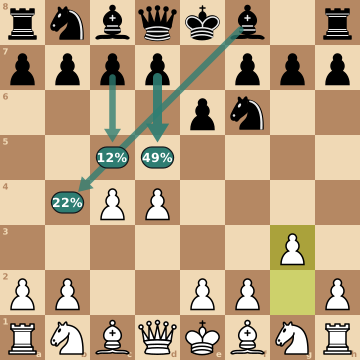
- 3...d5 (49%). d5 blocks your bishop's diagonal and holds the center, as in the Queen's Gambit Declined.
Your answer: 4. Bg2. The bishop takes its place on the long diagonal. - 3...Bb4+ (22%). Bb4+ develops a piece with check, so you have to answer it before doing anything else.
Your answer: 4. Bd2. Block with the bishop and challenge Black's bishop. - 3...c5 (12%). c5 challenges d4 at once.
Your answer: 4. d5. Push past the c5 pawn and grab space.
After 1. d4 Nf6 2. c4 e6 3. g3 d5 4. Bg2
Five replies, all between 12% and 26%. Against every one except the check, your next move is Nf3.
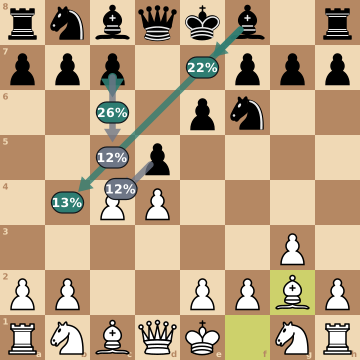
- 4...c6 (26%). c6 makes d5 rock-solid, but Black's c8 bishop is now stuck behind the pawns on e6 and d5.
Your answer: 5. Nf3. Develop and get ready to castle. - 4...Be7 (22%). Be7 is the classic, calm setup.
Your answer: 5. Nf3. Develop the knight and prepare castling. - 4...Bb4+ (13%). Bb4+ develops with check and invites a trade of bishops.
Your answer: 5. Bd2. Block the check and challenge the bishop. - 4...c5 (12%). c5 is an active try: Black attacks d4 and is happy to open the position.
Your answer: 5. Nf3. Defend d4 and get ready to castle. - 4...dxc4 (12%). dxc4 grabs the pawn early and opens the diagonal of your g2 bishop.
Your answer: 5. Nf3. Develop first. The pawn will come back.
After 1. d4 Nf6 2. c4 e6 3. g3 d5 4. Bg2 c6 5. Nf3
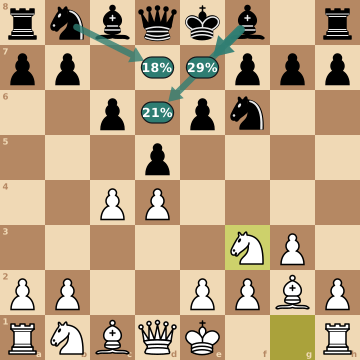
- 5...Be7 (29%). Be7 is quiet and safe. Black plans to castle next.
Your answer: 6. O-O. King to safety. - 5...Bd6 (21%). e5.
Your answer: 6. O-O. Castle and keep things calm. - 5...Nbd7 (18%). c5 and keeps the bishop's choice open.
Your answer: 6. O-O. Same plan: king safety first.
After 1. d4 Nf6 2. c4 e6 3. g3 d5 4. Bg2 Be7 5. Nf3 O-O 6. O-O
The fork in the road between the Closed Catalan (6...c6) and the Open Catalan (6...dxc4). Either way, your answer is 7.Qc2.
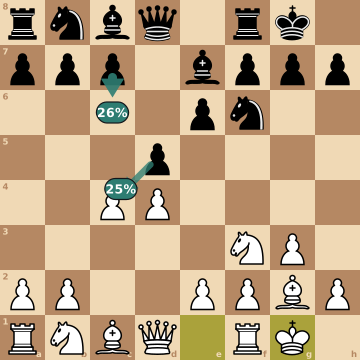
- 6...c6 (26%). c6 is solid and keeps the center closed.
Your answer: 7. Qc2. Protect c4 and prepare e4. - 6...dxc4 (25%). dxc4 wins a pawn for now, but it also opens the long diagonal for your g2 bishop.
Your answer: 7. Qc2. Attack c4 straight away.
After 1. d4 Nf6 2. c4 e6 3. g3 d5 4. Bg2 c5 5. Nf3
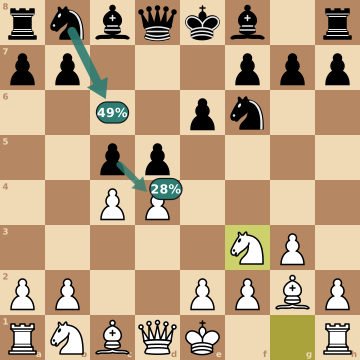
- 5...Nc6 (49%). Black now attacks d4 with the pawn and the knight.
Your answer: 6. O-O. Castle and let the tension stay. - 5...cxd4 (28%). You will win the pawn back with the knight.
Your answer: 6. O-O. Castle first, the d4 pawn isn't going anywhere.
After 1. d4 Nf6 2. c4 e6 3. g3 Bb4+ 4. Bd2
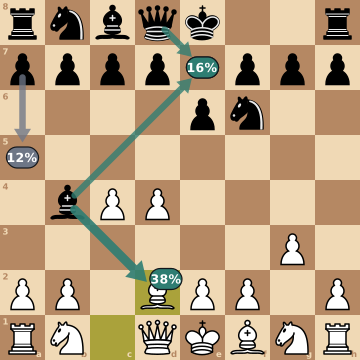
- 4...Bxd2+ (38%). It's simple, but Black has given up the bishop that was developed with check.
Your answer: 5. Qxd2. Recapture with the queen. - 4...Qe7 (25%). Qe7 keeps the b4 bishop protected.Bxb4, Black recaptures Qxb4 with check.
Your answer: 5. Bg2. Ignore the bishop and keep developing. - 4...Be7 (16%). Be7 looks like a lost move, but it has pulled your bishop to d2, where it's not very active.
Your answer: 5. Bg2. Continue with the normal Catalan setup. - 4...a5 (12%). a5 keeps the bishop on b4. If you take on b4, Black recaptures with the pawn.
Your answer: 5. Bg2. Keep developing.
After 1. d4 Nf6 2. c4 e6 3. g3 Bb4+ 4. Bd2 Bxd2+ 5. Qxd2
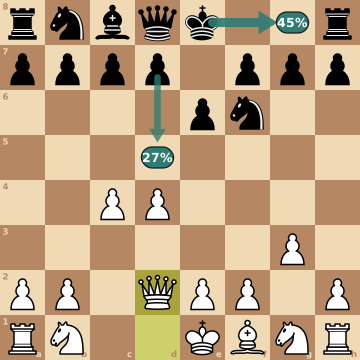
- 5...O-O (45%). Black gets the king safe before deciding on the center.
Your answer: 6. Bg2. The Catalan bishop comes to the long diagonal. - 5...d5 (27%). Black builds the center first.
Your answer: 6. Bg2. Same idea: bishop to the long diagonal.
After 1. d4 Nf6 2. c4 e6 3. g3 c5 4. d5
Pushing past gives you a Benoni pawn structure: space in the center for you, a queenside pawn majority for Black.
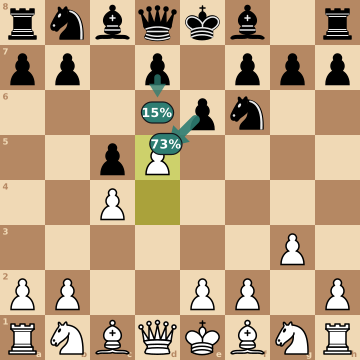
- 4...exd5 (73%). Black opens the e-file.
Your answer: 5. cxd5. Recapture, and you have a strong pawn on d5. - 4...d6 (15%). d6 keeps the tension and waits.
Your answer: 5. Bg2. Develop and support your d5 pawn.
After 1. d4 Nf6 2. c4 e6 3. g3 c5 4. d5 exd5 5. cxd5 d6 6. Bg2
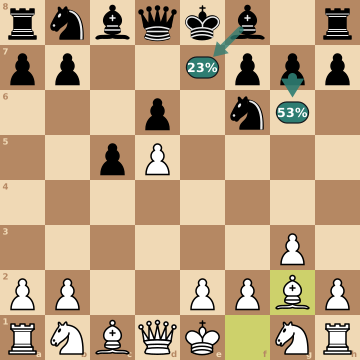
- 6...g6 (53%). g6 aims to put the bishop on g7, where it looks down the long diagonal toward your queenside.
Your answer: 7. Nf3. Develop and get ready to castle. - 6...Be7 (23%). Be7 is solid, but the bishop is less active than on g7.
Your answer: 7. Nf3. Develop and get ready to castle.
Your plan after the opening
Closed Catalan: Qc2, finish the queenside, then e4
Against ...c6 and ...Be7, put your queen on c2 to guard c4 and support e4. Then develop the queenside with b3 and Bb2 (or Nbd2), bring a rook to d1, and push e4 when it's ready. Black's c8 bishop has to take the long way round via ...b6 and ...Bb7, so there's no rush.
1. d4 Nf6 2. c4 e6 3. g3 d5 4. Bg2 c6 5. Nf3 Be7 6. O-O O-O 7. Qc2 b6 8. b3 Nbd7 9. Bb2 Bb7 10. Nc3
Open Catalan: Qc2, a4, then collect the pawn
After 6...dxc4, 7.Qc2 attacks the pawn at once. The usual reply at this level is 7...a6, getting ready for ...b5. Stop that with 8.a4, then take on c4 with the queen. You end up with free development and a bishop on an open diagonal.
1. d4 Nf6 2. c4 e6 3. g3 d5 4. Bg2 Be7 5. Nf3 O-O 6. O-O dxc4 7. Qc2 a6 8. a4
Against 3...Bb4+: block, trade, and play the same setup
Block with 4.Bd2. After the most common 4...Bxd2+, take back with the queen so your b1 knight can still go to c3. Then Bg2, Nf3, castle and a rook to c1 or d1. With the dark-squared bishops gone the game is calm, and your g2 bishop gives you the easier position. If Black defends the b4 bishop with 4...Qe7 or 4...a5, don't take it; just play Bg2.
1. d4 Nf6 2. c4 e6 3. g3 Bb4+ 4. Bd2 Bxd2+ 5. Qxd2 O-O 6. Bg2 d5 7. Nf3 c6 8. O-O Nbd7 9. Rc1
Against 3...c5: push to d5 and prepare e4
Play 4.d5, and after 4...exd5 5.cxd5 you have a Benoni structure. Your bishop on g2 protects d5, the knight goes to c3, and your plan is e4 (with Re1 or Nd2 to support it), later e5 to open lines. Black will look for ...a6 and ...b5 on the queenside, or ...Re8 against your e-pawn.
1. d4 Nf6 2. c4 e6 3. g3 c5 4. d5 exd5 5. cxd5 d6 6. Bg2 g6 7. Nf3 Bg7 8. O-O O-O 9. Nc3
Traps and common mistakes
Black holding on to c4 with ...b5 and ...c6
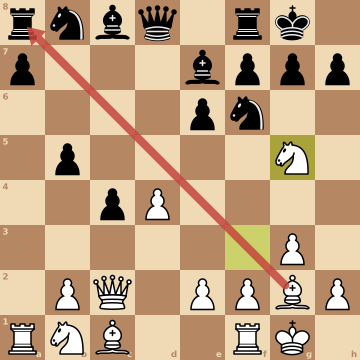
1. d4 Nf6 2. c4 e6 3. g3 d5 4. Bg2 Be7 5. Nf3 O-O 6. O-O dxc4 7. Qc2 b5 8. a4 c6? 9. axb5 cxb5 10. Ng5!
When Black defends the c4 pawn with ...b5, hit it with 8.a4. If Black props it up with 8...c6?, the pawns trade on b5 and the long diagonal is suddenly empty. 10.Ng5! moves the knight out of the way, and your g2 bishop attacks the rook on a8. Stockfish rates you almost two pawns better.
The same idea works earlier: after 4...dxc4 5.Nf3 b5?, play 6.Ne5! and the bishop again sees all the way to a8.
Missing the Qa4 pin
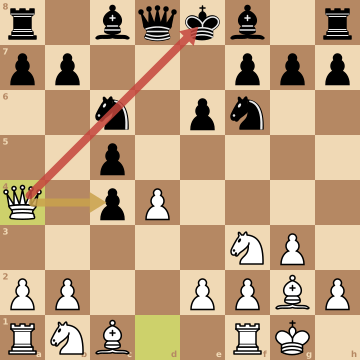
1. d4 Nf6 2. c4 e6 3. g3 d5 4. Bg2 c5 5. Nf3 Nc6 6. O-O dxc4 7. Qa4 Bd7 8. Qxc4
When Black has a knight on c6 and nothing on d7, Qa4 does two jobs. It attacks the pawn on c4, and it pins the c6 knight to Black's king. Black has to spend a move breaking the pin, and you take back the pawn with a nice position.
The same trick works after 4...dxc4 5.Nf3 Nc6: 6.Qa4 hits c4 and pins the knight.
Panicking about the missing pawn
After ...dxc4 you're only a pawn down for a few moves. Don't push pawns nervously to get it back. Develop, castle, and use Qc2, Qa4, Ne5 or a knight on d2 or a3 to win it back. In the ...c6 and ...Bd6 line, if Black takes on c4 after you castle, 7.Ne5 or 7.a4 wins the pawn back and Stockfish rates you about a pawn better.
Taking on b4 when Black wants you to
1. d4 Nf6 2. c4 e6 3. g3 Bb4+ 4. Bd2 Qe7 5. Bg2
After 3...Bb4+ 4.Bd2, a quarter of players defend the bishop with 4...Qe7. Taking with 5.Bxb4 lets the queen recapture with check, which helps Black. Play 5.Bg2 instead and let Black decide what to do with the bishop. The same goes for 4...a5: developing is better than trading.
Frequently asked questions
Is the Catalan Opening good for club players?
Yes, for players from about 1400 to 2200 who like calm, strategic games. The setup is the same almost every game, and few opponents at this level have faced it. It's less suited to players who want quick tactical wins.
What is the most common reply to the Catalan?
At 1400 to 2200 on Lichess, Black answers 3.g3 with 3...d5 in 49% of games, 3...Bb4+ in 22% and 3...c5 in 12%. After 3...d5 4.Bg2, the most popular move is the solid 4...c6.
How do I win back the c4 pawn in the Open Catalan?
Usually with the queen. Qc2 or Qa4 attacks the pawn, and if Black plays ...a6 to prepare ...b5, answer with a4 first. With a knight on c6 and d7 empty, Qa4 also pins the knight to the king.
What's the difference between the Open and Closed Catalan?
In the Open Catalan Black takes on c4 with ...dxc4 and you win the pawn back. In the Closed Catalan Black keeps the pawn on d5, usually with ...c6 and ...Be7, and you play for e4. In this guide you answer both with Qc2.
What should White play against 3...Bb4+ in the Catalan?
Block with 4.Bd2, the most common answer at this level. If Black trades on d2, take back with the queen. If Black defends the bishop with ...Qe7 or ...a5, ignore it and play Bg2, Nf3 and castle.
Keep learning
- All 36 opening guides: every opening on the site, grouped by what you play as White and Black.
- Is the Catalan Opening good for club players?: What the Catalan asks of you, and who should wait before taking it up.
- Best chess openings by rating: Where the Catalan fits among 36 openings grouped by rating.
The Coach plays Black against you with the moves 1400 to 2200 players actually choose after 3.g3, including the Open Catalan pawn grab, and explains every move in plain English. Progress tracking is free during the open beta.
Practice the Catalan Opening free →