Is the Catalan Opening Good for Club Players?
TL;DR
Short answer Yes, for club players from around 1400 who like slow pressure and don't mind playing a pawn down for a few moves. If you want early tactics, or you're below 1400, a simpler 1.d4 system will serve you better for now. Games behind this article About 940,000 Lichess games at 1400 to 2200 How rare it is Only 3% of players at this level choose 3.g3 after 1.d4 Nf6 2.c4 e6. 3.Nc3 is played 66% of the time. Black's reply to 3.g3 3...d5 49.3% · 3...Bb4+ 22.0% · 3...c5 12.2% Black's 4th move after 3...d5 4.Bg2 4...c6 26.1% · 4...Be7 22.0% · 4...Bb4+ 12.8% · 4...c5 12.3% · 4...dxc4 11.5% Lichess results 1400 to 2200 on Lichess: after 3...d5, White wins 52% of games and loses 42% Recommended range 1400 to 2200 Elo in our library, 17 lines
What the Catalan is
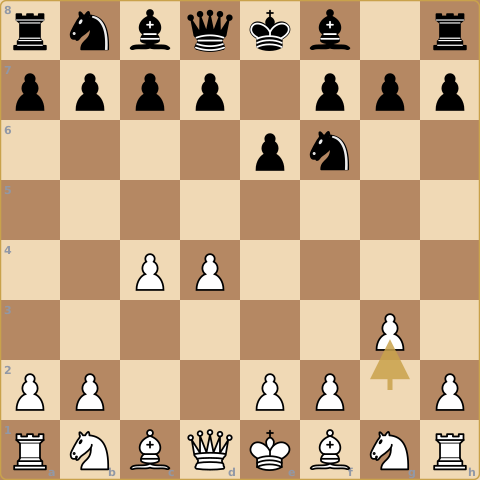
The Catalan mixes two ideas. White has the usual Queen's Gambit center with pawns on d4 and c4, and adds a bishop on g2 that aims down the long diagonal at b7 and a8. That bishop is the whole opening. It doesn't win anything quickly, but it makes Black's queenside awkward to develop, often deep into the middlegame.
The opening was created for the 1929 Barcelona tournament, and it has been used at the very top ever since. Vladimir Kramnik and Viswanathan Anand both played it in World Championship matches. So the question isn't whether the Catalan is sound. It's whether it suits the way you play right now.
What it asks of a club player
Most club games are decided by tactics. The Catalan aims for slow, lasting pressure rather than a quick attack. That's great if you enjoy squeezing, and frustrating if you want to be hunting the king by move 15. It also asks you to be comfortable a pawn down for a while, because in the Open Catalan White doesn't rush to win back the c4 pawn.
The good news is that the setup is almost always the same: g3, Bg2, Nf3, castle, and often Qc2. Our full repertoire is 17 lines, and since so few players choose 3.g3, many opponents won't know it well.
Black's main reply: 3...d5
3...d5 is the most common choice at 49.3%. Our repertoire puts the bishop on g2 straight away, and Black picks between five main setups.
After 4...Be7 (22.0%), Black castles in 73.9% of games, and White castles too. Now Black chooses: keep the center closed with 6...c6 (26.4%) or grab the pawn with 6...dxc4 (25.3%).
The Open Catalan: 6...dxc4
7.Qc2 attacks the c4 pawn straight away. At this level, 45% of players answer 7...a6, preparing ...b5 to keep it, and 17% try 7...b5 at once. The classic continuation against 7...a6 shows what White is after:
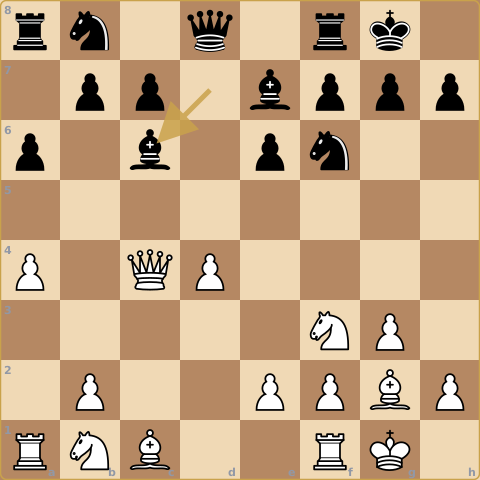
8.a4 makes ...b5 much harder, White collects the pawn, and Black's bishop goes to c6 to block the long diagonal. That tug of war with the g2 bishop is what the Open Catalan is about.
Holding on to the pawn with ...b5 is where Black goes wrong at club level. After 7...b5 8.a4 c6? 9.axb5 cxb5 10.Ng5!, the knight moves out of the way and the g2 bishop attacks the rook on a8.
The Closed Catalan: ...c6
The most common fourth move of all is 4...c6 (26.1%), and 6...c6 in the Be7 line reaches similar positions. Black makes d5 rock solid, but the c8 bishop is stuck behind the pawns on e6 and d5. White castles and plays Qc2, which guards c4 and prepares e2-e4, the main plan for gaining space. These positions are slow, and the plans matter more than the move order.
One trap to know: after 4...c6 5.Nf3 Bd6 6.O-O, grabbing the pawn with 6...dxc4?! lets White win it back with 7.Ne5 or 7.a4, and Stockfish rates White about a pawn better.
The other replies: 3...Bb4+ and 3...c5
3...Bb4+ (22.0%) is a check, and White blocks with 4.Bd2 in 71% of games. Black trades with 4...Bxd2+ (38.0%), keeps the tension with 4...Qe7 (24.5%), drops back with 4...Be7 (15.6%), or supports the bishop with 4...a5 (12.1%).
Against 4...Qe7 there's no need to take on b4: if 5.Bxb4 Qxb4+, Black's queen recaptures with check. White simply plays Bg2, Nf3 and castles.
3...c5 (12.2%) hits the center from the side. White pushes past it with 4.d5, and after 4...exd5 (72.8%) 5.cxd5 the game turns into a Benoni structure where White's bishop is already heading for g2.
That's a more dynamic position than the rest of the Catalan. White has more space in the center and plans e2-e4, while Black looks for queenside play. Don't skip it just because it's less common.
Where club players go wrong
The first mistake is panicking about the c4 pawn. Qc2 or Qa4 attacks the pawn and Qxc4 wins it back, so keep developing instead of making nervous pawn moves.
The second is missing the pin on c6. When Black has a knight on c6 and the d7 square is empty, Qa4 attacks c4 and pins the knight to the king, for example after 4...c5 5.Nf3 Nc6 6.O-O dxc4 7.Qa4!.
One more practical point: the Catalan mostly comes up when Black plays ...e6. Against the King's Indian, the Grünfeld or the Slav, you'll need other lines.
The verdict
The Catalan is a good opening for club players who enjoy positional chess, and our library recommends it from 1400 to 2200 Elo. It gives you one clear long-term idea, the g2 bishop against Black's queenside, and a manageable number of lines.
If you're below 1400, or you want sharp early fights, start with something more direct and come back to the Catalan later. If you already like slow pressure and endgames, it's a 1.d4 weapon you can keep for years. The Lichess numbers back up the practical case too: after the main reply 3...d5, White wins 52% of games at 1400 to 2200 and loses 42%.
Frequently asked questions
Is the Catalan Opening good for club players?
Yes, for club players from around 1400 who enjoy positional play. It aims for slow, long-lasting pressure based on the bishop on g2 rather than quick tactics. Our library recommends it from 1400 to 2200 Elo, with a 17-line repertoire. Only 3% of players at that level choose 3.g3, so many opponents won't know it well.
What is the difference between the Open and Closed Catalan?
In the Open Catalan, Black takes on c4 with ...dxc4 and White regains the pawn later, usually with Qc2 or Qa4. In the Closed Catalan, Black keeps the pawn on d5 with ...c6 and plays a slower game. At 1400 to 2200 on Lichess, after 4.Bg2 Be7 5.Nf3 O-O 6.O-O, Black plays 6...c6 in 26.4% of games and 6...dxc4 in 25.3%.
How does White win back the pawn in the Open Catalan?
The main move is 7.Qc2, attacking c4, and Qxc4 usually follows. If Black plays 7...a6 to prepare ...b5, White can stop it with 8.a4. At 1400 to 2200 on Lichess, 45% of players answer 7.Qc2 with 7...a6 and 17% try 7...b5 at once.
Is the Catalan too theoretical for club players?
Not really. Black has three main replies to 3.g3 (3...d5, 3...Bb4+ and 3...c5), and White's setup is almost always the same: g3, Bg2, Nf3, castle and often Qc2. Understanding the long-diagonal pressure matters more than memorizing long lines.
Copy the lines (PGN)
Every line in this article in standard PGN, ready to paste into Lichess, Chess.com or any chess database.
[Event "Is the Catalan Opening Good for Club Players?: Open Catalan, 7.Qc2"]
[Site "chesscoachacademy.com"]
[Result "*"]

1. d4 Nf6 2. c4 e6 3. g3 d5 4. Bg2 Be7 5. Nf3 O-O 6. O-O dxc4 7. Qc2 a6 8. a4 Bd7 9. Qxc4 Bc6 *

[Event "Is the Catalan Opening Good for Club Players?: Closed Catalan with 4...c6"]
[Site "chesscoachacademy.com"]
[Result "*"]

1. d4 Nf6 2. c4 e6 3. g3 d5 4. Bg2 c6 5. Nf3 Be7 6. O-O O-O 7. Qc2 *

[Event "Is the Catalan Opening Good for Club Players?: 3...Bb4+ 4.Bd2 Bxd2+"]
[Site "chesscoachacademy.com"]
[Result "*"]

1. d4 Nf6 2. c4 e6 3. g3 Bb4+ 4. Bd2 Bxd2+ 5. Qxd2 O-O 6. Bg2 d5 7. Nf3 *

[Event "Is the Catalan Opening Good for Club Players?: 3...c5, Benoni structure"]
[Site "chesscoachacademy.com"]
[Result "*"]

1. d4 Nf6 2. c4 e6 3. g3 c5 4. d5 exd5 5. cxd5 d6 6. Bg2 g6 7. Nf3 Bg7 8. O-O O-O 9. Nc3 *
Keep reading
- Reliable 1.d4 Defenses for Black: How Black's main answers to 1.d4 compare, including the ...e6 setups the Catalan meets.
Practice the Catalan against Black's real replies
Our Catalan trainer covers 17 lines built from about 940,000 Lichess games at 1400 to 2200: the Open Catalan with Qc2, the Closed Catalan with ...c6, 4...Bb4+, 4...c5 and 4...dxc4, plus 3...Bb4+ and the Benoni-style 3...c5. You play White against the moves Black players really choose, every one of your moves is checked by Stockfish, and each move comes with a plain-English note.
It's free during the open beta, and once you sign up your progress on every line is tracked for free.
17 lines built from 940,000 Lichess games. Free during the open beta, with free progress tracking.
Practice the Catalan free →