The Yugoslav Attack vs the Dragon: What 1700 to 2400 Players Really Play
TL;DR: the data
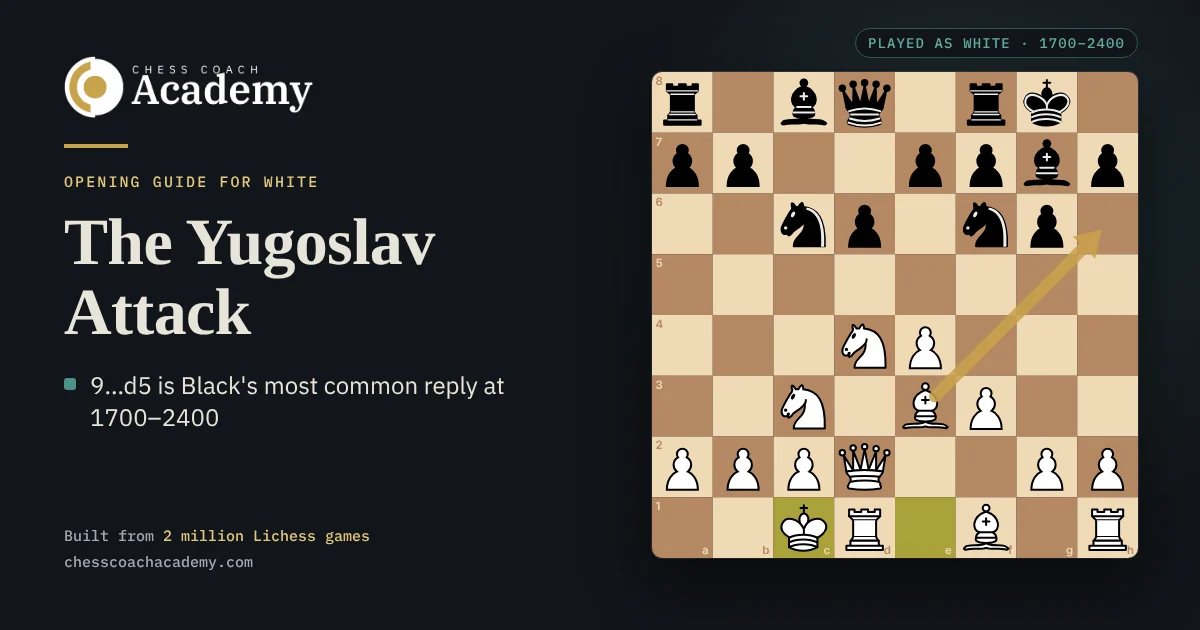
Built from 2 million Lichess games played by 1700 to 2400 rated players You play White, 10 practice lines, every move of yours checked by Stockfish Most common line 1. e4 c5 2. Nf3 d6 3. d4 cxd4 4. Nxd4 Nf6 5. Nc3 g6 6. Be3 Bg7 7. f3 O-O 8. Qd2 Nc6 9. O-O-O d5 10. exd5 Nxd5 11. Nxc6 bxc6 12. Bd4 Replies to 9.O-O-O 9...d5 35% · 9...Bd7 22% · 9...Nxd4 18% Worth knowing In the 9...d5 line, after 11.Nxc6 bxc6 half of White players grab a pawn with 12.Nxd5 and win only 36%; with 12.Bd4, White wins 47%.
The Yugoslav Attack is White's most direct answer to the Sicilian Dragon. You play Be3, f3, Qd2 and castle queenside, then throw your g- and h-pawns at Black's king while Black attacks yours on the other wing. The name comes from the Yugoslav players who worked out much of the plan.
Most guides teach it from games between masters. This one is built from 2 million Lichess games played by 1700 to 2400 rated players. The result is a shorter, more practical repertoire: one exact move order against the main counterattack 9...d5, and a simple attacking plan against everything slower.
1. e4 c5 2. Nf3 d6 3. d4 cxd4 4. Nxd4 Nf6 5. Nc3 g6 6. Be3 Bg7 7. f3 O-O 8. Qd2 Nc6 9. O-O-O
Practice the Sicilian Dragon: Yugoslav Attack free →Who it's for
Players rated roughly 1700 to 2400 who already play the Open Sicilian and want a clear plan when Black goes for the Dragon. You should be comfortable with opposite-side castling, where both players attack and the faster one usually wins.
It is not a lazy choice. The ideas are simple (king safety, pawn storm, trade the Dragon bishop), but the 9...d5 line needs an exact move order, and you have to calculate once the pawns start moving. If you want quiet positions against 1...c5, the Alapin is far less work.
Why it works at 1700 to 2400
- A plan you can remember: castle long, push g4 and h4, and trade the g7 bishop with Bh6 or Bd4. Once that bishop is gone, Black's king loses its best defender.
- Slow replies are punished hard. 9...Bd7 and 9...a6 give your pawns the time they need, and White wins 62% of games after 9...a6 at this level.
- Against the main counterattack 9...d5 you get a small, safe edge with 11.Nxc6 and 12.Bd4, and Black is left with a weak pawn on c6.
- Black's counterplay is real. The half-open c-file, ...Qa5 and the ...Rxc3 exchange sacrifice all aim at your king, so you cannot play on autopilot.
- The 9...d5 line punishes natural moves. Both 11.Nxd5 and 12.Nxd5 look good and throw away your advantage.
- This page covers only the Dragon. At this level just 23% of Black players choose 5...g6 after 5.Nc3, so you still need answers to the other Open Sicilian setups.
What 1700 to 2400 players actually play
Once you castle queenside, Black has to choose between fighting in the center and racing on the queenside. The center strike 9...d5 is the most common reply at 35%, and it's also the best. 9...Bd7 comes next at 22% and 9...Nxd4 at 18%. The slow 9...a6 shows up in 11% of games and is simply too slow: your pawns arrive first.
The numbers that matter most at 1700 to 2400:
- After 7.f3, Black castles in 76% of games at this level and plays 7...Nc6 in 17%; both lead to the same main positions.
- After 9.O-O-O, Black's most common replies are 9...d5 (35%), 9...Bd7 (22%), 9...Nxd4 (18%) and 9...a6 (11%). White wins 62% of games after 9...a6.
- In the 9...d5 line, after 11.Nxc6 bxc6 half of White players grab a pawn with 12.Nxd5 and win only 36%; with 12.Bd4, White wins 47%.
How to play the Sicilian Dragon: Yugoslav Attack: move by move
Each board below is a real decision point from the practice lines. The arrows show Black's most common replies at 1700 to 2400, labeled with how often each is played in that exact position. Under each board you'll find why players choose the move and the answer the Coach teaches.
After 1. e4 c5 2. Nf3 d6 3. d4 cxd4 4. Nxd4 Nf6 5. Nc3 g6 6. Be3 Bg7 7. f3
Whether Black castles first or plays ...Nc6 first, you answer with Qd2 and O-O-O. The move orders meet in the same position.
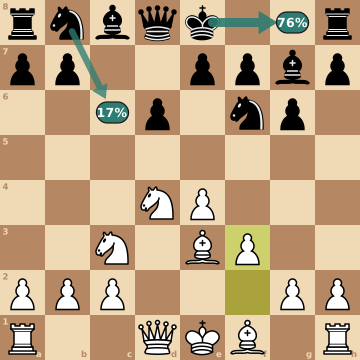
- 7...O-O (76%). Black's king is safe for now, but it sits right where your pawns are about to attack.
Your answer: 8. Qd2. Prepare to castle queenside and to play Bh6. - 7...Nc6 (17%). O-O.
Your answer: 8. Qd2. Same plan: queen to d2, then castle queenside.
After 1. e4 c5 2. Nf3 d6 3. d4 cxd4 4. Nxd4 Nf6 5. Nc3 g6 6. Be3 Bg7 7. f3 O-O 8. Qd2 Nc6 9. O-O-O
This is the main position of the Yugoslav Attack. Learn the 9...d5 move order by heart; against the other three replies, start your pawns moving at once.
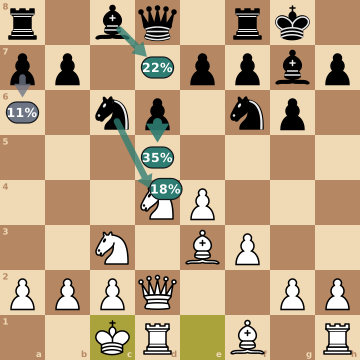
- 9...d5 (35%). Instead of waiting for your attack, Black opens lines toward your king and is happy to give up a pawn to do it.
Your answer: 10. exd5. Take the pawn. - 9...Bd7 (22%). It's playable, but it doesn't challenge the center, so your attack gets going first.
Your answer: 10. g4. Start the pawn storm. - 9...Nxd4 (18%). Black trades knights on d4.
Your answer: 10. Bxd4. Recapture with the bishop, facing the Dragon bishop. - 9...a6 (11%). a6? It doesn't challenge the center and doesn't develop, so your kingside attack arrives first.
Your answer: 10. g4. Start the storm right away.
After 1. e4 c5 2. Nf3 d6 3. d4 cxd4 4. Nxd4 Nf6 5. Nc3 g6 6. Be3 Bg7 7. f3 O-O 8. Qd2 Nc6 9. O-O-O Bd7 10. g4
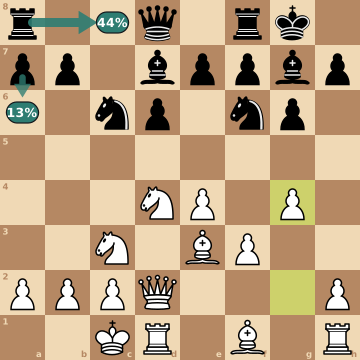
- 10...Rc8 (44%). Rxc3, giving the rook for your c3 knight to break open your king's pawns.
Your answer: 11. h4. Bring the h-pawn too. - 10...a6 (13%). a6?b4) just to hit your c3 knight, while your h-pawn will open lines in one or two.
Your answer: 11. h4. Keep the storm rolling.
After 1. e4 c5 2. Nf3 d6 3. d4 cxd4 4. Nxd4 Nf6 5. Nc3 g6 6. Be3 Bg7 7. f3 O-O 8. Qd2 Nc6 9. O-O-O Bd7 10. g4 Rc8 11. h4
Both replies here let you open a file on the kingside. Against ...h5 you take with the g-pawn and use the g-file; against ...Ne5 you push h5 straight away.
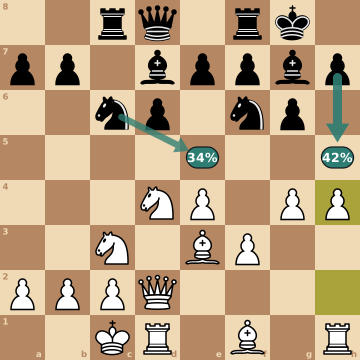
- 11...h5 (42%). Black blocks your h-pawn with h5.
Your answer: 12. gxh5. Open the g-file. - 11...Ne5 (34%). Stockfish rates you almost two pawns better after it.
Your answer: 12. h5. Attack g6 and get ready to open the h-file.
After 1. e4 c5 2. Nf3 d6 3. d4 cxd4 4. Nxd4 Nf6 5. Nc3 g6 6. Be3 Bg7 7. f3 Nc6 8. Qd2
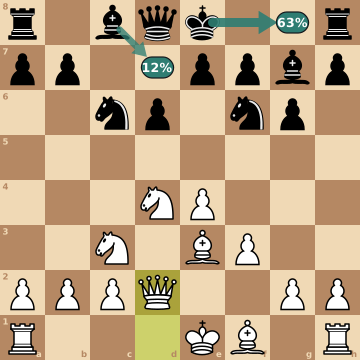
- 8...O-O (63%). O-O line, so the same plans apply.
Your answer: 9. O-O-O. Castle queenside.O-O line. - 8...Bd7 (12%). h5 to slow down your g4.
Your answer: 9. O-O-O. Castle anyway and keep your plans flexible.
After 1. e4 c5 2. Nf3 d6 3. d4 cxd4 4. Nxd4 Nf6 5. Nc3 g6 6. Be3 Bg7 7. f3 Nc6 8. Qd2 O-O 9. O-O-O
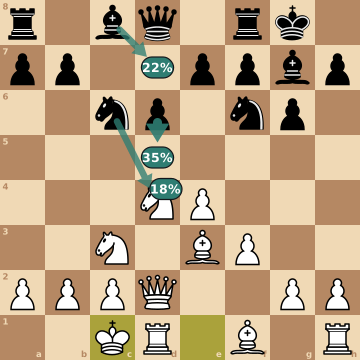
- 9...d5 (35%). O-O line, and your answer is the same too.
Your answer: 10. exd5. Take the pawn. - 9...Bd7 (22%). O-O-O Bd7. It's slow, so attack at once.
Your answer: 10. g4. Start the pawn storm. - 9...Nxd4 (18%). O-O line.
Your answer: 10. Bxd4. Recapture, facing the Dragon bishop.
Your plan after the opening
Against 9...d5: trade on c6, then offer the bishop trade
Take the pawn, and after 10...Nxd5 trade knights with 11.Nxc6 before anything else. Black has to recapture 11...bxc6, and then 12.Bd4 challenges the Dragon bishop. If Black trades, Qxd4 puts your queen in the center, hitting d5.
Black's most common answer is 12...e5, which blocks the g7 bishop with its own pawn. Play 13.Bc5, hitting the rook on f8. Your long-term target is the weak pawn on c6, and your king is safer than Black's.
1. e4 c5 2. Nf3 d6 3. d4 cxd4 4. Nxd4 Nf6 5. Nc3 g6 6. Be3 Bg7 7. f3 O-O 8. Qd2 Nc6 9. O-O-O d5 10. exd5 Nxd5 11. Nxc6 bxc6 12. Bd4 e5 13. Bc5
Against 9...Bd7: storm with g4 and h4
Black hasn't touched the center, so attack now. g4 prepares g5 to kick the f6 knight, the main defender of Black's king, and h4 prepares h5 to open the h-file for your rook.
If Black blocks with ...h5, take with the g-pawn and put a rook on g1. If Black plays ...Ne5 instead, push h5 at once. Keep an eye on ...Rxc3: the rook on c8 is there for a reason, and Kb1 is often a useful safety move before the storm lands.
1. e4 c5 2. Nf3 d6 3. d4 cxd4 4. Nxd4 Nf6 5. Nc3 g6 6. Be3 Bg7 7. f3 O-O 8. Qd2 Nc6 9. O-O-O Bd7 10. g4 Rc8 11. h4 h5 12. gxh5 Nxh5 13. Rg1
Against 9...Nxd4: king safety first, then the h-pawn
Recapture with the bishop. It now faces the Dragon bishop on the long diagonal, with only the f6 knight in between. After the usual 10...Be6, play 11.Kb1 to take your king off the c-file and guard a2. Then push the h-pawn: h4, h5 and h6 forces the g7 bishop to h8, where you can trade it with Bxh8.
1. e4 c5 2. Nf3 d6 3. d4 cxd4 4. Nxd4 Nf6 5. Nc3 g6 6. Be3 Bg7 7. f3 O-O 8. Qd2 Nc6 9. O-O-O Nxd4 10. Bxd4 Be6 11. Kb1 Qc7 12. h4
Traps and common mistakes
Taking on d5 with the knight (11.Nxd5?)
1. e4 c5 2. Nf3 d6 3. d4 cxd4 4. Nxd4 Nf6 5. Nc3 g6 6. Be3 Bg7 7. f3 O-O 8. Qd2 Nc6 9. O-O-O d5 10. exd5 Nxd5 11. Nxd5? Qxd5
It looks natural to trade on d5, but after 11...Qxd5 Black's queen hits your d4 knight and your a2 pawn at the same time, with the c6 knight and the g7 bishop joining in. You have to trade with 12.Nxc6 Qxc6, and the position is level.
Worse, 12.Nb3? runs into 12...Qe5!, which hits your e3 bishop and threatens mate on b2. Trade on c6 first with 11.Nxc6.
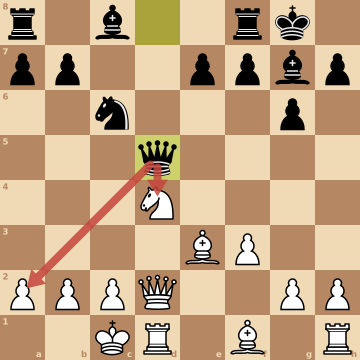
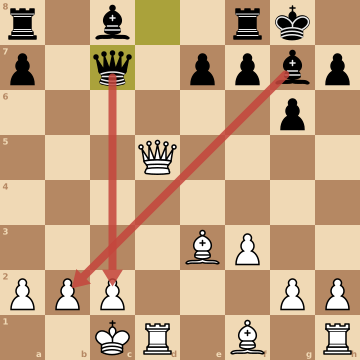
Grabbing the pawn with 12.Nxd5?
1. e4 c5 2. Nf3 d6 3. d4 cxd4 4. Nxd4 Nf6 5. Nc3 g6 6. Be3 Bg7 7. f3 O-O 8. Qd2 Nc6 9. O-O-O d5 10. exd5 Nxd5 11. Nxc6 bxc6 12. Nxd5? cxd5 13. Qxd5 Qc7
After 11...bxc6 the pawn on d5 looks free, and half of White players at this level take it. They win only 36% of those games, compared with 47% after 12.Bd4.
The reason is on the board. Once your c3 knight is gone, the g7 bishop sees all the way to b2, and after 13...Qc7 Black's queen and rooks use the open b- and c-files against your king. Stockfish calls it level. Play 12.Bd4 and keep your edge.
Taking on e5 with the bishop
1. e4 c5 2. Nf3 d6 3. d4 cxd4 4. Nxd4 Nf6 5. Nc3 g6 6. Be3 Bg7 7. f3 O-O 8. Qd2 Nc6 9. O-O-O d5 10. exd5 Nxd5 11. Nxc6 bxc6 12. Bd4 e5 13. Bc5!
After 12...e5 your bishop on d4 is attacked and the e5 pawn looks like a free capture. It isn't: 13.Bxe5? Bxe5 and you've given a bishop for a pawn. Move the bishop to 13.Bc5, where it hits the rook on f8 and keeps an eye on Black's dark squares.
Answering slow moves with slow moves
9...a6 prepares ...b5 and ...b4 against your c3 knight, but that needs two more pawn moves. White wins 62% of games after 9...a6 at this level, as long as White uses the time. Start with 10.g4 and follow with g5 and h4.
The same goes for 9...Bd7 10.g4 a6. Push 11.h4 at once. If Black plays ...h5 to stop your pawn, the Coach's line jumps 12.Nd5, attacking the f6 knight, Black's best defender.
Frequently asked questions
Is the Yugoslav Attack good for club players?
Yes, if you are comfortable with sharp positions. The plan is easy to remember (castle long, push g4 and h4, trade the Dragon bishop), and slow Black replies lose ground quickly. But the 9...d5 line needs an exact move order, so learn it before you play it at 1700 to 2400.
What is Black's most common reply to 9.O-O-O at club level?
At 1700 to 2400 on Lichess it's 9...d5 (35%), which opens the center at the cost of a pawn. Next come 9...Bd7 (22%), 9...Nxd4 (18%) and 9...a6 (11%).
Should I play 12.Nxd5 or 12.Bd4 in the 9...d5 line?
12.Bd4. Half of White players at this level take the pawn with 12.Nxd5 and win only 36%, while 12.Bd4 wins 47%. After 12.Nxd5 cxd5 13.Qxd5 Qc7 Black's play on the b- and c-files makes the game level.
What is the difference between 9.O-O-O and 9.Bc4 in the Yugoslav Attack?
Both are main moves. 9.O-O-O castles at once and lets Black strike with 9...d5, while 9.Bc4 stops ...d5 first and leads to a different system. This page covers 9.O-O-O.
Does it matter if Black plays 7...Nc6 before castling?
Usually not. At this level Black castles after 7.f3 in 76% of games and plays 7...Nc6 in 17%, and both lead to the same main positions. Keep playing Qd2 and O-O-O. If Black delays castling with 8...Bd7, castle anyway and keep your plans flexible.
Keep learning
- All 36 opening guides: every opening on the site, grouped by what you play as White and Black.
- How to Play Against the Sicilian Defense: All of White's options against 1...c5, from the Yugoslav Attack to the Alapin.
- Open Sicilian vs Alapin: Whether the Open Sicilian, and lines like this one, suit you better than 2.c3.
The Coach plays the Dragon against you with the moves 1700 to 2400 players actually choose, including 9...d5, 9...Bd7 and 9...Nxd4, and explains every move in plain English. Progress tracking is free during the open beta.
Practice the Sicilian Dragon: Yugoslav Attack free →