The English Opening: One Setup Against Everything, Built From 1000 to 2400 Games
TL;DR: the data
Built from 147 million Lichess games played by 1000 to 2400 rated players You play White, 18 practice lines, every move of yours checked by Stockfish Most common line 1. c4 e5 2. Nc3 Nf6 3. g3 d5 4. cxd5 Nxd5 5. Bg2 Replies to 1.c4 1...e5 34% · 1...Nf6 17% · 1...c5 11% Worth knowing After 1.c4 e5 2.Nc3 Nf6 3.g3 Bc5 4.Bg2, 12% of players try 4...Ng4, and White wins 61% of those games.
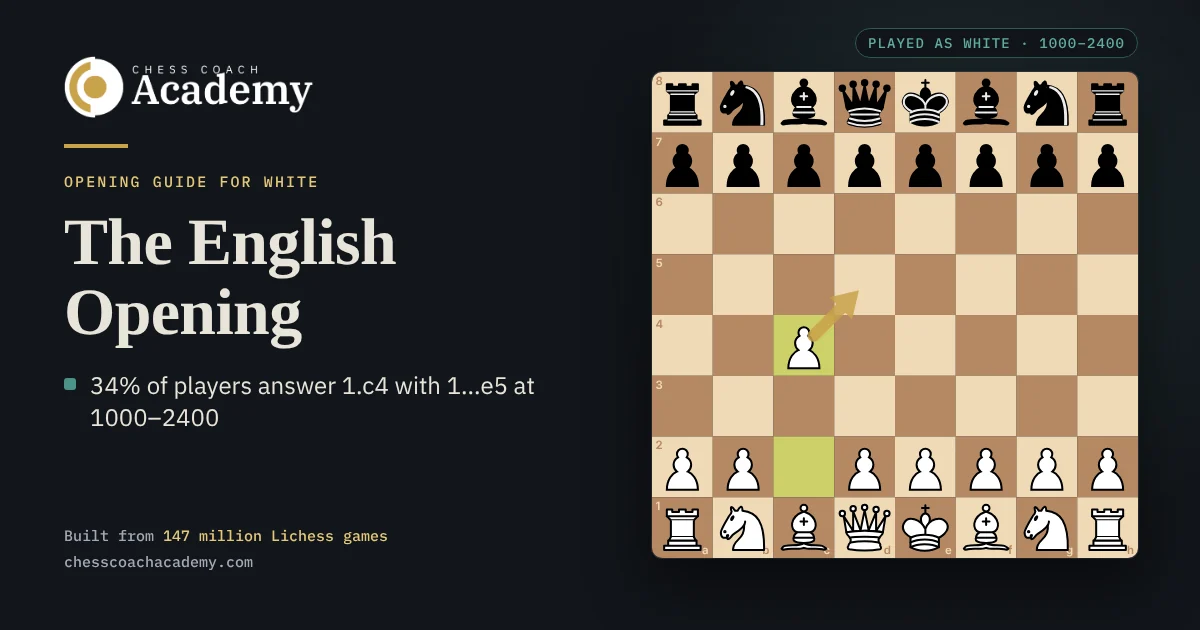
The English Opening starts 1.c4. Instead of putting a pawn in the middle, you control the d5 square from the side. Then you play one setup against almost anything: Nc3, g3 and Bg2, followed by Nf3 or e3, d3 and castling. Your knight, your c-pawn and your bishop all aim at d5.
This guide is built from 147 million Lichess games between 1000 and 2400 rated players. The data shows why the English is so easy to carry around: six different first replies each appear in at least 6% of games, and against five of them your next move is the same, 2.Nc3. The work is in knowing the few moments where autopilot costs you, like a Black bishop on c5 aiming at f2, or a pawn on d5 that asks you to switch to d4.
1. c4 e5 2. Nc3 Nf6 3. g3 d5 4. cxd5 Nxd5 5. Bg2
Practice the English Opening free →Who it's for
Players from about 1000 to 2400 who want one flexible plan instead of a lot of forcing theory. The same few moves come up in nearly every game, and different move orders often land in exactly the same position.
It suits patient players. Your king is safe behind the fianchetto, and it's hard to get blown off the board, but most lines are level after the opening. If you want early knockouts, the English won't give you many. If you like outplaying people in the middlegame, it's a very good home.
Why it works at 1000 to 2400
- Very little to memorize. Nc3, g3 and Bg2 work against almost every reply, and the plans repeat: pressure on d5, then a3, Rb1 and b4 on the queenside.
- Against 1...e5 you're playing a Sicilian with the colors reversed and an extra move, which is a comfortable place to be.
- Some common replies are small mistakes. After 1...d5 2.cxd5 most players bring their queen out early, and you develop with gain of time.
- It's slow. Most lines end about level, so you win in the middlegame rather than with opening traps.
- Black's bishop on c5 and queen or knight can gang up on f2. You need to know when Bg2 is safe and when e3 comes first.
- Against ...e6 and ...d5 (or ...c6 and ...d5) the game turns into Queen's Gambit positions, and the timing of d4 matters.
What 1000 to 2400 players actually play
Black's first move is spread across six real options. 1...e5 leads at 34%, then 1...Nf6 at 17%, 1...c5 at 11% and 1...e6 at 10%. The two ...d5 ideas, 1...d5 and 1...c6, make up the rest of the common replies. Only one of the six changes your second move: against 1...d5 you simply take the pawn.
Three numbers from the data worth keeping in mind:
- After 1.c4, 1000-2400 rated players on Lichess answer 1...e5 in 34% of games, 1...Nf6 in 17%, 1...c5 in 11% and 1...e6 in 10%.
- After 1.c4 e5 2.Nc3 Nf6 3.g3 Bc5 4.Bg2, 12% of players try 4...Ng4, and White wins 61% of those games.
- After 1.c4 d5 2.cxd5, 80% of players recapture with the queen, and White wins 55% of games after 2...Qxd5.
How to play the English Opening: move by move
Every position below comes from the practice lines. The arrows on each board show Black's most common replies at 1000 to 2400, labeled with how often each one is played in that exact position. Under each board you'll find why players choose the reply and the move you answer with.
After 1. c4
Against five of these six replies you play 2.Nc3. The exception is 1...d5, where you take on d5 and make Black's queen come out.
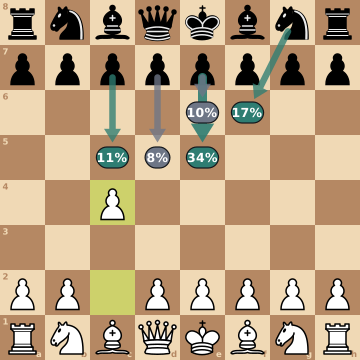
- 1...e5 (34%). It's like a Sicilian Defense with the colors reversed, and you are the side with the extra move.
Your answer: 2. Nc3. Develop and put a second piece on d5. - 1...Nf6 (17%). e6 setups for later.
Your answer: 2. Nc3. Your usual developing move, controlling d5 and e4. - 1...c5 (11%). Black copies you with c5, the Symmetrical English.
Your answer: 2. Nc3. Develop and control d5. - 1...e6 (10%). d5 in reserve.
Your answer: 2. Nc3. Develop and control d5. - 1...d5 (8%). Black offers a pawn trade in the center with d5.
Your answer: 2. cxd5. Take the pawn. - 1...c6 (6%). d5 with a pawn behind it.
Your answer: 2. Nc3. Develop and add control of d5.
After 1. c4 e5 2. Nc3
Black has six common moves here, but your answer to all of them is 3.g3. The one to watch is 2...Bc5, which aims at f2.
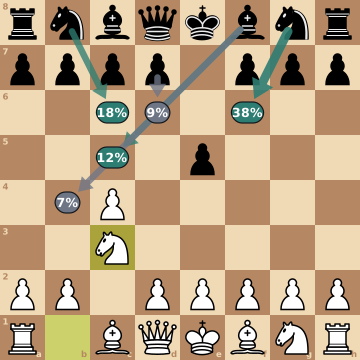
- 2...Nf6 (38%). Now it's time for your fianchetto.
Your answer: 3. g3. Make room for Bg2, the bishop that will sweep the long diagonal. - 2...Nc6 (18%). Your plan doesn't change: fianchetto first.
Your answer: 3. g3. Same plan: the bishop goes to g2 next. - 2...Bc5 (12%). Black's bishop and queen can team up against f2, so you need to watch that square.
Your answer: 3. g3. Qf6. - 2...d6 (9%). Black supports e5 with d6.
Your answer: 3. g3. Same setup: Bg2 comes next. - 2...Bb4 (7%). Black puts the bishop on b4 at once.
Your answer: 3. g3. Keep developing. Doubled pawns won't hurt you here. - 2...f5 (6%). Nf6 and control of e4. It also loosens Black's king position a little.
Your answer: 3. g3. Same plan as always.
After 1. c4 e5 2. Nc3 Nf6 3. g3
This is the main crossroads of the reversed Sicilian. Against 3...d5 you take on d5; against everything else you play Bg2. Against 3...Bc5, remember f2.
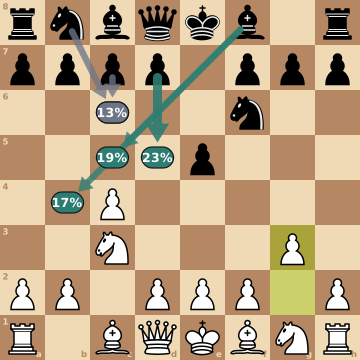
- 3...d5 (23%). Black wants a big center, but this is a Sicilian with the colors reversed, and you're a whole move up.
Your answer: 4. cxd5. Take the pawn, just like Black does in the Sicilian. - 3...Bc5 (19%). Black develops the bishop to c5, aiming at f2.
Your answer: 4. Bg2. Complete the fianchetto, and keep an eye on f2. - 3...Bb4 (17%). It isn't a pin: your d2 pawn still stands between the knight and your king.
Your answer: 4. Bg2. Bxc3. - 3...Nc6 (15%). Black develops the other knight to c6.
Your answer: 4. Bg2. Your bishop now looks straight down the long diagonal at the c6 knight. - 3...c6 (13%). d5 push, so that if you take on d5, Black can recapture with a pawn and keep a big center.
Your answer: 4. Bg2. d5 with d4.
After 1. c4 Nf6 2. Nc3
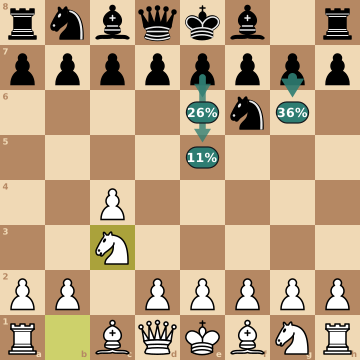
- 2...g6 (36%). Bg7, a King's Indian-style setup.
Your answer: 3. g3. Mirror it: your bishop goes to g2. - 2...e6 (26%). d5.
Your answer: 3. g3. Fianchetto, so your bishop can press on d5. - 2...e5 (11%). Nc3 Nf6 positions.
Your answer: 3. g3. g3.
After 1. c4 e6 2. Nc3
Once Black has played ...e6 and ...d5, switch to d4. You're now in a Queen's Gambit Declined.
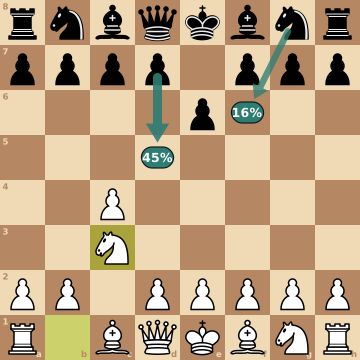
- 2...d5 (45%). Black takes the center with d5.
Your answer: 3. d4. Claim your share of the center. - 2...Nf6 (16%). d5 for later.
Your answer: 3. g3. The usual fianchetto.
Your plan after the opening
Against 1...e5: fianchetto, then expand on the queenside
Play Nc3, g3 and Bg2, then Nf3 or d3 and castle. When Black plays ...d5, take on d5 and hit the knight with Bg2, so your knight and bishop both attack it. After that, your typical plan is a3 and b4 to grab space on the queenside. That's where your extra move in this reversed Sicilian is most useful.
1. c4 e5 2. Nc3 Nf6 3. g3 d5 4. cxd5 Nxd5 5. Bg2 Nb6 6. d3 Be7 7. Be3 O-O 8. Nf3 Nc6 9. a3
Against 1...Nf6 and ...g6: mirror, then push b4
When Black fianchettoes too, both bishops point at the other side's queenside. Play Nf3 and d3, castle, and then go for a3, Rb1 and b4. Your c4 pawn and g2 bishop already point that way, so your pieces help the pawn push without any rearranging.
1. c4 Nf6 2. Nc3 g6 3. g3 Bg7 4. Bg2 O-O 5. Nf3 d6 6. d3 c5 7. O-O Nc6 8. Rb1 a6 9. a3
Against ...e6 and ...d5: switch to d4
After 1...e6 2.Nc3 d5, play 3.d4 and you're in a Queen's Gambit Declined. The simple plan is to take on d5, pin with Bg5, then e3, Bd3 and castle. Later, pushing your b-pawn to b4 and b5 to break up Black's queenside pawns is the standard plan in that structure (it's called the minority attack).
1. c4 e6 2. Nc3 d5 3. d4 Nf6 4. cxd5 exd5 5. Bg5 Be7 6. e3 h6 7. Bh4 O-O 8. Bd3
Against 1...c5: act first in a mirror position
In the Symmetrical English, both sides often end up with exactly the same setup. Moving first means you get to act first. Castle, then choose a break: b4 (after a3 or Rb1) on the queenside, or d4 in the center.
1. c4 c5 2. Nc3 Nc6 3. g3 g6 4. Bg2 Bg7 5. Nf3 d6 6. O-O Bg4 7. a3 Qd7 8. b4
Traps and common mistakes
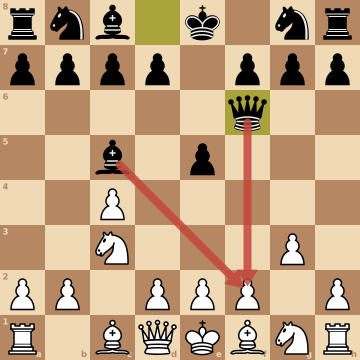
Playing Bg2 on autopilot against ...Bc5 and ...Qf6
1. c4 e5 2. Nc3 Bc5 3. g3 Qf6 4. Bg2?? Qxf2#
After 2...Bc5 3.g3, about one player in seven tries 3...Qf6. Now f2 is attacked by the queen and the bishop, and only your king defends it. The natural 4.Bg2?? loses on the spot: 4...Qxf2 is checkmate, because the c5 bishop protects the queen and your king has nowhere to go.
Block the bishop with 4.e3 or the queen with 4.Nf3 first. After 4.e3 Stockfish rates you almost a pawn better.
Ignoring ...Ng4 when Black's bishop is on c5
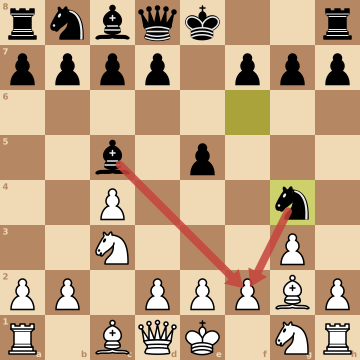
1. c4 e5 2. Nc3 Nf6 3. g3 Bc5 4. Bg2 Ng4 5. e3
The same target, a different attacker. After 3...Bc5 4.Bg2, 12% of players try 4...Ng4, hitting f2 twice. If you ignore it, ...Nxf2 forks your queen and rook.
Answer with 5.e3, which blocks the bishop. Now the knight has made two moves for nothing. At 1000 to 2400, White wins 61% of the games where Black tries 4...Ng4.
Playing Bg2 before d4 when Black has a pawn on d5
1. c4 Nf6 2. Nc3 e6 3. g3 d5 4. cxd5 exd5 5. d4
After 4...exd5 Black's pawn stands on d5 with support. If you play the routine 5.Bg2, Black answers 5...d4!, kicking your knight and grabbing space, and Stockfish then prefers Black. Play 5.d4 first to keep that pawn on d5, where your pieces can pressure it.
Swapping on d5 too early after ...c6
1. c4 e5 2. Nc3 Nf6 3. g3 c6 4. Bg2 d5 5. d4
When Black prepares ...d5 with ...c6, taking on d5 just lets Black recapture with the c-pawn and keep a big pawn center. Stockfish prefers 5.d4, striking at e5 before Black's center settles.
Frequently asked questions
Is the English Opening good for beginners?
It works well from about 1000 upward if you like calm positions. The setup is almost the same every game, so there's little to memorize. Just learn the two f2 traps with ...Bc5, because those are where beginners lose quickly.
What is the most common reply to 1.c4?
At 1000 to 2400 on Lichess, it's 1...e5 in 34% of games. Next come 1...Nf6 at 17%, 1...c5 at 11% and 1...e6 at 10%.
What should White play against 1...d5 in the English?
Take with 2.cxd5. At this level 80% of players recapture with the queen, and White wins 55% of games after 2...Qxd5. Develop with 3.Nc3, attacking the queen, and after it retreats, take the center with d4.
Is the English Opening a reversed Sicilian?
Against 1...e5, yes. The pawn structure is a Sicilian with the colors reversed, and you're the side with the extra move. That's why your plans (pressure on d5, then queenside expansion) look like Black's plans in the Sicilian.
When should I play d4 in the English?
When Black has built a ...d5 center with ...e6 or ...c6 behind it. Against 1...e6 2.Nc3 d5, 3.d4 turns the game into a Queen's Gambit Declined. Against 1...e5 lines with ...c6 and ...d5, 5.d4 hits e5 before Black's center settles.
Keep learning
- All 36 opening guides: every opening on the site, grouped by what you play as White and Black.
- Is 1.c4 good for beginners?: What makes the English easy, what makes it hard, and the simplest setup to learn.
- English vs Réti: 1.c4 or 1.Nf3: how the two flank openings compare and who each one suits.
The Coach plays Black against you with the moves 1000 to 2400 players actually choose after 1.c4, including the ...Bc5 tricks against f2, and explains every move in plain English. Progress tracking is free during the open beta.
Practice the English Opening free →