Is 1.c4 (the English Opening) Good for Beginners?
TL;DR
Short answer Yes, from around 1000 Elo, if you're willing to learn plans instead of traps. If you're newer than that, an e4 opening will teach you more tactics first. Games behind this article About 147 million English Opening games on Lichess, played by 1000 to 2400 rated players Black's replies to 1.c4 1...e5 33.6% · 1...Nf6 17.2% · 1...c5 11.3% · 1...e6 10.1% White's usual second move 2.Nc3 against every common first reply except 1...d5, where White takes with 2.cxd5 Recommended range 1000 to 2400 Elo · 18 lines in our repertoire
The short version
The English is a sound, respected opening that works at every level. Kasparov used 1.c4 to win the final game of his 1987 World Championship match against Karpov, the win that let him keep his title. So it's not a question of whether 1.c4 is good. The question is whether it's good for you right now.
Our answer: it's a good fit from around 1000 Elo, which is where our recommended range starts. Below that, most games are decided by loose pieces and simple tactics, and an opening like the Italian teaches those patterns faster because the pieces meet early. The English tends to keep the pieces apart for longer.
What makes the English beginner-friendly
The biggest plus is that you can use one setup against almost everything. White's pieces go to the same squares move after move: c4, Nc3, g3, Bg2, Nf3 and castle.
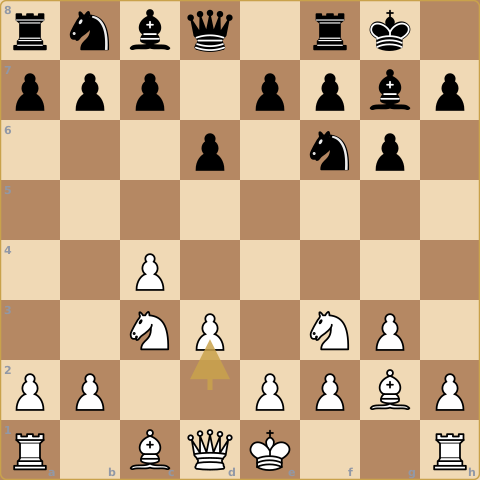
Our data backs this up. Among 1000 to 2400 rated players on Lichess, after 1...Nf6 2.Nc3 g6 3.g3, Black plays 3...Bg7 in 91.2% of games, and after 4.Bg2 Black castles in 64.6%. Both sides are building formations, so you aren't memorizing twenty different ideas. You're learning one setup and a few ways Black can react to it.
Other things that help a newer player:
- Few early traps. White isn't aiming at f7 and Black rarely gets quick shots at your king. There's one exception worth learning, around f2, which we cover below.
- A clear target. The c4 pawn, the c3 knight and the g2 bishop all aim at d5. When you're unsure what to do, asking "how does this help me control d5?" is usually a good start.
- Your king is safe. With g3, Bg2 and early castling, White's king is well covered in almost every line.
What makes it harder
The same features cut the other way. Because the pieces don't clash early, the English asks you to know what to do in the middlegame. If you don't have a plan, it's easy to shuffle pieces while your opponent takes over the center.
The other challenge is transpositions. Depending on what Black plays, an English can turn into something that looks like a King's Indian, a Queen's Gambit or a reversed Sicilian. Stronger players like this because they can steer the game. A beginner can find it confusing to arrive in a structure they've never seen.
That's why our English guide warns against playing Bg2 automatically when Black sets up with ...e6 and ...d5. After 1.c4 Nf6 2.Nc3 e6 3.g3 d5 4.cxd5 exd5, 5.Bg2?! runs into 5...d4, kicking your knight, so 5.d4 comes first. The setup is similar, but the plans aren't.
The one line to learn first: the Reversed Sicilian
If you only study one line, make it 1...e5, the most common reply at 33.6%. Our trainer answers with 2.Nc3, then fianchettoes with g3 and Bg2. After 2...Nf6 3.g3, the most common reply is 3...d5 (22.8%):
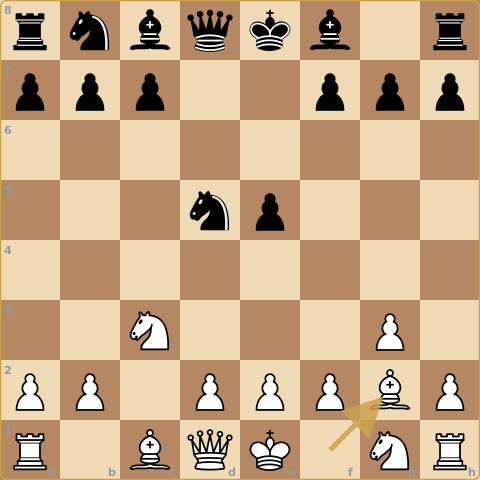
This is a Sicilian with the colors swapped, and White has an extra move. The knight on d5 is attacked by the c3 knight and the g2 bishop, so Black has to move it or defend it again. After that the plan is easy to remember: a3, then b4 (often with Rb1 first), gaining space on the queenside and pushing Black's knights around.
Along the way there's a trap to know. If Black puts the bishop on c5 and the queen on f6, both aim at f2:
Play 4.e3 or 4.Nf3 first. The same bishop backs up ...Ng4 ideas too. After 1.c4 e5 2.Nc3 Nf6 3.g3 Bc5 4.Bg2, 12% of players at 1000 to 2400 on Lichess try 4...Ng4, hitting f2 twice. Block the bishop with 5.e3. At this level, White wins 61% of the games where Black tries 4...Ng4.
Beginner mistakes to avoid
- Playing 1.c4 and then drifting. Pick a structure goal (the d5 square, the queenside push with b4) and make moves that serve it.
- Playing Bg2 on autopilot. Check f2 first whenever Black's bishop is on c5.
- Forgetting the extra tempo. In the Reversed Sicilian you're a move ahead of a normal Sicilian. Use it by starting your queenside play early.
- Ignoring the transposition. If the position starts to look like a King's Indian or a Queen's Gambit, think about the plans you know from those openings.
English or Réti for a beginner?
The Réti (1.Nf3 followed by c4) has a similar feel and the same recommended starting point of 1000 Elo. The main practical difference is that 1.Nf3 avoids 1...e5. We compare the two in detail in our English vs Réti guide.
Frequently asked questions
Is the English Opening good for beginners?
It's a good choice from around 1000 Elo. It uses one repeatable setup (c4, Nc3, g3, Bg2, Nf3, castle) and has few early traps. Complete beginners usually learn tactics faster with an e4 opening, because the English keeps the pieces apart longer and relies more on middlegame plans.
What is the easiest way to play the English Opening?
Use the same setup against almost everything: 1.c4, then Nc3, g3, Bg2, Nf3 and castle kingside. Our trainer plays 2.Nc3 against almost every first reply, including the two most common among 1000 to 2400 rated players on Lichess, 1...e5 (33.6%) and 1...Nf6 (17.2%).
What should White do against 1...e5 in the English?
Our repertoire plays 2.Nc3 followed by g3 and Bg2. The position is a Sicilian with colors reversed and White a move ahead, so White expands on the queenside with a3, Rb1 and b4. Watch f2 when Black's bishop comes to c5: after 2...Bc5 3.g3 Qf6, 4.Bg2?? allows 4...Qxf2 checkmate.
Is the English Opening too passive?
No. It controls the center from the side, especially the d5 square, instead of occupying it with pawns right away. Kasparov used 1.c4 to win the final game of his 1987 World Championship match against Karpov. It's flexible, not passive, but it does require knowing middlegame plans.
Copy the lines (PGN)
Every line in this article in standard PGN, ready to paste into Lichess, Chess.com or any chess database.
[Event "Is 1.c4 (the English Opening) Good for Beginners?: English, basic setup vs ...g6"]
[Site "chesscoachacademy.com"]
[Result "*"]

1. c4 Nf6 2. Nc3 g6 3. g3 Bg7 4. Bg2 O-O 5. Nf3 d6 6. d3 *

[Event "Is 1.c4 (the English Opening) Good for Beginners?: English, Reversed Sicilian"]
[Site "chesscoachacademy.com"]
[Result "*"]

1. c4 e5 2. Nc3 Nf6 3. g3 d5 4. cxd5 Nxd5 5. Bg2 *

[Event "Is 1.c4 (the English Opening) Good for Beginners?: English, 4.Bg2?? trap"]
[Site "chesscoachacademy.com"]
[Result "*"]

1. c4 e5 2. Nc3 Bc5 3. g3 Qf6 4. Bg2 Qxf2# *

[Event "Is 1.c4 (the English Opening) Good for Beginners?: English, 4...Ng4 5.e3"]
[Site "chesscoachacademy.com"]
[Result "*"]

1. c4 e5 2. Nc3 Nf6 3. g3 Bc5 4. Bg2 Ng4 5. e3 *
Keep reading
- English vs Réti: Which Flank Opening Should You Play?: How 1.c4 compares with 1.Nf3, and how to play the Réti step by step.
Learn the English one line at a time
Our English trainer covers 18 lines built from what 1000 to 2400 rated players actually play on Lichess, starting with the setup above and the Reversed Sicilian. Every move has a plain-English note, so you learn the plan as well as the moves.
The trainer is free during the open beta, and your progress on every line is tracked for free once you sign up.
18 lines built from 147 million Lichess games. Free during the open beta, with free progress tracking.
Practice the English free →