English vs Réti: Which Flank Opening Should You Play?
TL;DR
Short answer Play the English (1. c4) if you're happy to face 1...e5 and like the Reversed Sicilian. Play the Réti (1. Nf3, then c4) if you'd rather keep ...e5 off the board and meet ...d5 by hitting it from the side. Games behind this article About 152 million Lichess games: English Opening (147 million, 1000 to 2400) and Réti Opening (4.8 million, 1000 to 2000) Black's replies to 1.c4 1...e5 33.6% · 1...Nf6 17.2% · 1...c5 11.3% · 1...e6 10.1% After 1.Nf3 d5 2.c4 2...dxc4 35.2% · 2...d4 20.1% · 2...c6 14.5% · 2...e6 11.6% · 2...Nf6 11.3% Recommended range English 1000 to 2400 Elo (18 lines). Réti 1000 to 2000 Elo (19 lines). Both openings usually lead to roughly level positions, and our guides for both say the game is won in the middlegame rather than with opening traps, so this comparison is about positions and plans.
The difference is one move order
The English and the Réti are close relatives. Both control the center from the side instead of planting a pawn on e4 or d4 straight away, and both often end up with the same pieces on the same squares. What separates them is which move Black is allowed to play first.
With 1.c4, White puts an early claim on d5. Black is free to answer 1...e5, and among 1000 to 2400 rated players on Lichess that's exactly what happens most often (33.6%). You then get a Sicilian with the colors reversed, and White has a move in hand.
With 1.Nf3, the knight covers e5, so 1...e5 simply drops a pawn to 2.Nxe5. Black usually takes the center with 1...d5 instead, and White hits that pawn from the side with 2.c4, the move our Réti trainer is built on.
The two openings also cross over. These two move orders reach the same position:
So the choice isn't permanent. Many players use 1.Nf3 precisely because it keeps the English available while avoiding the Reversed Sicilian.
How to play the English (1.c4)
The main test is 1...e5. Our repertoire answers with 2.Nc3, then g3 and Bg2. After 2.Nc3 Nf6 3.g3, Black's most common try is to strike in the center at once:
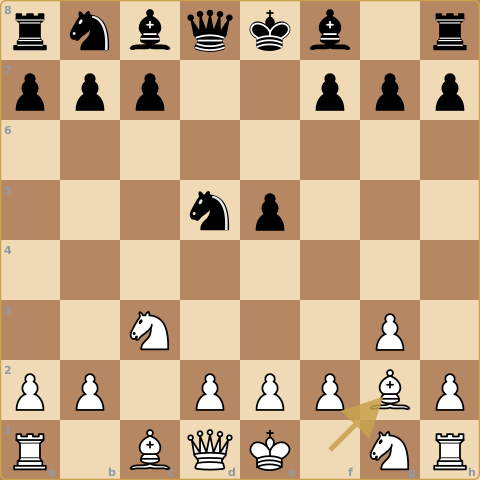
This is a Dragon Sicilian with the colors swapped. The knight on d5 is now attacked twice and defended only by the queen, so Black has to deal with it straight away. After that, White's plan is queenside expansion with a3, Rb1 and b4, while the bishop on g2 pressures the long diagonal.
One warning from our English guide: when Black's bishop is on c5, watch f2. Playing Bg2 on autopilot can lose on the spot:
Play 4.e3 or 4.Nf3 first. Against 1...Nf6 and 1...c5, the English is simpler: White develops with Nc3, g3 and Bg2. The common thread is control of d5: the c4 pawn, the c3 knight and the g2 bishop all aim at it. When Black sets up with ...e6 and ...d5, though, our repertoire switches to d4 and a Queen's Gambit style of development.
How do you play the Réti Opening (1.Nf3)?
The Réti is named after Richard Réti, one of the founders of the hypermodern school in the 1920s. The idea is to develop first and decide on a pawn center later. Against most replies White uses the same setup: g3, Bg2 and castling. Here it is against 2...d4, where Black grabs space:
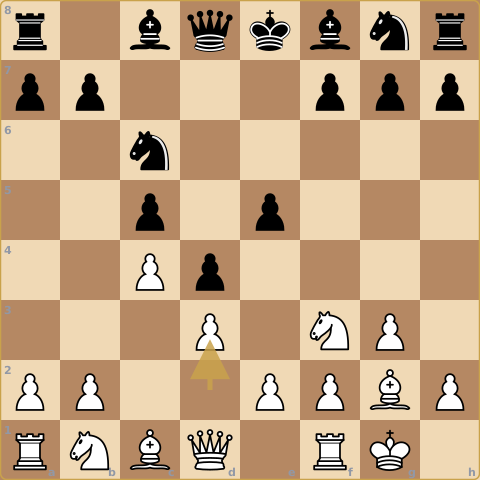
Black has a big pawn center, and White doesn't mind. With d3 in, a push to e4 would just lose a pawn, and White can prepare e3 or b4 to challenge Black's pawns later.
The most common reply at this level, though, is the Réti Gambit Accepted, 2...dxc4 (35.2%). White doesn't need to hurry. 3.e3 and Bxc4 regains the pawn calmly:
Trying to hold the pawn usually backfires. After 3...b5 4.a4, 70% of players at 1000 to 2000 on Lichess answer 4...c6, and White wins 65% of those games, because 5.axb5 cxb5 6.Nc3 wins the b5 pawn.
The other replies need their own answers:
- 2...c6 (14.5%): a Slav-style setup. White plays 3.g3 and Bg2 and castles.
- 2...e6 (11.6%): a Catalan-style setup. Again 3.g3 and Bg2.
- 2...Nf6 (11.3%): White takes with 3.cxd5, and after 3...Nxd5 plays 4.e4 to chase the knight.
Head to head
| What Black gets | English: the option of 1...e5 and a reversed Sicilian. Réti: no early ...e5, but free use of ...d5. |
| Typical setup | English: c4, Nc3, g3, Bg2 (d4 against ...e6 and ...d5). Réti: Nf3, c4, g3, Bg2 (e3 and Bxc4 against 2...dxc4). |
| Main strategic target | English: the d5 square. Réti: Black's d5 pawn and the long diagonal. |
| Our repertoire | English: 18 lines from 147 million Lichess games. Réti: 19 lines from 4.8 million. |
| Recommended range | English 1000 to 2400 Elo. Réti 1000 to 2000 Elo. |
Which should you play?
- Choose the English if you like having a clear structure to aim for. The Reversed Sicilian gives you a well-defined plan, and the same Nc3, g3, Bg2 setup works against most of Black's other replies.
- Choose the Réti if you'd rather not face 1...e5, you enjoy slow maneuvering, and you like a bishop on g2 raking the long diagonal.
- If you can't decide, start with 1.Nf3. It keeps both doors open, because 1...Nf6 2.c4 is an English anyway.
Both openings share the same weak spot for club players: they don't come with forcing lines, so you need to understand plans rather than memorize moves. If you're still fairly new to the game, read whether 1.c4 is good for beginners before committing.
Two other flank systems come up in the same conversations. The King's Indian Attack uses the Réti's Nf3, g3 and Bg2 but follows up with d3 and e4. And if you've wondered about the rarer first moves, we look at 1.b3 and 1.f4 separately.
Frequently asked questions
Is the Réti the same as the English Opening?
No, but they overlap. The English starts 1.c4 and the Réti starts 1.Nf3, usually followed by c4. After 1.Nf3 Nf6 2.c4 or 1.c4 Nf6 2.Nf3 you reach the same position. The key difference is that 1.c4 allows 1...e5, while 1.Nf3 does not.
How do you play the Réti Opening?
Start with 1.Nf3 and after 1...d5 play 2.c4. Against most replies, fianchetto with g3 and Bg2, castle kingside, and prepare a pawn break such as e3, b4 or d4. Against the Réti Gambit Accepted, 2...dxc4, the most common reply at 1000 to 2000 on Lichess (35.2%), play 3.e3 and win the pawn back with Bxc4.
What is Black's most common reply to the English Opening?
Among 1000 to 2400 rated players on Lichess, 1...e5 is the most common reply at 33.6%, followed by 1...Nf6 at 17.2%, 1...c5 at 11.3% and 1...e6 at 10.1%. After 1...e5 the position is a Sicilian with colors reversed, with White a move ahead.
Is the English or the Réti better for club players?
Neither is objectively better. The English gives a clearer structure to aim for, especially against 1...e5, and our repertoire recommends it from 1000 to 2400 Elo. The Réti avoids 1...e5 and suits patient, maneuvering players, with a recommended range of 1000 to 2000 Elo.
Copy the lines (PGN)
Every line in this article in standard PGN, ready to paste into Lichess, Chess.com or any chess database.
[Event "English vs Réti: Which Flank Opening Should You Play?: English, Reversed Sicilian"]
[Site "chesscoachacademy.com"]
[Result "*"]

1. c4 e5 2. Nc3 Nf6 3. g3 d5 4. cxd5 Nxd5 5. Bg2 *

[Event "English vs Réti: Which Flank Opening Should You Play?: English, 4.Bg2?? trap"]
[Site "chesscoachacademy.com"]
[Result "*"]

1. c4 e5 2. Nc3 Bc5 3. g3 Qf6 4. Bg2 Qxf2# *

[Event "English vs Réti: Which Flank Opening Should You Play?: Reti vs 2...d4"]
[Site "chesscoachacademy.com"]
[Result "*"]

1. Nf3 d5 2. c4 d4 3. g3 c5 4. Bg2 Nc6 5. O-O e5 6. d3 *

[Event "English vs Réti: Which Flank Opening Should You Play?: Reti Gambit, 3.e3"]
[Site "chesscoachacademy.com"]
[Result "*"]

1. Nf3 d5 2. c4 dxc4 3. e3 Nf6 4. Bxc4 e6 5. O-O *

[Event "English vs Réti: Which Flank Opening Should You Play?: Reti Gambit, 3...b5 4.a4 c6"]
[Site "chesscoachacademy.com"]
[Result "*"]

1. Nf3 d5 2. c4 dxc4 3. e3 b5 4. a4 c6 5. axb5 cxb5 6. Nc3 *
Keep reading
- Is 1.c4 (English Opening) Good for Beginners?: Who the English suits, the simplest setup to learn, and what to watch out for.
- The King's Indian Attack: Main Ideas: The Nf3, g3, d3, e4 system you can play against almost anything.
- Are 1.b3 and 1.f4 Actually Good?: The Nimzo-Larsen and Bird's Opening, plus From's Gambit, the trap every Bird player must know.
Play both before you choose
The fastest way to decide is to play a few lines of each. Our English trainer covers 18 lines against 1...e5, 1...Nf6, 1...c5, 1...e6, 1...d5 and 1...c6. The Réti trainer covers 19 lines against 2...dxc4, 2...d4, 2...c6, 2...e6 and 2...Nf6. Every move comes with a short note on why it's played.
Both trainers are free during the open beta, and your progress on each line is tracked for free when you sign up.
Lines built from what club players actually play on Lichess, with a plain-English note on every move. Free during the open beta, with free progress tracking.
Practice the English free →