Are Offbeat First Moves Like 1.b3 (Nimzo-Larsen) or 1.f4 (Bird's Opening) Actually Good?
TL;DR
Short answer Yes, both are sound enough to play at any club level. Neither gives White much of an edge against accurate defense, but both lead to fresh positions your opponent is unlikely to have studied. 1.b3 (Nimzo-Larsen) Fianchetto first. The bishop on b2 aims at e5 and down the long diagonal toward Black's kingside. 1.f4 (Bird's Opening) A reversed Dutch Defense. White grabs e5 and kingside space, but loosens the king. Biggest danger From's Gambit: 1. f4 e5. One natural-looking move by White loses to checkmate by move six. Our data We don't have datasets or trainers for 1.b3 or 1.f4, so there are no move percentages here. The closest trainer is the Dutch Defense (20 lines built from 16 million Lichess games at 1200 to 2000 Elo), with the Leningrad setup from the other side.
What makes a first move "offbeat"?
1.e4, 1.d4, 1.c4 and 1.Nf3 are the big four because they fight for the center or develop a piece straight away. 1.b3 and 1.f4 do something a little less direct. They're not bad moves. They just commit White to a particular setup very early, and they give Black a free choice of how to occupy the center.
The practical case for them is simple: your opponents will have studied far less against 1.b3 or 1.f4 than against 1.e4 or 1.d4.
1.b3: the Nimzo-Larsen Attack
Named after Aron Nimzowitsch and Bent Larsen, two strong players who championed it, 1.b3 prepares Bb2 at once. From b2 the bishop controls e5 and aims down the long diagonal toward g7 and h8.
The most direct answer is to take the center with 1...e5, which the bishop immediately attacks:
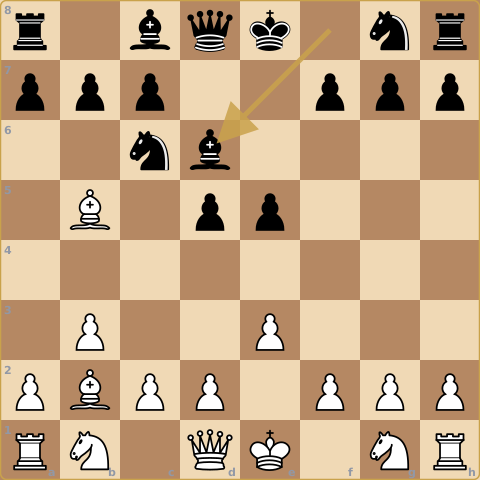
Black defends e5 with the knight, and White adds pressure with 4.Bb5, attacking the knight that guards e5. Black answers 4...Bd6 to defend e5 once more. White has given Black a big center, and the plan is to pressure it with pieces rather than challenge it with pawns right away. That's the hypermodern idea, the same one behind the Réti.
Against 1...d5 or 1...Nf6, White can go for a quieter double fianchetto with g3 and Bg2, or combine b3 with Nf3 and e3. Either way the positions are solid and flexible.
Verdict: sound and flexible. Black equalizes without much trouble by taking the center, but there's little forcing theory for White to learn and few ways to lose quickly.
1.f4: Bird's Opening
Bird's Opening is named after Henry Bird, a 19th-century English master. 1.f4 grabs the e5 square and kingside space. If you know the Dutch Defense (1.d4 f5), this is the same idea with colors reversed and White a move ahead.
White has two popular setups. One is a quiet setup with e3, b3 and Bb2, where the b2 bishop and the f4 pawn both aim at e5:
The other is a reversed Leningrad Dutch, with a kingside fianchetto:
In the Leningrad setup White often follows up with Qe1 and e4, the mirror of Black's ...Qe8 and ...e5 in the Leningrad Dutch. White can also build a reversed Stonewall with d4, e3 and f4, the same pawn chain Dutch players use as Black.
The cost of 1.f4 is king safety. The f-pawn has left f2, which opens the diagonal from h4 to e1. That weakness is what From's Gambit targets.
From's Gambit: the line every Bird player must know
Black's sharpest answer is to offer a pawn immediately:
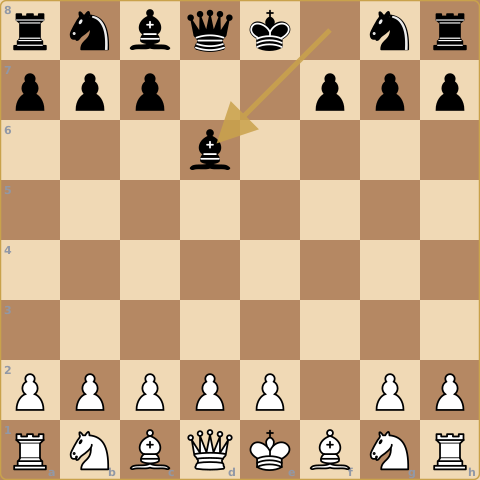
White is a pawn up, but Black's bishop on d6 now points at g3 and the queen is ready to jump to h4. If White plays a natural developing move that ignores the threat, the game ends quickly:
The queen check forces g3, the bishop takes on g3 with check, and after hxg3 the queen lands on g3 with mate. With the f-pawn gone, the queen covers f2 and the king has no escape.
The standard move is 4.Nf3, which covers h4. Black's main try is 4...g5, planning ...g4 to chase the knight away and renew the threat:
After 5.d4 the knight has the e5 square to land on when ...g4 kicks it. 5.g3 is also played. Both lead to sharp positions, and you need to know them before you play 1.f4 against anyone who knows From's Gambit.
If you'd rather avoid it altogether, you can answer 1...e5 with 2.e4, which turns the game into a King's Gambit. That's only a good idea if you're happy playing the King's Gambit, and our King's Gambit trainer is the place to check.
Verdict: 1.f4 is playable and gives White a clear kingside plan, but it's more committal than 1.b3. Learn From's Gambit before anything else.
So, should you play them?
- 1.b3 is a good surprise weapon for patient players who like pieces over pawns in the center. The risk of a quick loss is low.
- 1.f4 suits players who enjoy kingside play and already like the Dutch as Black. The risk is higher, mostly because of From's Gambit.
- If you want a flank opening with more backing and more structure, the English and the Réti are the more thoroughly tested choices. Our English vs Réti guide compares them.
Frequently asked questions
Is the Bird's Opening (1.f4) good?
Yes, 1.f4 is a sound opening that grabs the e5 square and kingside space, a Dutch Defense with colors reversed. Its main drawback is that it weakens White's king along the e1 to h4 diagonal, which Black can exploit with From's Gambit (1.f4 e5).
What is From's Gambit?
From's Gambit is 1.f4 e5 2.fxe5 d6 3.exd6 Bxd6. Black gives a pawn to open lines toward White's king and threatens ...Qh4+. White's standard reply is 4.Nf3. The natural 4.Nc3 loses to 4...Qh4+ 5.g3 Bxg3+ 6.hxg3 Qxg3 checkmate.
Is 1.b3 (the Nimzo-Larsen Attack) a good opening?
Yes. 1.b3 prepares Bb2, which controls e5 and the long diagonal. It's sound and flexible, with little forcing theory. Black can equalize by taking the center, for example with 1...e5 2.Bb2 Nc6 3.e3 d5 4.Bb5 Bd6, but the positions stay rich.
How do you avoid From's Gambit as White?
After 1.f4 e5 you can play 2.e4, which turns the game into a King's Gambit. That's only a good choice if you know and like the King's Gambit. Otherwise, accept with 2.fxe5 and learn the main line starting 4.Nf3.
Copy the lines (PGN)
Every line in this article in standard PGN, ready to paste into Lichess, Chess.com or any chess database.
[Event "Are Offbeat First Moves Like 1.b3 (Nimzo-Larsen) or 1.f4 (Bird's Opening) Actually Good?: Nimzo-Larsen, 1...e5"]
[Site "chesscoachacademy.com"]
[Result "*"]

1. b3 e5 2. Bb2 Nc6 3. e3 d5 4. Bb5 Bd6 *

[Event "Are Offbeat First Moves Like 1.b3 (Nimzo-Larsen) or 1.f4 (Bird's Opening) Actually Good?: Bird's Opening, b3 setup"]
[Site "chesscoachacademy.com"]
[Result "*"]

1. f4 d5 2. Nf3 Nf6 3. e3 g6 4. b3 Bg7 5. Bb2 O-O 6. Be2 *

[Event "Are Offbeat First Moves Like 1.b3 (Nimzo-Larsen) or 1.f4 (Bird's Opening) Actually Good?: Bird's Opening, Leningrad setup"]
[Site "chesscoachacademy.com"]
[Result "*"]

1. f4 d5 2. Nf3 Nf6 3. g3 g6 4. Bg2 Bg7 5. O-O O-O 6. d3 *

[Event "Are Offbeat First Moves Like 1.b3 (Nimzo-Larsen) or 1.f4 (Bird's Opening) Actually Good?: From's Gambit, 4.Nc3 trap"]
[Site "chesscoachacademy.com"]
[Result "*"]

1. f4 e5 2. fxe5 d6 3. exd6 Bxd6 4. Nc3 Qh4+ 5. g3 Bxg3+ 6. hxg3 Qxg3# *

[Event "Are Offbeat First Moves Like 1.b3 (Nimzo-Larsen) or 1.f4 (Bird's Opening) Actually Good?: From's Gambit, 4.Nf3 g5"]
[Site "chesscoachacademy.com"]
[Result "*"]

1. f4 e5 2. fxe5 d6 3. exd6 Bxd6 4. Nf3 g5 5. d4 g4 6. Ne5 *
Keep reading
- English vs Réti: Which Flank Opening Should You Play?: The two main flank openings compared, with how to play the Réti step by step.
Learn the structures from the other side
We don't have trainers for 1.b3 or 1.f4 yet. The closest match for Bird players is our Dutch Defense trainer: the Bird is a reversed Dutch, so the Leningrad setup you practice as Black (...g6, ...Bg7, castle and ...d6) is the same one you use as White after 1.f4. It covers 20 lines built from what 1200 to 2000 rated players actually play on Lichess.
For the Nimzo-Larsen, our Réti trainer is the better fit. It's built on the same hypermodern idea: develop first, let Black take the center, then hit it from the side. Its fianchetto is on g2 rather than b2, but the long-diagonal pressure works the same way.
Both trainers are free during the open beta, and your progress is tracked for free when you sign up.
20 Dutch Defense lines built from 16 million Lichess games. Free during the open beta, with free progress tracking.
Practice the Dutch free →