The London System for 400 to 1400 Players: One Setup, Built From Real Games
TL;DR: the data
Built from 35 million Lichess games played by 400 to 1400 rated players You play White, 20 practice lines, every move of yours checked by Stockfish Most common line 1. d4 d5 2. Bf4 Nc6 3. e3 Nf6 4. Nf3 e6 5. c3 Replies to 2.Bf4 2...Nc6 37% · 2...Nf6 20% · 2...e6 15% Worth knowing In the Englund Gambit after 1.d4 e5 2.dxe5 Nc6 3.Nf3 Qe7, 47% of players at this level play 4.Bf4 and win only 39% of those games, because of 4...Qb4+. With 4.Nc3 instead, White wins 53%.
The London System is the opening you can learn in an afternoon. Push 1.d4, bring your dark-squared bishop out to f4, and then build the same wall of pieces almost every game: e3, Nf3, c3, Nbd2, a bishop to d3 or e2, and castle.
Most guides teach it from games between masters. This one is built from 35 million Lichess games played by 400 to 1400 rated players, so you prepare for what your opponents really do. At this level that means lots of 2...Nc6, a fair number of copycat ...Bf5 moves, and the Englund Gambit, which has one nasty trap you need to know before your next game.
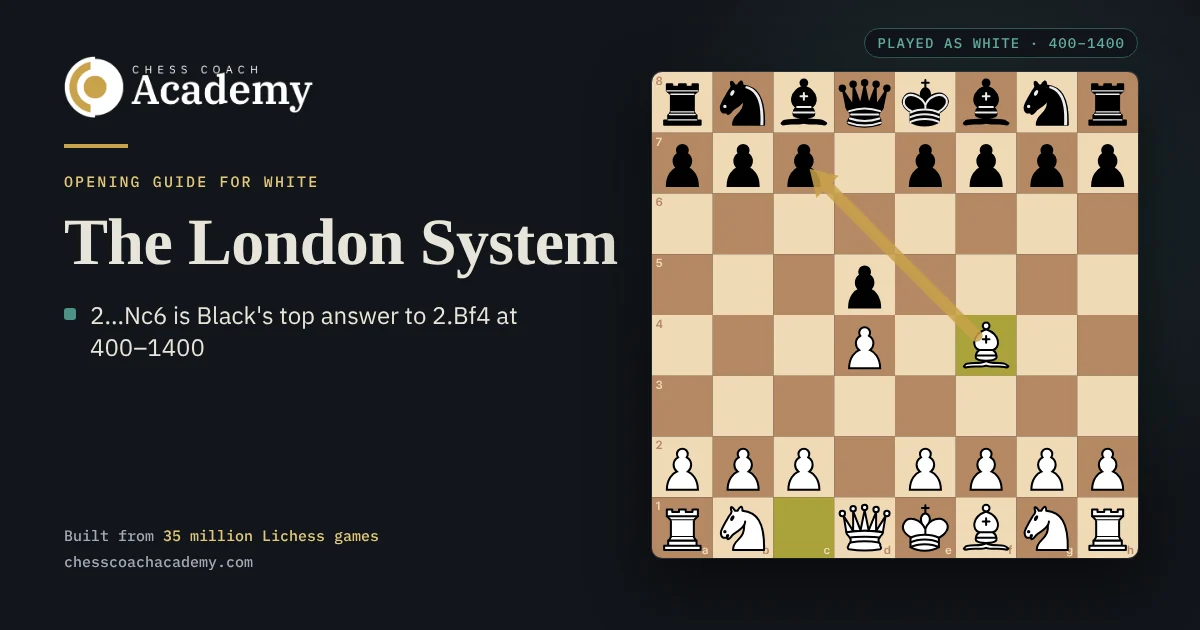
1. d4 d5 2. Bf4
Practice the London System free →Who it's for
Beginners and improving players rated roughly 400 to 1400 who want one plan they can play against almost anything. You don't need to memorize long lines: the same few moves come back again and again, often in a different order.
It suits you if you'd rather spend your study time on tactics and endgames than on openings. If you enjoy wild attacking games from move one, the London will feel slow, but it gives you a safe, solid position nearly every time.
Why it works at 400 to 1400
- Very little to memorize. Many different Black moves lead to the same few positions, so learning one setup covers most of your games.
- It's hard to get a bad position. Your pawns on d4, e3 and c3 are solid, and your king castles quickly.
- You get free chances. Common mistakes at this level, like an early ...e5 after ...f6 or ...d6, simply lose a pawn, and the lines show you how to take it.
- Against good play the London gives you a level game, not a big advantage. You win later, in the middlegame.
- Once your bishop leaves c1, nothing guards b2. You need to know what to do when Black's queen comes to b6.
- The setup can make you lazy. Watch for Black's tricks, like ...Nb4 hitting c2 and ...Qb4+ in the Englund Gambit.
What 400 to 1400 players actually play
Once your bishop reaches f4, the most common reply at this level is 2...Nc6 at 37%. It develops a piece but blocks Black's c-pawn, so ...c5 won't come soon. Next are 2...Nf6 (20%), 2...e6 (15%) and the copycat 2...Bf5 (13%). Against all four, your next move is the same: 3.e3.
Three numbers from the data worth remembering:
- At 400-1400 on Lichess, 2.Bf4 is played in 22% of games after 1.d4 d5, second only to 2.c4 (27%).
- Black's most common replies to 1.d4 d5 2.Bf4 are 2...Nc6 (37%), 2...Nf6 (20%), 2...e6 (15%) and 2...Bf5 (13%).
- In the Englund Gambit after 1.d4 e5 2.dxe5 Nc6 3.Nf3 Qe7, 47% of players at this level play 4.Bf4 and win only 39% of those games, because of 4...Qb4+. With 4.Nc3 instead, White wins 53%.
How to play the London System: move by move
Each board below is a real decision point from the practice lines. The arrows show Black's most common replies at 400 to 1400, labeled with how often each is played in that exact position. Under each board you'll find why players choose the move and the answer the Coach teaches.
After 1. d4
More than half of players answer with 1...d5. Against 1...d5, 1...Nf6 and 1...e6 your next move is 2.Bf4. Only the Englund Gambit (1...e5) needs something different: take the pawn.
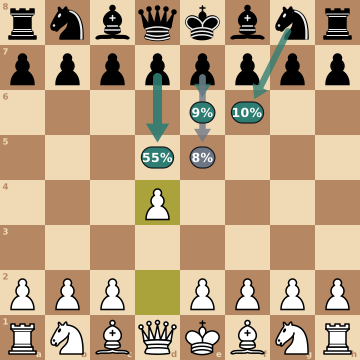
- 1...d5 (55%). d5 claims an equal share of the center.d4 this way.
Your answer: 2. Bf4. The London bishop. Get it out before you play e3. - 1...Nf6 (10%). You play the same London moves.
Your answer: 2. Bf4. Same idea: the bishop comes out before e3. - 1...e6 (9%). d5 next, or head into other setups.
Your answer: 2. Bf4. Your bishop comes out as always. - 1...e5 (8%). , the Englund Gambit, gives away a pawn.
Your answer: 2. dxe5. Take the free pawn.
After 1. d4 d5 2. Bf4
Whatever Black plays here, you answer 3.e3. The bishop is already outside the pawn chain, so e3 doesn't block it in.
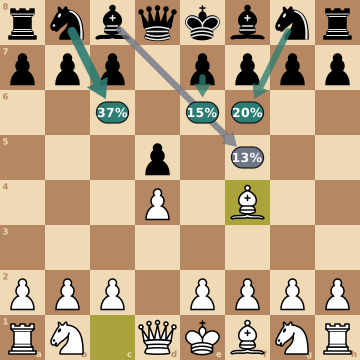
- 2...Nc6 (37%). It develops a piece, but it also blocks Black's c-pawn, so the pawn can't easily go to c5 to attack your center.
Your answer: 3. e3. Supports d4 and opens a path for your other bishop. - 2...Nf6 (20%). It controls e4 and prepares castling.
Your answer: 3. e3. Support d4 and open your f1 bishop. - 2...e6 (15%). Black plays e6 right away.
Your answer: 3. e3. The usual London move: support d4 and open your f1 bishop. - 2...Bf5 (13%). e6 can block it.
Your answer: 3. e3. Same setup as always.
After 1. d4 d5 2. Bf4 Nc6 3. e3
Black's bishop often comes to f5 or g4 in these lines. When it does, b7 is left without a defender, which is worth remembering for later (Qb3).
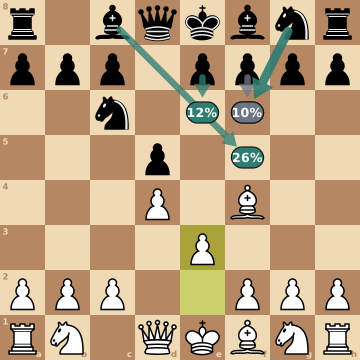
- 3...Nf6 (38%). Both sides are simply getting pieces out.
Your answer: 4. Nf3. Develop your knight and get closer to castling. - 3...Bf5 (26%). e6 can block it in.
Your answer: 4. Nf3. Keep developing.Nb4. - 3...e6 (12%). Black plays e6, a quiet move.
Your answer: 4. Nf3. Develop and get ready to castle. - 3...f6 (10%). e5 to attack your center and your bishop. But it takes f6 away from Black's knight and opens a diagonal toward Black's king.
Your answer: 4. Nf3. e5 would lose a pawn.
After 1. d4 d5 2. Bf4 Nc6 3. e3 Nf6 4. Nf3
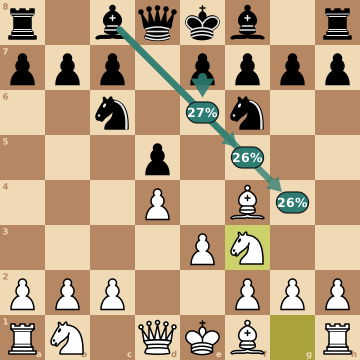
- 4...e6 (27%). e6 is solid and gets Black ready to castle. The downside: Black's light-squared bishop on c8 is now stuck behind its own e6 pawn.
Your answer: 5. c3. Supports d4 and takes the b4 square away from Black's knight. - 4...Bg4 (26%). It's not dangerous, just annoying.
Your answer: 5. c3. Supports d4, and gets your queen ready for Qb3. - 4...Bf5 (26%). e6 can block it.Nb4.
Your answer: 5. c3. Supports d4 and takes the b4 square away from Black's knight.
After 1. d4 d5 2. Bf4 Nf6 3. e3
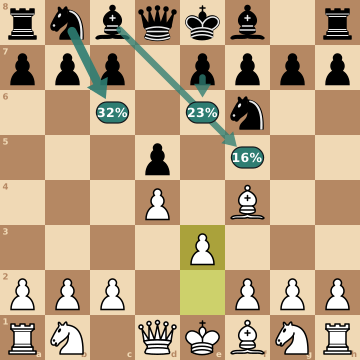
- 3...Nc6 (32%). e3 Nf6 line.
Your answer: 4. Nf3. Develop and prepare to castle. - 3...e6 (23%). Be7 and castling. The c8 bishop is now stuck behind the e6 pawn.
Your answer: 4. Nf3. Develop and get ready to castle. - 3...Bf5 (16%). e6. It also leaves b7 without a defender.
Your answer: 4. Nf3. Develop and keep your setup flexible.
After 1. d4 d5 2. Bf4 e6 3. e3
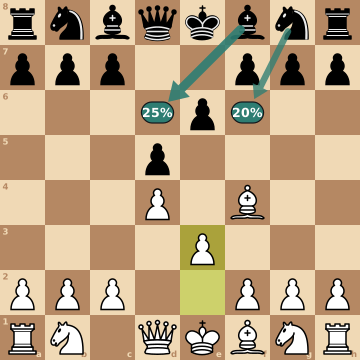
- 3...Bd6 (25%). Black would like to swap it off.
Your answer: 4. Nf3. Develop and let Black take if they want. - 3...Nf6 (20%). Black develops the knight to f6.
Your answer: 4. Nf3. Develop and get ready to castle.
After 1. d4 d5 2. Bf4 Bf5 3. e3
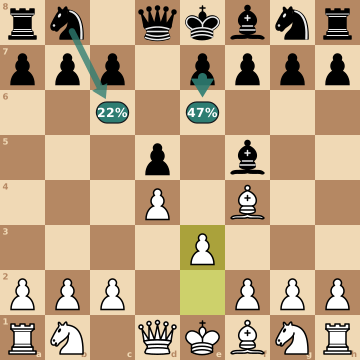
- 3...e6 (47%). The position is now almost symmetrical.
Your answer: 4. Nf3. Develop and prepare to castle. - 3...Nc6 (22%). e3 Bf5 line.
Your answer: 4. Nf3. Nb4 trick.
After 1. d4 Nf6 2. Bf4
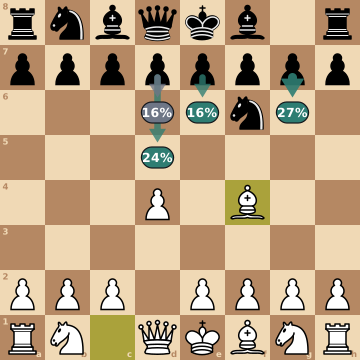
- 2...g6 (27%). Bg7, a 'fianchetto'. That means the bishop goes to g7, where it aims along the long diagonal toward your center.
Your answer: 3. e3. Support d4 and open your f1 bishop. - 2...d5 (24%). d5 lines.
Your answer: 3. e3. Your standard move. - 2...e6 (16%). c5 and opens the f8 bishop.
Your answer: 3. e3. Support d4 and continue your setup. - 2...d6 (16%). e5, which would attack your d4 pawn and your bishop.
Your answer: 3. e3. Support d4.e5 would lose a pawn.
After 1. d4 e5 2. dxe5
You're a pawn up. Keep your bishop on c1 for now: it's the piece guarding b2, and Black's queen is about to aim at b4.
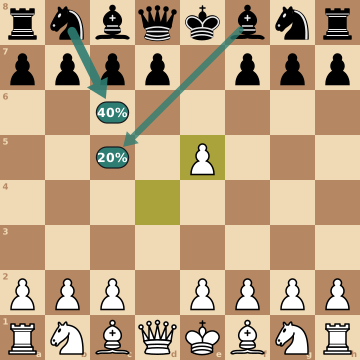
- 2...Nc6 (40%). Black attacks your e5 pawn with Nc6.
Your answer: 3. Nf3. Defend e5 with the knight. The London bishop waits for now. - 2...Bc5 (20%). Black develops the bishop to c5, aiming at f2.
Your answer: 3. Nc3. Develop, and block the line from b4 to your king first.
Your plan after the opening
Build the London wall, then use e5
Your setup is Bf4, e3, Nf3, c3, Nbd2, a bishop to d3 or e2, and castle. c3 is the last brick: it makes d4 rock-solid and takes b4 away from Black's knight.
Once you've castled, look at the e5 square. Your bishop on f4 and knight on f3 both control it, and Ne5 is often a great post for your knight.
1. d4 d5 2. Bf4 Nc6 3. e3 Nf6 4. Nf3 e6 5. c3
When Black's bishop leaves c8: think Qb3
If Black plays ...Bf5 or ...Bg4 before ...e6, nothing guards the b7 pawn. After c3, your queen can come to b3 and attack it. Against ...Bg4, h3 is also a useful move to ask the bishop what it wants to do.
1. d4 d5 2. Bf4 Nc6 3. e3 Nf6 4. Nf3 Bg4 5. c3
When Black offers a bishop trade with ...Bd6
You can keep your bishop with Bg3, or let Black take. If Black trades on f4, recapture with the e-pawn. Your pawns on f2 and f4 are doubled, but the f4 pawn controls e5, so your knight can settle there, and your rook gets the e-file.
1. d4 d5 2. Bf4 e6 3. e3 Bd6 4. Nf3 Bxf4 5. exf4
Against 1...Nf6 and ...g6: same moves, plus h3
When Black puts a bishop on g7, play e3, Nf3, Be2, h3 and castle. h3 gives your bishop a safe retreat on h2 if Black attacks it with ...Nh5. This setup is harder to win against, so stay solid and wait for chances.
1. d4 Nf6 2. Bf4 g6 3. e3 Bg7 4. Nf3
Traps and common mistakes
The Englund Gambit trap (4.Bf4? Qb4+)
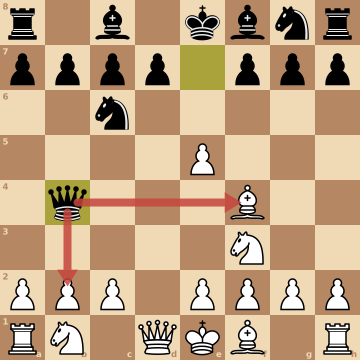
1. d4 e5 2. dxe5 Nc6 3. Nf3 Qe7 4. Bf4? Qb4+ 5. Bd2 Qxb2 6. Bc3?? Bb4! 7. Qd2 Bxc3 8. Qxc3 Qc1#
Bf4 is your London move, so it feels natural here too. But after 3...Qe7, 47% of players at this level play 4.Bf4 and win only 39% of those games. 4...Qb4+ checks your king and attacks both b2 and the bishop on f4.
Play 4.Nc3 instead: the knight blocks the line from b4 to your king, so ...Qb4 is no longer check. With 4.Nc3, White wins 53%. If you do get caught, block with 5.Bd2 and after 5...Qxb2 play 6.Nc3, never 6.Bc3??, which ends in the mate shown above.
Forgetting about c2 and ...Nb4
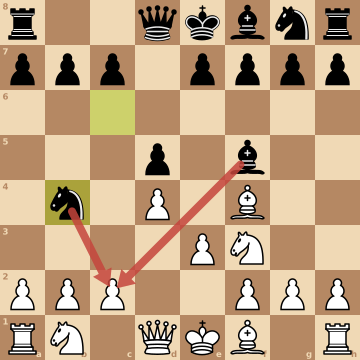
1. d4 d5 2. Bf4 Nc6 3. e3 Bf5 4. Nf3 Nb4 5. Na3
When Black has a bishop on f5 and a knight on c6, ...Nb4 threatens ...Nxc2+, forking your king and rook. Your queen guards c2 once, but the knight and bishop attack it twice.
Guard c2 a second time with Na3, or play c3 early so the knight can never reach b4. That's why c3 is part of the setup.
Missing the free pawn after an early ...e5
1. d4 Nf6 2. Bf4 d6 3. e3 e5? 4. dxe5 dxe5 5. Qxd8+ Kxd8 6. Bxe5
Many players at this level want to push ...e5 to kick your bishop. When they do it too early, take twice. After 2...d6 3.e3 e5?, trade on e5, trade queens with check, and 6.Bxe5 wins a pawn. Black's king has moved, so it can no longer castle.
The same idea works after 2...Nc6 3.e3 f6 4.Nf3 e5?: 5.dxe5 fxe5 6.Nxe5 wins a pawn, because you attack e5 twice and Black defends it only once.
Playing e3 before Bf4
The order matters. If you play e3 first, your own pawn shuts the c1 bishop in, and it can't reach f4 anymore. Always play Bf4 before e3. The only time the bishop waits is against the Englund Gambit, until ...Qb4+ is off the table.
Panicking when Black's queen hits b2
After ...c5 and ...Qb6, Black's queen attacks b2, which your bishop no longer guards. Don't rush your bishop back to c1. Calmly guard the pawn with Rb1 or Qc1 (or c3 and Qd2 in some lines) and keep developing.
Frequently asked questions
Is the London System good for beginners?
Yes. It's one of the easiest openings to learn because you play the same setup against almost everything. At 400 to 1400 it also gives you a solid position nearly every game, and the lines show you how to punish the common mistakes.
What is the most common reply to the London System?
At 400 to 1400 on Lichess, Black's most common answer to 1.d4 d5 2.Bf4 is 2...Nc6 (37%). Next come 2...Nf6 (20%), 2...e6 (15%) and 2...Bf5 (13%). Your answer to all four is 3.e3.
How popular is the London System at club level?
Very popular. At 400 to 1400 on Lichess, 2.Bf4 is played in 22% of games after 1.d4 d5, second only to 2.c4 (27%).
How do I beat the Englund Gambit with the London?
Take the pawn with 2.dxe5 and don't rush your bishop to f4. After 2...Nc6 3.Nf3 Qe7, play 4.Nc3 so ...Qb4 isn't check. At this level White wins 53% with 4.Nc3, but only 39% with 4.Bf4.
Does the London System work against 1...Nf6 and ...g6?
Yes. You play the same moves: Bf4, e3 and Nf3, then Be2, h3 and castle. h3 gives your bishop a safe square on h2 if Black attacks it with ...Nh5. These positions are level, so play solid moves and wait for your chances.
Keep learning
- All 36 opening guides: every opening on the site, grouped by what you play as White and Black.
- The London System's Real Weakness Is That It's Easy: Why the London's most common mistakes all come from playing on autopilot.
- How to Refute the Englund Gambit: The ...Qb4+ trap in full, and quick answers to other early gambits against 1.d4.
- London vs Torre vs Trompowsky: Three low-theory 1.d4 systems compared, using real Lichess replies.
- How Black Counters the London System: The anti-London plans you'll meet, seen from Black's side.
The Coach plays against your London with the moves 400 to 1400 players actually choose, including the Englund Gambit, and explains every move in plain English. Progress tracking is free during the open beta.
Practice the London System free →