Is the Budapest Gambit Sound? Engine vs. Practical Play
TL;DR
- In 1918, Milan Vidmar used the Budapest Gambit to defeat Akiba Rubinstein, already agreed as reigning World Champion Emanuel Lasker's official challenger years earlier, in a real, documented 24-move game.
- That result put the gambit on the map. The question this article checks is whether it still holds up, verified against about 8.1 million Lichess games at 900 to 2100, not 1918 anecdote.
- White accepts the gambit pawn with 3.dxe5 in 58% of games at this level, and Black wins 46% of games after it. Declining with 3.d5 (20%) is worse for White: Black wins 52% after it.
- In the main line, 4.Nf3 Bc5, White blocks the bishop with 5.e3 in 95% of games, close to a forced continuation.
- The famous trap is real and common: after 4.Bf4 Nc6 5.Nf3 Bb4+ 6.Nbd2 Qe7 7.a3 Ngxe5, 42% of White players take the bishop with 8.axb4?? and Black wins 99% of those games after 8...Nd3#.
- With best play Stockfish still gives White a small edge, around half a pawn in most main lines. Engine soundness and practical soundness are treated as separate, both-real questions here.
The Game That Made It Famous
At a four-player tournament in Berlin in April 1918, Milan Vidmar was set to face Akiba Rubinstein, then ranked among the best players in the world and already agreed as Emanuel Lasker's official World Championship challenger. Shortly before the round, the Hungarian master Istvan Abonyi showed Vidmar an unusual pawn sacrifice, one of a handful of ideas a trio of Hungarian masters, Abonyi, Barász, and Breyer, had been developing since 1916. Vidmar adopted it on the spot and beat Rubinstein in 24 moves.
That's a real, documented result, not a legend. But it's also over a century old, and it answers a narrower question than "is this gambit sound today." This site's Lichess data exists to check that separately.
The Real Line
1. d4 Nf6 2. c4 e5
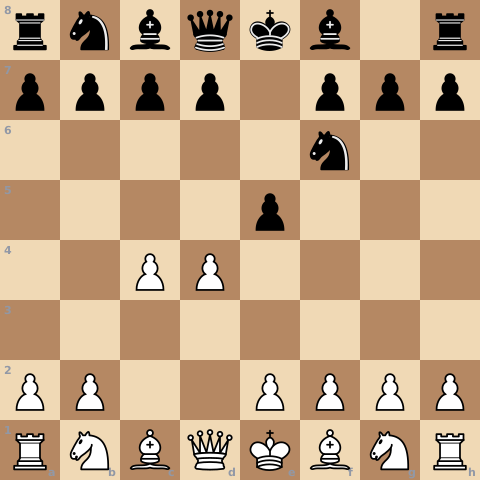
Black offers the pawn immediately rather than settle into a slower structure. At 900 to 2100 on Lichess, most White players take it:
3. dxe5
White's pawn on d4 captures the newly-offered pawn on e5. Accepting the gambit pawn and daring Black to prove the compensation is real, played in 58% of games. Declining is common too: 3.d5 in 20%, 3.Nc3 in 11% and 3.e3 in 6%. The push 3.d5 closes the center and leaves Black's e5 pawn safe, and Black wins 52% of games after it.
3...Ng4
The knight jumps from f6 to g4. This is the whole point of the gambit, the knight jumps straight back to attack the newly-advanced e5 pawn, and it's the move our trainer plays, the defining move of the entire opening.
White's response here splits three ways at this level:
- 4. Nf3 (developing the knight to f3), developing naturally while defending e5 with the knight, the main choice at 55%.
- 4. Bf4 (developing the bishop to f4), developing the bishop to an active square instead, White's toughest try at this level at 19%. White wins 53% of games after it.
- 4. e4 (pushing the pawn to e4), giving up the extra pawn immediately rather than try to hold it, the Alekhine Variation, at 7%.
4.Nf3 is the clear favorite, but 4.Bf4 is the one to respect, and it's also where the famous trap lives. After 4...Nc6 5.Nf3 Bb4+ 6.Nbd2 Qe7, 47% of White players play the safe 7.e3, while 44% play 7.a3. After 7...Ngxe5, 42% of them grab the bishop with 8.axb4??, and 8...Nd3 is mate, because the queen on e7 pins the e2 pawn. Black wins 99% of those games.
Following the most common path:
4...Bc5
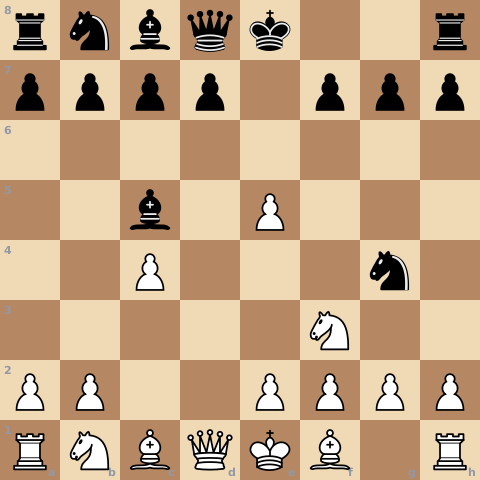
Black develops the bishop from f8 to c5, and now the bishop and the knight on g4 both aim at f2. This is the move our trainer plays.
5. e3
White pushes the e-pawn one square. Here the data becomes about as clear as it gets: played in 95% of games reaching this exact position, a simple, effective way to shut the c5 bishop out of f2. A natural move like 5.Nc3? instead allows ...Bxf2+, winning a pawn and forcing White's king to d2.
So, Is It Sound?
This is the same honest distinction that applies to any opening carrying a "trap" or "refutation" reputation: engine soundness and practical soundness are different, both-real questions.
On the engine side, the answer is "not quite": with best play Stockfish gives White a small edge, around half a pawn in most main lines. On the practical side, the numbers are kind to Black. At 900 to 2100 on Lichess, Black wins 46% of games after 3.dxe5 and 52% after 3.d5, and in almost every line Black wins the gambit pawn back within a few moves. White's most dangerous try, 4.Bf4, scores 53% for White, but it also contains the trap that 42% of White players fall into.
A century-old upset combined with results like these in modern online games is a different, stronger claim than either fact alone: the Budapest isn't a refutation of 1.d4, but it's a very practical fighting choice below the top level.
Read the full Budapest Gambit repertoire →
Keep reading
Next in this part of the series:
- How to Refute the Englund Gambit and Other Early 1.d4 Gambits: The Englund's Qb4+ trap, the clean way to meet it, and notes on other early tries.
More traps and gambits
Back to the full series:
- Chess Opening Traps & Gambits: Every trap and gambit guide in this series, checked against our data.
Try It Yourself for Free
Every line above, from Vidmar's original idea to the modern main line, is fully interactive on this site. All 36 openings, including the Budapest Gambit, are completely unlocked during this site's open beta, no card, no limit, no account required to start, with your progress tracked for free if you create one.
Every line checked the same way, against real game data, not against what sounds right.
Browse all 36 openings free →